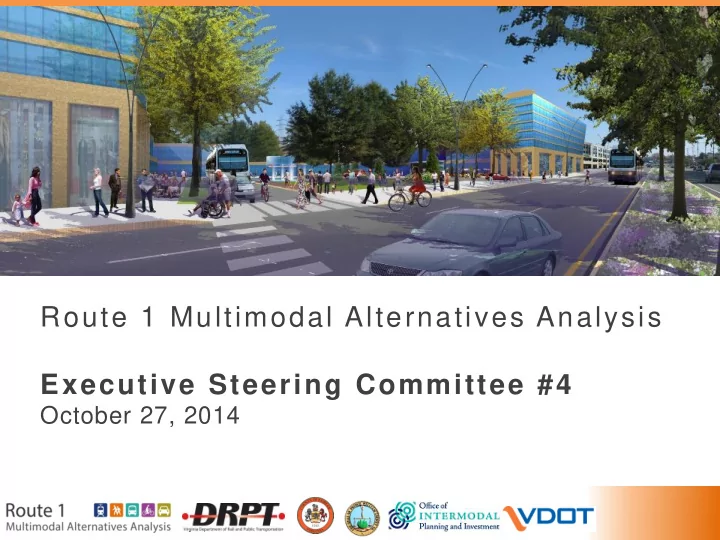
Route 1 Multimodal Alternatives Analysis Executive Steering - - PowerPoint PPT Presentation
Route 1 Multimodal Alternatives Analysis Executive Steering Committee #4 October 27, 2014 Agenda 1. Public Meeting #3 summary 2. Final project recommendations 3. Potential implementation timeline revisions 4. Project action items 5. Next
Agenda
- 1. Public Meeting #3 summary
- 2. Final project recommendations
- 3. Potential implementation timeline revisions
- 4. Project action items
- 5. Next steps
− Transportation Project Development − Planning Initiatives − Adoption into local and regional plans
- 6. Resolution
2
3
Public Meeting #3
Meeting Format:
- Open House (Boards)
- Presentation
- Moderated Q&A
- Boards, Discussion
- Activity: Survey, Talk with Project Team
Members Attendance Meeting 1- Prince William County (Oct 8):
- 49 attendees
- 13 completed surveys
Meeting 2 - Fairfax County (Oct 9):
- 103 attendees
- 51 completed surveys
4
Public Meeting #3: Key Themes and Survey Results
- Majority of residents generally support
draft recommendation
- Want to expedite Metrorail extension
- Interested in learning more about
County land use planning and transit modes
- Recognize project funding is biggest
challenge
5
Draft Recommendations
Evaluation results suggest:
- Median running Bus Rapid Transit (BRT) would
provide a near-term cost-effective transportation solution to support economic development plans.
- Metrorail extension to Hybla Valley would
provide a higher level of local and regional mobility and support long-term corridor development, contingent upon increased future land use density.
6
Phasing Approach
Phase I-III: Implement Multimodal Improvements and BRT (Median Running) Phase IV: Extend Metrorail to Hybla Valley, contingent upon future land use
3.1 mi. 7.3 mi 4.6 mi. 3.1 mi.
Note: contingent upon future land use
7
Final Project Recommendations
Phased implementation of the multimodal investments of Alternative 4- BRT/Metrorail Hybrid, including:
- Roadway Widening: Widen roadway from four lanes to six lanes where
necessary to create a consistent, six-lane cross section along the corridor
- Bicycle and Pedestrian Facilities: Create a continuous facility for
pedestrians and bicyclists along the 15 mile corridor; the configuration will vary depending upon urban design, right-of-way availability, and
- ther local considerations
- Transit: Implement a median-running Bus Rapid Transit (BRT) system
from Huntington to Route 123 in Woodbridge (curb-running BRT in mixed traffic within the Prince William County portion) and a 3-mile Metrorail Yellow Line extension from Huntington to Hybla Valley as expeditiously as possible, contingent upon increased land use density and project funding
8
15 16 17 18 19 20 21 22 23 24 25 26 27 28 29 30 31 32 33 34 35 36 37 38 39 40
Roadway Widening and Bike/Ped, BRT Market Absorption Study Phase I Comprehensive Plan Revisions
Phase II: Hybla Valley to Fort Belvoir
BRT and Bicycle/Pedestrian, BRT Market Absorption Study Phase II Comprehensive Plan Revisions
Phase III: Fort Belvoir to Woodbridge Improvements
Roadway Widening and Bike/Ped Market Absorption Study Phase III Comprehensive Plan Revisions
PhaseIV: Huntington to Hybla Valley Metrorail Extension
Metrorail Market Absorption Study Phase IV Comprehensive Plan Revisions
Years (2015-2040)
Phase I: Huntington to Hybla Valley + Roadway Widening
Potential Implementation Timelines
Comprehensive Plan Planning Scoping/ NEPA PE Final Design Right of Way Utilities Relocation Construction Operation
Legend: General Project Development Sequence
Note: Timelines assume a funding stream to support projects implementation. *Contingent upon increased future land use density. *
FTA NEW STARTS PROJECT DEVELOPMENT PROCESS FTA SMALL STARTS PROJECT DEVELOPMENT PROCESS
Typical New Starts Funding Steps/Sequence:
9
Project Action Items
1. Transmit study results to local governments for endorsement and implementation 2. Begin to incorporate recommendations in local, regional, and state plans:
- County Comprehensive Plans and Capital Improvement Programs
- NVTA TransAction 2040 Plan and 6-Year Program
- MWCOG Constrained Long Range Plan and Transportation Improvement Program
- Virginia Statewide Transportation Plans and 6-Year Program
3. Identify immediate next steps and responsible parties 4. Identify immediate next steps associated with BRT implementation and land use evaluation
10
Next Steps: Transportation Project Development
1. Develop more detailed funding plan 2. Identify Project Sponsor(s) 3. Request class of action determination from FTA and FHWA 4. Initiate environmental documentation for Phases I and II (Huntington to Fort Belvoir)
11
Next Steps: Planning Initiatives
1. Comprehensive Plan Amendment Update – Infrastructure requirements due to increased land use density (roads, schools, etc.) – Refined street cross sections and corridor design standards – BRT stop locations 2. Market Absorption Study: understand rate of growth anticipated in and to the corridor 3. Right of Way Survey: Route 1 will need a survey performed to confirm potential impacts during the environmental review phase 4. Continue involvement and engagement with business owners and economic development stakeholders
12
Complete Current Study
- Consultant Team:
– Finalizing Alternatives Analysis Final Report – Posting project documents on project website
- Executive Steering Committee:
– Endorses study findings – Sends study for action by County Boards
13
Action Plan for Implementation
14
Resolution
Issued by Executive Steering Committee, which has coordinated regularly with the study team through 15 months of work. Summarizes outcomes and recommendations:
- Multimodal (roadway, bicycle/pedestrian, and transit)
investments of “Alternative 4 BRT/Metrorail Hybrid”
- Include the recommendations in local, regional, and statewide
funding plans
- Plan for supportive land uses and infrastructure