
SLIDE 1
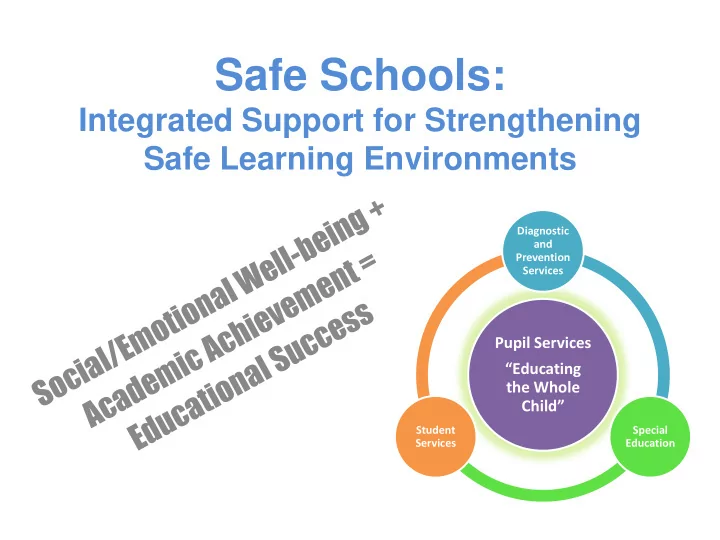
Safe Schools:
Integrated Support for Strengthening Safe Learning Environments
Pupil Services “Educating the Whole Child”
Diagnostic and Prevention Services Special Education Student Services
Safe Schools: Integrated Support for Strengthening Safe Learning - - PowerPoint PPT Presentation
Safe Schools: Integrated Support for Strengthening Safe Learning Environments Diagnostic and Prevention Services Pupil Services Educating the Whole Child Student Special Services Education Presentation Objectives 1) Review the
Pupil Services “Educating the Whole Child”
Diagnostic and Prevention Services Special Education Student Services
involvement in bullying as a bully or victim (Guerra, Williams, & Sadek, 2011; Meyer-Adams & Conner, 2008; Nansel et al., 2001), reduced peer rejection (Waasdorp, Bradshaw, & Leaf, 2012), and increased academic achievement (Spier, Cai, & Osher, 2007; Spier, Cai, Osher, & Kendziora, 2007).
student violence in schools with a supportive school climate (Virginia High School Safety Study) .
staff to be supportive are more likely to endorse positive attitudes toward seeking help for bullying and threats of
prevention approach reported (1) less victimization and bullying, (2) a greater willingness to seek help when being victimized, and (3) more positive perceptions of the learning environment. (Cornell, Gregory, Fan, & Sheras, 2007).
that reductions in bullying were associated with:
Disciplinary methods Teacher training Parent training/meetings Information for parents Cooperative group work Increased supervision (particularly playground) Classroom management Classroom rules Whole-school anti-bullying policy Number of bulling prevention program elements Duration and intensity of the program for teachers & students
correlation with suspension rates in the entire school for both Black and White students. (Virginia High School Safety Study).
Students School Staff
43% of MS students and 54% of HS students see teachers at school watching bullying and doing nothing 97% of staff who said they would intervene if they saw bullying 58% of MS and 66% of HS students indicated that they believe adults at their school are not doing enough to stop or prevent bullying 87% of staff believe they have effective strategies for handling bullying 61% of middle and 59% of high school students believe teachers made it worse when they tried to intervene. 93% of teachers believed they effectively managed the situation when they intervened 33.7% of ES, 32.7% of MS, and 22.7% of HS students reported being frequently bullied. Majority of school staff reported that 15%
frequently bullied. (Bradshaw, Sawyer, and O’Brennan, 2007)
wrong with bullying or putdowns, and consequently intervene in only 4% of bullying incidents (Cohn & Canter, 2002)
helping victims makes it worse, that victims have reasons to be bullied, and that ignoring bullying is an effective response (Horne, Orpinas, Newman- Carlson, & Bartolomucci, 2004)
Positive Behavioral Interventions and Supports Bullying Prevention Safe School Ambassadors PEER Helper Suicide Prevention Food Allergy Awareness, Safety, and Prevention Crisis Intervention & Restraint and Seclusion Threat Assessment
Positive and Safe School Climate High Student Achievement Student Social- Emotional Skills
– Psychologist – Educational Diagnostician – Social Worker – Consulting Teacher
– School Counselor – Teachers/Specialists
Year, and Returning School
Model: Monthly Coaches Support Meetings
Application
meetings and events
Sessions
1 2 3 4 Student Relations Rules and Expectations School Safety Teacher-Student Relations Behavior Problems* Punitive Techniques* Positive Techniques Social-Emotional Learning
District Student Climate Survey Results (2012)
Elementary Middle High
* Reverse Scored
What ADULTS See What STUDENTS See
(provided by Pupil Services Team of school counselors, social workers, psychologists, and health clinic assistants/school nurses) School-Wide Framework— PBIS Adult-Led Programs— Bullying Prevention Lessons Student-Led Programs— Safe School Ambassadors, PEER
10 9 79 33 14 15 31 16 10 20 30 40 50 60 70 80 90
I have not seen or heard another student being bullied. I ignored it. I helped the person. I told an adult.
SSA (168) non-SSA (286)
Dealing with specific issues to keep students safe
– Primary Pupil Service Team Member: school psychologist
and school social workers
– Primary Pupil Service Team Member: school psychologist
and school social workers
– Primary Pupil Service Team Member: consulting teacher
– Primary Pupil Service Team Member: school psychologist and school social worker
– Primary Pupil Service Team Member: school nurse/health clinic assistant
School Climate
High Structured Discipline Robust Bulling Prevention Program School-wide Behavior Approach Supportive & Caring Adult Student Attitudes, Help Seeking Behavior, & Response Adult Attitudes & Behavior Classroom Management & Rules
Guidelines located on the LCPS website.
sexual harassment, and cyber bullying.
and bullying prevention through assemblies, special programs, courageous conversations, and seminars.
information for administrators, faculty, counselors, parents and the school community on bullying prevention and awareness.
Effective school-wide discipline requires a positive approach to promote a safe and orderly environment as well as meet the instructional and behavioral needs of all students within the building.
behavioral needs of all students within the building using available resources to maximize efficiency of practices.
to promote a positive school climate and learning environment.
Refresher Training provided by Pupil Service Personnel on a yearly basis.
the school year.
adults are conducted to provide ongoing support, supervision, and skill development.
and frequency of their interventions on Action Logs.
supervise students in the PEER Helper Program. PEER Sponsors must be able to demonstrate and model the skills students (PEER helpers) are expected to learn.
curriculum developed by Student Support Services.
and experiential activities with coaching and feedback. The training sessions should include role rehearsal, homework, and practical assignments.
parents and other students in a school-based setting.
quality relationship with the peer helpers that allows for monitoring, dealing with confidentiality, and making referrals to professionals.
must be followed.
containing allergens should not be consumed in the classrooms
permissible and is a safety practice that has been in place in LCPS for several years.
healthy and safe food choices as they progress from elementary to middle and high school.
Guidelines located on the LCPS intranet.
will attend training and implement the Threat Assessment Guidelines to safely manage student threats of violence.
administrators and safety decisions are made by the school threat assessment team.
regarding student victimization.
direct student communication of suicidal intent.
workers can screen students of risk.
contemplating suicide relates to parental abuse/neglect.
Depression Awareness Suicide Prevention presentation during the first quarter.
Intervention Procedures protocol in the event of a school crisis including contact the Central Office Contact to develop a response plan.
(Behavior Intervention Team) trained in Mandt and the use of physical restraint and seclusion to intervene when the physical safety of the student
Restraint and Seclusion Guidelines located on the LCPS intranet.
(see handout) In small groups, read a scenario along with the questions and discuss your responses?
this situation? Consider both the internal and external resources and supports along with the information from this presentation to guide your response.
similar situation in the future?