
SLIDE 1
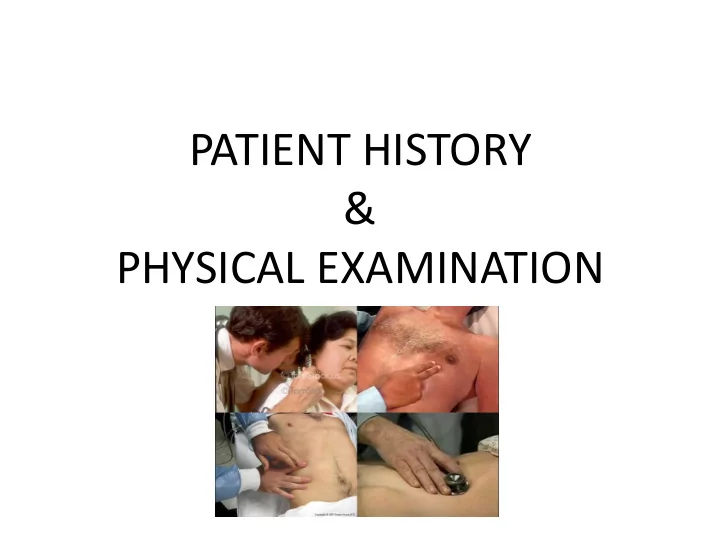
PATIENT HISTORY & PHYSICAL EXAMINATION Making a diagnosis 1. - - PowerPoint PPT Presentation
PATIENT HISTORY & PHYSICAL EXAMINATION Making a diagnosis 1. Anamnesis = history taking 2. Physical examination inspection, palpation, percussion, auscultation, vital signs, weight, height 3. Working diagnosis - preliminary dg.,
1. Anamnesis = history taking 2. Physical examination – inspection, palpation, percussion, auscultation, vital signs, weight, height 3. Working diagnosis - preliminary dg., diff. dg. considerations 4. Further diagnostic examinations – lab, endoscopy, X-ray, EKG etc. 5. Final diagnosis 6. Therapy
1. Anamnesis = history taking 2. Physical examination – inspection, palpation, percussion, auscultation, vital signs, weight, height 3. Working diagnosis - preliminary dg., diff. dg. considerations 4. Further diagnostic examinations – lab, endoscopy, X-ray, EKG etc. 5. Final diagnosis 6. Therapy
– Summary of all data regarding the patient’s health from birth to present. – Direct vs. indirect
1. Create an atmosphere of confidence and trust
a) Privacy b) Comfortable environment c) Eliminate haste/stress
2. Ask open questions 3. Let the patient choose his/her own words
1. Personal data
2. Chief complaint 3. Social status
4. Medical history
a) Family illnesses – parents, siblings, children b) Prior illnesses – in chronologic order. Duration, treatment, complications c) Present illnesses – onset, symptoms, course of symptoms, present status
5. Review of systems
lymphatics, GIT, urinary tract, genitalia, locomotor, nervous, psychological state, endocrine, allergies
6. Stimulantia
7. Medication
A. Inspection
B. Palpation
C. Percussion
D. Auscultation
E. Smell
– Mental state, voice, speech, nutrition, posture, walk
– Pigmentations, rashes, moisture, elasticity – Scars, hematomas, hemorrhages, erythemas
– Direct percussion of skull – CN V exit points – tenderness? – CN VII – make grimaces – CN XII – protrude tongue – Eyes: conjunctiva, pupils round and equal (CN III) – anisocoria?, symmetric accommodation reflex and reaction to light, movements, eyelids – Mouth: teeth (prostheses), moist and clean mucosa and tongue, central cyanosis
– Stiffness – Venous congestion – Palpable gl. thyreoidea – Carotid stenosis – Lymph nodes
– Normal shape and movements, breathing – Breasts
– Axilla
– Heart
– Lungs
murmur
– Pain, stiffness, asymmetry – lordoses/ kyphoses/ scolioses – Ex. Schober’s distance test, Stibor’s distance test
– Symmetry: any signs of enlargements or masses? Hernia? – Dilated veins – caput medusae – Palpation: texture, tenderness/pain?, palpable spleen or liver? – borders, palpable masses or possible tumors?
»
Plenie’s symptom – percussion tenderness of right hypogastrium
– Percussion: borders of liver/spleen, tympanites?, ascites? – Direct percussion of flanks – kidney tenderness? – Auscultation: intestinal sounds – Urinary bladder
– tumors, rash, discharge, pain – Testes
– normal tonus of sphincter, tumors – Prostata: size (walnut), shape, consistency – Brown faeces on glove
– Radial pulse – Raynaud’s phenomenon (SLE) – Finger clubbing
– Pulse of a. dorsalis pedis and a. tibialis posterior – Ischemia – diabetic microangiopathy – Edema, varicose veins – Lymphedema - elephantiasis
A. Cranial nerves
normal saccadic movements
nose, mouth. Sentral vs. peripheral paresis
through bone
and soft palate
C. Force
D. Coordination E. Reflexes
F. Sensibility
G. Balance and walking