Sam Baban, Diyar Mohammad, Ismet Tastan Email: - - PDF document

sam baban diyar mohammad ismet tastan
SMART_READER_LITE
LIVE PREVIEW

Sam Baban, Diyar Mohammad, Ismet Tastan Email: - - PDF document

Presentation to Joint Standing Committee for Foreign Affairs, Defence and Trade, Human Rights Subcommittee, 12.30 pm, 24 November 2015, Committee Room 1R4, Parliament House Canberra (Summary of written submission) From Kurdish Lobby Australia


slide-1
SLIDE 1

Presentation to Joint Standing Committee for Foreign Affairs, Defence and Trade, Human Rights Subcommittee, 12.30 pm, 24 November 2015, Committee Room 1R4, Parliament House Canberra

(Summary of written submission)

From Kurdish Lobby Australia

Email: kurdishlobbyaus@gmail.com Representatives attending presentation: Zirian Fatah, Dr. Gina Lennox, Sam Baban, Diyar Mohammad, Ismet Tastan

slide-2
SLIDE 2

Email: kurdishlobbyaus@gmail.com

2 Summary presentation:

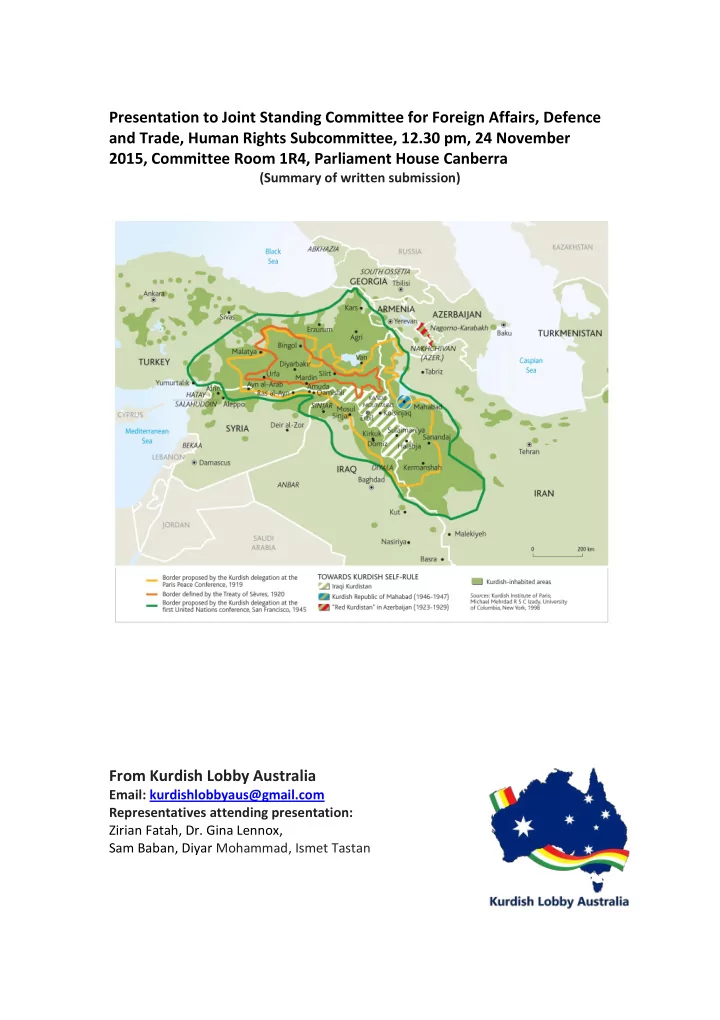
Kurdistan: Confronting ISIS Why political solutions are necessary to defeat ISIS

Overview

The war against ISIS is at a stalemate because of a lack of resolve, strategy and political co-ordination. Some predict it will go on for 10 to 20 years. That is a disastrous prospect for human rights and governance, especially for Muslims, who are predicted to be 35% of the world’s population by 2050. The US-led coalition has no wish to put troops on the ground. Of all the ground forces, it is only the Kurds that consistently co-ordinate with the coalition and have defended and taken back territory so civilians can return home. Yet this military alliance is undermined by politics, and comes with no political guarantees. Syria The alliance in Syria is fraught because Turkey considers the Syrian Kurds to be terrorists, more dangerous than ISIS, and a security threat. Turkey is demanding they be added to international terrorist lists. For a month, Turkey has been conducting daily attacks on these allied forces, and is threatening to continue its attacks until its concerns are met. For the last four months, Turkey has been also attacking another ground force fighting ISIS: the PKK. President Erdogan claims these operations in Turkey and Iraqi Kurdistan will not cease until PKK is liquidated. Meanwhile, Turkey regularly closes the border with Iraqi Kurdistan, through which Kurdistan imports food and other essentials. Turkey’s preoccupation with fighting Kurds in three countries, and its support for Al Nusra and ISIS in Syria, is a gain for ISIS. Yet Turkey is not publically criticised because Turkey belongs to NATO. The coalition wants to use its air bases and the EU wants a refugee agreement. Since 30 September, Russian-backed regime offensives in Syria have united Opposition groups, which are putting up a fierce resistance. This has allowed ISIS to

  • advance. If the war continues like this, some predict 3 million refugees will head for

Europe in 2016. Russia, Syria, Iraq and Iran have agreed to share intelligence on ISIS and in late October, Iraq agreed to Russia striking ISIS convoys entering Iraq.

slide-3
SLIDE 3

Email: kurdishlobbyaus@gmail.com

3 Kurdistan Region of Iraq In Iraq, politics is constantly undermining the war against ISIS. In June 2014, when the Iraq army deserted Mosul and Kirkuk, ISIS took Mosul and Peshmerga established a frontline of 1,000 kilometres to defend the Kurdistan Region, Kirkuk and other disputed territories. Peshmerga fight with inadequate weapons, communications and other supplies. Most foreign supplies go through Baghdad, but Baghdad either undersupplies or abstains from supplying Peshmerga. Peshmerga don’t even receive salaries because Baghdad refuses to pay them and refuses to pay the Kurdistan Regional Government its allocated revenue. This is because Baghdad and Erbil are in dispute over who has the right to export oil and who should govern the disputed territories. At a time when Iraqi Kurdistan is fighting a war against ISIS, hosting 2.2 million refugees and IDPs, and providing security and services in the disputed territories, the region is suffering a severe financial crisis. Government workers and contractors are not being paid. Electricity, water and health services are not keeping up with the 35% increase in the population, and the KRG has become mired in political disagreements.

Political solutions

To defeat ISIS, military and political strategies need to be linked and contribute to long-term political transformations. Iraq In Iraq, an immediate priority is to ensure Peshmerga receive salaries, weapons, intelligence, and immediate and long term medical treatment. International support is required to unify Peshmerga within the Ministry of Peshmerga, and there is an urgent need for humanitarian aid and services. The Australian government could contribute. International mediation between Baghdad and Erbil is vital. Baghdad must be convinced to fulfill its constitutional obligations and support economic autonomy for the Kurdistan Region, provided the KRG complies with the constitution and guarantees transparent accounting for oil revenue. Iraqi Kurdistan also needs support to tackle corruption, ensure transparency in foreign relations and to streamline and diversify its economy. Australia could help Kurdistan become the food basket of the Middle East. In 2005, people in southern Iraq had less interest in forming autonomous regions. Then came the Maliki government’s mismanagement, corruption and Sunni

  • disenfranchisement. Since 2011, 9 out of 14 provinces outside Kurdistan and Kirkuk

have formally applied, or expressed an intention to become an autonomous region, following the Kurdish model. If Sunni Arabs were given autonomy they would have more incentive to fight ISIS. Australia has contributed military resources between

slide-4
SLIDE 4

Email: kurdishlobbyaus@gmail.com

4 2003 and 2011 and since 2014. Australia could contribute to Iraq becoming a functioning federation. Syria In Syria, the US is asking the newly formed Syrian Democratic Forces to take part in an offensive on Raqqa. These forces need to be armed and paid. Kurds make up a majority of the force. If the political aim is to create credible alternatives to the Assad regime, the four multi-ethnic administrations established by Kurds and their allies in Rojava need support. In a country that is already partitioned, there is an urgent need to convince Russia and Assad to stop fighting any opposition group that agrees to stop fighting the regime, before political negotiations can start on 1 January. If Assad continues to refuse negotiations until all who oppose him are defeated, he must be bypassed. The UN Security Council agreed to back ceasefires, but defining ceasefire regions will be difficult, given the presence of so many groups. Yet, under the current road map, establishing ceasefire regionss is the only way to support political negotiations and local pluralist administrations, solve the refugee crisis, establish humanitarian and trade corridors, and start an international reconstruction effort. In Vienna it was decided that political negotiations, a new constitution and elections would take two-years. In multi cultural Syria, Kurds offer a way forward. In January 2014, three multi-ethnic, multi-religious autonomous councils were established in Cizere, Kobani and Afrin, and last October a fourth council was established in Tel

  • Abyad. In future meetings, it is important to recognize these achievements and

consider a decentralized democratic federal system of government in Syria, as advocated by PYD and their allies. This may also suit Alawites, who fear persecution under a Sunni-majority government. Turkey Turkey’s role in fighting ISIS is complicated by its fear of Kurds in and outside Turkey. In the June elections, the pro-Kurdish HDP won an unprecedented 80 seats. Afterwards, President Erdogan called an end to the stalled peace process. A trigger for war occurred on 22 July, when youths not affiliated with the PKK, killed two policemen who they claim could have prevented the killing of 32 youths in Suruc two days earlier. Two days after the policemen were killed, Erdogan launched a war on PKK for political gain. The AKP had lost its absolute majority in the June election and rather than form a coalition, AKP called another election for November 1. AKP wants to change the constitution to give President Erdogan executive powers. Other parties

  • ppose this.

In the lead up to the November election there was media censorship and government and nationalist attacks on media outlets, HDP offices and civilians; mass arrests, including 500 HDP members, and daily clashes between security forces and

slide-5
SLIDE 5

Email: kurdishlobbyaus@gmail.com

5

  • Kurds. 127 security zones were established in eastern Turkey. Security forces

blockade suburbs; enforce a curfew; cut water, electricity and telecommunications; conduct house-to-house searches and arrests; and bomb and shoot at infrastructure, vehicles and anyone breaking the curfew. In response, PKK attacked security convoys travelling between military bases and security zones. In 15 zones, Kurdish youth set up blockades and trenches, and declared self government. When local councils supported them, the mayors and

  • fficials were arrested and suspended from their posts.

On 10 October, at a rally in central Ankara to protest the war between the state and PKK, two suicide bombers killed more than 100 people, wounding over 500. Eyewitnesses claim police suddenly appeared and attacked people helping the wounded with tear gas, water cannons, batons and bullets. The state issued an immediate ban on all radio and television coverage. Despite the PKK announcing a unilateral ceasefire in support of elections, and officials identifying two ISIS-linked suicide bombers, President Erdogan blamed the Ankara bombings on a terror cocktail including PKK and YPG. No-one has claimed responsibility for the attack. Security forces and foreign embassies were warned of the attack. Mass protests asked why Turkish intelligence and security forces are incapable of stopping serial carnage at peaceful pro-Kurdish gatherings. The reasons may never be known as confidentiality orders restricting the release of evidence, even to lawyers, were put in place after Ankara, Suruc and an attack on a HDP rally in Diyarbakir in June. After the Ankara bombings, HDP called off all election rallies. In a climate of fear and media censorship, AKP won a clear majority on November 1, and increased its attacks on PKK, declaring new security zones and killing more civilians. On November 5, PKK ended its unilateral ceasefire. We call on Australia to use its close relationship with Turkey and the US, and its role in the UN, to support peace between Turkey and Kurds. Turkey needs to address human rights issues, media independence, judicial transparency, and appropriate constitutional reforms. PKK is key to any ceasefire. It is asking for regional autonomy within a democratic federation. Iran Iran has trained, equipped and led Shia militia in Iraq and Syria, and is well placed to support political transitions.nYet, Iran has an alarming human rights record. The death penalty has increased from 100 per annum in 2005 to an estimated 800 to 1000 in 2015. Although Kurds comprise 13% of the population, they make up 50% of all executions. The Kurdish region remains poverty stricken and militarized. Kurds are politically oppressed and discriminated against.

slide-6
SLIDE 6

Email: kurdishlobbyaus@gmail.com

6 On President Rouhani’s first visit to the Kurdish region he claimed the Iranian government cares for Kurds and is helping Kurds defeat ISIS. Yet there are intermittent clashes between security forces and Iranian Kurds, who are asking for autonomy within a federal system.

Conclusion

In fighting ISIS the coalition is relying on Kurdish ground forces. What Kurds fear most is that they will be bypassed in favour of the status quo. Many Kurds dream of an independent nation state called Kurdistan. Lacking international support, Kurdish leaders talk of democratic federations. Linking aid and investment to political milestones is one way to achieve political transformations. Australia needs to take a stand. We have been militarily involved in the region since World War I. We have been politically involved as a member of the League of Nations and the UN. In 2014, Australia’s exports to Iraq, Syria Turkey and Iran exceeded A$1 billion. With our experience in federalism, agriculture, conservation, mining and tourism we could contribute to sustainable futures in these countries.