Scenario of the plastic waste recycling in Emilia Romagna Region - - PowerPoint PPT Presentation

scenario of the plastic waste recycling in emilia romagna
SMART_READER_LITE
LIVE PREVIEW

Scenario of the plastic waste recycling in Emilia Romagna Region - - PowerPoint PPT Presentation

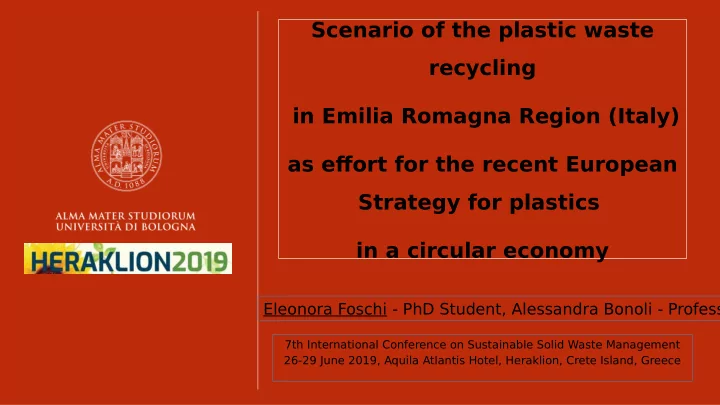
Scenario of the plastic waste recycling in Emilia Romagna Region (Italy) as efgort for the recent European Strategy for plastics in a circular economy Eleonora Foschi - PhD Student, Alessandra Bonoli - Profess 7th International Conference on


slide-1
SLIDE 1

Scenario of the plastic waste recycling in Emilia Romagna Region (Italy) as efgort for the recent European Strategy for plastics in a circular economy

Eleonora Foschi - PhD Student, Alessandra Bonoli - Profess

7th International Conference on Sustainable Solid Waste Management 26-29 June 2019, Aquila Atlantis Hotel, Heraklion, Crete Island, Greece

slide-2
SLIDE 2

Context: TRIS project

The activity is carried out within the action plan of the Interreg project TRANSITION REGIONS TOWARDS INDUSTRIAL SYSMBIOSIS. The activity is coordinated by: And supported by:

slide-3
SLIDE 3

Preface: The plastic value chain in a nutshell 1.4

PLASTIC PRODUCTION 56 Mt 55 Mt 58 Mt 57 Mt 57 Mt 2007 2009 2011 2012 2013 2015 2016 2017 58 Mt 64.6 Mt 60 Mt 257 Mt 250 Mt 279 Mt 288 Mt299 Mt 322 Mt 335 Mt 348 Mt

Source: PlasticsEurope (2007, 2009, 2011, 2012, 2013, 2015, 2016, 2017, 2018), The fact, 2007, 2009, 2011, 2012, 2013, 2015, 2016, 2017, 2018

slide-4
SLIDE 4

Global plastic conversion demand (Mt)

Preface: The plastic value chain in a nutshell 2.4

PLASTICS CONVERSION

39.7 % 19.8 % 10.1 % 6.2% % 4.1% 3.4% 16.7 %

EUROPEAN PLASTIC CONVERSIO N DEMAND IN 2017

Source: Geyer et al. (2017), Production, use, and fate of all plastics ever made

Packaging Automotive Building and construction Other

slide-5
SLIDE 5

Source: PlasticsEurope (2006, 2007, 2008, 2009, 2010, 2011, 2012, 2013, 2014, 2015, 2016)

Preface: The plastic value chain in a nutshell 3.4

Source: OECD (2018), Improving Markets for Recycled Plastics: T rends, Prospects and Policy Responses

2006 2007 2008 2009 2010 2011 2012 2013 2014 2015 2016 2 4 6 8 10 12 14 Recycling Energy recovery Landfjlling P l a s t i c w a s t e t r e a t m e n t i n E u r o p e ( M t )

PLASTIC WASTE MANAGEMENT

Global and European plastic waste production (Mt) OECD (2018), Improving Plastics Management: T rends, policy responses, and the role of international co-operation and trade OECD (2018), Improving Plastics Management: T rends, policy responses, and the role of international co-operation and trade
slide-6
SLIDE 6

Preface: The plastic value chain in a nutshell 4.4

Source: Jambeck et al. (2015), Marine pollution. Plastic waste inputs from land into the ocean

30 Mt of plastic are yearly mismanaged

PLASTICS LEAKAGE

slide-7
SLIDE 7

ENERGY RECOVER Y LANDFIL L

PLASTIC PRODUCTS

DISTRIBUTION

PLASTIC PRODUCTS CONSUMPTIO N

  • a. PLASTIC

WASTE COLLECTION

  • b. PLASTIC

WASTE SORTING (per polymer and colour)

  • c. PLASTIC

WASTE RECYCLING

  • d. PLASTICS

RE- MANUFACTURING Waste Product PLASTICS CONVERSION PLASTICS COMPOUND

Mission: Circularizing the plastic value chain

slide-8
SLIDE 8

The commitment of European Commission in the plastic fjelds

  • All

plastics packaging placed on the EU market must be reusable

  • r

recycled in a cost-efgective manner by 2030

  • Secondary plastic market

will increase fourfold since 2015 by 2030 Separate collection for hazardous household waste (by end 2022), bio- waste (by end 2023), textiles (by end 2025).

COLLECTI ON RECYCLI NG REMANUFACTU RING

EUROPEAN STRATEGY FOR PLASTICS IN A CIRCULAR ECONOMY CIRCULAR ECONOMY PACKAGE SUPs DIRECTIVE

  • 65% of plastic packaging waste

must be recycled by 2030;

  • 70% of plastic packaging must

be recycled by 2030

Additional target: binding target to reduce landfjll to maximum of 10% of municipal waste by 2035.

  • More than half of plastics

waste generated in Europe will be recycled by 2030

  • Sorting

and recycling capacity will increase fourfold since 2015 by 2030

  • 77% of such single-use

plastic beverage bottles must be collected separately by 2025

  • 90% of such single-use

plastic beverage bottles must be collected separately by 2029

  • 25% of recycled plastics

must be included PET bottles by 2025

  • 30% of recycled plastics

must be included in PET bottles by 2030

slide-9
SLIDE 9

Multi-stakeholder analysis

NGOs and CIVIL COMMUNITY INDUSTRY

POLICY

MAKERS

slide-10
SLIDE 10

What’s the role of regions in promoting a circular plastic economy?

Challenge

slide-11
SLIDE 11

Case study: Emilia Romagna Region (Italy)

1a Describing the context 1b Setting priorities Circular regional plastic value chain by valorizing the local recycling industry 1c Defjning goals and strategy Alignment of regional policy framework to the European Strategy on plastics in a circular economy 1d Planning and review

90 PLASTICS CONVERTERS 177 PLASTIC S COMPOU NDERS 107 PLASTIC WASTE RECYCLERS

45 Plastic packaging machinery manufacturing companies

PACKAGING VALLEY

slide-12
SLIDE 12

Regulatory framework: regional policy on waste

Regional law on circular economy

Regional plan on waste management

Permanent table on by-products valorization

Regional list of by-products

Permanent forum “Chiudi il cerchio” Living lab on circular economy and industrial symbiosis

Regional targets European targets Waste reduction 20-25% by 2020

  • Separate collection

73% by 2020 77% by 2025, 90% by 2030 (for PET beverage bottles) Municipal waste recycling Plastic packaging waste 70% by 2020 65% by 2020 55% by 2025, 60% by 2030, 65% by 2035 (Calculation Method n.4) 55% by 2030 Landfjlling 5% by 2020 10% by 2030

slide-13
SLIDE 13

Material framework: plastics in regional waste streams

PLASTIC WASTE POST

  • INDUSTRIAL

PLASTIC WASTE POST-CONSUMER PLASTIC WASTE Plastic packaging waste coming from residential activities Plastic packaging waste coming from industrial and commercial activities and disposed in separate collection scheme Plastic waste from mono material waste stream Plastic waste from multi material waste stream EWC 150102 EWC 200139 EWC 200139 Plastic packaging waste coming from industrial and commercial activities EWC 020104 Plastic waste coming from mechanical treatment of waste EWC 120105 EWC 160119 EWC 170203 EWC 191204 from agricolture

from physichal/mechanical treatment of plastics from B&C sector from EoL vehicles

Municipal waste Special waste

slide-14
SLIDE 14

PS packaging General packaging

PLASTIC WASTE MANAGEMENT Framework of private enterprises PARI CORIPET CONIP

LDPE fmexible packaging

COREPLA Platforms

PO secondary and tertiary packaging PET packaging for food beverage Drums and tanks

PIFU PIA PEPS Public/private waste collectors Public/private waste managers COREPLA:

  • Pre-sorting plants

(CC)

  • Sorting plants

(CSS) Framework of private enterprises Recycling companies SPECIAL WASTE MUNICIPAL WASTE

Material framework: plastics waste management

MUD db ORSO db Indipendent consortia

slide-15
SLIDE 15

Plastic waste generation

  • 10.000

20.000 30.000 40.000 50.000 60.000 70.000 80.000 90.000 020104 120105 150102 160119 170203 200139 191204 S p e c i a l p l a s t i c w a s t e g e n e r a t i o n ( t )

1,00 10,00 100,00 1.000,00 10.000,00 100.000,00 T

  • tal production (ton)

Per capita production (kg per capita) Municipal plastic waste generation

27.7% 72.3%

Municipal waste Special waste

slide-16
SLIDE 16

Plastic waste treatment

The performance of plastic waste recycling depends on:

  • Recycling infrastructure
  • Type of plastic materials and applications

TYPE OF WASTE STREAM EWC POL YMERIC COMPOSITION PACKAGING 120105, 150102 PET, HDPE, LDPE, PP AUTOMOTIVE 160119 PA, ABS, PP B&C 170203 PVC, HDPE AGRICOLTURE 020104 LDPE, EVA PLASTIC MANUFACTURING/RECYCL ING 200139, 191204 All

slide-17
SLIDE 17

Municipal plastic waste management: COREPLA

SORTING 50.94% ENERGY RECOVERY 47.98% LANDFILLING 1.07% RECYCLING 22%

EXPORT

Plastic packaging recycling target (Directive 98/2008): 22,5 % by weight, counting exclusively material that is recycled back into plastics

slide-18
SLIDE 18

Industrial plastic waste management

1,92% 65,89% 12,95%

D1; 4 ; 0,07%

19,18%

EWC 020104

2,65% 69,76% 18,84%

D1; 19 ; 0,22% D10; 6 ; 0,07%

7,84%

D15; 56 ; 0,63%

EWC 120105

55,50% 40,68% D1; 1 ; 0,03% 0,93% 2,85%

EWC 160119

2,07%

45,55% 42,79% 7,31% 2,28%

EWC 170203

INDUSTRIAL PLASTIC WASTE

25,84% 67,96% 5,20%

D1; 7 ; 0,00% D2-D14; 190 ; 0,08% 0,91%

EWC 191204

to other Italian regions to global countries

EXPORT

slide-19
SLIDE 19

Secondary plastic manufacturing

Granuli Chips Polvere Cubetti 2.000 4.000 6.000 8.000 10.000 12.000 14.000 16.000

Secondary plastics by polymer type and shape

ABS PS PP PVC LDPE HDPE PET Kg

Granules Chips Powder Cube 2,27% 1,59% 22,23% 0,20% 5,46% 0,22% 0,03% 1,75% 1,64% 53,82% 10,80%

Plastic waste sorted by polymer type

PET HDPE LDPE LLDPE PVC PP PS ABS Plasmix Altro Plastiche miste a specifjca Corepla Plastiche miste a libero mercato

Regional sorting plants Regional recycling plants Investigation at:

slide-20
SLIDE 20

Conclusion: Towards the Strategy on plastics for circular economy QUALITATIVE

Packaging waste: Reducing municipal waste (DRS, PAYT) Increasing awareness on plastics users (including consumers) Promoting servitization and design for recycling Recovering plastics from unseparated waste stream C&D waste: Improving selective demolition Automotive waste: Promoting the use of recycles and the design for disassembly Agricolture: Promoting biocompostable plastics and effjcient collection Investing in local recycling infrastructure

QUANTITATIVE

Monitoring industrial plastic waste Harmonizing data collection and target calculation on waste recycling (Met. 4) Introducing value_based circularity indicators

slide-21
SLIDE 21

www.unibo.it

THANK YOU FOR THE ATTENTION!

  • Eng. Eleonora Foschi, PhD Student

eleonora.foschi3@unibo.it

Department of Civil, Chemical, Environmental and Materials Engineering