Waste-to-Energy: Energising your waste Waste-to-Energy Plants (waste - - PowerPoint PPT Presentation

waste to energy energising your waste
SMART_READER_LITE
LIVE PREVIEW

Waste-to-Energy: Energising your waste Waste-to-Energy Plants (waste - - PowerPoint PPT Presentation

Waste-to-Energy: Energising your waste Waste-to-Energy Plants (waste incineration with energy recovery) thermally treat household and similar waste that remains after waste prevention and recycling generating energy from it. Uddevalla WtE


slide-1
SLIDE 1

Waste-to-Energy: Energising your waste

1

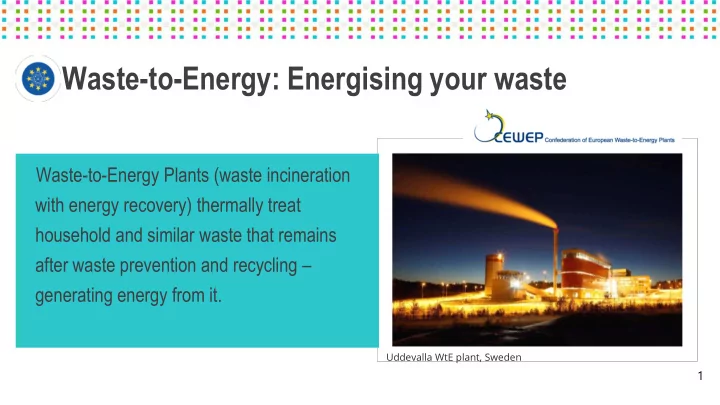
Waste-to-Energy Plants (waste incineration with energy recovery) thermally treat household and similar waste that remains after waste prevention and recycling – generating energy from it.

Uddevalla WtE plant, Sweden

slide-2
SLIDE 2

24% Landfilled 47% Recycled + Composted 28% Waste-to-Energy

Municipal waste treatment in 2017 in EU28

Waste is a Resource.

However 24% of municipal waste across the EU28 is still landfilled although landfill gases (methane) contribute significantly to global warming.

slide-3
SLIDE 3

3

Where does Waste-to-Energy stand?

Circular Economy

Waste to Energy

Energy Union

quality recycling diverting waste from landfills energy efficiency replacing fossil fuels with renewables sink for pollutants local, cost-effective, secure energy

slide-4
SLIDE 4

Circular Economy

4

“In a circular economy the value of products and materials is maintained for as long as possible; waste and resource use are minimised, and resources are kept within the economy when a product has reached the end of its life, to be used again and again to create further value.” (European Commission, 2015)

Waste Hierarchy

Set in the EU Waste Framework Directive it helps to achieve sustainable waste management.

slide-5
SLIDE 5

5

And of course make things better in the first place… There are many ways to keep the waste higher up the waste hierarchy:

Circular Economy

Repair Swap Donate Share Recycle Borrow Lend Compost

slide-6
SLIDE 6

But what do we do with residual waste?

While some things that there is no further use for can be at least recycled: What about:

  • Dirty, contaminated materials?
  • Mixed materials?
  • Degraded materials after multiple times
  • f recycling?
  • Materials containing substances of high

concern? The only options are…

Recovery e.g. Waste-to-Energy Disposal e.g. Landfilling

slide-7
SLIDE 7

Not everything should be recycled…

“In the recycling processes, articles (and the materials they consist of) that contain toxic substances contaminate the respective waste streams and are diluted in materials that do not contain toxic substances.” * “According to modelling studies, it may take centuries to decontaminate a recycled waste stream, even if preventive measures are implemented”*

*Study for the strategy for a non-toxic environment of the 7th Environment Action Programme, European Commission 2017

slide-8
SLIDE 8

But landfilling should be avoided

We need to divert waste from landfills in order to: protect soil and groundwater from contamination prevent microplastics from being blown into the seas and rivers avoid the creation of methane - a potent greenhouse gas (equal to 25 times CO2 in mass) harness the material and energy content

  • f residual waste
slide-9
SLIDE 9

Waste-to-Energy provides local energy from our residual waste

While helping to divert waste from landfills Helps to reduce dependence on fossil fuels imports Saves millions of tonnes of CO2 Contributes to security of energy supply Provides sustainable, local, low carbon, cost-effective and reliable energy

“Diversion from landfill is the main contributor to GHG mitigation in the waste management sector”*

*The Climate Change Mitigation Potential of the Waste Sector, Öko-Institut and IFEU on behalf of German Federal Environment Agency (UBA), 2015

slide-10
SLIDE 10

46% Recycled + Composted

Health studies

Lisbon University's Institute of Preventive Medicine: waste incineration "does not impact on dioxin blood levels of nearby residents" of Waste- to-Energy plants http://www.sciencedirect.com/science/article/pii/S0045653506016158 UK Committee of Carcinogenity: “any potential risk of cancer due to residency near to municipal solid waste incinerators was exceedingly low, and probably not measurable by the most modern epidemiological techniques”

http://www.advisorybodies.doh.gov.uk/Coc/munipwst.htm

A Spanish study concluded that the Tarragona Waste-to-Energy plant “does not produce additional health risks for the population living nearby.” It presents results from monitoring of the Tarragona (Catalonia, Spain) Waste-to-Energy plant regarding dioxins and furans (PCDD/Fs) levels in soil, vegetation, and air samples collected in the period 2009–2010. The concentrations of PCDD/Fs in the surroundings of the Tarragona plant were monitored over the last 15 years.

http://wmr.sagepub.com/content/30/9/908.full.pdf+html

slide-11
SLIDE 11

Sophisticated flue-gas cleaning devices guarantee low emissions

slide-12
SLIDE 12

24% 1% 1% 1% 1% 1% 2% 7% 13% 19%20%22%26%26% 31% 33% 42% 48%49%50%54% 60%61% 71%75% 82%82% 93% 3% 57%

28% 53%53% 31% 43% 59% 44%39% 44% 14% 35% 44% 36% 21% 30% 3% 19% 24%17% 16%20%13%4% 10% 4% 47% 53% 4%

47% 47%46% 68% 54% 41% 54%59% 48% 73% 44% 30% 43% 52% 41%27%49% 34%34%35%30%33%36% 30% 14% 25% 17%17% 7% 53% 39%33% 0% 10% 20% 30% 40% 50% 60% 70% 80% 90% 100%

Recycling & WtE complementary to divert waste from landfills

EU 28 + Switzerland, Norway and Iceland, 2017

Legend:

Landfill Waste-to-Energy Recycling +Composting

Graph by CEWEP, Source: EUROSTAT Last update January 2019
slide-13
SLIDE 13

Recycling & WtE complementary to divert waste from landfills

Lessons to be learnt from the countries in the EU28 Landfilling 4% of municipal waste or less: Germany, the Netherlands, Austria, Belgium, Denmark, Sweden & Finland Most of them have introduced landfill bans And have proven that Waste-to-Energy & Recycling are complementary to divert waste from landfills

slide-14
SLIDE 14

14

Graph by CEWEP, Source: EUROSTAT 2019

Recycling & WtE complementary to divert waste from landfills

EU 28 + Switzerland, Norway and Iceland

Municipal waste treatment trends 2001-2017 EU 28

Legend:

Landfill -32% points Waste-to-Energy +12% points Recycling +19% points

0% 10% 20% 30% 40% 50% 60% 2001 2002 2003 2004 2005 2006 2007 2008 2009 2010 2011 2012 2013 2014 2015 2016 2017

slide-15
SLIDE 15

Waste to Products: Bottom Ash recycling

15

1 tonne of recycled metals from bottom ash saves 2 tonnes of CO2equ emissions 1 tonne of bottom ash contains between 10-12% metals Minerals can be used as secondary aggregates (road construction or in building products)

slide-16
SLIDE 16

Waste-to-Energy Cycle

This energy can be in the form of

steam, electricity or hot water:

Electricity is fed into the grid and distributed to the end-users, Hot water can be sent to a nearby district heating (or cooling) network to heat (or cool) homes, hospitals, offices etc. And steam can be used by nearby industry in production processes.

slide-17
SLIDE 17
slide-18
SLIDE 18

Waste-to-Energy: examples of innovative sustainable energy use

SUEZ Waste-to-Energy plant in Toulouse, France, provides heating for nearby greenhouses growing 6,000 tonnes of tomatoes each year Twence Waste-to-Energy plant in the Netherlands captures CO2 and transforms it into sodium bicarbonate. It is used in the plant’s flue gas cleaning system thereby saving precious raw materials while reducing its carbon emissions In Linköping, Sweden, Waste-to-Energy produces cooling for the district cooling network in a process that avoids the use of hydrofluorocarbons gases, that are thousands of times more destructive to the climate than CO2

slide-19
SLIDE 19

Waste-to-Energy in Europe in 2016

WtE Plants operating in Europe (not including hazardous waste incineration plants) Waste thermally treated in WtE plants (in million tonnes)

Data supplied by CEWEP members and national sources * Includes plant in Andorra Finland 8 1.47 Norway 17 1.61 Sweden 34 5.99 Estonia 1 0.24 Latvia Lithuania 1 0.26 Poland 5 0.5 Czech Republic 4 0.7 Slovakia 2 0.29 Hungary 1 0.35 Romania Bulgaria Greece Italy 41 6.21 Croatia France 126 14.4 Spain* 12 2.88 Portugal 4 1.2 Austria 11 2.5 Switzerland 30 4 Slovenia Netherlands 12 7.8 Belgium 18 3.41 Germany 121 26 Luxembourg 1 0.16 Denmark 26 3.47 United Kingdom 46 10.07 Ireland 1 0.23

2

slide-20
SLIDE 20

They thermally treat household and similar commercial & industrial waste that remains after waste prevention, reuse and recycling by generating energy from it.

CEWEP - Confederation of European Waste-to-Energy Plants

20

CEWEP is the umbrella association

  • f the operators of Waste-to-Energy

Plants across Europe.

slide-21
SLIDE 21

Confederation of European Waste-to-Energy Plants info@cewep.eu

  • Tel. +32 2 770 63 11

www.cewep.eu

Thank you for your attention

21