SLIDE 1
SCIP Introduction Sep. 26, 2018
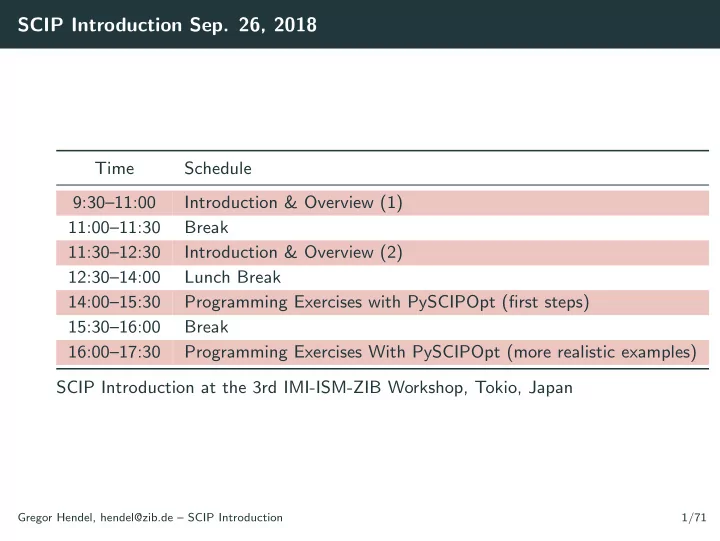
Time Schedule 9:30–11:00 Introduction & Overview (1) 11:00–11:30 Break 11:30–12:30 Introduction & Overview (2) 12:30–14:00 Lunch Break 14:00–15:30 Programming Exercises with PySCIPOpt (first steps) 15:30–16:00 Break 16:00–17:30 Programming Exercises With PySCIPOpt (more realistic examples) SCIP Introduction at the 3rd IMI-ISM-ZIB Workshop, Tokio, Japan
Gregor Hendel, hendel@zib.de – SCIP Introduction 1/71
SLIDE 2
Introduction to SCIP
Gregor Hendel, hendel@zib.de SCIP Introduction Day September 26, 2018 3rd IMI-ISM-ZIB MODAL Workshop
SLIDE 3 What is SCIP?
SCIP (Solving Constraint Integer Programs) . . .
- provides a full-scale MIP and MINLP solver,
- is constraint based,
- incorporates
- MIP features (cutting planes, LP relaxation), and
- MINLP features (spatial branch-and-bound, OBBT)
- CP features (domain propagation),
- SAT-solving features (conflict analysis, restarts),
- is a branch-cut-and-price framework,
- has a modular structure via plugins,
- is free for academic purposes,
- and is available in source-code under http://scip.zib.de !
Gregor Hendel, hendel@zib.de – SCIP Introduction 2/71
SLIDE 4 Meet the SCIP Team
31 active developers
- 7 running Bachelor and Master projects
- 16 running PhD projects
- 8 postdocs and professors
4 development centers in Germany
- ZIB: SCIP, SoPlex, UG, ZIMPL
- TU Darmstadt: SCIP and SCIP-SDP
- FAU Erlangen-N¨
urnberg: SCIP
Many international contributors and users
- more than 10 000 downloads per year from 100+ countries
Careers
- 10 awards for Masters and PhD theses: MOS, EURO, GOR, DMV
- 7 former developers are now building commercial optimization software at
CPLEX, FICO Xpress, Gurobi, MOSEK, and GAMS
Gregor Hendel, hendel@zib.de – SCIP Introduction 3/71
SLIDE 5
Outline
SCIP – Solving Constraint Integer Programs
Constraint Integer Programming The Solving Process of SCIP Extending SCIP by Plugins The SCIP Optimization Suite http://scip.zib.de
Gregor Hendel, hendel@zib.de – SCIP Introduction 4/71
SLIDE 6
Outline
SCIP – Solving Constraint Integer Programs
Constraint Integer Programming The Solving Process of SCIP Extending SCIP by Plugins The SCIP Optimization Suite http://scip.zib.de
Gregor Hendel, hendel@zib.de – SCIP Introduction 5/71
SLIDE 7
An example: the Traveling Salesman Problem
Definition (TSP) Given a complete graph G = (V , E) and distances de for all e ∈ E: Find a Hamiltonian cycle (cycle containing all nodes, tour) of minimum length. K8
Gregor Hendel, hendel@zib.de – SCIP Introduction 6/71
SLIDE 8
An example: the Traveling Salesman Problem
Definition (TSP) Given a complete graph G = (V , E) and distances de for all e ∈ E: Find a Hamiltonian cycle (cycle containing all nodes, tour) of minimum length. K8
Gregor Hendel, hendel@zib.de – SCIP Introduction 6/71
SLIDE 9
An example: the Traveling Salesman Problem
Definition (TSP) Given a complete graph G = (V , E) and distances de for all e ∈ E: Find a Hamiltonian cycle (cycle containing all nodes, tour) of minimum length.
Gregor Hendel, hendel@zib.de – SCIP Introduction 6/71
SLIDE 10
What is a Constraint Integer Program?
Mixed Integer Program Objective function: ⊲ linear function Feasible set: ⊲ described by linear constraints Variable domains: ⊲ real or integer values
min cT x s.t. Ax ≤ b (xI , xC ) ∈ ❩I × ❘C
Constraint Program Objective function: ⊲ arbitrary function Feasible set: ⊲ given by arbitrary constraints Variable domains: ⊲ arbitrary (usually finite)
min c(x) s.t. x ∈ F (xI , xN) ∈ ❩I × X
Gregor Hendel, hendel@zib.de – SCIP Introduction 7/71
SLIDE 11 TSP – Integer Programming Formulation
Given
- complete graph G = (V , E)
- distances de > 0 for all e ∈ E
Binary variables
xe K8
Gregor Hendel, hendel@zib.de – SCIP Introduction 8/71
SLIDE 12 TSP – Integer Programming Formulation
Given
- complete graph G = (V , E)
- distances de > 0 for all e ∈ E
Binary variables
xe K8 min
de xe subject to
xe = 2 ∀v ∈ V
xe ≥ 2 ∀S ⊂ V , S = ∅ xe ∈ {0, 1} ∀e ∈ E
Gregor Hendel, hendel@zib.de – SCIP Introduction 8/71
SLIDE 13 TSP – Integer Programming Formulation
Given
- complete graph G = (V , E)
- distances de > 0 for all e ∈ E
Binary variables
xe K8 min
de xe subject to
xe = 2 ∀v ∈ V
xe ≥ 2 ∀S ⊂ V , S = ∅ xe ∈ {0, 1} ∀e ∈ E node degree
Gregor Hendel, hendel@zib.de – SCIP Introduction 8/71
SLIDE 14 TSP – Integer Programming Formulation
Given
- complete graph G = (V , E)
- distances de > 0 for all e ∈ E
Binary variables
xe K8 min
de xe subject to
xe = 2 ∀v ∈ V
xe ≥ 2 ∀S ⊂ V , S = ∅ xe ∈ {0, 1} ∀e ∈ E subtour elimination
Gregor Hendel, hendel@zib.de – SCIP Introduction 8/71
SLIDE 15 TSP – Integer Programming Formulation
Given
- complete graph G = (V , E)
- distances de > 0 for all e ∈ E
Binary variables
xe K8 min
de xe subject to
xe = 2 ∀v ∈ V
xe ≥ 2 ∀S ⊂ V , S = ∅ xe ∈ {0, 1} ∀e ∈ E distance
Gregor Hendel, hendel@zib.de – SCIP Introduction 8/71
SLIDE 16 TSP – Constraint Programming Formulation
Given
- complete graph G = (V , E)
- for each e ∈ E a distance de > 0
Integer variables
- xv position of v ∈ V in tour
xv K8
Gregor Hendel, hendel@zib.de – SCIP Introduction 9/71
SLIDE 17 TSP – Constraint Programming Formulation
Given
- complete graph G = (V , E)
- for each e ∈ E a distance de > 0
Integer variables
- xv position of v ∈ V in tour
1 2 3 4 5 6 7 8 min length(x1, . . . , xn) subject to alldifferent(x1, . . . , xn) xv ∈ {1, . . . , n} ∀v ∈ V
Gregor Hendel, hendel@zib.de – SCIP Introduction 9/71
SLIDE 18 What is a Constraint Integer Program?
Constraint Integer Program Objective function: ⊲ linear function Feasible set: ⊲ described by arbitrary constraints Variable domains: ⊲ real or integer values
min cT x s.t. x ∈ F (xI , xC ) ∈ ❩I × ❘C
Remark:
- arbitrary objective or variables
modeled by constraints
Gregor Hendel, hendel@zib.de – SCIP Introduction 10/71
SLIDE 19 What is a Constraint Integer Program?
Constraint Integer Program Objective function: ⊲ linear function Feasible set: ⊲ described by arbitrary constraints Variable domains: ⊲ real or integer values
min
de xe s.t.
xe = 2 ∀ v ∈ V nosubtour(x) xe ∈ {0, 1} ∀ e ∈ E (CIP formulation of TSP)
Single nosubtour constraint rules
- ut subtours (e.g. by domain prop-
agation). It may also separate sub- tour elimination inequalities.
Gregor Hendel, hendel@zib.de – SCIP Introduction 10/71
SLIDE 20 Mixed-Integer Nonlinear Programs (MINLPs)
min cTx s.t. gk(x) ≤ 0 ∀k ∈ [m] xi ∈ Z ∀i ∈ I ⊆ [n] xi ∈ [ℓi, ui] ∀i ∈ [n] The functions gk ∈ C 1([ℓ, u], R) can be
−1 1 −1 1 5 10
convex or
100 200 300 200 −200 200
nonconvex
Gregor Hendel, hendel@zib.de – SCIP Introduction 11/71
SLIDE 21 Application: Data Classification
Support Vector Machine, e.g., with ramp loss. min w Tw 2 + C n
n
(ξi + 2(1 − zi)) s.t. zi(yi(w Txi + b) − 1 + ξi) ≥ 0 ∀i ξi ∈ [0, 2], zi ∈ {0, 1} ∀i w ∈ Rd, b ∈ R
Gregor Hendel, hendel@zib.de – SCIP Introduction 12/71
SLIDE 22 Constraint Integer Programming
MIP
Gregor Hendel, hendel@zib.de – SCIP Introduction 13/71
SLIDE 23 Constraint Integer Programming
- Mixed Integer Programs
- SATisfiability problems
MIP SAT
Gregor Hendel, hendel@zib.de – SCIP Introduction 13/71
SLIDE 24 Constraint Integer Programming
- Mixed Integer Programs
- SATisfiability problems
- Pseudo-Boolean Optimization
PBO MIP SAT
Gregor Hendel, hendel@zib.de – SCIP Introduction 13/71
SLIDE 25 Constraint Integer Programming
- Mixed Integer Programs
- SATisfiability problems
- Pseudo-Boolean Optimization
- Mixed Integer Nonlinear Programs
MINLP PBO MIP SAT
Gregor Hendel, hendel@zib.de – SCIP Introduction 13/71
SLIDE 26 Constraint Integer Programming
- Mixed Integer Programs
- SATisfiability problems
- Pseudo-Boolean Optimization
- Mixed Integer Nonlinear Programs
- Constraint Programming
CP MINLP PBO MIP SAT
Gregor Hendel, hendel@zib.de – SCIP Introduction 13/71
SLIDE 27 Constraint Integer Programming
- Mixed Integer Programs
- SATisfiability problems
- Pseudo-Boolean Optimization
- Mixed Integer Nonlinear Programs
- Constraint Programming
- Constraint Integer Programming
CP CIP MINLP PBO MIP SAT
Gregor Hendel, hendel@zib.de – SCIP Introduction 13/71
SLIDE 28 Constraint Integer Programming
- Mixed Integer Programs
- SATisfiability problems
- Pseudo-Boolean Optimization
- Mixed Integer Nonlinear Programs
- Constraint Programming
- Constraint Integer Programming
CP CIP MINLP PBO MIP SAT Relation to CP and MIP
- Every MIP is a CIP. “MIP CIP”
- Every CP over a finite domain space is a CIP. “FD CIP”
Gregor Hendel, hendel@zib.de – SCIP Introduction 13/71
SLIDE 29
Outline
SCIP – Solving Constraint Integer Programs
Constraint Integer Programming The Solving Process of SCIP Extending SCIP by Plugins The SCIP Optimization Suite http://scip.zib.de
Gregor Hendel, hendel@zib.de – SCIP Introduction 14/71
SLIDE 30
Branch-and-bound
Gregor Hendel, hendel@zib.de – SCIP Introduction 15/71
SLIDE 31 SCIP Interactive Shell Basics
Basic Workflow read . . / check / i n s t a n c e s /MIP/ b e l l 5 . mps
w r i t e s o l u t i o n mysolution . s o l q u i t Displaying information Use the display ... command to enter the menu and
- obtain solution information
- print the current transproblem to the console
- display plugin information, e.g., list all available branching rules
Changing Settings Use the set ... command to list the settings menu.
Gregor Hendel, hendel@zib.de – SCIP Introduction 16/71
SLIDE 32 Important Parameters
Numerical parameters These must be set before reading a problem.
- numerics/feastol, default 10−6
- numerics/epsilon, default 10−9
- numerics/infinity, default 1020
Limits
- limits/time
- limits/nodes
- limits/gap
Randomization
- randomization/randomseedshift
- randomization/lpseed
- randomization/permutationseed
Gregor Hendel, hendel@zib.de – SCIP Introduction 17/71
SLIDE 33 Different Tasks – Different Plugins
Different plugin classes are responsible of the following tasks.
- 1. Presolving and node propagation
- Constraint handlers
- Presolvers
- Propagators
- 2. Separation
- Constraint handlers
- Separators
- 3. Improving solutions
- Primal heuristics
- 4. Branching
- Constraint handlers
- Branching rules
- 5. Node selection
- Node selectors
Gregor Hendel, hendel@zib.de – SCIP Introduction 18/71
SLIDE 34
Operational Stages
Init Problem Transforming Free Transform Presolving Init Solve Solving Free Solve
Gregor Hendel, hendel@zib.de – SCIP Introduction 19/71
SLIDE 35 Operational Stages
Init Problem Transforming Free Transform Presolving Init Solve Solving Free Solve
- Basic data structures are allocated and initialized.
- User includes required plugins (or just takes default plugins).
Gregor Hendel, hendel@zib.de – SCIP Introduction 19/71
SLIDE 36 Problem Specification
Init Problem Transforming Free Transform Presolving Init Solve Solving Free Solve
- User creates and modifies the original problem instance.
- Problem creation is usually done in file readers.
Gregor Hendel, hendel@zib.de – SCIP Introduction 20/71
SLIDE 37
Define Variables (LOP Example)
SCIP_VAR* var; SCIP_CALL( // return value macro SCIPcreateVar ( scip , // SCIP pointer &var , // save in variable "varname", // pass variable name 0.0, // lower bound 1.0, // upper bound length , // obj. value SCIP_VARTYPE_BINARY , // type TRUE , // initial FALSE , // removable NULL , NULL , NULL , // no callback functions NULL // no variable data ) ); SCIP_CALL( SCIPaddVar(scip , var) ); // add var.
Gregor Hendel, hendel@zib.de – SCIP Introduction 21/71
SLIDE 38 TSP: Define Degree Constraints
SCIP_CALL( SCIPcreateConsLinear ( scip , // SCIP pointer &cons , // save in cons "consname", // name nvar , // number of variables vars , // array of variables vals , // array of values 2.0, // left hand side 2.0, // right hand side (equation) TRUE , // initial? FALSE , // separate? TRUE , // enforce? TRUE , // check? TRUE , // propagate? FALSE , // local? FALSE , // modifable? FALSE , // dynamic? FALSE , // removable? FALSE // stick at node? )); SCIP_CALL( SCIPaddCons (scip , cons) ); // add constraint SCIP_CALL( SCIPreleaseCons (scip , &cons) ); // free
MIPs are specified using linear constraints only (may be “upgraded”).
Gregor Hendel, hendel@zib.de – SCIP Introduction 22/71
SLIDE 39 Transformation
Init Problem Transforming Free Transform Presolving Init Solve Solving Free Solve
- Creates a working copy of the original problem.
Gregor Hendel, hendel@zib.de – SCIP Introduction 23/71
SLIDE 40 Original and Transformed Problem Original CIP
Original variables Original constraints
Transformed CIP
Transformed variables Transformed constraints
- data is copied into separate memory area
- presolving and solving operate on transformed problem
- original data can only be modified in problem modification stage
Gregor Hendel, hendel@zib.de – SCIP Introduction 24/71
SLIDE 41
Presolving
Init Problem Transforming Free Transform Presolving Init Solve Solving Free Solve
Gregor Hendel, hendel@zib.de – SCIP Introduction 25/71
SLIDE 42 Presolving
Task
removing irrelevant information
- strengthen LP relaxation by
exploiting integrality information
numerically more stable
- extract useful information
Primal Reductions:
- based on feasibility reasoning
- no feasible solution is cut off
Dual Reductions:
- consider objective function
- at least one optimal solution remains
Gregor Hendel, hendel@zib.de – SCIP Introduction 26/71
SLIDE 43 Presolving Tips and Parameters
Use display presolvers to list all presolvers of SCIP. Disable Presolving Disable all presolving for a model s e t p r e s o l v i n g emphasis
Deactivate single techniques s e t p r e s o l v i n g tworowbnd maxrounds 0 s e t propagating probing maxprerounds 0 s e t c o n s t r a i n t s components advanced maxprerounds 0 Aggressive Presolving s e t p r e s o l v i n g emphasis a g g r e s s i v e General Rule of Thumb Only deactivate single presolving techniques if you encounter performance problems.
Gregor Hendel, hendel@zib.de – SCIP Introduction 27/71
SLIDE 44
Solving
Init Problem Transforming Free Transform Presolving Init Solve Solving Free Solve
Gregor Hendel, hendel@zib.de – SCIP Introduction 28/71
SLIDE 45
Flow Chart SCIP
Processing Presolving Stop Node selection Processing Branching
Conflict analysis Primal heuristics Domain propagation
Solve LP Pricing Cuts
Enforce constraints Gregor Hendel, hendel@zib.de – SCIP Introduction 29/71
SLIDE 46
Flow Chart SCIP
Processing Presolving Stop Node selection Processing Branching
Conflict analysis Primal heuristics Domain propagation
Solve LP Pricing Cuts
Enforce constraints
Node selection
Gregor Hendel, hendel@zib.de – SCIP Introduction 29/71
SLIDE 47 Node Selection
Task
- improve primal bound
- keep comp. effort small
- improve global dual bound
Techniques
- basic rules
- depth first search (DFS)
→ early feasible solutions
→ improve dual bound
- best estimate search (BES)
→ improve primal bound
- combinations
- BBS or BES with plunging
- hybrid BES/BBS
- interleaved BES/BBS
Gregor Hendel, hendel@zib.de – SCIP Introduction 30/71
SLIDE 48 Node Selection Tips and Parameters
Available Node Selectors
d i s p l a y n o d e s e l e c t o r s node s e l e c t o r std p r i o r i t y memsave p r i o d e s c r i p t i o n − − − − − − − − − − − − −− − − − − − − − − − − −− − − − − − − − − − − − − − − − − − − − − − − e s t i m a t e 200000 100 best e s t i m a t e s e a r c h b f s 100000 best f i r s t s e a r c h . . . d f s 100000 depth f i r s t s e a r c h
Switching Node Selectors Only the node selector with highest standard priority is active. Use s e t n o d e s e l e c t i o n d f s s t d p r i o r i t y 1000000 to activate depth first search also in non-memsave mode.
Gregor Hendel, hendel@zib.de – SCIP Introduction 31/71
SLIDE 49
Flow Chart SCIP
Processing Presolving Stop Node selection Processing Branching
Conflict analysis Primal heuristics Domain propagation
Solve LP Pricing Cuts
Enforce constraints
Processing
Gregor Hendel, hendel@zib.de – SCIP Introduction 32/71
SLIDE 50
Flow Chart SCIP
Processing Presolving Stop Node selection Processing Branching
Conflict analysis Primal heuristics Domain propagation
Solve LP Pricing Cuts
Enforce constraints
Processing
Domain propagation Gregor Hendel, hendel@zib.de – SCIP Introduction 32/71
SLIDE 51 Domain Propagation
x1 x2 x3 x4
⇒
x1 x2 x3 x4
Task
- simplify model locally
- improve local dual bound
- detect infeasibility
Techniques
- constraint specific
- each cons handler may provide a
propagation routine
- reduced presolving (usually)
- dual propagation
- root reduced cost strengthening
- objective function
- special structures
- variable bounds
Gregor Hendel, hendel@zib.de – SCIP Introduction 33/71
SLIDE 52
Flow Chart SCIP
Processing Presolving Stop Node selection Processing Branching
Conflict analysis Primal heuristics Domain propagation
Solve LP Pricing Cuts
Enforce constraints
Processing Solve LP
Gregor Hendel, hendel@zib.de – SCIP Introduction 34/71
SLIDE 53 LP Solving
- LP solver is a black box
- interface to different LP solvers:
SoPlex, CPLEX, XPress, Gurobi, CLP, . . .
- primal/dual simplex
- barrier with/without crossover
- feasibility double-checked by SCIP
- condition number check
- resolution by changing parameters:
scaling, tolerances, solving from scratch, other simplex
Gregor Hendel, hendel@zib.de – SCIP Introduction 35/71
SLIDE 54 LP Solving Tips and Parameters
Most Important LP Parameters
- lp/initalgorithm, lp/resolvealgorithm
- Primal/Dual Simplex Algorithm
- Barrier w and w/o crossover
- lp/pricing
- normally LP solver specific default
- Devex
- Steepest edge
- Quick start steepest edge
- lp/threads
Slow LP performance is a blocker for the solving process and can sometimes be manually tuned significantly.
Gregor Hendel, hendel@zib.de – SCIP Introduction 36/71
SLIDE 55
Flow Chart SCIP
Processing Presolving Stop Node selection Processing Branching
Conflict analysis Primal heuristics Domain propagation
Solve LP Pricing Cuts
Enforce constraints
Processing Pricing
Gregor Hendel, hendel@zib.de – SCIP Introduction 37/71
SLIDE 56 Pricing
Branch-and-Price
- huge number of variables
- start with subset
- add others, when needed
Pricing
- find variable with negative reduced
costs
- or prove that there exists none
- typically problem specific
- dynamic aging of variables
- problem variable pricer to add
them again
- early branching possible
- lazy variable bounds
Gregor Hendel, hendel@zib.de – SCIP Introduction 38/71
SLIDE 57
Flow Chart SCIP
Processing Presolving Stop Node selection Processing Branching
Conflict analysis Primal heuristics Domain propagation
Solve LP Pricing Cuts
Enforce constraints
Processing Cuts
Gregor Hendel, hendel@zib.de – SCIP Introduction 39/71
SLIDE 58 Cutting Plane Separation
Task
- strengthen relaxation
- add valid constraints
- generate on demand
Techniques
- general cuts
- complemented MIR cuts
- Gomory mixed integer cuts
- strong Chv´
atal-Gomory cuts
- implied bound cuts
- reduced cost strengthening
- problem specific cuts
- 0-1 knapsack problem
- stable set problem
- 0-1 single node flow problem
Gregor Hendel, hendel@zib.de – SCIP Introduction 40/71
SLIDE 59 Cuts for the 0-1 Knapsack Problem
Feasible region: (b ∈ ❩+, aj ∈ ❩+ ∀ j ∈ N) X BK := { x ∈ {0, 1}n :
ajxj ≤ b } Minimal Cover: C ⊆ N
j∈C
aj > b
j∈C\{i} aj ≤ b
∀ i ∈ C
Minimal Cover Inequality
xj ≤ |C| − 1 5x1 + 6x2 + 2x3 + 2x4 ≤ 8 Minimal cover: C = {2, 3, 4} Minimal cover inequality: x2 + x3 + x4 ≤ 2
Gregor Hendel, hendel@zib.de – SCIP Introduction 41/71
SLIDE 60 Separation Tips and Parameters
Disable/Speed up/Emphasize All Separation s e t s e p a r a t i n g emphasis
- f f / f a s t / a g g r e s s i v e
Disable Single Separation Techniques s e t s e p a r a t i n g c l i q u e f r e q −1 s e t c o n s t r a i n t s c a r d i n a l i t y s e p a f r e q −1 Some Important Parameters
- separating/maxcuts, separating/maxcutsroot
- separating/maxrounds, separating/maxroundsroot
- separating/maxstallrounds, separating/maxstallroundsroot
Gregor Hendel, hendel@zib.de – SCIP Introduction 42/71
SLIDE 61
Flow Chart SCIP
Processing Presolving Stop Node selection Processing Branching
Conflict analysis Primal heuristics Domain propagation
Solve LP Pricing Cuts
Enforce constraints
Processing
Enforce constraints Gregor Hendel, hendel@zib.de – SCIP Introduction 43/71
SLIDE 62 Constraint Enforcement
LP solution may violate a constraint not contained in the relaxation. Enforcing is necessary for a correct implementation! Constraint handler resolves the infeasibility by ...
- Reducing a variable’s domain,
- Separating a cutting plane (may use integrality),
- Adding a (local) constraint,
- Creating a branching,
- Concluding that the subproblem is infeasible and can be cut off, or
- Just saying “solution infeasible”.
Gregor Hendel, hendel@zib.de – SCIP Introduction 44/71
SLIDE 63 Constraint Enforcement
Processing Presolving Stop Node selection Processing Branching
Conflict analysis Primal heuristics Domain propagation
Solve LP Pricing Cuts
Enforce constraints Enforce constraints
- Reduced domain
- Added constraint
- Added cut
- Branched
- Cutoff
- Infeasible
- Feasible
Gregor Hendel, hendel@zib.de – SCIP Introduction 45/71
SLIDE 64 Constraint Enforcement
Processing Presolving Stop Node selection Processing Branching
Conflict analysis Primal heuristics Domain propagation
Solve LP Pricing Cuts
Enforce constraints Enforce constraints
- Reduced domain
- Added constraint
- Added cut
- Branched
- Cutoff
- Infeasible
- Feasible
Gregor Hendel, hendel@zib.de – SCIP Introduction 45/71
SLIDE 65 Constraint Enforcement
Processing Presolving Stop Node selection Processing Branching
Conflict analysis Primal heuristics Domain propagation
Solve LP Pricing Cuts
Enforce constraints Enforce constraints
- Reduced domain
- Added constraint
- Added cut
- Branched
- Cutoff
- Infeasible
- Feasible
Gregor Hendel, hendel@zib.de – SCIP Introduction 45/71
SLIDE 66 Constraint Enforcement
Processing Presolving Stop Node selection Processing Branching
Conflict analysis Primal heuristics Domain propagation
Solve LP Pricing Cuts
Enforce constraints Enforce constraints
- Reduced domain
- Added constraint
- Added cut
- Branched
- Cutoff
- Infeasible
- Feasible
Gregor Hendel, hendel@zib.de – SCIP Introduction 45/71
SLIDE 67 Constraint Enforcement
Processing Presolving Stop Node selection Processing Branching
Conflict analysis Primal heuristics Domain propagation
Solve LP Pricing Cuts
Enforce constraints Enforce constraints
- Reduced domain
- Added constraint
- Added cut
- Branched
- Cutoff
- Infeasible
- Feasible
Gregor Hendel, hendel@zib.de – SCIP Introduction 45/71
SLIDE 68 Constraint Enforcement
Processing Presolving Stop Node selection Processing Branching
Conflict analysis Primal heuristics Domain propagation
Solve LP Pricing Cuts
Enforce constraints Enforce constraints Enforce constraints
- Reduced domain
- Added constraint
- Added cut
- Branched
- Cutoff
- Infeasible
- Feasible
Gregor Hendel, hendel@zib.de – SCIP Introduction 45/71
SLIDE 69 Constraint Enforcement
Processing Presolving Stop Node selection Processing Branching
Conflict analysis Primal heuristics Domain propagation
Solve LP Pricing Cuts
Enforce constraints Enforce constraints
- Reduced domain
- Added constraint
- Added cut
- Branched
- Cutoff
- Infeasible
- Feasible
Gregor Hendel, hendel@zib.de – SCIP Introduction 45/71
SLIDE 70 Constraint Enforcement
Processing Presolving Stop Node selection Processing Branching
Conflict analysis Primal heuristics Domain propagation
Solve LP Pricing Cuts
Enforce constraints Enforce constraints
- Reduced domain
- Added constraint
- Added cut
- Branched
- Cutoff
- Infeasible
- Feasible
Gregor Hendel, hendel@zib.de – SCIP Introduction 45/71
SLIDE 71
Flow Chart SCIP
Processing Presolving Stop Node selection Processing Branching
Conflict analysis Primal heuristics Domain propagation
Solve LP Pricing Cuts
Enforce constraints
Branching
Gregor Hendel, hendel@zib.de – SCIP Introduction 46/71
SLIDE 72 Branching Rules
Task
subproblems
Techniques
- branching on variables
- most infeasible
- least infeasible
- random branching
- strong branching
- pseudocost
- reliability
- VSIDS
- hybrid reliability/inference
- branching on constraints
- SOS1
- SOS2
Gregor Hendel, hendel@zib.de – SCIP Introduction 47/71
SLIDE 73 Branching Rule Tips and Parameters
Branching Rule Selection Branching rules are applied in decreasing order of priority. SCIP> d i s p l a y branching branching r u l e p r i o r i t y maxdepth maxbddist − − − − − − − − − − − − − − − − − − − − − − − − − − − − − − − − − − − − − − − r e l p s c o s t 10000 −1 100.0% pscost 2000 −1 100.0% i n f e r e n c e 1000 −1 100.0% mostinf 100 −1 100.0% Reliability Branching Parameters All parameters prefixed with branching/relpscost/
- sbiterquot, sbiterofs to increase the budget for strong branching
- minreliable (= 1), maxreliable (= 5) to increase threshold to consider
pseudo costs as reliable
Gregor Hendel, hendel@zib.de – SCIP Introduction 48/71
SLIDE 74
Flow Chart SCIP
Processing Presolving Stop Node selection Processing Branching
Conflict analysis Primal heuristics Domain propagation
Solve LP Pricing Cuts
Enforce constraints Primal heuristics Gregor Hendel, hendel@zib.de – SCIP Introduction 49/71
SLIDE 75 Primal Heuristics
Task
- improve primal bound
- effective on average
- guide remaining search
Techniques
- structure-based
- clique
- variable bounds
- rounding
- possibly solve final LP
- diving
- least infeasible
- guided
- objective diving
- objective feasibility pump
- Large Neighborhood Search
- RINS, local branching
- RENS
- Adaptive LNS
- Completion of partial solutions
Gregor Hendel, hendel@zib.de – SCIP Introduction 50/71
SLIDE 76 Primal Heuristics Tips and Parameters
Disable/Speed Up/Emphasize Heuristics s e t h e u r i s t i c s emphasis
- f f / f a s t / a g g r e s s i v e
Disable an individual heuristic via s e t h e u r i s t i c s feaspump f r e q −1 Important Parameters
- heuristics/alns/nodesofs, heuristics/alns/nodesquot to increase
the computational budget of this LNS technique
- heuristics/guideddiving/... lpsolvefreq, maxlpiterofs
maxlpiterquot to control the LP solving during this diving technique Advice Use emphasis settings. Do not attempt to individually tune heuristics by hand.
Gregor Hendel, hendel@zib.de – SCIP Introduction 51/71
SLIDE 77
Flow Chart SCIP
Processing Presolving Stop Node selection Processing Branching
Conflict analysis Primal heuristics Domain propagation
Solve LP Pricing Cuts
Enforce constraints Conflict analysis Gregor Hendel, hendel@zib.de – SCIP Introduction 52/71
SLIDE 78 Conflict Analysis
Task
- Analyze infeasibility
- Derive valid constraints
- Help to prune other nodes
Techniques
- Analyze:
- Propagation conflicts
- Infeasible LPs
- Bound-exceeding LPs
- Strong branching conflicts
- Detection:
- Cut in conflict graph
- LP: Dual ray heuristic
- Use conflicts:
- Only for propagation
- As cutting planes
Gregor Hendel, hendel@zib.de – SCIP Introduction 53/71
SLIDE 79
Operational Stages
Init Problem Transforming Free Transform Presolving Init Solve Solving Free Solve
Gregor Hendel, hendel@zib.de – SCIP Introduction 54/71
SLIDE 80
Outline
SCIP – Solving Constraint Integer Programs
Constraint Integer Programming The Solving Process of SCIP Extending SCIP by Plugins The SCIP Optimization Suite http://scip.zib.de
Gregor Hendel, hendel@zib.de – SCIP Introduction 55/71
SLIDE 81 The SCIP C API
- C code and documentation
- more than 800 000 lines of C code, 20% documentation
- over 50 000 assertions and 5 000 debug messages
- HowTos: plugins types, debugging, automatic testing
- 10 examples illustrating the use of SCIP
- 5 problem specific SCIP applications to solve Coloring, Steiner Tree, or
Multiobjective problems.
- Interface and usability
- Cross-platform availability due to CMake
- user-friendly interactive shell
- C++ wrapper classes
- LP solvers: SoPlex, CPLEX, Gurobi, Xpress, CLP, MOSEK, QSopt
- NLP solvers: IPOPT, FilterSQP, WORHP
- over 2 300 parameters and 15 emphasis settings
Gregor Hendel, hendel@zib.de – SCIP Introduction 56/71
SLIDE 82 Interfaces to SCIP
- interactive shell supports 10 different input formats
→ cip, cnf, flatzinc, rlp, lp, mps, opb, pip, wbo, zimpl
- C API/callable library
- C++ wrapper classes
- Python interface
- Java JNI interface
- AMPL
- GAMS
- Matlab (see also OPTI toolbox,
http://www.i2c2.aut.ac.nz/Wiki/OPTI/)
Gregor Hendel, hendel@zib.de – SCIP Introduction 57/71
SLIDE 83 Getting help
If you should ever get stuck, you can . . .
- 1. type help in the interactive shell
- 2. read the documentation http://scip.zib.de/doc/html
→ FAQ, HowTos for each plugin type, debugging, automatic testing, . . .
- 3. active mailing list scip@zib.de (350+ members)
- search the mailing list archive (append site:listserv/pipermail/scip)
- register http://listserv.zib.de/mailman/listinfo/scip/ and post
- 4. search or post on Stack Overflow using the tag scip (more than 100
questions already answered)
Gregor Hendel, hendel@zib.de – SCIP Introduction 58/71
SLIDE 84 Structure of SCIP
SCIP
Primal Heuristic actcons diving coef diving cross
dins feaspump fixand infer fracdiving guided diving intdiving int shifting linesearch diving local branching mutation subnlp
diving
pscost diving rens rins rootsol diving rounding shifting shift& prop simple rounding trivial trysol twoopt under cover veclen diving zi round Variable Event default Branch allfull strong full strong infer ence leastinf mostinf pscost random relps cost Conflict Constraint Handler and bound disjunc. count sols cumu lative indi cator integral knap sack linear linking logicor
tope quadr atic setppc soc sos1 sos2 var bound xor Cutpool LP clp cpx msk none qso spx xprs Dialog default Display default Node selector bfs dfs estimate hybrid estim restart dfs · · · Presolver bound shift dualfix implics intto binary probing trivial Impli cations Tree Reader ccg cip cnf fix lp mps
ppm rlp sol sos zpl Pricer Separator clique cmir flow cover gomory implied bounds intobj mcf
cycle rapid learn redcost strong cg zero half Propa gator pseudo
root redcost vbound Relax
Gregor Hendel, hendel@zib.de – SCIP Introduction 59/71
SLIDE 85 Structure of SCIP
SCIP
Primal Heuristic actcons diving coef diving cross
dins feaspump fixand infer fracdiving guided diving intdiving int shifting linesearch diving local branching mutation subnlp
diving
pscost diving rens rins rootsol diving rounding shifting shift& prop simple rounding trivial trysol twoopt under cover veclen diving zi round Variable Event default Branch allfull strong full strong infer ence leastinf mostinf pscost random relps cost Conflict Constraint Handler and bound disjunc. count sols cumu lative indi cator integral knap sack linear linking logicor
tope quadr atic setppc soc sos1 sos2 var bound xor Cutpool LP clp cpx msk none qso spx xprs Dialog default Display default Node selector bfs dfs estimate hybrid estim restart dfs · · · Presolver bound shift dualfix implics intto binary probing trivial Impli cations Tree Reader ccg cip cnf fix lp mps
ppm rlp sol sos zpl Pricer Separator clique cmir flow cover gomory implied bounds intobj mcf
cycle rapid learn redcost strong cg zero half Propa gator pseudo
root redcost vbound Relax
Gregor Hendel, hendel@zib.de – SCIP Introduction 59/71
SLIDE 86 Structure of SCIP
SCIP
Primal Heuristic actcons diving coef diving cross
dins feaspump fixand infer fracdiving guided diving intdiving int shifting linesearch diving local branching mutation subnlp
diving
pscost diving rens rins rootsol diving rounding shifting shift& prop simple rounding trivial trysol twoopt under cover veclen diving zi round Variable Event default Branch allfull strong full strong infer ence leastinf mostinf pscost random relps cost Conflict Constraint Handler and bound disjunc. count sols cumu lative indi cator integral knap sack linear linking logicor
tope quadr atic setppc soc sos1 sos2 var bound xor Cutpool LP clp cpx msk none qso spx xprs Dialog default Display default Node selector bfs dfs estimate hybrid estim restart dfs · · · Presolver bound shift dualfix implics intto binary probing trivial Impli cations Tree Reader ccg cip cnf fix lp mps
ppm rlp sol sos zpl Pricer Separator clique cmir flow cover gomory implied bounds intobj mcf
cycle rapid learn redcost strong cg zero half Propa gator pseudo
root redcost vbound Relax
Gregor Hendel, hendel@zib.de – SCIP Introduction 59/71
SLIDE 87 Plugin based design
SCIP core
- branching tree
- variables
- conflict analysis
- solution pool
- cut pool
- statistics
- clique table
- implication graph
- . . .
Gregor Hendel, hendel@zib.de – SCIP Introduction 60/71
SLIDE 88 Plugin based design
SCIP core
- branching tree
- variables
- conflict analysis
- solution pool
- cut pool
- statistics
- clique table
- implication graph
- . . .
Plugins
- external callback objects
- interact with the framework through a very detailed interface
Gregor Hendel, hendel@zib.de – SCIP Introduction 60/71
SLIDE 89 Plugin based design
SCIP core
- branching tree
- variables
- conflict analysis
- solution pool
- cut pool
- statistics
- clique table
- implication graph
- . . .
Plugins
- external callback objects
- interact with the framework through a very detailed interface
- SCIP knows for each plugin type:
- the number of available plugins
- priority defining the calling order (usually)
- SCIP does not know any structure behind a plugin
⇒ plugins are black boxes for the SCIP core
Gregor Hendel, hendel@zib.de – SCIP Introduction 60/71
SLIDE 90 Plugin based design
SCIP core
- branching tree
- variables
- conflict analysis
- solution pool
- cut pool
- statistics
- clique table
- implication graph
- . . .
Plugins
- external callback objects
- interact with the framework through a very detailed interface
- SCIP knows for each plugin type:
- the number of available plugins
- priority defining the calling order (usually)
- SCIP does not know any structure behind a plugin
⇒ plugins are black boxes for the SCIP core ⇒ Very flexible branch-and-bound based search algorithm
Gregor Hendel, hendel@zib.de – SCIP Introduction 60/71
SLIDE 91 Types of Plugins
- Constraint handler: assures feasibility, strengthens formulation
- Separator: adds cuts, improves dual bound
- Pricer: allows dynamic generation of variables
- Heuristic: searches solutions, improves primal bound
- Branching rule: how to divide the problem?
- Node selection: which subproblem should be regarded next?
- Presolver: simplifies the problem in advance, strengthens structure
- Propagator: simplifies problem, improves dual bound locally
- Reader: reads problems from different formats
- Event handler: catches events (e.g., bound changes, new solutions)
- Display: allows modification of output
- . . .
Gregor Hendel, hendel@zib.de – SCIP Introduction 61/71
SLIDE 92 A closer look: branching rules
SCIP
Primal Heuristic actcons diving coef diving cross
dins feaspump fixand infer fracdiving guided diving intdiving int shifting linesearch diving local branching mutation subnlp
diving
pscost diving rens rins rootsol diving rounding shifting shift& prop simple rounding trivial trysol twoopt under cover veclen diving zi round Variable Event default Branch allfull strong full strong infer ence leastinf mostinf pscost random relps cost Conflict Constraint Handler and bound disjunc. count sols cumu lative indi cator integral knap sack linear linking logicor
tope quadr atic setppc soc sos1 sos2 var bound xor Cutpool LP clp cpx msk none qso spx xprs Dialog default Display default Node selector bfs dfs estimate hybrid estim restart dfs · · · Presolver bound shift dualfix implics intto binary probing trivial Impli cations Tree Reader ccg cip cnf fix lp mps
ppm rlp sol sos zpl Pricer Separator clique cmir flow cover gomory implied bounds intobj mcf
cycle rapid learn redcost strong cg zero half Propa gator pseudo
root redcost vbound Relax
Gregor Hendel, hendel@zib.de – SCIP Introduction 62/71
SLIDE 93
A closer look: branching rules
Branch allfull strong full strong infer ence leastinf mostinf pscost random relps cost u lative tegral Gregor Hendel, hendel@zib.de – SCIP Introduction 62/71
SLIDE 94 What does SCIP know about branching rules?
- SCIP knows the number of available branching rules
- each branching rule has a priority
- SCIP calls the branching rule in decreasing order of priority
- the interface defines the possible results of a call:
- branched
- reduced domains
- added constraints
- detected cutoff
- did not run
Gregor Hendel, hendel@zib.de – SCIP Introduction 63/71
SLIDE 95
How does SCIP call a branching rule?
/* start timing */ SCIPclockStart (branchrule ->branchclock , set ); /* call external method */ SCIP_CALL( branchrule -> branchexeclp (set ->scip , branchrule , allowaddcons , result) ); /* stop timing */ SCIPclockStop (branchrule ->branchclock , set ); /* evaluate result */ if( *result != SCIP_CUTOFF && *result != SCIP_CONSADDED && *result != SCIP_REDUCEDDOM && *result != SCIP_SEPARATED && *result != SCIP_BRANCHED && *result != SCIP_DIDNOTRUN ) { SCIPerrorMessage ( "branchingrule <%s>returnedinvalidresultcode <%d>fromLP\ solutionbranching\n", branchrule ->name , *result ); return SCIP_INVALIDRESULT ; } Gregor Hendel, hendel@zib.de – SCIP Introduction 64/71
SLIDE 96 What can a plugin access?
Plugins are allowed to access all global (core) information
- branching tree
- variables
- conflict analysis
- solution pool
- cut pool
- statistics
- clique table
- implication graph
- . . .
Gregor Hendel, hendel@zib.de – SCIP Introduction 65/71
SLIDE 97 What can a plugin access?
Plugins are allowed to access all global (core) information
- branching tree
- variables
- conflict analysis
- solution pool
- cut pool
- statistics
- clique table
- implication graph
- . . .
Ideally, plugins should not access data of other plugins!!!
Gregor Hendel, hendel@zib.de – SCIP Introduction 65/71
SLIDE 98 What can a plugin access?
Plugins are allowed to access all global (core) information
- branching tree
- variables
- conflict analysis
- solution pool
- cut pool
- statistics
- clique table
- implication graph
- . . .
Ideally, plugins should not access data of other plugins!!! Branching Rules
- LP solution
- variables
- statistics
Gregor Hendel, hendel@zib.de – SCIP Introduction 65/71
SLIDE 99 Constraint Handlers
Constraint handlers
- most powerful plugins in SCIP
- define the feasible region
- a single constraint may represent a whole set of inequalities
Functions
- check and enforce feasibility of solutions
- can add linear representation to LP relaxation
- constraint-specific presolving, domain propagation, separation
Result
- SCIP is constraint based
- Advantage: flexibility
- Disadvantage: limited global view
Gregor Hendel, hendel@zib.de – SCIP Introduction 66/71
SLIDE 100 Default Plugins
SCIP
Primal Heuristic actcons diving coef diving cross
dins feaspump fixand infer fracdiving guided diving intdiving int shifting linesearch diving local branching mutation subnlp
diving
pscost diving rens rins rootsol diving rounding shifting shift& prop simple rounding trivial trysol twoopt under cover veclen diving zi round Variable Event default Branch allfull strong full strong infer ence leastinf mostinf pscost random relps cost Conflict Constraint Handler and bound disjunc. count sols cumu lative indi cator integral knap sack linear linking logicor
tope quadr atic setppc soc sos1 sos2 var bound xor Cutpool LP clp cpx msk none qso spx xprs Dialog default Display default Node selector bfs dfs estimate hybrid estim restart dfs · · · Presolver bound shift dualfix implics intto binary probing trivial Impli cations Tree Reader ccg cip cnf fix lp mps
ppm rlp sol sos zpl Pricer Separator clique cmir flow cover gomory implied bounds intobj mcf
cycle rapid learn redcost strong cg zero half Propa gator pseudo
root redcost vbound Relax
Gregor Hendel, hendel@zib.de – SCIP Introduction 67/71
SLIDE 101 Extending SCIP
SCIP
Primal Heuristic actcons diving coef diving cross
dins feaspump fixand infer fracdiving guided diving intdiving int shifting linesearch diving local branching mutation subnlp
diving
pscost diving rens rins rootsol diving rounding shifting shift& prop simple rounding trivial trysol twoopt under cover veclen diving zi round Variable Event default Branch allfull strong full strong infer ence leastinf mostinf pscost random relps cost Conflict Constraint Handler and bound disjunc. count sols cumu lative indi cator integral knap sack linear linking logicor
tope quadr atic setppc soc sos1 sos2 var bound xor Cutpool LP clp cpx msk none qso spx xprs Dialog default Display default Node selector bfs dfs estimate hybrid estim restart dfs · · · Presolver bound shift dualfix implics intto binary probing trivial Impli cations Tree Reader ccg cip cnf fix lp mps
ppm rlp sol sos zpl Pricer Separator clique cmir flow cover gomory implied bounds intobj mcf
cycle rapid learn redcost strong cg zero half Propa gator pseudo
root redcost vbound Relax
Gregor Hendel, hendel@zib.de – SCIP Introduction 68/71
SLIDE 102 Extending SCIP
SCIP
Primal Heuristic actcons diving coef diving cross
dins feaspump fixand infer fracdiving guided diving intdiving int shifting linesearch diving local branching mutation subnlp
diving
pscost diving rens rins rootsol diving rounding shifting shift& prop simple rounding trivial trysol twoopt under cover veclen diving default Variable Event default Branch allfull strong full strong infer ence leastinf mostinf pscost random relps cost Conflict Constraint Handler and bound disjunc. count sols cumu lative indi cator integral knap sack linear linking logicor
tope quadr atic setppc soc sos1 sos2 var bound default Cutpool LP clp cpx msk none qso spx default Dialog default Display default Node selector bfs dfs estimate hybrid estim default · · · Presolver bound shift dualfix implics intto binary probing default Impli cations Tree Reader ccg cip cnf fix lp mps
ppm rlp sol sos default Pricer Separator clique cmir flow cover gomory implied bounds intobj mcf
cycle rapid learn redcost strong cg default Propa gator pseudo
root redcost default Relax
Gregor Hendel, hendel@zib.de – SCIP Introduction 68/71
SLIDE 103 Extending SCIP: TSP
SCIP
Primal Heuristic farthest insert coef diving 2-Opt dins feaspump fixand infer fracdiving guided diving intdiving int shifting linesearch diving local branching mutation subnlp
diving
pscost diving rens rins rootsol diving rounding shifting shift& prop simple rounding trivial trysol twoopt under cover veclen diving default Variable Event default sol found Branch allfull strong full strong infer ence leastinf mostinf pscost random relps cost Conflict Constraint Handler subtour bound disjunc. count sols cumu lative indi cator integral knap sack linear linking logicor
tope quadr atic setppc soc sos1 sos2 var bound default Cutpool LP clp cpx msk none qso spx default Dialog default Display default Node selector bfs dfs estimate hybrid estim default · · · Presolver bound shift dualfix implics intto binary probing default Impli cations Tree Reader tsp cip cnf fix lp mps
ppm rlp sol sos default Pricer Separator clique cmir flow cover gomory implied bounds intobj mcf
cycle rapid learn redcost strong cg default Propa gator pseudo
root redcost default Relax
Gregor Hendel, hendel@zib.de – SCIP Introduction 68/71
SLIDE 104 Extending SCIP: Coloring
SCIP
Primal Heuristic init coef diving 2-Opt dins feaspump fixand infer fracdiving guided diving intdiving int shifting linesearch diving local branching mutation subnlp
diving
pscost diving rens rins rootsol diving rounding shifting shift& prop simple rounding trivial trysol twoopt under cover veclen diving default Variable Event default Branch Ryan& Foster strong Ryan& Foster infer ence leastinf mostinf pscost random relps cost Conflict Constraint Handler store Graph bound disjunc. count sols cumu lative indi cator integral knap sack linear linking logicor
tope quadr atic setppc soc sos1 sos2 var bound default Cutpool LP clp cpx msk none qso spx default Dialog default Display default Node selector bfs dfs estimate hybrid estim default · · · Presolver bound shift dualfix implics intto binary probing default Impli cations Tree Reader col csol cnf fix lp mps
ppm rlp sol sos default Pricer coloring Separator clique cmir flow cover gomory implied bounds intobj mcf
cycle rapid learn redcost strong cg default Propa gator pseudo
root redcost default Relax
Gregor Hendel, hendel@zib.de – SCIP Introduction 68/71
SLIDE 105 Extending SCIP: STP
SCIP
Primal Heuristic TM coef diving local dins feaspump fixand infer fracdiving guided diving intdiving int shifting linesearch diving local branching mutation subnlp
diving
pscost diving rens rins rootsol diving rounding shifting shift& prop simple rounding trivial trysol twoopt under cover veclen diving default Variable Event default sol found Branch allfull strong full strong infer ence leastinf mostinf pscost random relps cost Conflict Constraint Handler stp bound disjunc. count sols cumu lative indi cator integral knap sack linear linking logicor
tope quadr atic setppc soc sos1 sos2 var bound default Cutpool LP clp cpx msk none qso spx default Dialog default Display default Node selector bfs dfs estimate hybrid estim default · · · Presolver stp dualfix implics intto binary probing default Impli cations Tree Reader stp cip cnf fix lp mps
ppm rlp sol sos default Pricer Separator clique cmir flow cover gomory implied bounds intobj mcf
cycle rapid learn redcost strong cg default Propa gator pseudo
root redcost default Relax
Gregor Hendel, hendel@zib.de – SCIP Introduction 68/71
SLIDE 106
Outline
SCIP – Solving Constraint Integer Programs
Constraint Integer Programming The Solving Process of SCIP Extending SCIP by Plugins The SCIP Optimization Suite http://scip.zib.de
Gregor Hendel, hendel@zib.de – SCIP Introduction 69/71
SLIDE 107 SCIP Optimization Suite
- Toolbox for generating and solving constraint integer programs
- free for academic use, available in source code
Gregor Hendel, hendel@zib.de – SCIP Introduction 70/71
SLIDE 108 SCIP Optimization Suite
- Toolbox for generating and solving constraint integer programs
- free for academic use, available in source code
ZIMPL
- model and generate LPs, MIPs, and MINLPs
SCIP
- MIP, MINLP and CIP solver, branch-cut-and-price framework
SoPlex
- revised primal and dual simplex algorithm
GCG
- generic branch-cut-and-price solver
UG
- framework for parallelization of MIP and MINLP solvers
Gregor Hendel, hendel@zib.de – SCIP Introduction 70/71
SLIDE 109 Wrap-up
How to solve your MINLP optimization problem:
- write down the mathematical description
- modeling language, e.g., ZIMPL, generates input for MINLP solver
- SCIP can even read ZIMPL files directly
MIP and MINLP solving
- . . . is a bag of tricks
- new tricks are introduced almost every day
- advantages of SCIP
- open source, you can see everything that happens
- hundreds of parameters to play with
- broad scope
- easily extendable
Gregor Hendel, hendel@zib.de – SCIP Introduction 71/71