Seaweb as a DTN pilot application Joseph A. Rice SPAWAR Systems - - PowerPoint PPT Presentation

seaweb as a dtn pilot application
SMART_READER_LITE
LIVE PREVIEW

Seaweb as a DTN pilot application Joseph A. Rice SPAWAR Systems - - PowerPoint PPT Presentation

Seaweb Seaweb IETF Meeting, DTNRG session 2006 March 24 Seaweb as a DTN pilot application Joseph A. Rice SPAWAR Systems Center, San Diego Naval Postgraduate School, Monterey +1 831 402 5666 rice@nps.edu Seaweb is a US Navy developmental


slide-1
SLIDE 1

SPAWAR Systems Center, San Diego 1

Seaweb Seaweb

IETF Meeting, DTNRG session 2006 March 24

Seaweb as a DTN pilot application

Joseph A. Rice SPAWAR Systems Center, San Diego Naval Postgraduate School, Monterey

+1 831 402 5666 rice@nps.edu

Seaweb is a US Navy developmental technology.

slide-2
SLIDE 2

SPAWAR Systems Center, San Diego 2

Seaweb Seaweb

US Navy Seaweb Initiative

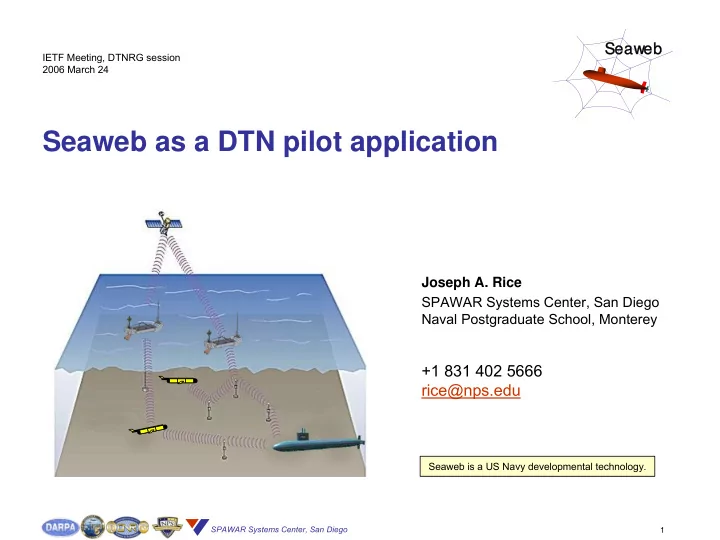
Enabling Undersea FORCEnet for cross-system, cross-platform, cross-mission, cross-nation interoperability Through-water digital com/nav networks Scalable wide-area wireless grid Composable architectural flexibility Fixed and mobile autonomous nodes Gateways to command centers Persistent and pervasive Low source level, wide band, high freq Integrated undersea applications Littoral ASW sensor telemetry (e.g., DADS) METOC sensor telemetry Sensor-to-sensor cueing Submarine comms @ S&D Submersibles (e.g., SDV) UUVs (e.g., Gliders, Ematt, etc) Sea mines (e.g., Sea Predator) Collaborative operations (e.g., Sea Eagle ACTD) Command & control Deployable ranges Sea base defense Harbor defense

  • J. Rice, “Enabling Undersea FORCEnet with Seaweb

Acoustic Networks,” Biennial Review 2003, SSC San Diego TD 3155, pp. 174-180, December 2003

slide-3
SLIDE 3

SPAWAR Systems Center, San Diego 3

Seaweb Seaweb

Seaweb repeater node

Seaweb telesonar modem, circa 2000-2005 Benthos, Inc. COTS hardware Texas Instruments TMS320C5410 DSP US Navy firmware Spectral bandwidth = 5 kHz (9-14 kHz) SL = 174 dB re 1 μPa @ 1m Modulation = MFSK 128 tones, 1 of 4 tones keyed Forward Error Correction Raw bit rate = 2400 bit/s Utility packets = 150 b/s Data packets = 800 b/s DI = 0 dB (omni) DI = 0 dB (omni)

  • K. Scussel, “Acoustic Modems for

Underwater Communications,” Wiley Encyclopedia of Telecommunications, Vol. 1,

  • pp. 15-22, Wiley-Interscience, 2003
slide-4
SLIDE 4

SPAWAR Systems Center, San Diego 4

Seaweb Seaweb Demonstrated capabilities:

FRONT ocean observatory

National Oceanographic Partnership Program FRONT-4 Jan-June, 2002 FRONT-3 March-June, 2001

  • D. L. Codiga, et al, “Networked Acoustic Modems for Real-Time Data Telemetry from

Distributed Subsurface Instruments in the Coastal Ocean: Application to Array of Bottom- Mounted ADCPs,” J. Atmospheric & Oceanic Technology, June 2005

Concept

slide-5
SLIDE 5

SPAWAR Systems Center, San Diego 5

Seaweb Seaweb

340 342 344 346 348 10 20 30 W ind speed (mph) 340 342 344 346 34 50 100 150 Correct receptions (%)

R = 0 .5 k m R = 1 .0 k m R = 1 .5 k m R = 2 .0 k m

Upward refraction in FRONT-1 caused strong dependence on the sea-surface boundary

Year-day BER=0 (%) S/N (dB) Wind (kts)

1 4 8 5 1 4 9 0 1 4 9 5 1 5 0 0 1 0 2 0 3 0 4 0 5 0

Depth (m) Depth (m) Range (m) Sound speed (m/s) BER=0 (%) S/N (dB) Wind (kts)

slide-6
SLIDE 6

SPAWAR Systems Center, San Diego 6

Seaweb Seaweb

NSW through-water link

Clandestine undersea connectivity to/from SDV and ASDS during expeditionary ops

20-m 60 80 40 60 40-m

Sea Eagle ACTD is demonstrating connectivity in littoral environments

slide-7
SLIDE 7

SPAWAR Systems Center, San Diego 7

Seaweb Seaweb

Seaweb 2005 NSW Experiment

February 2005, Panama City, FL SRQ link-layer mechanism NSMA (Neighbor Sense Multiple Access, a cross-layer variation on CSMA) Ranging and node localization Iridium-equipped Racom buoy SDV Periscope Controller Compressed image telemetry NPS, SSCSD, CSS, Benthos Engineering sea test for: DADS ASW Barrier Sea Eagle ACTD NSW Expeditionary Ops Sea Predator (2010 Mine) RECO

slide-8
SLIDE 8

SPAWAR Systems Center, San Diego 8

Seaweb Seaweb Demonstrated capabilities:

Seaweb network with UUVs

US/Canada collaboration Gulf of Mexico, Feb 1-8, 2003

6 fixed repeater nodes FreeWave radio links 3 glider UUV mobile nodes Shipboard command center Over-the-horizon command center 2 Racom buoy gateway nodes Iridium satellite radio links

Mobile gateway nodes Mobile sensor nodes 200 km logged by UUVs 300 hrs logged by UUVs Node-to-multinode comm/nav

UUV nose section

slide-9
SLIDE 9

SPAWAR Systems Center, San Diego 9

Seaweb Seaweb

Experimental DADS sensor node

Demonstrated capabilities:

FBE India

June 2001

  • J. Rice, et al, “Networked Undersea Acoustic Communications

Involving a Submerged Submarine, Deployable Autonomous Distributed Sensors, and a Radio Gateway Buoy Linked to an Ashore Command Center,” Proc. UDT Hawaii, October 2001

SSN with BSY-1 sonar Seaweb TEMPALT Ashore ASW command center Seaweb server at SSN and ASWCC Acoustic chat and GCCS-M links to fleet SSN/MPA cooperative ASW against XSSK Flawless ops for 4 continuous test days

Racom buoy

slide-10
SLIDE 10

SPAWAR Systems Center, San Diego 10

Seaweb Seaweb Seaweb message example:

Multi-Access Collision Avoidance (MACA) Internet Protocol (IP)

RTS CTS D A T A RTS R T S RTS C T S CTS CTS DATA DATA DATA

  • G. Hartfield, Performance of an Undersea Acoustic

Network during Fleet Battle Experiment India, MS Thesis, Naval Postgraduate School, Monterey, CA, June, 2003

slide-11
SLIDE 11

SPAWAR Systems Center, San Diego 11

Seaweb Seaweb Demonstrated capability:

Selective Automatic Repeat Request (SRQ) is a link-layer mechanism for reliable transport of large datafiles even when the physical layer suffers high BERs Node A Node B

RTS CTS HDR SRQ HDR SRQ HDR

  • 3. Node A transmits a

4000-byte Data packet using 16 256-byte subpackets, each with an independent CRC.

  • 4. Node B receives 12 subpackets successfully;

4 subpackets contained uncorrectable bit errors.

  • 5. Node B issues an SRQ utility packet, including

a 16-bit mask specifying the 4 subpackets to be retransmitted.

  • 6. Node A retransmits

the 4 subpackets specified by the SRQ mask.

  • 7. Node B receives 3 of the 4 packets

successfully (future implementation of cross-layer time-diversity processing will recover 4 of 4). B issues an SRQ for the remaining subpacket.

  • 8. Node A retransmits

the 1 subpacket specified by the SRQ.

  • 2. Node B is prepared to receive a large Data

packet as a result of RTS/CTS handshaking.

  • 1. Node A initiates a

link-layer dialog with Node B.

  • 9. Node B successfully receives and

processes Data packet.

  • J. Kalscheuer, A Selective Automatic Repeat Request

Protocol for Undersea Acoustic Links, MS Thesis, Naval Postgraduate School, June 2004
slide-12
SLIDE 12

SPAWAR Systems Center, San Diego 12

Seaweb Seaweb Current research

Adaptive modulation

Reconstruct transmitted waveform Estimate channel scattering function Map channel characteristics against available repertoires and signal techniques Final decision RTS Data CTS Node B Node A Demodulate RTS transmission Specify Data-packet comms parameters Determine h(τ, t ) / Doppler / SNR

  • S. Dessalermos, Undersea Acoustic Propagation

Channel Estimation, MS Thesis, Naval Postgraduate School, Monterey, CA, June 2005

slide-13
SLIDE 13

SPAWAR Systems Center, San Diego 13

Seaweb Seaweb Seaweb repeater nodes

COTS telesonar modem 9-14 kHz

180 dB re 1μPa @ 1m Alkaline batteries 1-man deployable Redundant acoustic releases Recoverable using RHIB $15K/node

TASWEX 04 Seaweb Plan Oct, 2004

slide-14
SLIDE 14

SPAWAR Systems Center, San Diego 14

Seaweb Seaweb

50m Cable Transducer 3/8” nylon Shackle Swivel 3/8” nylon Swivel 1/4” synthetic 3/8” SS wire Swivel 1/2” wire sling 700lb Chain

Cable scope ≈ 2.5 water depths

US Navy racom buoy

radio/acoustic communications gateway node 6 units built for TASWEX 04

ATM-885 Modem Power Management Battery Pack Iridium PC-104 microprocessor GPS & Freewave (not shown) End cap

Staging Deployment (6-8 minutes) Assembly

Note: Other racom configurations exist, including pop-up buoys and expendable

  • buoys. Mooringless, energy-harvesting station-keeping USVs are now in

development as next-generation racom buoys through SBIR topic N05-077.

slide-15
SLIDE 15

SPAWAR Systems Center, San Diego 15

Seaweb Seaweb

Seaweb 2004 Undersea Vehicle Experiment cellular grid deployment

Average speed 6.5 knots Average 1 repeater every 20 min

slide-16
SLIDE 16

SPAWAR Systems Center, San Diego 16

Seaweb Seaweb

Seaweb 2004 grid post mortem

Impacted by trawling along the 300-m isobath 3 nodes removed, 6 nodes displaced or damaged COMEX FINEX FINEX

  • H. Kriewaldt, Communications Performance of an

Undersea Acoustic Wide-Area Network, MS Thesis, Naval Postgraduate School, December 2005

slide-17
SLIDE 17

SPAWAR Systems Center, San Diego 17

Seaweb Seaweb

104 111 61 56 56 264

50 100 150 200 250 300 Undersea Vehicle transmissions Ship receptions Ship transmissions Undersea Vehicle receptions Undersea Vehicle returned receipts Ship received receipts

Seaweb 2004 Experiment

Undersea Vehicle initiates the Seaweb sessions

Initiating message Response message Return receipt Seaweb transport-layer success

Undersea Vehicle Ship Undersea Vehicle

Seaweb transport-layer statistics show solid performance with dropped messages attributable to UV limited aspect, UV fix- expansion uncertainty, and interference from other UV active sonar

Ship

slide-18
SLIDE 18

SPAWAR Systems Center, San Diego 18

Seaweb Seaweb

Unet 2006 Sea Trial

May 2006, Nova Scotia

Site selection criteria 50-300 m waters 20 km x 40 km oparea < 3 days from port “Benchmark” site useful for follow-on experiments