
SLIDE 1
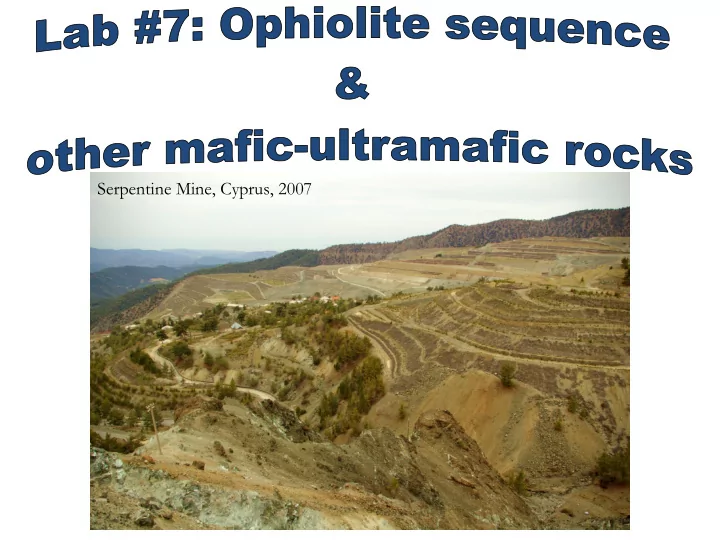
Serpentine Mine, Cyprus, 2007
Serpentine Mine, Cyprus, 2007 What is an ophiolite? Simply: - - PowerPoint PPT Presentation
Serpentine Mine, Cyprus, 2007 What is an ophiolite? Simply: Ophiolites are pieces of oceanic crust found on land The international ophiolite conference restricted the term ophiolite to only include the following rock
Serpentine Mine, Cyprus, 2007
restricted the term “ophiolite” to only include the following rock types/assemblages
recently due to recent discoveries made by the IODP
Anthophyllite: (Mg,Fe)2 (Mg,Fe)5 SiO22 (OH)2 Gedrite: (Mg,Fe)5 Al2 [Al2 Si6 O22 (OH)2 ]
not in igneous rocks. Amphiboles are hydrous minerals which break down in anhydrous environments.
magmas have little dissolved water. The amphiboles will break down to form pyroxenes instead.
– Orthoamphiboles have parallel extinction – Maximum interference colours of first order red and second order blue – Brown color of orthoamphibole may be useful in distinguishing it from hornblende, which usually has a green-black color
(Ca,Na,Fe,Mg)2 (Mg,Fe,Al)5 (Si,Al)8 O22 (OH)2
Name given to an amphibole with an indeterminate composition Ubiquitous mineral in intermediate igneous rocks and amphibolite facies metamorphism
Ca-rich amphiboles are most common in greenschist-amphibolite facies metamorphism (i.e. meta-carbonates)
Tremolite: Ca2 Mg5 Si8 O22 (OH) 2
White colour in HS; maximum interference colours are upper 1st order; inclined extinction; large 2V (75-88)
Actinolite: Ca2 (Mg,Fe)5 Si8 O22 (OH)2
Pale-deep green; negative optic sign
Commonly found in mafic metamorphic rocks at intermediate pressures and temperatures
Cummingtonite: (Mg,Fe)7 Si8 O22 (OH)2
Inclined extinction, twins and higher birefringence distinguish from orthoamphiboles; positive optic sign and
Grunerite: Fe7 Si8 O22 (OH)2
Subtle pleochroism when compared to cummingtonite
Mg3 Al2 Si8 O22 (OH)2
Only found in metamorphic rocks (i.e. Blueschist facies) Distinct pleochroism (colourless-medium blue)