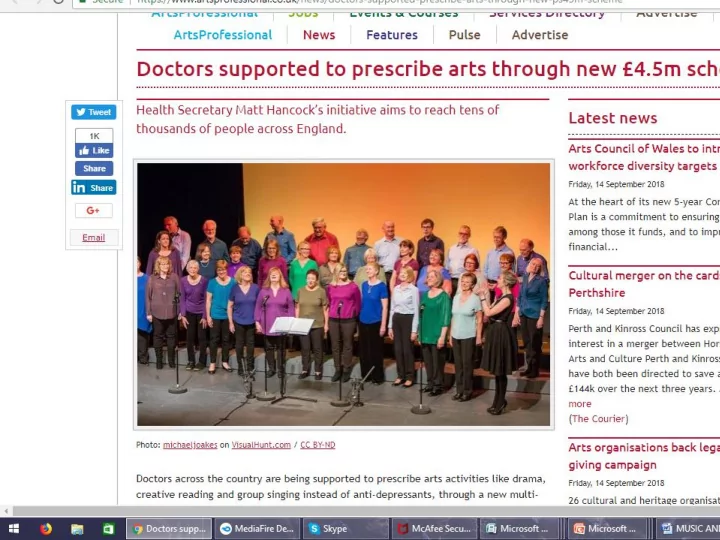
Severe mental health issues were on the rise, there were 6,000 - - PowerPoint PPT Presentation

severe mental health issues were on the rise there were 6
SMART_READER_LITE
LIVE PREVIEW

Severe mental health issues were on the rise, there were 6,000 - - PowerPoint PPT Presentation

Severe mental health issues were on the rise, there were 6,000 suicides in the UK every year, and 10% of children had a diagnosed condition. Anti-depressant prescriptions doubled between 2006 and 2016 and detentions under the mental health act


slide-1
SLIDE 1
slide-2
SLIDE 2

"Arts and Minds" revealed those undertaking an arts-based interventions reported 71% decrease in feelings of anxiety 73% fall in depression 76% of participants said their wellbeing increased 69% felt more socially included. Severe mental health issues were on the rise, there were 6,000 suicides in the UK every year, and 10% of children had a diagnosed condition. Anti-depressant prescriptions doubled between 2006 and 2016 and detentions under the mental health act were also on the rise.

slide-3
SLIDE 3
  • In 2018 the CBI President Paul Drechsler called
  • n policymakers to prioritise teaching that

encourages creativity and teamwork

slide-4
SLIDE 4

Musical Activities Programme (MAP)

For supporting children with dyslexia

slide-5
SLIDE 5

Dyslexia & Music

  • Children with dyslexia can have difficulties with rhythm

production tasks as well as with language skills (e.g. Thomson & Goswami, 2008)

  • Performance on rhythm production tasks is linked with

performance on phonological, reading and spelling tasks (e.g. Flaugnacco et al., 2014)

  • A recent MAP study found that 15 weeks of classroom-

based rhythm games with children with dyslexia significantly improved their phonological and literacy skills (Moore, Branigan & Overy, in prep)

slide-6
SLIDE 6
  • Evidence suggests that musical learning can promote structural and functional

changes in the brain (e.g. Tervaniemi, 2009; Moore et al., 2014)

  • Evidence suggests that music and language are processed in similar, as well as

distinct regions of the brain (e.g. Patel, 2010, Koelsch, 2012)

  • Evidence suggests that joint music-making can have a positive impact on social

skills and feelings of well-being (e.g. Kirschner & Tomasello, 2010, MacDonald et al., 2012)

  • Evidence suggests that other conditions related to timing issues in the brain will

see similar improvements from active music learning (Slater & Tate 2018)

  • A strong, highly specific relationship was found between knowledge of nursery

rhymes and the development of phonological skills, which remained significant when differences in IQ and social background were controlled. (Maclean et al., 1987)

slide-7
SLIDE 7

Overy 2013

  • Participants in the singing condition showed

superior overall performance on a collection

  • f Hungarian language tests after the 15-min

learning period, compared with participants in the speaking and rhythmic speaking conditions.

  • These results suggest that a “listen-and-sing”

learning method can facilitate verbatim memory for spoken foreign language phrases.

slide-8
SLIDE 8
  • “The frightening lack of music in our

curriculum, indeed the definite anti-music tendency, is gravely detrimental to the education of the nation, too.” - Zoltan Kodály

slide-9
SLIDE 9
  • Headteachers sometimes unaware of benefits, but more often feel

constrained by hurdles.

  • Patchy - at the whim of headteachers – academies can opt out,
  • Too easy to box-tick, no quality control, very low expectations
  • Skills shortage in the profession.
  • How do we differentiate between expensive, low-quality

commercial packages, and high quality music education?

  • Cuts
  • “Ca*****ls”
  • “Cold Spots” – unreachable schools.
  • 2-6 hours given to music on ITE courses.
slide-10
SLIDE 10

How I was taught music

Presenting everything at once. Pointing out all the mistakes Drilling – practise makes perfect Music for the few. Racing through exams. Writing about Music Stay Still! “Woodshedding” alone 

slide-11
SLIDE 11

“The purpose of music is not that it should be judged, but that it should become our substance”

slide-12
SLIDE 12

Music is for Everyone

  • Musically “literate” – able to read, write,

aurally dictate, compose and improvise.

  • Instilled with life-long musical literacy.
slide-13
SLIDE 13

The Whole School Approach

  • Miminim 3 sessions per week for every class.
  • Daily Singing.
  • Musical Routines.
  • Using music in other lessons.
  • Whole staff development with a primary

music specialist – everyone a musician.

  • Playground music leaders.
  • Training support staff for SEN
slide-14
SLIDE 14
  • Extra curricular clubs every lunchtime and

after school.

  • Music Assembly with weekly visiting

musicians.

  • 2 school choirs.
  • 2 music specialists
slide-15
SLIDE 15
  • Special measures to recommendation for Outstanding

in 5 years.

  • Our results for disadvantaged pupils are well above

average.

  • SATS results spectaluarly above the national average
  • Attendance improved from 92% to 98%
  • 98% speak English as a second language at home
  • We are now in the top 1% of schools for pupil progress.
  • Nominated for TES Primary School of the Year 2018.
slide-16
SLIDE 16
slide-17
SLIDE 17
  • A shift in thinking to value active music making as a

“core” subject, essential for multiple deveopmental reasons.

  • Sustained training and high expectations.
  • CPD in methodology and musicianship for existing,

non-specialist music co-ordinators.

  • Systemic change to schools framework to enable and

empower schools to thrive musically –

  • Schools to be responsible and accountable for the

quality of their music programmes and progress of children.

  • 2020 NPME

Lets do this properly

slide-18
SLIDE 18

Let’s do this together