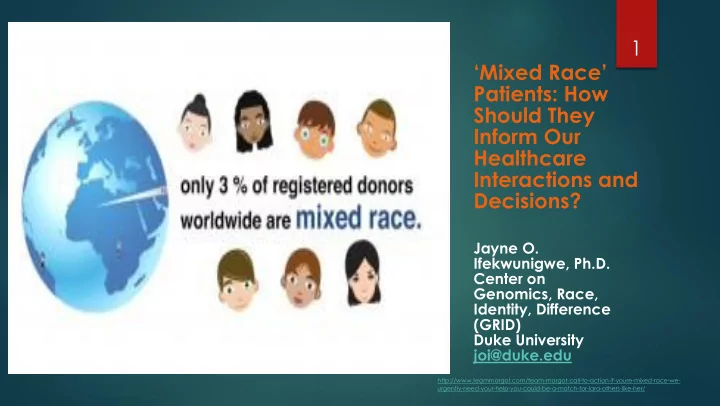
SLIDE 1 Jayne O. Ifekwunigwe, Ph.D. Center on Genomics, Race, Identity, Difference (GRID) Duke University joi@duke.edu
http://www.teammargot.com/team-margot-call-to-action-if-youre-mixed-race-we- urgently-need-your-help-you-could-be-a-match-for-lara-others-like-her/
‘Mixed Race’ Patients: How Should They Inform Our Healthcare Interactions and Decisions? 1
SLIDE 2 Three Presentation Objectives
1)
to provide an
the interdisciplinary concept of ‘mixed race’ and illustrate the ways in which this global, historical and political idea is neither new nor fixed
2) to define and critique contemporary
‘mixed race’ categories, identities, and studies
3) to engage with ‘mixed race’ identities
and categories as lived experiences and as they pertain to healthcare interactions and decisions
2
SLIDE 3 Important Caveats: Paradoxes of ‘Mixed Race’
As long as modern humans have populated the earth
and migrated within and across continents, inter-group mating and marriages have been inevitable and commonplace.
There are no discrete or pure biological ‘races’. There is more genetic variation within a group socially
designated as a race than between groups socially identified as different races.
Yet,
the idea
‘mixed race’ persists and in fact continues grow in spite
the fact that genetic explanations for ‘racial’ differences have been contested.
3
SLIDE 4
Abbreviated Working Definition of ‘Mixed Race’
Like ‘race’, ‘mixed race’ is also an historical, social, cultural and political construct, which does not travel easily. 4
SLIDE 5
Abbreviated Working Definition of ‘Mixed Race’ (cont.)
Social applications of the term ‘mixed race’ highlight the paradoxes of kin and color and tensions between complex familial identifications and lived experiences versus simplistic and superficial public designations.
5
SLIDE 6 Tashiro’s 5 Dimensions of Multiracial Identity
1) Cultural Identity
How the individual internalizes cultural core values influenced by family and community experiences
2) Ascribed Racial Identity
How one is racially identified and labeled by
- thers based on physical appearance or
phenotype
Tashiro, Cathy J. (2012) Standing on Both Feet: Voices of Older Mixed Race Americans, Boulder, Co: Paradigm, pp. 63-64.
6
SLIDE 7 Tashiro’s 5 Dimensions of Multiracial Identity (cont.)
3) Racial Identification to Others
How one labels oneself publicly, both on
- fficial forms and in response to others’ social
demands for categorization
4) Racial Self-Identification
An individual’s internal sense of who they are
5) Situational Racialization of Feeling
How different contexts bring out different aspects or “sides” of one’s identity or heritage
7
SLIDE 8
Genesis of Almost 30 Years of Ongoing Comparative and Global Research on ‘Mixed Race’ Global ‘mixed race’ identities, categories and politics are embedded in my own multiethnic, multiracial and multinational family background and upbringing. I was born in London, England to an Irish/English/Guyanese mother and an Igbo/Nigerian father and spent three childhoods in England, Nigeria and Los Angeles, California.
8
SLIDE 9
My Maternal Grandparents
Married in 1925 Lionel Freeman (in the British Merchant Navy) (from Le Guan, Guyana) Mary Freeman ( from South Shields, England) 9
SLIDE 10 My Paternal Grandparents Nando, Onitsha, Nigeria Summer, 1976 Chief Aaron Nsiegbuna Ifekwunigwe Florence Ugoye Ifekwunigwe
10
SLIDE 11 My Parents Onitsha, Nigeria Circa 1959
Ifekwunigwe and
Ifekwunigwe
11
SLIDE 12
Serendipitous Doctoral Dissertation Project
My intellectual interest in global ‘mixed race’ identities, categories and politics was serendipitously created for me while initially conducting doctoral dissertation ethnographic research in Bristol, England on transformations of political consciousness for British-born youth of immigrant parents.
12
SLIDE 13 Scattered Belongings (Routledge, 1999) was based
ethnographic field work in Bristol, England with a multi- generational cohort of 25 ‘mixed race’ adults on ‘mixed race’, identities, families and memories. Across space and time, the study highlighted the shifting and gendered dynamics of British ‘race’ relations. 13
SLIDE 14 My next research project (Routledge, 2004) specifically focused on North America and traced the interdisciplinary evolution of ‘mixed race’ as an intellectual idea and a social
the 19th to the 21st century, it identified three ‘ages’: the age of pathology, the age of celebration and the age of critique.
14
SLIDE 15 18th and 19th Century Age of Pathology: Miscegenation and Moral Degeneracy ideological and pseudo- scientific belief that interbreeding across ‘racial’ borders would threaten the assumed purity and supremacy
race’
http://56608592.weebly.com/an
miscegenation.html
15
SLIDE 16
20th (and 21st Century) Age of Celebration actor-centered conceptual and biographical approaches which presume that ‘mixed race’ identities are fluid, shifting, contingent, situational and complex
16
SLIDE 17 20th and 21st Century Age of Critique In popular and scholarly discourses, ‘mixed race’ categories, identities and politics continue to be contested and debated, particularly as they extend beyond ‘black and white’ and pertain to the Census and social justice issues.
https://escholarship.org/uc /ucsb_soc_jcmrs
17
SLIDE 18 Rules of Global ‘Mixed Race’
In the global context, in different societies, which were or are differentially organized on the bases of specific hierarchical ‘race’/color systems and hierarchies, there are specific rules or statuses, which determine the social positions and lived experiences
individuals socially designated and/or self-identified as ‘mixed race’. Status is frequently defined in a relational fashion based on
- ne’s phenotypic “proximity” to whiteness.
18
SLIDE 19 Global Racial Hierarchies and White Hegemonies
https://ars.els- cdn.com/content/image/ 1-s2.0-S1090952403000317- gr1.gif
19
SLIDE 20 ‘Mixed Race’ Communities, Gender, Labor, and Migration
Global ‘mixed race’ individuals and communities in particular local geographical contexts are produced by specific sets
gendered historical, economic and political circumstances.
20
SLIDE 21 INDIA A “buffer community”, Anglo- Indians: products of white British fathers (employees of British Empire i.e. British East India Company) and local Indian women; from 18th century to late 19th century; when white women began to arrive; mixture of British and Indian parentage
http://news.bbc.co.uk/2/hi/south_asia/6932623.stm
21
SLIDE 22 AUSTRALIA “The Stolen Generation” From the 1800s to the 1970s, “half- white”Aboriginal children were removed from homes and raised in boarding schools or fostered by white families.
http://i.imgur.com/bvmyR.jpg
22
SLIDE 23 VIETNAM Vietnam War (1964-1975) Babies
- r “Children of the Enemy”
Born to Vietnamese mothers and U.S. fathers, who were servicemen or civilians stationed in Vietnam
http://a142.idata.over-blog.com/500x348/2/43/23/13/after-the- rain/nuo/005.jpg
23
SLIDE 24 SOUTH SHIELDS, ENGLAND, UK
“Geordie-Yemenis” Yemeni sailors first arrived as early as 1860 and began inter-marrying with local English women. The British-Yemeni community is now 6 generations deep.
http://www.theyemeniproject.org.uk/content/pages/img/integration_image1.jpg
24
SLIDE 25 Dictates that the offspring
- f a ‘Black’ and a ‘White’
union takes on the ‘racial’ identity of the ‘subordinate’ parental group. In particular, one known and ‘visible’ Black/African ancestor designates a person as Black
http://affability.files.wordpress.com /2011/05/obamamom1.jpg
The American One Drop Rule and its Cultural Paradoxes 25
SLIDE 26 Predominance of Black/White Discourses on ‘Mixed Race’
Much popular and scholarly emphasis is placed
the binary black/white dynamics of socially defined races, inter- racial relationships/ marriages, and the
- ffspring of these unions as this dialectic
emerged from a particular set
historical, economic and political circumstances, including the subjugation
- f people of African descent during and
after enslavement.
26
SLIDE 27 Charmaran, Linda et al. (2014)”How Have Researchers Studied Multiracial Populations?: A Content and Methodological Review of 20 Years of Research,” Cultural Diversity and Ethnic Minority Psychology 20 (3): 336-352.
[Since 2000] “Racial categories have changed
- ver the course of census-taking in the United
States, with implications for defining and counting racial mixtures” (Charmaraman et al. 2014: 337).
There is a lack of academic and popular
consensus about which terminology (i.e. ‘mixed race’, biracial, multiracial, mixed parentage, etc.) to use.
There is a great deal of diversity between and
among various ‘mixed race’ sub-groupings. 27
SLIDE 28
Current Size of U.S. ‘Mixed Race’ Population Pew Research Center (2015) Multiracial in America: Proud, Diverse and Growing in Numbers, Washington, D.C. 28
SLIDE 29
3 Examples of ‘Mixed Race’ Healthcare Implications and Decisions
1) Clinical Interactions 2) Categories and Patient Intake
Forms: “What is Your Ancestry?”
3) Bone Marrow Donors and
Transplants
29
SLIDE 30 ‘Mixed Race’ and Health: Uncharted and Challenging Territory
In healthcare, self-reported ‘race’ is frequently treated
as a proxy for genetic explanations instead of either ancestry or social determinants of health, such as environmental or social factors i.e. education, poverty,
- r access to health insurance.
Very
little is know about the longitudinal health
- utcomes of ‘mixed race’ individuals or populations, in
part, because prior to 2000, when the US Census provided an opportunity for individuals to identify as more than one ‘race’, we did not know who these people were.
30
SLIDE 31
Screen “Mixed Race America and the Future of Health” TEDxUIUC Talk by Karen Tabb Dina (6:05-11:46) https://www.youtube.com/watch? v=cWAQzD5wcFc
31
SLIDE 32 “What is Your Ancestry?”: Project RACE (Reclassify All Children Equally) Sample Medical Questionnaire
MEDICAL RACIAL AND ETHNIC BACKGROUND QUESTIONNAIRE It is vitally important to the health of every individual that as much racial and ethnic information as possible is collected. There are diseases that are more likely in certain racial and ethnic groups. Researchers need to be able to promote studies that look at people of multiracial and/or multiethnic heritage, which will benefit all of society. Please take the time to fill in what you know about your or your children’s background. For each member of your family listed below, please indicate their racial and/or ethnic origins (if known). For multiracial people please list as many as necessary.
32
SLIDE 33 Project RACE Sample Questionnaire (cont.)
Please fill in letter and number combinations: _______ The racial and ethnic background(s) I consider myself to be. ________Mother _________Father ________Maternal Grandmother _________Paternal Grandmother ________Maternal Grandfather _________Paternal Grandfather ________Maternal Great Grandmother _________Paternal Great Grandmother ________Maternal Great Grandfather _________Paternal Great Grandfather
33
SLIDE 34 Project RACE Sample Questionnaire (cont.)
From A to E, there are Five Major Census Categories Each with Multiple Sub-Categories of Ancestry or Ethnicity
1) Asian/Pacific Islander 2) Black/African-American 3) Hispanic/Latino 4) American Indian/Alaska Native 5) White/Caucasian
34
SLIDE 35 Project Race Sample Questionnaire : Sub-Categories of Ancestry or Ethnicity
- B. Black/African-American
B-1 North African B-2 Black or African American B-3 Caribbean B-4 Central American B-5 South American B-6 Sub-Saharan African Black or African American racial or ethnic designations that do not appear above: B-7_________________________________ B-8_________________________________
35
SLIDE 36 Project Race Sample Questionnaire : Sub-Categories of Ancestry or Ethnicity
- D. American Indian or Alaska Native
D-1 American Indian D-2 Alaska Native American Indian or Alaska Native racial or ethnic designations that do not appear above: D-3____________________________ D-4____________________________
36
SLIDE 37 Modification of Project RACE Sample Questionnaire
Project Race’s Sample Form is a very Important step in
the right direction. If I were to modify ALL of the sub- categories, I would provide individuals with the
to include/write-in more fine-tuned and specific ethnicities, such as Senegalese for (B7) and Cherokee for (D3).
In other words, at the end of the list of sub-categories, I
would provide patients with the option of writing in a specific ethnicity similar to the “any other race” option
37
SLIDE 38
2010 Census: Any Other Race Question https://www.census.gov/ne wsroom/releases/archives /2010_census/cb12- 146.html 38
SLIDE 39 Mixed Marrow Project
Began as a response to the need for outreach due to both the lack of public knowledge as well as the paucity of registered donors for ‘mixed race’ individuals. They are dedicated to finding bone marrow and blood cell donors for these ‘mixed race’ patients.
Mixedmarrow.org
39
SLIDE 40 “Mixed Match is an important human story told from the perspective of mixed race blood cancer patients who are forced to reflect on their multiracial identities and complex genetics as they struggle with a nearly impossible search to find bone marrow donors, all while exploring what role race plays in medicine.”
http://mixedmatchproject. com/
40
SLIDE 41
Screen “Mixed Match” Documentary (2:30 minutes) https://vimeo.com/179551767
41
SLIDE 42 ‘Mixed Race’ Identities, Multiple Ancestries, Social Categories and Healthcare Interactions: My New Qualitative Research Pilot Study
Utilizing
both quantitative and qualitative research methodologies, the aim of this pilot study is to understand how healthcare interactions are related to both the complexities
- f individual interpretations of ‘race’, ‘mixed
race’, and multiple ancestries as well as dynamic perspectives
identities, kinships, families and lived experiences. 42
SLIDE 43
Concluding Points
1) We cannot assume that we know anything about someone’s lived experiences by simply “reading their phenotype”. Ask people about their families and their growing up experiences!
43
SLIDE 44 Concluding Points 2) As potent constructs and categories, neither ‘race’ nor ‘mixed race’ travels easily. We have to understand the complex and specific histories
societies
the bases
hierarchical and gendered ‘race’/color systems and how they have influenced
- fficial and popular categorizations of
‘race’ and ‘mixed race’.
44
SLIDE 45
Concluding Points
3) Across time, within different social contexts, and across generations within families, shifting self-identification represents both the multi-dimensional as well as the situational nature of identity for ‘mixed race’ individuals.
45
SLIDE 46 Concluding Points
4) How ‘mixed race’ individuals self-identify and/or are identified by
including medical practitioners, can influence psychological well-being and health.
46
SLIDE 47 Concluding Points
5) Rather than eliminating ‘race’, which is an important political, demographic and epidemiological monitoring category, probing deeper to enquire about the multiplicity
ethnicities and ancestries may yield more accurate results.
47
SLIDE 48
Concluding Points
6) The unique and complex characteristics of ‘mixed race’ families and individuals make them relevant and important subjects for clinical trials and health disparities research.
48
SLIDE 49
8 Concluding Points
7) Across the life course, we need to examine the similar and differential ways in which ‘mixed race’ individuals interpret ‘race’, ‘mixed race’, multiple ancestries, and genetic information and how these may affect social identities and health.
49
SLIDE 50 Concluding Points
8) Rethinking how we interact with and care for ‘mixed race’ patients is not simply about addressing diversity and inclusion
inter-cultural competence, it can be a matter
50
SLIDE 51 www.mixedracestudies.org Mixed Race Studies: Scholarly Perspectives on the Mixed Race Experience Excellent, Comprehensive and Interdisciplinary Online Resource and Database
http://www.mixedracestudies.org/?tag=sickle-cell- anemia
51
SLIDE 52
Thank you! joi@duke.edu
52