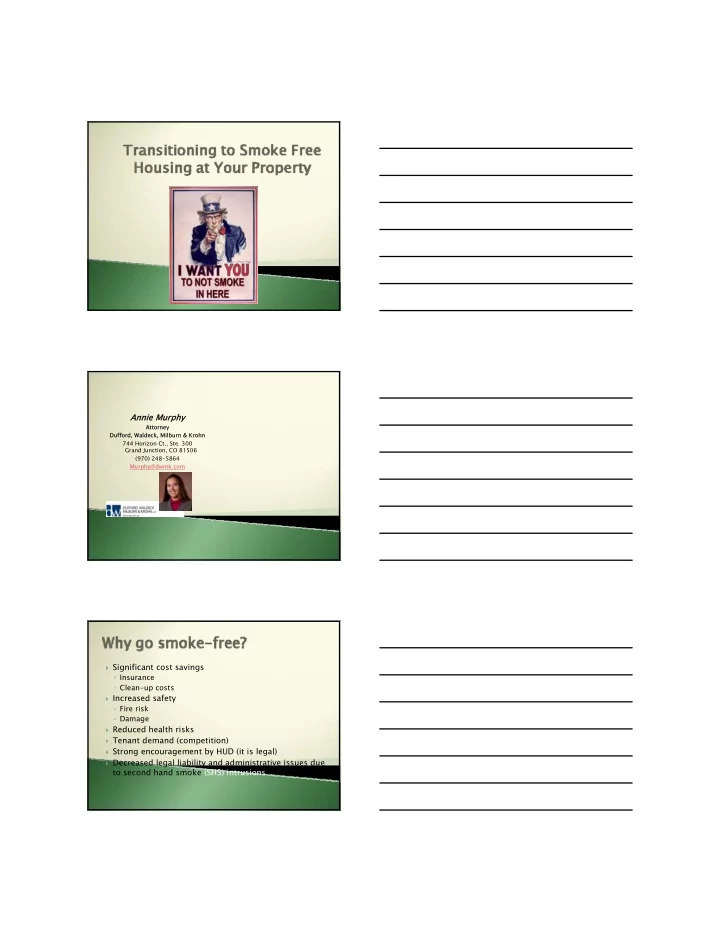
Significant cost savings Insurance Clean-up costs Increased - - PDF document

significant cost savings
SMART_READER_LITE
LIVE PREVIEW

Significant cost savings Insurance Clean-up costs Increased - - PDF document

Annie Murphy Annie Murphy Attorn Attorney Du Dufford, fford, Walde Waldeck, Milbu k, Milburn & Kroh & Krohn 744 Horizon Ct., Ste. 300 Grand Junction, CO 81506 (970) 248-5864 Murphy@dwmk.com Significant cost savings


slide-1
SLIDE 1

Annie Murphy Annie Murphy

Attorn Attorney Du Dufford, fford, Walde Waldeck, Milbu k, Milburn & Kroh & Krohn 744 Horizon Ct., Ste. 300 Grand Junction, CO 81506 (970) 248-5864 Murphy@dwmk.com Significant cost savings

  • Insurance
  • Clean-up costs

Increased safety

  • Fire risk
  • Damage

Reduced health risks Tenant demand (competition) Strong encouragement by HUD (it is legal) Decreased legal liability and administrative issues due

to second hand smoke (SHS) intrusions

slide-2
SLIDE 2

Reduce the costs of excessive wear and tear: cleaning

and repairing carpets, furniture, fixtures, window treatments, priming and painting walls, and general maintenance

Lower utility bills and decrease the use of air-

treatment systems — 30% less according to estimates by Marriott Hotels

Lower insurance premiums may be possible,

negotiate with your insurance provider

Improves property values because there is less

damage caused by smoking and discarded cigarettes

Maintenance costs even less when the policy covers

the entire grounds

Non-smoker’s unit renovation= $860 Cost of recent renovation of a “smoker’s unit”

  • Labor

$1,842

  • Material

679 Total Co $2,521

  • Also see “Maintenance Corner”, p. 2 of HUD 2009

newsletter attached to your materials

slide-3
SLIDE 3
  • Th

The N e Nati tional Fi Fire P Protec ecti tion A Agenc ency a and Colora rado S State Fi e Fire C Chief’s s As Association sociation provide provide th the follow following facts: facts:

  • Cigarettes are a leading cause of home fire fatalities in the United States, killing

700 to 900 people per year (smokers and non-smokers).

  • Cigarettes cause an average of 5% of Colorado residential fires.
  • In 2006, in Colorado, residential fires caused 39% of all residential fire fatalities,

7% of residential fire injuries, and 3% of all residential property loss.

  • Mattresses and bedding, upholstered furniture, and trash are the items most

commonly ignited in smoking-material (such as cigarette, cigar or pipe) home fires.

  • There were 82,400 smoking-material structure fires in the United States in 1985.
  • The risk of dying in a home structure fire caused by smoking materials rises with
  • age. Between 2002 and 2005, one-third (34 percent) of fatal smoking-material

fire victims were age 65 and older. Protect the health of your residents and workers — including

staff and maintenance. The Su e Surg rgeon Gen n General ral has s dete term rmine ined the f e follow llowing:

  • The

There is no Ris e is no Risk-F

  • Free l

ree level of l of exp exposu sure t re to Sec Second ndhand Smok Smoke. e.

  • Secondhand smoke causes lung cancer and contains more than

50 chemicals that can cause cancer. Secondhand smoke causes heart disease.

  • Secondhand smoke causes acute respiratory effects such as

triggering cough, phlegm, wheezing and breathlessness.

  • Secondhand smoke can cause sudden infant death syndrome and
  • ther health consequences in infants and children. Exposed

children are at an increased risk for acute respiratory infections, ear problems and more severe asthma.

  • Lung growth in children is slowed by smoke from parent’s

cigarettes.

  • Separa

parating smo ting smoker ers fro s from non- non-smoke smokers, s, cleani cleaning th ng the air and e air and ven ventilati ilating buil ng building dings ca s cannot elimi nnot eliminat ate secon e secondhand s nd smoke

  • ke

exp exposure. Selling point for renters (83% of Coloradans

do not smoke)

Increasing number of complaints about SHS

infiltration in multi-unit dwellings

Considerable number of residents with

chronic diseases, such as asthma and cardiovascular disease, who are particularly vulnerable to the effects of SHS
slide-4
SLIDE 4 10

84% do not allow

smoking inside their

  • wn dwellings.

Only 12% smoke

inside regularly.

85.4% of Colorado households reported having smoke-free home rules (2008 state survey).

In Colorado, more than 1,500 multiunit

residential communities with 45,000 units have 100% no-smoking policies indoors. View the current list at www.mysmokefreehousing.com

27 Colorado Housing Authorities have

implemented or are phasing in no-smoking policies!

  • 600+ buildings
  • 4,500+ units

The U.S. Department of Housing and Urban

Development strongly encourages Public Housing Authorities to implement no- smoking policies in some or all of their public housing units. July 2009.

HUS again encourages owners and

management agents to implement smoke- free housing policies in some or all of the properties they own or manage. September 2010.

slide-5
SLIDE 5

No-smoking policies are legal in all 50 states The Colorado Clean Indoor Air Act of 2006,

for example, allows landlords to make any part of their property nonsmoking and prohibits smoking in all indoor common areas (CRS 25-14-206)

There is no constitutional “right to smoke” Smokers are not a specially protected class of

persons

“Currently, there are no statutory or regulatory

provisions governing smoking in Section 8 project- based subsidized properties. Owners of such properties are required to comply with applicable state and local laws, which would include any laws governing cigarette smoking in residential units and in common areas.

  • However, owners may adopt reasonable house rules

that are related to the safety and habitability of the building and comfort of the residents. It is at the

  • wner's discretion to determine if a smoke-free

policy would be applicable to their property.”

  • Marcie D. LaPorte, Director, Denver Multifamily Hub at

HUD

Spend less time dealing with smoking-related

complaints

Spend less time and money in dealing with SHS-

related reasonable accommodation requests

Landlords who continue to allow smoking on their

property face potential lawsuits from residents exposed to SHS

State courts have ruled against apartment owners

under various legal theories, such as breach of warranty of habitability, private nuisance, breach of covenant of quiet enjoyment and constructive eviction

slide-6
SLIDE 6

Save on unit turnover costs Eliminate one fire risk Protect tenants/children from

dangerous 2nd hand smoke

Possible Tax – credit

incentives for smoke-free affordable housing

Possible insurance savings

Survey residents and consult resident board Talk to other landlords Educate residents Develop policy Communicate policy terms Set up enforcement protocol Advertise policy Provide information about quitting smoking Visit mysmokefreehousing.com for sample

surveys

Physical survey posted on each tenant door

with easy return instructions in hopes of getting good response.

Follow-up with education with newsletter, Q

and A sessions, one-on-one sessions.

slide-7
SLIDE 7

Consult with resident board before adopting

non-smoking policy

Powerful allies: get resident board on your

side and use them as a tool to garnish support for policy

Peer pressure

  • Anxiety

OK to smoke in your family Socially Accep cially Acceptabl able

  • 9. If your building, including all individual units, became non-

smoking, what would you do? a.I/we prefer to live in a smoke-free building b.I/we would smoke outside c.I/we would consider moving d.I/we would try to quit smoking e.Other

slide-8
SLIDE 8

What did they do What was the tenant response How was it implemented What did they wish they had done differently How is the policy enforced There is no risk-free level of exposure ot SHS SHS cannot be controlled using ventilation or

air-cleaning systems. Up to 50% of the air in multiunit housing may be re-circulated throughout an entire building

The only means of effectively eliminating the

health risk associated with indoor exposure is to ban smoking activity

It is not

is not about the Smoker

It is

is about the Smoke, the fire and the litter

slide-9
SLIDE 9

How (House Rules/Lease) Purpose Definitions Who does policy apply to Include all indoor areas and units Designate an outdoor smoking area Consider a grandfather clause Set an absolute quit date Revise lease and/or house rules Considerations:

  • HUD Lease? – Difficult to amend
  • House Rules – Notice Requirements (see HUD

memo)

  • Look at Lease to determine whether a notice

provision exists for changes/amendments to lease

Safety Health Economics Encouragement from HUD Resident demand

slide-10
SLIDE 10

The term “smoking” means inhaling,

exhaling, breathing, burning, carrying, or possessing any lighted cigar, cigarette, pipe,

  • r other similarly lighted product in any

manner or in any form.

Current residents Prospective residents All household members Guests Staff

Owners are not restricted from establishing smoke-free

buildings, wings, floors, units, etc.

Policy must address: smoking in a tenant’s unit, common

areas, playground areas, areas near any exterior window or door, and areas outside a tenant’s unit

Consider the layout of the property.

  • Example: Smoking shall not be permitted anywhere inside

Walnut Park buildings including individual apartment units and balconies, entryways, and all common areas such as hallways, restrooms, elevators, stairways, laundry rooms, and all openings to the building including window and door openings.

slide-11
SLIDE 11

Involve residents in this process Designate specific smoking areas and identify these

areas with clear signage (unless a totally smoke-free policy is established)

Example:

  • Smoking outside the buildings shall be limited to

individual patios and specific area(s) as designated on the attached site map and as identified with signs. Smoking shall not be permitted in any other outside areas of the property, including yards, all common areas, entry ways, playground areas, parking lots, and

  • penings to the building (e.g. windows and doors).

HUD’s policies do not require the

grandfathering of any resident

Local and state laws in Colorado do not

address this issue

A grandfather policy must be clearly defined Recommendation: implement policy upon

lease renewal or on an established policy- change date

Allow enough time for required public

notice/advertising

Allow time for the minimum 60 day notice

requirement

Consider the weather when setting the quit

date – it is easier to accept smoking outdoors if the weather is pleasant.

Phase-in time should be no longer than six

months

slide-12
SLIDE 12 Example:
  • a. Effective on [ef

[effectiv ective d date te of

  • f the Policy],

the Policy], all current residents, all employees, all guests, and all new residents of Walnut Park Apartments will be prohibited from smoking anywhere in the building, including in apartment units.

  • b. Any current resident as of [e

[effe ffectiv ctive date date of th

  • f the policy]

policy] who is a smoker and who wishes to continue smoking in Resident’s individual unit must complete a temporary smoking exemption form which will allow resident to smoke in Resident’s individual apartment and in the designated smoking area(s) only. This exemption will continue only until the date of Resident's lease renewal, or until 90 (ninety) days after the adoption date

  • f this Policy, whichever time is longer.
  • c. ALL RESIDENTS will be required to comply with this Policy, regardless of

their move-in date on [si six mo months nths from effective date of Policy].

Implementation

  • New tenants

Policy (House Rules) must be provided to all new tenants

  • Existing tenants

Existing tenants must be notified of House Rule modifications 30 days prior to implementation if they have completed their initial lease term. If they have not completed their initial lease term, the tenant must be provided with 60 60 d days notice prior to the end of their lease term, of the change in the House Rules

The notice of the adopted policy should not

be a surprise to the tenant population.

Education sessions to inform the tenants

should precede the policy effective date.

A signed statement should be included in

each tenant file acknowledging the new policy and a copy of the complete policy should be given to each household.

slide-13
SLIDE 13

Post signs to ensure that the new policy is

well known among the tenants and for visitors to the property.

Maintain good sign placement. http://www.gaspforair.org/gasp/ SMOKE – FREE Colorado Clean Indoor Air Act C.R.S. 25-14 Smoking is not allowed within 15 feet of this entryway Colorado Clean Indoor Air Act C.R.S. 25-14 Review Lease and House Rules to check for

conflicts.

Where conflicts arise, amend. Review state and local law to make sure

policy does not conflict.

Follow the HUD policy manual for advertising

requirements for each housing type.

Be aware of any local jurisdiction

requirements for advertising a new policy in subsidized housing.

slide-14
SLIDE 14

Policy must NOT deny occupancy to any individual

who smokes or to any individual who does not smoke who is otherwise eligible for admission

Management must NOT ask at the time of application

  • r move-in whether applicant or any members of

applicant’s household smoke

MUST inform applicant of the policy Management must NOT maintain separate wait-lists

for smokers and nonsmokers

Must NOT ask, at recertification, whether tenant or

any household members smoke

Must NOT require existing tenants to move out or to

transfer

Landlords are encouraged to take action to

PREVENT problems with signage and newsletters.

Visit property and perform inspections to ensure

compliance

No-Smoking policy is enforced same as any other

house rule (repeated violations may constitute material noncompliance).

Documentation of all incidents is necessary in the

unfortunate event of eviction due to repeat

  • ffenses.

Eviction is only a last resort for a tenant who

willfully continues to break the no-smoking rule inside a unit.

Free smoking-cessation assistance:

  • Quitline: (800) QUIT-NOW;

myquitpath.com

slide-15
SLIDE 15 Mysmokefreehousing.org Resources for housing providers to help implement no-smoking policies in residential buildings, including sample policies, fact sheets, signs, and more www.mysmokefreehousing.com A listing of residential buildings in Colorado that have no-smoking policies for their entire building
  • r property
smokefreeColorado.org provides information about the Colorado Clean Indoor Air Act, free signs, and other materials www.gaspforair.org Group to Alleviate Smoking Pollution (GASP of Colorado)

Anni nnie D. e D. Murp Murphy Du Dufford, fford, Walde Waldeck, Milbu k, Milburn & Kroh & Krohn 744 Horizon Ct., Ste. 300 Grand Junction, CO 81506 (970) 248-5864 Murphy@dwmk.com