
SLIDE 1
Clarence Wret, c.wret14@imperial.ac.uk Nu-Tune 2016, Liverpool 12 July 2016
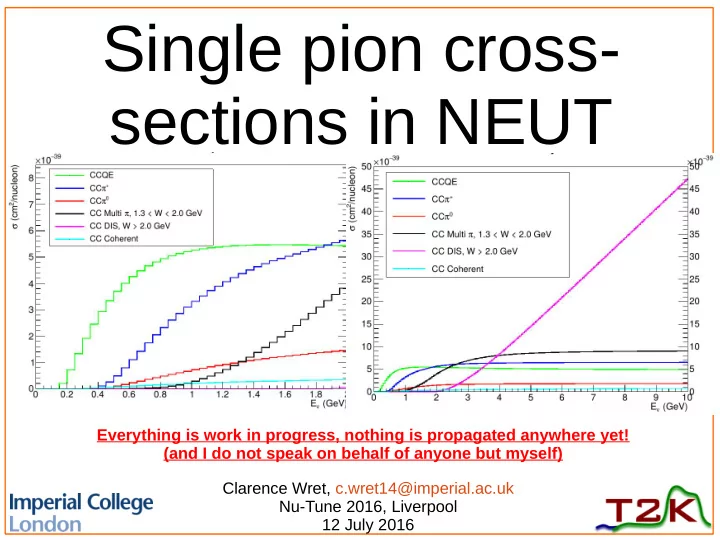
Single pion cross- sections in NEUT
Everything is work in progress, nothing is propagated anywhere yet! (and I do not speak on behalf of anyone but myself)
Single pion cross- sections in NEUT Everything is work in progress, - - PowerPoint PPT Presentation
Single pion cross- sections in NEUT Everything is work in progress, nothing is propagated anywhere yet! (and I do not speak on behalf of anyone but myself) Clarence Wret, c.wret14@imperial.ac.uk Nu-Tune 2016, Liverpool 12 July 2016 2 Outline
Clarence Wret, c.wret14@imperial.ac.uk Nu-Tune 2016, Liverpool 12 July 2016
Everything is work in progress, nothing is propagated anywhere yet! (and I do not speak on behalf of anyone but myself)
Clarence Wret 2
easier…
Clarence Wret 3
–
Ranging from the 60s to present day
–
Variety of targets with a variety of fluxes in many different kinematic variables
–
Nucleon models might become effective, how do we feel about that?
Clarence Wret 4
– Cutting phase space and then unfolding with MC – Correct for phase space cuts by overall normalisation – Fluxes which are “published” as conferences proceedings – Specific data not available in publication but in PhD theses
taken… Also a humbling reminder from FKR:
(Borrowed from
…
Clarence Wret 5
– Form-factor tuned to the Delta resonance CA
5(0), Graczyk-Sobczyk
– Lepton mass effects, Berger-Sehgal (I think GENIE has this?) – Includes resonance-resonance interferences – Includes a non-interfering non-resonant I½ background, as
prescribed by Rein-Sehgal (no DIS scaling)
– Outgoing pion generated an-isotropically from P(1232) amplitude
and spherical harmonics, as prescribed by Rein-Sehgal
RES, CA 5(0), non-resonant scaling
– Tricky to tune using only 1π data; will need priors from “tunes” to
Nπ data from bubble chambers (+MINERvA?)
Clarence Wret 6
RES, CA 5(0), non-resonant I=½ scaling
–
Delta dominated region for single pion production
–
See small effects from higher resonances; partly Eν, partly FSI
–
Use W < 1.4 GeV data when possible
Clarence Wret 7
peak significantly widened
Clarence Wret 8
CC1π0 (exists some NC and anti-nu data, but low-ish stats)
Clarence Wret 9
RES, CA 5(0), non-resonant I=½ scaling
RES, CA 5(0) to W < 1.4 GeV data
– Either do CC1π+1p for pure I=3/2 (non-res. background free) – Or all CC channels, with or without I½ background – Or can use fit from W < 1.4 GeV on W < 2.0 GeV, with the intent on
better constraining I½ background (larger contribution at high W)
theory justification and happily fit all 1π parameters to all 1π events…
– Are we doing external fits solely to give priors? – How much do we care about the underlying physics? – I think the latter is difficult; it seems like Rein-Sehgal is unable to
predict wide range of Eν cross-sections; acts as effective model?
Clarence Wret 10
Callum corrected), N(Q2) shape
Parameter Nominal CC1π+1p w/ norm CC1π+1p w/o norm MA
RES
0.95 ± 0.15 0.92 ± 0.10 1.00 ± 0.08 CA
5(0)
1.01 ± 0.12 0.89 ± 0.22 0.95 ± 0.09 ANL norm. 1.00 ± 0.20 0.94 ± 0.14 1.00 BNL norm. 1.00 ± 0.20 1.04 ± 0.10 1.00
Clarence Wret 11
differences between normalisation penalty and fixed
changes
improvement
parameter set is roughly adequate
Clarence Wret 12
Cousins and Louis Lyons at Phystat-nu Tokyo
Parameter Nominal CC1π+1p w/ norm CC1π+1p w/o norm CC1π+1p kitchenSink MA
RES
0.95 ± 0.15 0.92 ± 0.10 1.00 ± 0.08 0.89 ± 0.04 CA
5(0)
1.01 ± 0.12 0.89 ± 0.22 0.95 ± 0.09 1.02 ± 0.05 ANL norm. 1.00 ± 0.20 0.94 ± 0.14 1.00 1.00 BNL norm. 1.00 ± 0.20 1.04 ± 0.10 1.00 1.00
Clarence Wret 13
real surprises; smaller uncertainties
Clarence Wret 14
Parameter Nominal CC1π+1p w/ norm CC1π+1p w/o norm CC1π+1p kitchen all CC1π σ(Eν) N(Q2) all CC1π kitchen MA
RES
0.95 ± 0.15 0.92 ± 0.10 1.00 ± 0.08 0.89 ± 0.04 0.82 ± 0.08 0.87 ± 0.05 CA
5(0)
1.01 ± 0.12 0.89 ± 0.22 0.95 ± 0.09 1.02 ± 0.05 1.04 ± 0.12 1.18 ± 0.08 I½ bckgd 1.30 1.30 1.30 1.30 1.66 ± 0.25 1.33 ± 0.26 ANL norm. 1.00 ± 0.20 0.94 ± 0.14 BNL norm. 1.00 ± 0.20 1.04 ± 0.10
Clarence Wret 15
5; broken by including more
kinematic distributions. A bit concerned about Minuit2; MCMC future?
– Fit W < 1.4 GeV for MA and CA
5, 1.4 < W < 2.0 for I½ and use priors
– Will have to subtract the ANL data to get 1.4 < W < 2.0 range; also only have
BNL CC1π+1p W < 1.4; rest are W < 2.0 GeV
Lalakulich, Graczyk-Sobczyk, Berger-Sehgal, Nieves, Martini, Phil-Callum)
5 (or similar) = 0.95~1.20
– My fits seem to agree
certainly an issue, mismodelling is a possibility too
– Haven't showed higher Eν data yet, but joint fit goes horribly wrong – Might be higher resonances mismodelled, might be FKR
Clarence Wret 16
history database to find NuInt02 proceedings
– Makes the fit dominated by ANL data in W < 1.4 GeV
– Many CC1π+1p event rates and kinematic variables (e.g. muon
direction in CM frame, pion momentum, proton momentum, Adler angles…)
density, selected by “kinematical fit”
– Should still technically see nuclear effects, so excluded here
Clarence Wret 17
– Nuclear effects seep in; region which is most sensitive to params
– Problem when cutting into W and/or Q2
fixed/mitigated in one way or another c.wret14@imperial.ac.uk
– You might have a better fix!
Clarence Wret 18
– CCN/1π+ (nu), CC1π0 (nu, nubar), CC coherent
– MINERvA CC1π0 is best bet, future MINERvA CC1π+
– Careful selection of distributions
Clarence Wret 19
– Q2 is the natural variable to fit in – W isn't a bad idea, but is difficult to reconstruct in nuclear
– Eμ is (hopefully) an observable – Eν is not; will involve MC dependence in Eν
true
– The effect is considerable; both pions and nucleons undergo FSI
(hopefully) don't, unless they unfolded over nuclear effects…
Clarence Wret 20
– This is the only direct probe of the vertex interaction – Relatively “FSI-free” – muons exit nucleus ~cleanly – Could potentially agree quite well with predictions using fits
from nucleon data
– Use the “vertex” best-fits from muon and apply these to pion
variables; should tell you about pion kinematic mismodelling
– Fit FSI parameters with priors on 1π parameters from fits to
muon kinematics
Clarence Wret 21
background, pion propagation, and DIS mismodelling
– Can gauge impact by confronting CC1π0 muon data with
predictions from fitting to CC1π+ muon data
– GENIE, NEUT and NuWro see difficulty in agreeing – Generally, if CC1/Nπ+ is well modelled, CC1π0 is probably not
MINERvA, arXiv:1606.07127
Clarence Wret 22
– Asks for two Michel electrons (muon and pion contained) – All sorts of great distributions; kinetic variables, Q2 Eν
Parameter Nominal BC CC1π+1p w/o norm BC CC1π+1p kitchen MiniBooNE 2D μ CC1π+ MA
RES
0.95 ± 0.15 1.00 ± 0.08 0.89 ± 0.04 0.88 ± 0.03 CA
5(0)
1.01 ± 0.12 0.95 ± 0.09 1.02 ± 0.05 0.87 ± 0.03
Clarence Wret 23
– Unfolding issues?
…
Clarence Wret 24
Clarence Wret 25
contribution and DIS components, not constrained from nucleons
– Will probably need to inflate errors from nucleons for prior
Clarence Wret 26
Clarence Wret 27
– MINERνA covariance seems too put very strong constraints
– Very difficult to judge goodness of fit by eye – Is this actual effect in data or unfolding side-effect?
free in the pions either
Clarence Wret 28
normalisation of the distributions
– MINERvA CC1π± uses a Michel tag, effectively making it CC1π+;
rather than PID = 211 for signal
– MINERvA CCNπ± data release; also never explicitly states highest
pion selected. Not clear from publication if restricted phase space used throughout selection or only for plotting pμ cosθμ
– MiniBooNE CC1π+ W < 1.35 GeV cut, previously mentioned
Clarence Wret 29
– Is the data actually data? How much is MC dependent?
becoming effective, or letting experiment MC determine fitted MC
– Multiple distributions, more correlations – Less unfolding, more observables; don't be afraid of low acceptance – Making an anti-ν cross-section? Publish the ν contamination, and even
anti-ν + ν cross-sections; don't rely on your MC or sideband too much
error and Δχ2 inflation; subject to change
Clarence Wret 30
certainly are short-comings and approximations
ejection angles from all resonances (Minoo)
– Run this through a generator with nuclear effects on top – Any improvements? Nucleus washes out fine distributions?
excitation, Ghent group
releases; once it's analysed it's analysed
Clarence Wret 31
Louis Lyons, Michael Betancourt gave some advice
– “Fit everything that you're given” – “You can't do much without correlations” – “If they unfolded, they screwed you over” – “I've never unfolded in my life and I hope I never have to!”
equivalent, Phystat-nu Fermilab (it's $35!)
– https://indico.fnal.gov/conferenceDisplay.py?
Clarence Wret 32
– Similar to the old Durham bubble chamber data-base (only bubble
chambers, and doesn't include all BC dists by miles)
– Include comments on how much we trust the data and why; what
problems we've found (let's not re-invent the wheel...)
framework for anyone to look at
– Important that experimenters know difference between GENIE,
NEUT, NuWro, etc rather than thinking they know the differences and then publishing (MINERvA has unfortunately done this)
– Aka “fold your MC to data, don't unfold your data to MC” – Stephen Dolan, Callum, Kendall, Kevin et al are advocating at T2K – Many novel cross-section experiments coming up: let's make
them useful for as long as possible
Clarence Wret 33
Full production in GENIE, NEUT and NuWro (GiBUU?)
– Would ease future joint oscillation analyses – But, needs to be more of us committed to generator work – And, more effort for experiment to write general framework
– Tutorials, documentation, much more commented code
Clarence Wret 34
mitigate for issues in the data and model degeneracies
– Use bubble chamber data to constrain fundamental
interaction; much trust because of reconstruction
– Propagate to reasonable nuclear distributions; choose to
minimise possible MC dependence in data
– Try to explain the observed differences, inflate error?
little about how FSI and initial state affect observed kinematics
Clarence Wret 35
Clarence Wret 36
– σ(Eν), Q2 (dσ/dQ2 or N(Q2)), cosθ*μ, pπ, θprot, φAdler, cosθAdler
– σ(Eν), N(Q2), cosθ*μ
– σ(Eν), N(Q2), cosθ*μ
– σ(Eν), N(Q2)
Clarence Wret 37
– CC1pi+: Enu, Q2, Tmu cosmu, Tpi cospi, Tmu, Tpi, Q2 Enu, Enu Tpi, Enu Tmu – CC1pi0: Enu, Q2, cosmu, cospi, ppi0, Tmu – CC1pi+/CCQE(-like): Enu – NC1pi0: (nu, nubar, nu+nubar in both modes): ppi0, cospi0
– CC1pi+ (old): – CC1pi0 (nubar new, old) – CCNpi+ (new, old)
– CC1pi+/CCQE – NC1pi0
– NC1pi0
– CC1pi+ H2O – CC1pi+ CH coming – CC1pi0 coming
Clarence Wret 38
Concern about Q2 shape-only bias
ANL and BNL only published N(Q2), not dσ/dQ2
Clarence Wret 39
ANL dσ/dQ2 fit
ANL and BNL only published N(Q2), not dσ/dQ2
nucleons
5 = 1.14±0.16
(1.01±0.25)
5 almost perfectly becomes a normalisation change...