
SLIDE 1
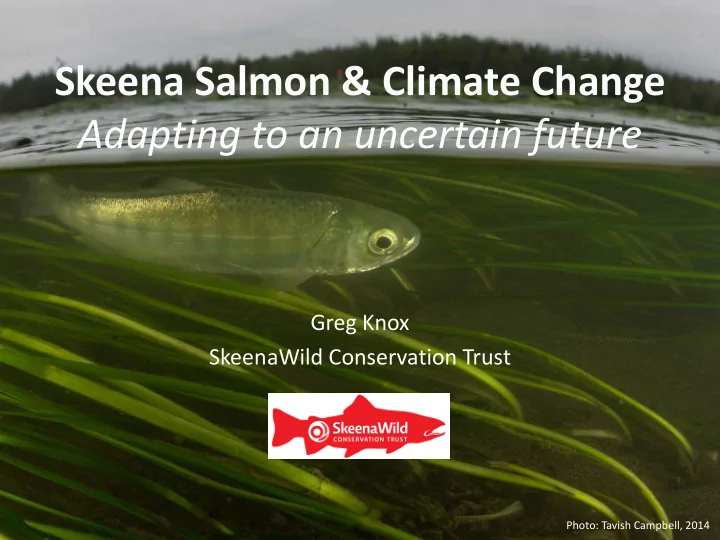
Skeena Salmon & Climate Change Adapting to an uncertain future
Greg Knox SkeenaWild Conservation Trust
Photo: Tavish Campbell, 2014
Skeena Salmon & Climate Change Adapting to an uncertain future - - PowerPoint PPT Presentation
Skeena Salmon & Climate Change Adapting to an uncertain future Greg Knox SkeenaWild Conservation Trust Photo: Tavish Campbell, 2014 Skeena Watershed Source: Ecotrust Canada, 2010 Source: SkeenaWild, 2009 The Story is Complex The Skeena
Photo: Tavish Campbell, 2014
Skeena Watershed
Source: Ecotrust Canada, 2010
Source: SkeenaWild, 2009
The Skeena has 6 species, and over 300 individual populations
estuary and ocean, and use slightly different habitats Climate change impacts all of these environments, species and populations in different, complex, and often unpredictable ways.
turbidity, nutrients …….
Acidification
Healey 2011. CJFAS 68: 718-737.
Mean annual temperature has increased by .5 °C from the 1961 – 1990 average Extreme weather events seem to be more common Glaciers are receding rapidly Mountain pine beetle epidemic & forest fires We also see climate change happening in many other places, indicating it is likely also happening here – a global phenomena Since the 1980’s:
increased in intensity
“Warm Temperature Records Will Fall As A Strong Atmospheric River Hits the Pacific Northwest”
– Nov 21, 2017
Source: US National Oceanic & Atmospheric Administration
Copper River
Photo: Troy Peters
Large flood events can displace eggs, change river habitats, flush nutrients
Impacts from sedimentation
Clore River
Photo: BC Ministry of Environment
Copper River Hydrograph – Fall 2017
Source: Environment Canada, 2017
Skeena River at Usk - 2013 Skeena River at Usk - 2014 Skeena River at Usk - 2016
Photo: Lake Babine Nation Fisheries, 2016
Low water can prevent spawning access, increase predation, increase stress
Photo: Lake Babine Nation Fisheries, 2016
Photo: Gitanyow Fisheries Authority, 2016
Issue for Skeena sockeye some years (Babine) Increasing issue for Fraser sockeye
Photo: USGS Photo: Scott Renyard
Decreased snowpack Means lower water levels in July & August Impact migration and spawning, susceptibility to fisheries
Nilkitkwa River Sicintine River Shelagyote River Shedi Creek Zymoetz River Kitsumkalum Exstew Exchamsiks
Source: Matthew Beedle, 2017
1985: 972 km2 (1.8%) 2005: 825 km2 (1.5%)
Exchamsiks River:
Exstew River:
Source: Matthew Beedle, 2017
Rain Fed Snow Fed Glacier Fed
0.02 0.04 0.06 0.08 0.1 0.12 0.14 0.16 0.18 0.2 jan feb mar apr may jun jul aug sep
nov dec
Precipitation Discharge
0.02 0.04 0.06 0.08 0.1 0.12 0.14 0.16 0.18 0.2 jan feb mar apr may jun jul aug sep
nov dec
Precipitation Discharge
0.02 0.04 0.06 0.08 0.1 0.12 0.14 0.16 0.18 0.2 jan feb mar apr may jun jul aug sep
nov dec
Precipitation Discharge
Source: Rick Edwards, PNW FSL
Glaciers help provide cold water input in short term, which helps buffer against warm, dry summers Once they melt, can dramatically change a river system.
time to glacially fed rivers
Photo: Brian Huntington, 2014
Source: World Wildlife Fund, 2013
Source: Northwest Fisheries Science Center, 2017
Potential Breakdown in Pacific Decadal Oscillation
Source: Ocean Networks Canada, 2015
2013 - 2016 Warm water =
rich food
predators
Documented occurrences of warm-water species of fishes and squid in British Columbia and southeast Alaska in 2004 and 2005.
Source: WWF, 2012 (reproduced from Trudel et al. 2006)
Difficult to measure
populations used to be more stable
Source: SkeenaWild, 2017
Source: SkeenaWild, 2017
Source: SkeenaWild, 2017
Source: SkeenaWild, 2017
Source: SkeenaWild, 2017
Red = “at-risk” Yellow = “between at-risk and healthy” Green = “healthy” Purple = “no information”
Source: SkeenaWild, 2016
Source: DFO, 2005
Source: Pacific Climate Impacts Consortium, 2012
Climate Change Projection for Kitimat-Stikine in the 2050’s
Precipitation increasing from 3130 mm to:
(28% increase in extreme precipitation days by 2080 – 2100 (USGS)
Source: Shanley et al., Journal of Climatic Change, 2015
Source: Shanley et al., Journal of Climatic Change, 2015
Snow decreasing from 1200 mm to;
1961 – 1990 mean annual temp = 3.2 °C
+1.7°C to 5.5°C by 2080s
Source: Shanley et al., Journal of Climatic Change, 2015
Ocean acidification Slide 1/3 of CO2 we release is absorbed by oceans – reacts to form carbonic acid Impacts a primary food source for Salmon
(pull calcium carbonate out of seawater) – osteoporosis of the sea
We can help our salmon adapt and help our communities continue to benefit Better Monitoring – stream counts are at historic lows Don’t kill too many
fluctuations – start with Chinook, but do ABMP’s for all species.
Protect their habitat
Benefit by being adaptable
are healthy
Source: Weatherdon et al, 2016
There’s Hope! Salmon are resilient Skeena salmon are well positioned
Some populations may actually become more productive
Weatherdon et al, 2016