Slide 1 TITLEs The Mobile Turn To briefly recall Dominiques - - PDF document

slide 1 titles the mobile turn to briefly recall
SMART_READER_LITE
LIVE PREVIEW

Slide 1 TITLEs The Mobile Turn To briefly recall Dominiques - - PDF document

Slide 1 TITLEs The Mobile Turn To briefly recall Dominiques introduction: In the last 6 years social protest movements have had a new rise of importance and major political changes have occurred in the Arabic world and in East Asia. At the


slide-1
SLIDE 1

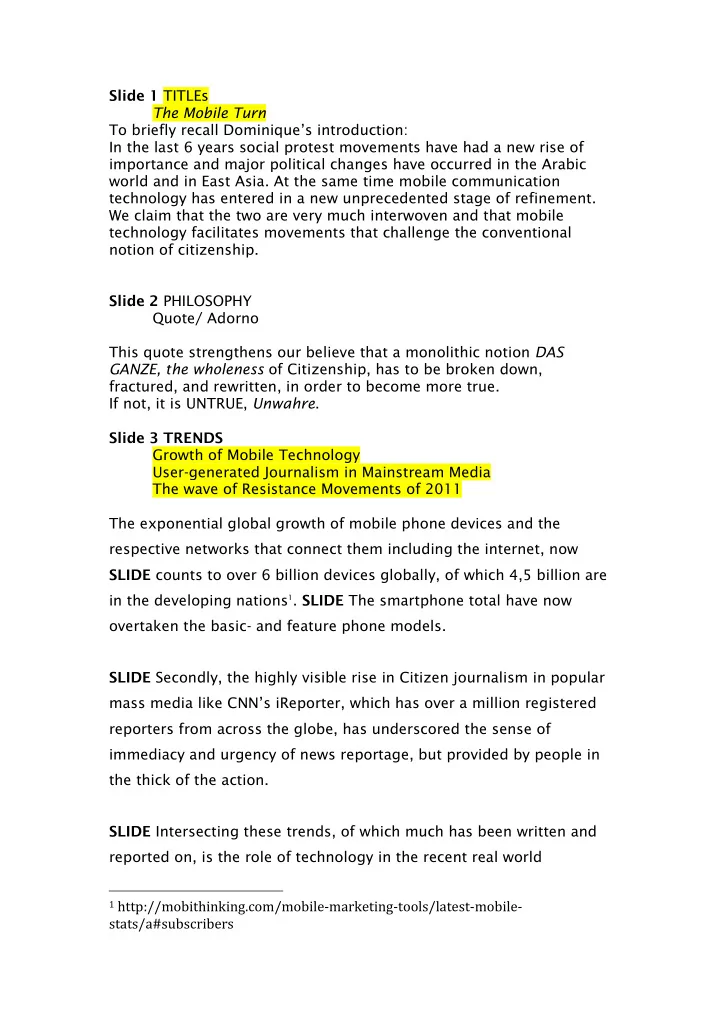
Slide 1 TITLEs The Mobile Turn To briefly recall Dominique’s introduction: In the last 6 years social protest movements have had a new rise of importance and major political changes have occurred in the Arabic world and in East Asia. At the same time mobile communication technology has entered in a new unprecedented stage of refinement. We claim that the two are very much interwoven and that mobile technology facilitates movements that challenge the conventional notion of citizenship. Slide 2 PHILOSOPHY Quote/ Adorno This quote strengthens our believe that a monolithic notion DAS GANZE, the wholeness of Citizenship, has to be broken down, fractured, and rewritten, in order to become more true. If not, it is UNTRUE, Unwahre. Slide 3 TRENDS Growth of Mobile Technology User-generated Journalism in Mainstream Media The wave of Resistance Movements of 2011 The exponential global growth of mobile phone devices and the respective networks that connect them including the internet, now SLIDE counts to over 6 billion devices globally, of which 4,5 billion are in the developing nations1. SLIDE The smartphone total have now

  • vertaken the basic- and feature phone models.

SLIDE Secondly, the highly visible rise in Citizen journalism in popular mass media like CNN’s iReporter, which has over a million registered reporters from across the globe, has underscored the sense of immediacy and urgency of news reportage, but provided by people in the thick of the action. SLIDE Intersecting these trends, of which much has been written and reported on, is the role of technology in the recent real world ¡ ¡ ¡ ¡ ¡ ¡ ¡ ¡ ¡ ¡ ¡ ¡ ¡ ¡ ¡ ¡ ¡ ¡ ¡ ¡ ¡ ¡ ¡ ¡ ¡ ¡ ¡ ¡ ¡ ¡ ¡ ¡ ¡ ¡ ¡ ¡ ¡ ¡ ¡ ¡ ¡ ¡ ¡ ¡ ¡ ¡ ¡ ¡ ¡ ¡ ¡ ¡ ¡ ¡ ¡ ¡

1 ¡http://mobithinking.com/mobile-­‑marketing-­‑tools/latest-­‑mobile-­‑

stats/a#subscribers ¡

slide-2
SLIDE 2

expressions of resistance and citizen revolutions in North Africa, the Middle East and other places. SLIDE However, the presence of technology in itself is not the reason for the revolutionary movements, but it is the advantages of the lowering cost of entry, the ease of use, the speedy documentation and communication of crucial information plus the search-and-findability of produced and distributed useful content that enable and facilitate the effective organisation of resistance dynamics, and its narrative. Slide 4 SOME QUESTIONS [Positioning of Re-Casting Citizenship] How does Mobile Technology contribute to the fracturing and dissolution

  • f a traditional notion of Citizenship?

How does resistance movements in particular benefit from an established Networked Infrastructure? How does the collective production of knowledge through networked infrastructure contribute to a notion of participatory governance? We are asking some pertinent questions to guide us through the investigation, not to necessary look for answers, but to open a way towards some understanding and a continuous generation of new questions. How would we even start to answer these complex questions? Slide 5 A METHOD A Taxonomic interrogation of Citizen user-generated content from Social Media Platforms, Twitter and Instagram Development of a Set of productive Questions Can we establish a position? Starting with a few short case studies, we got an understanding

  • f the contribution of the Internet to the [SLIDE] Burmese

uprising in 2007, already an early indication of the power of the

slide-3
SLIDE 3

distribution of knowledge through technology channels, it is followed by a history of the artist [SLIDE] Ai Wei Wei and his ACTIVIST use of web applications like his blog, particularly highlighting the Sichuan earthquake tragedy, 3rd ly the global tracking by TWITTER tweeters of radioactive clouds moving across the globe from [SLIDE] Fukushima fallout and finally the expression of resistance during the [SLIDE] Egyptian revolution through mobile social media like Instagram, Twitter, Video apps, the web and so on. This major body of research material is located over 18 days in Egypt, 25 January to 11 February 2011, both image and text, data pulled from the mobile web platforms, Instagram and Twitter. SLIDE] Development of a Set of productive Questions We aim to cast a light on how citizens across geographic boundaries are using the mobile device to challenge, and re-figure their own diverse notions of Citizenship, by developing an ongoing set

  • f interrogatory questions.

Can we establish a position? How, and can, one establish a position as a Citizen, located in the nation state, within the pull of Globalisation? SLIDE 6 SPECULATION What exactly is the relation between mobile infrastructure and resistance movements? We mapped a basic timeline of the growth of the web, the mobile device and its functionalities, and of some of the major citizen–

  • rganised resistance movements from 2010 onwards.

SLIDE] DISCUSS EACH BRAND SLOWLY AND LEAD INTO MOBILE’S GROWTH 2011 has seen massive uprising and resistance by citizens across the globe – against capitalism and commodities, against neo-liberal politics, against racial inequality and subordination, the definition of

slide-4
SLIDE 4

marriage and its included inequality. And Against authoritarian governments and its dictators. The collective use of mobile technology infrastructure in all its manifestations; the hardware, programmed software, designed interface and its interactive logic, and most importantly, its user-based productive tools like text and lens-based image-making applications contributes to the mobile interface, theso-called 4th screen’s, importance in a mediated modern world. This sets of technology infrastructures not only networks, negotiates, distributes and delivers both the global and the local content, through government and privately owned servers and switches, but also hosts the programs that apply the constituted rules that organise, manage and control the system. It is the manipulation

  • f this infrastructure and its rules by the multitude, that fascinates us.

Slide 7 INSPIRATION In order to access this intersection of Technology and Resistance from an other productive place, we look to Derrida and his concept of writing in Of Grammatology: SLIDE “action, movement, thought, reflection, consciousness, unconsciousness, experience, affectivity etc. and “not only the physical gestures of literal pictographic or ideographic inscription, but also the totality that makes it possible… All this to describe not only the system of notation secondarily connected with these activities but the essence and content of the activities themselves”

  • Derrida, Of Grammatology

The Ubiquitous primary functions like Texting and Picture-taking, complemented by various other functions like Search, Save and Share, have shifted dramatically and punctuate the move from the singular event of a “phone call” to the collective participation of the individual in a stream of digital consciousness of information, establishing an interface to making sense of the concrete world, of the state of the world and things, and by the social nature of these tools, of being in the world with other individuals.

slide-5
SLIDE 5

Decoding this flow of communal memory-making and moment- collecting, allow us to develop an insight into the role of mobile technology in resistance-citizenship, and we call this Mobile Writing. SLIDE “if supplementarity is a necessarily indefinite process, writing is the supplement par excellence since it proposes itself as the supplement of the supplement, sign of a sign, taking the place

  • f a speech already significant”
  • Derrida, Of Grammatology

Slide 8 CIRCULATION Writing and Circulating the Narrative Peer2Peer/Citizen-to-Citizen

Mobile writing does not necessarily replace the original task of being in the world, but functions ultimately as both an accretion and a kind of substitute for certain functions, to existence2. Adding layers of meaning and function to the original, superseding some and substitute others. Mobile writing is the active creation and production of Narrative, which is distributed between peers, and between citizens. Let us focus on image –making for a moment: Whereas photographs used to make the world comprehensible in an abstracted flat frame, mobile image-making is making sense of being in the world, while moving through it, marking your place in the world, but also documented by location check- ins and data tracking, and marking temporality by time stamping every click, tick, share, save and search, and your text, tagged to make it easier to find with the likes of hashtags. Furthermore, image-making in itself, having moved from traditionally being significant moments captured by the specialist photographer, to digital pictures of significant moments by every single mobile device wearing person. The mere act of recording by performing specific functions like texting and picture-taking, becomes the primary function because it is live, it’s in the moment, it records, documents and remembers, it also distributes, it collects and it tells everyone about it. For the mobile device to fully function it requires other human beings who are operating similar networked mobile devices and it also needs a pre-

¡ ¡ ¡ ¡ ¡ ¡ ¡ ¡ ¡ ¡ ¡ ¡ ¡ ¡ ¡ ¡ ¡ ¡ ¡ ¡ ¡ ¡ ¡ ¡ ¡ ¡ ¡ ¡ ¡ ¡ ¡ ¡ ¡ ¡ ¡ ¡ ¡ ¡ ¡ ¡ ¡ ¡ ¡ ¡ ¡ ¡ ¡ ¡ ¡ ¡ ¡ ¡ ¡ ¡ ¡ ¡

2 ¡(OG ¡200). ¡

slide-6
SLIDE 6

existent set of organised offline human networks like trusted relationships and sa hared common focus, in the resistance movements especially between normally disparate groups, to develop a broad basis for co-

  • peration and co-creation.

Slide 9 AN INTERVENTION Interrogate Citizen-generated content by focusing both geographically and temporally on a singular moment 25 January 2011, TAHRIR SQUARE Develop a Knowledge Based Data Set & a position from which to understand the dynamics and the flow of knowledge

Now, just imagine that the common focus is for example against general principles of fiscal (im) propriety ie Wall street banking, or individual indignation against the suppression of a dictator, and its forms of representation and political life, begun to be expressed by a constituent or collective power of the common person, amplified by the mobile circulation

  • f the shared struggle.

We have interrogated the content produced over 18 days on Instagram and Twitter, during the Egyptian resistance, specifically on Tahrir Square,

  • Cairo. A constrained geographic footprint and time period allows for a

focused sample, even though it still amounts to hundreds of thousands of

  • data. However, a manual sorting through a few thousands images and text

sets, resulted and reveals the complexity of the Citizen’s resistance

  • behaviours. It becomes clear that the multitude produces and shares

knowledge, exchanges ideas and writes, outside of the nation-state narrative

  • f the Citizen and its rehearsal by the controlled media, its own narrative and

notion of citizenship. The multitude is self-organising, it is decentralised and it is mostly without a clear individual leader unlike the well-known individual struggle of for example Nelson Mandela or Aung San Suu Kyi. It allows for a kind of democratic smuggling or an obscured transferring or passing on of information, ideas, rules and content.

slide-7
SLIDE 7

SLIDES SHOW OF THE CONTENT. And finally, a poor informal working class neighbourhood in [SLIDE] Cairo, Ard EL Lewa, harnessed their newfound collective confidence to build an

  • nramp onto the closeby highway after years of governmental neglect. In the

absence of a working government in power they built ramps from dirt, trash and sand, and then invited the police to open a kiosk at the interchangeIN A simplistic bricks and mortar rendering of active and participatory citizenship.

SLIDE 10 SUMMARY

Its clear that the primary citizen activities are Organisation, Reporting, Documenting and Communicating but though this activity, it is the Creation and Communication of an owned Narrative, that challenges the controlled state-owned Narrative of the Citizen. New processes of constituent citizenship are being constructed and exercised. A huge, useful body of knowledge is produced by the connected individuals, the resistance movements and the collective participation of various subjective figures, which are attempting to subvert these subjectivities by their acts of resistance and rejection.

A Set of Questions How do you continue to re-cast the notion of Citizenship? How can the dominant subjective figures be resisted? What can (mobile) Writing do? Who does the Writing?