
SLIDE 1
Smooth Proxy-Anchor Loss for Noisy Metric Learning
Carlos Roig David Varas Issey Masuda Juan Carlos Riveiro Elisenda Bou-Balust Vilynx
{carlos,david.varas,issey,eli}@vilynx.com
Abstract
Many industrial applications use Metric Learning as a way to circumvent scalability issues when designing sys- tems with a high number of classes. Because of this, this field of research is attracting a lot of interest from the aca- demic and non-academic communities. Such industrial ap- plications require large-scale datasets, which are usually generated with web data and, as a result, often contain a high number of noisy labels. While Metric Learning sys- tems are sensitive to noisy labels, this is usually not tackled in the literature, that relies on manually annotated datasets. In this work, we propose a Metric Learning method that is able to overcome the presence of noisy labels using our novel Smooth Proxy-Anchor Loss. We also present an archi- tecture that uses the aforementioned loss with a two-phase learning procedure. First, we train a confidence module that computes sample class confidences. Second, these con- fidences are used to weight the influence of each sample for the training of the embeddings. This results in a system that is able to provide robust sample embeddings. We compare the performance of the described method with current state-of-the-art Metric Learning losses (proxy- based and pair-based), when trained with a dataset con- taining noisy labels. The results showcase an improvement
- f 2.63 and 3.29 in Recall@1 with respect to MultiSimi-
larity and Proxy-Anchor Loss respectively, proving that our method outperforms the state-of-the-art of Metric Learning in noisy labeling conditions.
- 1. Introduction
Recent deep learning applications use a semantic dis- tance metric, which enables applications such as face ver- ification [17, 4], person re-identification [1, 27], few-shot learning [16, 21], content-based image retrieval [14, 19, 18]
- r representation learning [28, 14]. These type of applica-
tions rely on vectorial spaces (embedding spaces), which are generated with the objective of gathering together the samples of the same classes while distancing themselves from the ones of other classes.
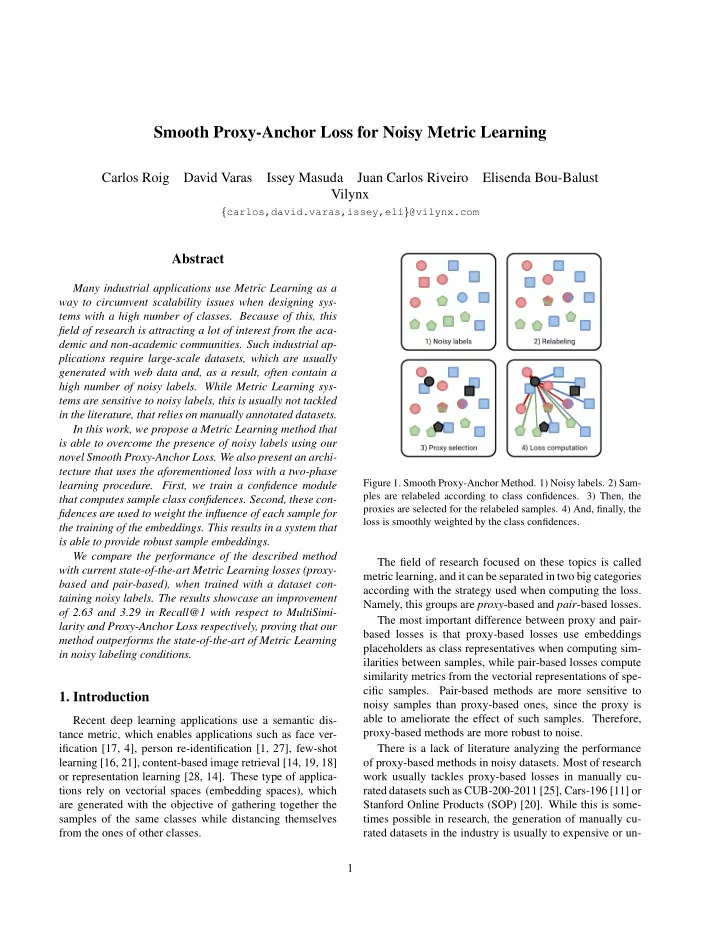
Figure 1. Smooth Proxy-Anchor Method. 1) Noisy labels. 2) Sam- ples are relabeled according to class confidences. 3) Then, the proxies are selected for the relabeled samples. 4) And, finally, the loss is smoothly weighted by the class confidences.
The field of research focused on these topics is called metric learning, and it can be separated in two big categories according with the strategy used when computing the loss. Namely, this groups are proxy-based and pair-based losses. The most important difference between proxy and pair- based losses is that proxy-based losses use embeddings placeholders as class representatives when computing sim- ilarities between samples, while pair-based losses compute similarity metrics from the vectorial representations of spe- cific samples. Pair-based methods are more sensitive to noisy samples than proxy-based ones, since the proxy is able to ameliorate the effect of such samples. Therefore, proxy-based methods are more robust to noise. There is a lack of literature analyzing the performance
- f proxy-based methods in noisy datasets. Most of research