
SLIDE 1
Software into GPU code, Multicore Software and FPGA Hardware Satnam - - PowerPoint PPT Presentation
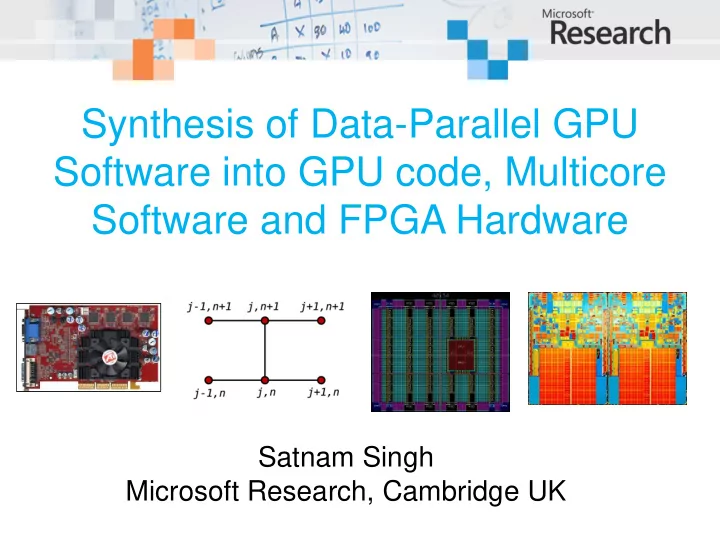
Synthesis of Data-Parallel GPU Software into GPU code, Multicore Software and FPGA Hardware Satnam Singh Microsoft Research, Cambridge UK locks monitors condition variables spin locks priority inversion FPGA hardware (VHDL, ISE) GPU
data parallel Descriptions C++, C#, F#… FPGA hardware (VHDL, ISE) GPU code (HLSL, DX9) SSE3 X64 multicore SSE3
Machine Collection
r0 := x0 + y0 r1 := x1 + y1 r2 := x2 + y2 r3 := x3 + y3
128-bits MMX/
multiple independent multi-ported memories fine-grain parallelism and pipelining hard and soft embedded processors
i
i0
lut2 lut3 lut4
i0 i1 i2
i0 i1 i2 i3
universal language? embedded high level software FPGA GPU DSP machine learning
Gannet
using System; using Microsoft.ParallelArrays; namespace AddArraysPointwise { class AddArraysPointwiseDX9 { static void Main(string[] args) { var x = new FloatParallelArray (new[] {1.0F, 2, 3, 4, 5}); var y = new FloatParallelArray (new[] {6.0F, 7, 8, 9, 10}); var dx9Target = new DX9Target(); var z = x + y; foreach (var i in dx9Target.ToArray1D (z)) Console.Write(i + " "); Console.WriteLine(); } } }
using System; using Microsoft.ParallelArrays; namespace AddArraysPointwiseMulticore { class AddArraysPointwiseMulticore { static void Main(string[] args) { var x = new FloatParallelArray (new[] {1.0F, 2, 3, 4, 5}); var y = new FloatParallelArray (new[] {6.0F, 7, 8, 9, 10}); var multicoreTarget = new X64MulticoreTarget(); var z = x + y; foreach (var i in multicoreTarget.ToArray1D (z)) Console.Write(i + " "); Console.WriteLine(); } } }
using System; using Microsoft.ParallelArrays; namespace AddArraysPointwiseFPGA { class AddArraysPointwiseMulticore { static void Main(string[] args) { var x = new FloatParallelArray (new[] {1.0F, 2, 3, 4, 5}); var y = new FloatParallelArray (new[] {6.0F, 7, 8, 9, 10}); var fpgaTarget = new FPGATarget(); var z = x + y; fpgaTarget.ToArray1D (z) ; } } }
let main(args) = let x = new FloatParallelArray (Array.map float32 [|1; 2; 3; 4; 5 |]) let y = new FloatParallelArray (Array.map float32 [|6; 7; 8; 9; 10 |]) let z = x + y use dx9Target = new DX9Target() let zv = dx9Target.ToArray1D(z) printf "%A\n" zv
rX * pa Shift (0,0) k[0] + + * Shift (0,1) k[1] + …
let rec convolve (shifts : int -> int []) (kernel : float32 []) i (a : FloatParallelArray) = let e = kernel.[i] * ParallelArrays.Shift(a, shifts i) if i = 0 then e else e + convolve shifts kernel (i-1) a
static float Horner(float[] coe, float x) { float result = 0.0f; foreach (var c in coe) { result = result + x * c; } return result; } static FloatParallelArray Horner(float[] coe, FloatParallelArray x) { FloatParallelArray result = new FloatParallelArray(0.0f, x.Shape); foreach (var c in coe) { result = result + x * c; } return result; }
static float NormCdf(float x) { var coe = new []{ 0.0f, 0.31938153f, 0.356563782f, 1.781477937f, 1.821255978f, 1.330274429f }; float poly = Horner(coe, x); float l = Math.Abs(x); float k = (float) (1.0f/(1.0 + 0.2316419f*l)); float w = (float)(1.0f - 1.0f / Math.Sqrt(2.0f * Math.PI) * Math.Exp(-l * l / 2.0f) * poly * k); if (x < 0) return 1.0f - w; else return w; } static FloatParallelArray NormCdf(FloatParallelArray x) { var coe = new[] { 0.0f, 0.31938153f, 0.356563782f, 1.781477937f, 1.821255978f, 1.330274429f }; FloatParallelArray poly = Horner(coe, x); FloatParallelArray l = ParallelArrays.Abs(x); FloatParallelArray k = 1.0f / (1.0f + 0.2316419f * l); FloatParallelArray e = new FloatParallelArray(2.718281828459045f, l.Shape); FloatParallelArray w = 1.0f - 1.0f / (float)(Math.Sqrt(2.0f * Math.PI)) * ParallelArrays.Pow(e, -l * l / 2.0f) * poly * k; return ParallelArrays.Select(x, w, 1.0f - w);
}
static float NormCdf(float x) { var coe = new []{ 0.0f, 0.31938153f, 0.356563782f, 1.781477937f, 1.821255978f, 1.330274429f }; float poly = Horner(coe, x); float l = Math.Abs(x); float k = (float) (1.0f/(1.0 + 0.2316419f*l)); float w = (float)(1.0f - 1.0f / Math.Sqrt(2.0f * Math.PI) * Math.Exp(-l * l / 2.0f) * poly * k); if (x < 0) return 1.0f - w; else return w; } static FloatParallelArray NormCdf(FloatParallelArray x) { var coe = new[] { 0.0f, 0.31938153f, 0.356563782f, 1.781477937f, 1.821255978f, 1.330274429f }; FloatParallelArray poly = Horner(coe, x); FloatParallelArray l = ParallelArrays.Abs(x); FloatParallelArray k = 1.0f / (1.0f + 0.2316419f * l); FloatParallelArray e = new FloatParallelArray(2.718281828459045f, l.Shape); FloatParallelArray w = 1.0f - 1.0f / (float)(Math.Sqrt(2.0f * Math.PI)) * ParallelArrays.Pow(e, -l * l / 2.0f) * poly * k; return ParallelArrays.Select(x, w, 1.0f - w);
}
ParallelArrays.Select(x, w, 1.0f - w);
static float BlackCholes1(float s, float x, float t, float r, float v) { float d1 = (float)((Math.Log(s / x) + (r + v * v / 2) * t) / (v * Math.Sqrt(t))); float d2 = (float)(d1 - v * Math.Sqrt(t)); return (float)(s * NormCdf(d1) - x * Math.Exp(-r * t) * NormCdf(d2)); } static FloatParallelArray BlackCholes1(FloatParallelArray ss, FloatParallelArray xs, FloatParallelArray ts, float r, float v) { FloatParallelArray d1 = ParallelArrays.Log2(ss / xs) + ((r + v * v / 2) * ts) / (v * ParallelArrays.Sqrt(ts)); FloatParallelArray d2 = (d1 - v * ParallelArrays.Sqrt(ts)); FloatParallelArray e = new FloatParallelArray(2.718281828459045f, ts.Shape); return (ss * NormCdf(d1) - xs * ParallelArrays.Pow(e, -r * ts) * NormCdf(d2)); }
static float[] BlackScholes(float[] ss, float[] xs, float[] ts) { float r = 1.3f; float v = 2.5f; var result = new float[ss.GetLength(0)]; for (int i = 0; i < ss.GetLength(0); i++) { result[i] = BlackCholes1(ss[i], xs[i], ts[i], r, v); } return result; } static FloatParallelArray BlackScholes(FloatParallelArray ss, FloatParallelArray xs, FloatParallelArray ts) { float r = 1.3f; float v = 2.5f; return BlackCholes1(ss, xs, ts, r, v); }
public static int[] SequentialFIRFunction(int[] weights, int[] input) { int[] window = new int[size]; int[] result = new int[input.Length]; // Clear to window of x values to all zero. for (int w = 0; w < size; w++) window[w] = 0; // For each sample... for (int i = 0; i < input.Length; i++) { // Shift in the new x value for (int j = size - 1; j > 0; j--) window[j] = window[j - 1]; window[0] = input[i]; // Compute the result value int sum = 0; for (int z = 0; z < size; z++) sum += weights[z] * window[z]; result[i] = sum; } return result; }
y = [y[0], y[1], y[2], y[3], y[4], y[5], y[6], y[7]] y[0] = a[0]x[0] + a[1]x[-1] + a[2]x[-2] + a[3]x[-3] + a[4]x[-4] y[1] = a[0]x[1] + a[1]x[0] + a[2]x[-1] + a[3]x[-2] + a[4]x[-3] y[2] = a[0]x[2] + a[1]x[1] + a[2]x[0] + a[3]x[-1] + a[4]x[-2] y[3] = a[0]x[3] + a[1]x[2] + a[2]x[1] + a[3]x[0] + a[4]x[-1] y[4] = a[0]x[4] + a[1]x[3] + a[2]x[2] + a[3]x[1] + a[4]x[0] y[5] = a[0]x[5] + a[1]x[4] + a[2]x[3] + a[3]x[2] + a[4]x[1] y[6] = a[0]x[6] + a[1]x[5] + a[2]x[4] + a[3]x[3] + a[4]x[2] y[7] = a[0]x[7] + a[1]x[6] + a[2]x[5] + a[3]x[4] + a[4]x[3] y = [y[0], y[1], y[2], y[3], y[4], y[5], y[6], y[7]] = a[0] * [x[0], x[1], x[2], x[3], x[4], x[5], x[6], x[7]] + a[1] * [x[-1], x[0], x[1], x[2], x[3], x[4], x[5], x[6]] + a[2] * [x[-2], x[-1], x[0], x[1], x[2], x[3], x[4], x[5]] + a[3] * [x[-3], x[-2], x[-1], x[0], x[1], x[2], x[3], x[4]] + a[4] * [x[-4], x[-3], x[-2], x[-1], x[0], x[1], x[2], x[3]]
shift (x, 0) = [7, 2, 5, 9, 3, 8, 6, 4] = x shift (x, -1) = [7, 7, 2, 5, 9, 3, 8, 6] shift (x, -2) = [7, 7, 7, 2, 5, 9, 3, 8]
y = [y[0], y[1], y[2], y[3], y[4], y[5], y[6], y[7]] = a[0] * [x[0], x[1], x[2], x[3], x[4], x[5], x[6], x[7]] + a[1] * [x[-1], x[0], x[1], x[2], x[3], x[4], x[5], x[6]] + a[2] * [x[-2], x[-1], x[0], x[1], x[2], x[3], x[4], x[5]] + a[3] * [x[-3], x[-2], x[-1], x[0], x[1], x[2], x[3], x[4]] + a[4] * [x[-4], x[-3], x[-2], x[-1], x[0], x[1], x[2], x[3]] y = a[0] * shift (x, 0) + a[1] * shift (x, -1) + a[2] * shift (x, -2) + a[3] * shift (x, -3) + a[4] * shift (x, -4)
using Microsoft.ParallelArrays; using A = Microsoft.ParallelArrays.ParallelArrays; namespace AcceleratorSamples { public class Convolver { public static float[] Convolver1D(Target computeTarget, float[] a, float[] x) { var xpar = new FloatParallelArray(x); var n = x.Length; var ypar = new FloatParallelArray(0.0f, new [] { n }); for (int i = 0; i < a.Length; i++) ypar += a[i] * A.Shift(xpar, -i); float[] result = computeTarget.ToArray1D(ypar); return result; } } }
using Microsoft.ParallelArrays; using A = Microsoft.ParallelArrays.ParallelArrays; namespace AcceleratorSamples { public class Convolver { public static float[,] Convolver1D_2DInput (Target computeTarget, float[] a, float[,] x) { var xpar = new FloatParallelArray(x); var n = x.GetLength(0); var m = x.GetLength(1); var ypar = new FloatParallelArray(0.0f, new [] { n, m }); var shiftBy = new [] { 0, 0 }; for (var i = 0; i < a.Length; i++) { shiftBy[1] = -i; ypar += a[i] * A.Shift(xpar, shiftBy); } var result = computeTarget.ToArray2D(ypar); return result; } } }
using System; using Microsoft.ParallelArrays; namespace AcceleratorSamples { public class Convolver2D { static FloatParallelArray convolve(Func<int, int[]> shifts, float[] kernel, int i, FloatParallelArray a) { FloatParallelArray e = kernel[i] * ParallelArrays.Shift(a, shifts(i)); if (i == 0) return e; else return e + convolve(shifts, kernel, i - 1, a); } static FloatParallelArray convolveXY(float[] kernel, FloatParallelArray input) { FloatParallelArray convolveX = convolve(i => new [] { -i, 0 }, kernel, kernel.Length - 1, input); return convolve(i => new [] { 0, -i }, kernel, kernel.Length - 1, convolveX); } static void Main(string[] args) { const int inputSize = 10; var random = new Random(42); var inputData = new float[inputSize, inputSize]; for (int row = 0; row < inputSize; row++) for (int col = 0; col < inputSize; col++) inputData[row, col] = (float)random.NextDouble() * random.Next(1, 100); var testKernel = new float[]{2, 5, 7, 4, 3} ; var dx9Target = new DX9Target(); var inputArray = new FloatParallelArray(inputData); var result = dx9Target.ToArray2D(convolveXY (testKernel, inputArray)); for (var row = 0; row < inputSize; row++) { for (var col = 0; col < inputSize; col++) Console.Write("{0} ", result[row, col]); Console.WriteLine(); } } } }
static FloatParallelArray convolve(Func<int, int[]> shifts, float[] kernel, int i, FloatParallelArray a) { FloatParallelArray e = kernel[i] * ParallelArrays.Shift(a, shifts(i)); if (i == 0) return e; else return e + convolve(shifts, kernel, i - 1, a); } static FloatParallelArray convolveXY(float[] kernel, FloatParallelArray input) { FloatParallelArray convolveX = convolve(i => new [] { -i, 0 }, kernel, kernel.Length - 1, input); return convolve(i => new [] { 0, -i }, kernel, kernel.Length - 1, convolveX); }
using System; using System.Linq; using Microsoft.ParallelArrays; namespace AcceleratorSamples { static class Convolver2D { static FloatParallelArray convolve(this FloatParallelArray a, Func<int, int[]> shifts, float[] kernel) { return kernel .Select((k, i) => k * ParallelArrays.Shift(a, shifts(i))) .Aggregate((a1, a2) => a1 + a2); } static FloatParallelArray convolveXY(this FloatParallelArray input, float[] kernel) { return input .convolve(i => new[] { -i, 0 }, kernel) .convolve(i => new[] { 0, -i }, kernel); } static void Main(string[] args) { const int inputSize = 10; var random = new Random(42); var inputData = new float[inputSize, inputSize]; for (int row = 0; row < inputSize; row++) for (int col = 0; col < inputSize; col++) inputData[row, col] = (float)random.NextDouble() * random.Next(1, 100); var testKernel = new[] { 2F, 5, 7, 4, 3 }; var dx9Target = new DX9Target(); var inputArray = new FloatParallelArray(inputData); var result = dx9Target.ToArray2D(inputArray.convolveXY(testKernel)); for (var row = 0; row < inputSize; row++) { for (int col = 0; col < inputSize; col++) Console.Write("{0} ", result[row, col]); Console.WriteLine(); } } } }
static FloatParallelArray convolve(this FloatParallelArray a, Func<int, int[]> shifts, float[] kernel) { return kernel .Select((k, i) => k * ParallelArrays.Shift(a, shifts(i))) .Aggregate((a1, a2) => a1 + a2); } static FloatParallelArray convolveXY(this FloatParallelArray input, float[] kernel) { return input .convolve(i => new[] { -i, 0 }, kernel) .convolve(i => new[] { 0, -i }, kernel); }
FPA ConvolveXY(Target &tgt, int height, int width, int filterSize, float filter[], FPA input, float *resultArray) { // Convolve in X (row) direction. size_t dims[] = {height,width}; FPA smoothX = FPA(0,dims, 2); intptr_t counts[] = {0,0}; int filterHalf = filterSize/2; float scale; for (int i = -filterHalf; i <= filterHalf; i++) { counts[0] = i; scale = filter[i + filterHalf]; smoothX += Shift(input, counts, 2) * scale; } // Convolve in Y (col) direction. counts[0] = 0; FPA result = FPA(0,dims, 2); for (int i = -filterHalf; i <= filterHalf; i++) { counts[1] = i; scale = filter[filterHalf + i]; result += Shift(smoothX, counts, 2) * scale; } tgt.ToArray(result, resultArray, height, width, width * sizeof(float)); return smoothX ; };
[<EntryPoint>] let main(args) = // Declare a filter kernel for the convolution let testKernel = Array.map float32 [| 2; 5; 7; 4; 3 |] // Specify the size of each dimension of the input array let inputSize = 10 // Create a pseudo-random number generator let random = Random (42) // Declare a psueduo-input data array let testData = Array2D.init inputSize inputSize (fun i j -> float32 (random.NextDouble() * float (random.Next(1, 100)))) // Create an Accelerator float parallel array for the F# input array use testArray = new FloatParallelArray(testData) // Declare a function to convolve in the X or Y direction let rec convolve (shifts : int -> int []) (kernel : float32 []) i (a : FloatParallelArray) = let e = kernel.[i] * ParallelArrays.Shift(a, shifts i) if i = 0 then e else e + convolve shifts kernel (i-1) a // Declare a 2D convolver let convolveXY kernel input = // First convolve in the X direction and then in the Y direction let convolveX = convolve (fun i -> [| -i; 0 |]) kernel (kernel.Length - 1) input let convolveY = convolve (fun i -> [| 0; -i |]) kernel (kernel.Length - 1) convolveX convolveY // Create a DX9 target and use it to convolve the test input use dx9Target = new DX9Target() let convolveDX9 = dx9Target.ToArray2D (convolveXY testKernel testArray) printfn "DX9: -> \r\n%A" convolveDX9
let convolveXY kernel input = // First convolve in the X direction and then in Y let convolveX = convolve (fun i -> [| -i; 0 |]) kernel (kernel.Length - 1) input let convolveY = convolve (fun i -> [| 0; -i |]) kernel (kernel.Length - 1) convolveX convolveY
20 40 60 80 100 120 140 160 50 100 150 200 250 execution time (seconds) kernel size
Convolver 2D 4000x4000 Benchmark
Nvidia Quadro FX 580 (32 cores) Xeon X5550 (8 cores) Nvidia GeoForce 8600 GTS (32 cores) Core2 Quad Q9550 (4 cores) NVIDIA Quadro NVS 160M (8 cores) Core2 Duo P9600 (2 cores) ATI Radeon HD 5870 (1600 cores) 2 x Xeon X5355 (8 cores) Nvidia Quadro FX 580 (32 cores) Xeon X5550 (8 cores) Nvidia GeoForce 8600 GTS (32 cores) Core2 Quad Q9550 (4 cores) NVIDIA Quadro NVS 160M (8 cores) Core2 Duo P9600 (2 cores) ATI Radeon HD 5870 (1600 cores) 2 x Xeon X5355 (8 cores)
0.5 1 1.5 2 2.5 3 3.5 4 5 10 15 20 execution time (seconds) kernel size
Convolver 2D 4000x4000 Benchmark
Nvidia Quadro FX 580 (32 cores) Xeon X5550 (8 cores) Nvidia GeoForce 8600 GTS (32 cores) Core2 Quad Q9550 (4 cores) NVIDIA Quadro NVS 160M (8 cores) Core2 Duo P9600 (2 cores) ATI Radeon HD 5870 (1600 cores) 2 x Xeon X5355 (8 cores) Nvidia Quadro FX 580 (32 cores) Xeon X5550 (8 cores) Nvidia GeoForce 8600 GTS (32 cores) Core2 Quad Q9550 (4 cores) NVIDIA Quadro NVS 160M (8 cores) Core2 Duo P9600 (2 cores) ATI Radeon HD 5870 (1600 cores) 2 x Xeon X5355 (8 cores)
5 10 15 20 25 5 10 15 20 25 30 35 40 45 speedup over one core kernel size
x64 multicore target benchmark for 2D convolver (24 core server Xeon E7540)
6 core speedup 12 core speedup 18 core speedup 24 core speedup
XD2000i FPGA in-socket accelerator for Intel FSB XD2000F FPGA in-socket accelerator for AMD socket F XD1000 FPGA co-processor module for socket 940
FPA ConvolveX(Target &tgt, int height, int width, int filterSize, float filter[], FPA input, float *resultArray) { // Convolve in X direction. size_t dims[] = {height,width}; FPA smoothX = FPA(0,dims, 2); intptr_t counts[] = {0,0}; int filterHalf = filterSize/2; float scale; for (int i = -filterHalf; i <= filterHalf; i++) { counts[1] = i; scale = filter[i + filterHalf]; smoothX += Shift(input, counts, 2) * scale; } tgt.ToArray(smoothX, resultArray, height, width, width * sizeof(float)); return smoothX ; };
8.249ns max delay 3 x DSP48Es 63 slice registers 24 slice LUTs
// Compute grayscale Target &tgt = CreateDX9Target(); float* grayF = (float*) malloc(sizeof(float) * pixels) ; FPA red = FPA(redF, rectHeight, rectWidth) ; FPA green = FPA(greenF, rectHeight, rectWidth); FPA blue = FPA(blueF, rectHeight, rectWidth); FPA sum = Add (77 * red, Add (151 * green, 28 * blue)) ; FPA gray = Divide (sum, 256) ; tgt.ToArray(gray, grayF, rectHeight, rectWidth, rectWidth * sizeof(float)); // Update Photoshop image buffer pixel = (uint8*)data; for(int32 pixelY = 0; pixelY < rectHeight; pixelY++) { for(int32 pixelX = 0; pixelX < rectWidth; pixelX++) { uint8 gray = (uint8) grayF[pixelX+pixelY*rectWidth] ; pixel[0] = (uint8)gray ; pixel[1] = (uint8)gray ; pixel[2] = (uint8)gray ; pixel = pixel + 3 ; bigPixel++; fPixel++; dissolve++; if (maskPixel != NULL) maskPixel++; } pixel += (dataRowBytes - 3*rectWidth); bigPixel += (dataRowBytes / 2 - 3*rectWidth); fPixel += (dataRowBytes / 4 - 3*rectWidth); if (maskPixel != NULL) maskPixel += (maskRowBytes - rectWidth); }