
SLIDE 1
SOLID WASTE DISPOSAL PROCESSES FOR ISOLATED PATIENTS WITH - - PowerPoint PPT Presentation
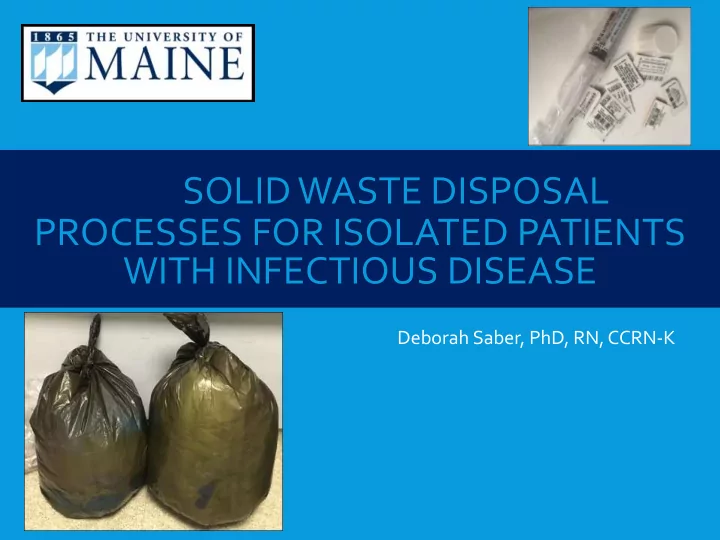
SOLID WASTE DISPOSAL PROCESSES FOR ISOLATED PATIENTS WITH INFECTIOUS DISEASE Deborah Saber, PhD, RN, CCRN-K Broad Brush Background Solid waste is defined as unwanted solid material at the time of generation and it is one of the most
(Chandrappa & Das, 2012)
(Compendium, 2012)
(Compendium, 2012)
(CDC, 2013)
classified as medical waste
(AHA, 2015; Rutala & Weber, 1991)
(Moulton et al., 2013; Zhou et al., 2014)
Black Isolation White Regular Sharp
Medical-Unregulated Regulated
Variable n (%) Regular Waste (Clear) (%) Isolation Gown and Gloves Waste (Black/ Regular) (%) Sharps Container (%) Biomedical bag (Red) (%) Unknown Receptacle (%) Non-latex glove 1028 (30.4) (1.9) (95.9) (0) (0) (2.2) Isolation gown 467 (13.8) (.6) (98.0) (0) (0) (1.4) Isolation gown packaging 437 (13.0) (6.3) (91.6) (0) (0) (2.1) Medication Package 267 (7.9) (68.3) (28.5) (0) (0) (3.2) Plastic syringe 132 (3.9) (21.3) (10.7) (65.3) (2.7) (0) Paper product Paper medicin e cup (0.2) Paper towel & Misc. (2.46) 90 (2.7) (68.4) (26.4) (0) (2.6) (2.6) Gauze bandage 85 (2.5) (60.8) (27.5) (0) (11.7) (0) Alcohol wipe 77 (2.3) (63.6) (32.7) (0) (1.8) (1.9) White/red syringe cap 76 (2.3) (65.0) (28.0) (7.0) (0) (0) Needles and needle cap 63 (1.9) (0) (0) (100) (0) (0)
Variable n (%) Regular Waste (Clear) (%) Isolation Gown and Gloves Waste (Black/ Regular) (%) Sharps Container (%) Biomedical bag (Red) (%) Unknown Receptacle (%) Syringe wrapper 54 (1.6) (61.1) (38.9) (0) (0) (0) Gauze package 51 (1.5) (68.4) (26.3) (0) (0) (5.3) Plastic sleeve for crushed oral pills 48 (1.4) (84.2) (5.3) (5.3) (0) (5.3) Hydrogen peroxide wipe 47 (1.4) (17.6) (82.4) (0) (0) (0) Glucometer strip 29 (0.9) (51.7) (31.0) (3.4) (13.9) (0) Oral syringe 27 (0.8) (17.6) (0) (64.7) (17.6) (0) Patient care pads 27 (0.8) (72.2) (27.8) (0) (0) (0) Lancet 26 (0.7) (0) (0) (92.3) (7.7) (0) Metal item 26 (0.7) (61.1) (33.3) (5.6) (0) (0) Lancet seal 24 (0.7) (29.2) (25.0) (33.3) (12.5) (0) Foam item 24 (0.7) (41.2) (58.8) (0) (0) (0) Bleach wipe 22 (0.6) (16.7) (77.8) (0) (0) (5.5) Suctioning tray for tracheostomy 18 (0.5) (76.9) (23.1) (0) (0) (0)
Variable n (%) Regular Waste (Clear) (%) Isolation Gown and Gloves Waste (Black/ Regular) (%) Sharps Container (%) Biomedical bag (Red) (%) Unknown Receptacle (%) Intravenous fluid bag 17 (0.49) (60.0) (40.0) (0) (0) (0) IV green caps 12 (0.4) (50.0) (60.0) (0) (0) (0) Kerlix packaging 10 (0.3) (50.0) (50.0) (0) (0) (0) Gastrointestinal tube feeding bag 9 (0.3) (71.4) (28.6) (0) (0) (0) Tape 8 (0.2) (57.1) (14.3) (0) (28.6) (0) Intravenous fluid bag 17 (0.49) (60.0) (40.0) (0) (0) (0) Patient care pad package 6 (0.2) (80.0) (20.0) (0) (0) (0) Glass item 6 (0.2) (0) (0) (100) (0) (0) Aluminum item 4 (0.05) (100) (0) (0) (0) (0) Gastrointestinal tube 4 (0.05) (75.0) (25.0) (0) (0) (0) Cloth item 3 (0.01) (100) (0) (0) (0) (0) Isolation mask (0) (0) (0) (0) (0) (0) Isolation goggle (0) (0) (0) (0) (0) (0) Latex glove (0) (0) (0) (0) (0) (0)
2 Patients/Week 1 Patient/Week 1 Patient/Day 1 Patient/Year 143 lbs. 71.5 lbs. 10.2 lbs./day
3,723 lbs. or 1.86 tons
Variable n (%) Number/Patient/ Week Individual Weight (ounces) Weight/Year/Patient (pounds) Non-latex gloves 1028 (14.8) 514 0.125 208.8 Gown and individual Packaging 467 (30.4) 234 1.8 1,369 Empty plastic syringe with packaging 132 (13) 66 0.4 85.8
(Compendium, 2012)
(David et al., 2010)
American Hospital Association. (2015). Sustainability roadmap for hospitals: A guide for achieving your sustainability goals. Retrieved from: http://www.sustainabilityroadmap.org/topics/waste.shtml Begley, S. (2014). Ebola waste disposal has proven a thorny issue: Reuters CDC. Retrieved from http://www.reuters.com/article/us- health-ebola-usa-waste-idUSKCN0HT0P520141004 Center of Disease Control [CDC]. (2003; updated 2014). Guidelines for infection control in healthcare facilities. Retrieved from https://www.cdc.gov/hicpac/pdf/guidelines/eic_in_HCF_03.pdf Center of Disease Control [CDC]. (2013). Antibiotic resistance threats in the United States. Retrieved from https://www.cdc.gov/drugresistance/pdf/ar-threats-2013-508.pdf Chandrappa, R. & Das, B. D. (2012). Solid waste management: Principles and practice. New York: Springer.
https://www.healthcarewaste.org/fileadmin/user_upload/resources/Compendium_Technologies_for_Treatment_Dest ruction_of_Healthcare_Waste_2012.pdf David, M., & Daum, R. (2010). Community-associated methicillin-resistant Staphylococcus aureus: Epidemiology and clinical consequences of an emerging epidemic. Clinical Microbiology Reviews, 23(3), 616-687. Moulton, J., Tambyah, P., Ang, B., Ling, M.L.,& Fisher, D. (2013). The global spread of healthcare-associated multidrug resistant bacteria: A perspective form Asia. Healthcare Epidemiology, 56, 1310-131. Rutala W and Weber D (1991) Infectious waste: Mismatch between science and policy. The New England Journal of Medicine 325(8): 578-582. Zhou, Y., Wilder-Smith, A., & Hsu, L.-Y. (2014). The role of international travel in the spread of methicillin-resistant Staphylococcus