
SLIDE 1
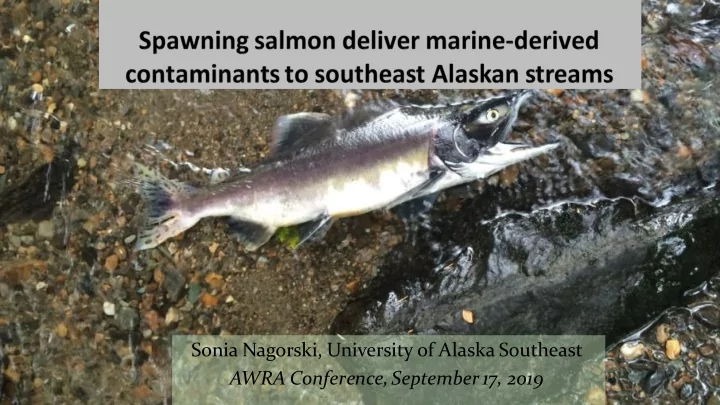
Sonia Nagorski, University of Alaska Southeast AWRA Conference, - - PowerPoint PPT Presentation
Sonia Nagorski, University of Alaska Southeast AWRA Conference, September 17, 2019 Collaborators John Hudson, Independent Aquatic Ecologist, Juneau, AK. Eran Hood and Jason Fellman, University of Alaska Southeast John DeWild, David
➢ John Hudson, Independent Aquatic Ecologist, Juneau, AK. ➢ Eran Hood and Jason Fellman, University of Alaska Southeast ➢ John DeWild, David Krabbenhoft, and staff at USGS Mercury Research Lab, Middleton, WI ➢ Gina Ylitalo at Northwest Fisheries Science Center, Seattle, WA ➢ Undergraduate research assistants: Chris Salazar, Alex Whitehead, and Alex Botelho (UAS)
Increase
biofilm abundance (Mitchell and Lamberti 2005;
Chaloner et al. 2004, 2007; Tiegs et al. 2011; Hood et al 2019)
(Minikawa 1997, Wipfli et al. 1998, Lessard and Merritt 2006)
Heinz et al. 2004)
Salmon growth
Biovectors: Migrating animals may transport and focus pollutants
From Blais et al. Environ. Sci. Technol. 2007
Long-range atmospheric deposition of contaminants
GRAHM (Global/Regional Atmospheric Heavy Metals Model) simulation – Ashu Dastoor, Meteorological Service of Canada,Environment Canada
Average elemental mercury surface concentrations for July 2001 (ng/m3)
Chichagof Island lake sediment cores
show 2.9±0.5-fold increase since industrialization
Engstrom et al. ES&T, 2014
Marine Intertidal Freshwater aquatic Atmospheric deposition
What happens to deposited contaminants?
Salmon Wetland Glacier Upland Forest Toxic methylmercury
Geogenic Hg
Hg POPs POPs Hg
28.4 46.1 34.4 52.5 80.7 57.8 98.5 68.5 68.1 53.5 20 40 60 80 100 120 Baetidae Heptageniida Limnephilidae Ephemerelidae Chloroperlidae Total Hg (ng/g) Peterson A Peterson B
To investigate the relationship between salmon spawner density and
❖ To assess concentrations of marine-derived pollutants in various aquatic components (water, sediment, biofilm, macroinvertebrates, juvenile fish) ❖ Measure upstream (salmon absent) vs. downstream (salmon present) ❖ Compare across streams with varying spawnerdensity
Bridget Cove Cr. Peterson Cr. Shrine Cr. Fish Cr. Salmon Cr.
Stream water: filtered and particulate fractions Streambed sediment Benthic macroinvertebrates Juvenile/resident fish Biofilm on incubated leaves
Hg Hg + POPs
+ Fish density counts 1-3x/ week
Leaf incubation Water samples Sediment samples Fish, BMI samples
1. Salmon spawnerdensities varied among streams
were present (one-way paired t-test, p<0.05) for:
No spawners----------------------------→highest spawner density
Methyl-Hg in Heptageneiid larvae
S a l m
F i s h P e t e r s
B C C S h r i n e
Methyl-Hg (ng g
20 40 60 80 100 120 140
Bed sediment Methyl-Hg
Salmon Fish Peterson BCC Shrine
Methyl Hg in bed sediment (ng g-1 dw)
0.1 0.2 0.3 0.4 0.5 0.6 0.7
Upstream (Site A) Downstream (Site B)
Biofilm+leaves %Hg as MeHg
Salmon Fish Peterson BCC Shrine
% methyl-Hg of total Hg in biofilm+leaves
5 10 15 20
No spawners--------------------------→highest spawner density No spawners---------------------------→-highest spawner density No spawners---------------------------→-highest spawner density
%Filtered Hg as MeHg
Salmon Fish Peterson BCC Shrine
5 10 15 20 25 30 35 Percent methyl-Hg
Upstream (Site A) Downstream (Site B)
well.
Fish tissues: sumDDTs
Salmon Fish Peterson BCC Shrine
sum DDTs (ng/g)
0.0 0.5 1.0 1.5 2.0 2.5 3.0
Fish tissues: HCB
Salmon Fish Peterson BCC Shrine
HCB (ng/g)
0.2 0.4 0.6 0.8 1.0 1.2
Fish tissues: sumPCBs
Salmon Fish Peterson BCC Shrine
sum PCBs (ng/g)
1 2 3 4 5 6
Fish tissues: chlordanes
Salmon Fish Peterson BCC Shrine
sum chlordanes (ng/g)
0.0 0.2 0.4 0.6 0.8 1.0 1.2
were present (one-way paired t-test, p<0.05) for:
aqueous total Hg aqueous methyl-Hg spawner density,
indicating their potential usefulness as a
passive integrator of MeHg and monitoring/assessment tool.
R² = 0.7434 0.2 0.4 0.6 0.8 1 1.2 1.4 1.6 2 4 6 8 10 Mean salmon density (fish/m2) Methylmercury in biofilm (ng/g)
Methyl-Hg in biofilm vs avg salmon density
R² = 0.7227 1 2 3 4 5 6 10 20 30 40 Filtered water (ng/L) Total Hg in biofilm (ng/g)
Total Hg in biofilm vs Filtered water
Alder leaf packs, incubated for biofilm growth, resulted in particularly consistent spatial patterns
4. Other analytes followed this trend but did not pass statistical tests (likely due to
small sample size (n=5)of individual streams.
For example, unfiltered total and methyl-Hg were consistently higher (up to 20x) in the
lower reaches except for in Salmon Creek (no salmon present)
Total Hg (unfiltered water)
Salmon Fish Peterson BCC Shrine
2 4 6 8 10
Methyl-Hg (unfiltered water)
Salmon Fish Peterson BCC Shrine 0.0 0.5 1.0 1.5 2.0 2.5 3.0
(ng L
In the two streams with the highest spawner densities, filtered MeHg was 10 to 11-fold higher in the lower stream reach and made up 5-33% of the total Hg.
Total Hg (unfiltered water)
Salmon Fish Peterson BCC Shrine
2 4 6 8 10
Methyl-Hg (unfiltered water)
Salmon Fish Peterson BCC Shrine 0.0 0.5 1.0 1.5 2.0 2.5 3.0
(ng L
30-day standard for fish-eating wildlife National average
in the salmon-supporting reaches.
with the highest salmon density
2.4 ng/L= Within the top 1% %
the U.S.A. and 12x higher than the national mean (n=336; Scudder et al. 2009). Less than 1 km upstream, with few salmon, the concentration was only 0.18 ng/L).
Methylmercury concentrations in aquatic organisms increase with increasing methylmercury concentrations in water and with increasing trophic level. Fish at the top of the food web tend to have the highest concentrations of methylmercury. (From: USGS Circular 1395 (Wentz et al. 2014).
Fish tissue-total Hg
Salmon Fish Peterson BCC Shrine
total Hg concentration (ng g-1 dw)
50 100 150 200 250 300 350 400
Concern for fish-eating mammals EPA protection of Human health
for fish-eating mammals (Fig.9)
atmospheric influences.
lower stream reaches, indicating a dominant marine source
challenging due to differences in presence (by species, age) above and below barriers.
as a meaningful monitoring tool in streams
to streams to spawn, they can have a measureable effect on contaminant concentrations in stream ecosystems.
monitored into the future as marine contaminant levels change
Funding: INBRE
John Hudson, Independent Aquatic Ecologist, Juneau, AK. John DeWild, David Krabbenhoft, and staff at USGS Mercury Research Lab, Middleton, WI Gina Ylitalo and Bernadita Anulacion at Northwest Fisheries Science Center, Seattle, WA Eran Hood and Jason Fellman, University of Alaska Southeast Undergraduate research assistants: Chris Salazar, Alex Whitehead, and Alex Botelho (UAS)