
SLIDE 1
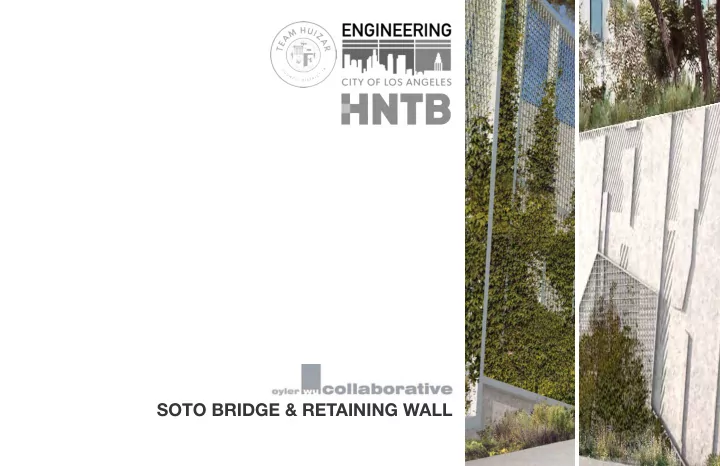
SOTO BRIDGE & RETAINING WALL SOTO STREET ROAD WIDENING | A - - PowerPoint PPT Presentation
SOTO BRIDGE & RETAINING WALL SOTO STREET ROAD WIDENING | A FAMILY OF IMPROVEMENTS As we considered this area of the bridge upgrade and widening, one of the important aspects we took into consideration was the larger Soto Street improvement
As we considered this area of the bridge upgrade and widening, one of the important aspects we took into consideration was the larger Soto Street improvement
characteristics specific to this location yet belongs within a family of improvements.
Like the upper portion of the Soto project (between Mission and Multnomah), the bridge location (and it’s retaining wall to the north) faces a set of design challenges that we’d like to address.Theseinclude:
Over the last several months we’ve developed a number of ideas for the stretch of Soto street between Mission Road and Multnomah Street. We thought it may be helpful to briefly discuss those ideas in order to understand our starting point for the bridge and retaining wall at Valley Boulevard. FortheMission/Multnomahsection,wedeveloped ways to incorporate a green wall into the retaining
that a layered metal mesh might play in the design. Because green walls take some time to grow, we felt it was important that the design serve as both a deterrent against graffiti and has a beautifulaestheticquality prior to full growth. This was achieved through the use of a dense mesh thatislayeredoverthewall-simultaneouslymaking it difficult to graffiti, and providing a system for plants togrowon.Additionally,weconsideredtexturingthe concrete in ways that works in tandem with some of the patterns that occurred in the mesh framework.
Welookedmorespecifjcallyatwaysofcreatingaperceptualthree- dimensionality to the wall, using a system that suggests folds in the surface. In reality, it is a simple (and materially conventional) meshsystemthatisgeometricallycomposedtosuggestathree- dimensional folded surface in the impression of the wall. This idea would also be used at the bridge location. We have also been working on some ideas that are specific to the bridge location, which we will go over in more detail.
HereareafewimagesshowingtheMission/Multnomah section of the wall. The wall includes the steel mesh systemthatwediscussed-inmostcasesdeployedina waythatistwo-dimensional.Itincludesonemomentof three-dimensionalityformingabenchandshadecanopy.
Wehavealsobeenexploringasystemofusingconcrete formworkpatternsthatactsinmultipleways:1)agraffjti deterrent, aesthetically speaking to the folded mesh system, which 2) provides variation in the overall length
That system is created using conventional corrogated panels (ofvaryingsizesanddensities)thatarearrangedtoform patterns across the wall.
As we thought about the bridge section of the roadway at Valley Boulevard, we began by looking closely at some of the geological formationsaroundthearea-specifjcallyalongSotoStreet.Hereare a couple of our images, that we found particularly compelling. This geologyischaracterizedbyvariationinthefracturedrock,witha predominantly diagonal orientation (in hillside locations where it is typically cut), revealing the natural eccentricities that occur in the layers of rock.
Withtheseimagesinmind,weexaminedwaysofabstractingthe geologicalimagesintotwo-dimensionalpatterns.Theintention here was not to replicate the formation precisely, but rather to capture the character using some of the basic characteristics of thegeologytoproduceancreative/artisticrepresentation.Weare interestedinsimultaneouslyexpressinganartisticapproachthat speaksaestheticallytothesomeofthequalitieswe’vedeveloped for the other portion of the wall, having its creative origins firmly embedded in the long history of the site (pun fully intended). These are some of the patterns we have been developing.
Basedonthetwo-dimensionalpatterns,wethenconsidered waystoproducesemithree-dimensionalpatternsthatcould be used at a range of scales. Specifically, we developed two majorareasoffocus:1)theprecastguardrailpanelsofthe bridge, and 2) the retaining wall, adjacent to the north of the bridge, along the western side.
GALVANIZED WELDED WIRE MESH (rather than chain link) PANEL1 Precast pattern in concrete PANEL 2 Precast pattern in concrete GALVANIZED STEEL “embedded” in the precast
ALTERNATING PANELS used to better conceal the simple repetition seen in most precast panels EMBEDDED STEEL ELEMENTS used as fence supports to create a stronger relationship between panel and fencing.