SOUTH AFRICAS REIPP - LESSONS TO-DATE ENERGY SECURITY IS A - - PDF document

south africa s reipp lessons to date
SMART_READER_LITE
LIVE PREVIEW

SOUTH AFRICAS REIPP - LESSONS TO-DATE ENERGY SECURITY IS A - - PDF document

FEATURES SOUTH AFRICAS REIPP - LESSONS TO-DATE ENERGY SECURITY IS A LONG-STANDING ISSUE IN SOUTH AFRICA. ALTHOUGH ITS COST OF POWER IS AMONG THE LOWEST IN THE WORLD, SOUTH AFRICA HAS ENDURED AN ONGOING POWER CRISIS SINCE 2007. BY DAMIAN


slide-1
SLIDE 1

At that time, state power supplier Eskom encountered problems with ageing plants and meeting electricity demand, necessitating power cuts to residents and businesses in the major

  • cities. Country-wide rolling blackouts continue,

constraining economic growth, particularly in the energy-intensive mining and mineral processing

  • sectors. Combined with South Africa’s rapid

industrialisation, these shortages have culminated in an urgent need to increase electricity generation capacity. In addition to increasing demand, the diversification of energy supply is also a key aspect of South Africa’s long-term renewable energy strategy. In its White Paper on Energy Policy 1998 and reiterated in the supplemental White Paper on Renewable Energy 2003 (White Paper), the South African Government considered a range of measures regarding the integration of renewable energies into the mainstream energy economy, and said that an increase in renewable energy capacity would provide improved

  • pportunities for energy trade and would enhance

energy security by encouraging diversity of both supply sources and primary energy carriers. Under the White Paper, South Africa committed itself to a target of a 10,000GW (4%) renewable energy contribution to final energy consumption by 2013, to be produced mainly from wind, solar, biomass and small-scale hydro. In 2011 the Department of Energy (DoE) published the Integrated Resource Plan (IRP), which contemplated the addition of over 55GW of energy generation by 2030 (an increase of more than 170% on existing levels), 42% of which was to be sourced from renewable energy sources. Initially, it was assumed that the additional renewable energy capacity outlined in the IRP would be delivered by the Renewable Energy Feed-In Tariff (REFIT) Programme. Announced in 2009, the REFIT Programme proposed to provide a guaranteed tariff for electricity supply from renewable energy sources that covered the cost of generation plus a “reasonable profit”. In June 2011, the DoE announced that it would no longer proceed with the REFIT Programme and that it would instead procure the additional capacity under a programme now known as the Renewable Energy Independent Power Producers Procurement Programme (REIPP Programme).

REIPP Programme

Under the REIPP Programme, bidders submit bids to construct and operate renewable energy projects and sell power to Eskom. Key features of the REIPP Programme include:

A competitive bid process with five rounds

(phases), with selection on price and non-price criteria;

Bidders must meet minimum thresholds in

respect of economic development requirements in order for their bid to be compliant;

In addition to minimum thresholds, there is a

strong weighting on criteria relating to job creation, local content and ownership, social development, preferential procurement and management control for black South Africans;

Bidders bid the price (tariff) that will be

payable by Eskom (as buyer) pursuant to the power purchase agreement (PPA), with the price not to exceed the price cap for each technology for each phase;

Bidders required to submit the detailed heads

  • f terms of material contracts, including financing

agreements and construction and operation contracts (generally an engineer, procure and construct (EPC) contract and an operating and maintenance (O&M) contract); and

Successful (preferred) bidders required to

reach financial close and commercial operation of the project within specified time-frames. The technologies comprising the REIPP Programme, and their envisaged split, are set out below in Table 1.

Project Finance International November 28 2012 46

SOUTH AFRICA’S REIPP - LESSONS TO-DATE

ENERGY SECURITY IS A LONG-STANDING ISSUE IN SOUTH AFRICA. ALTHOUGH ITS COST OF POWER IS AMONG THE LOWEST IN THE WORLD, SOUTH AFRICA HAS ENDURED AN ONGOING POWER CRISIS SINCE

  • 2007. BY DAMIAN MCNAIR, PARTNER, HEAD OF FINANCE AND PROJECTS ASIA-PACIFIC, AND ALISON DODD,

SENIOR ASSOCIATE, FINANCE AND PROJECTS, DLA PIPER.

FEATURES

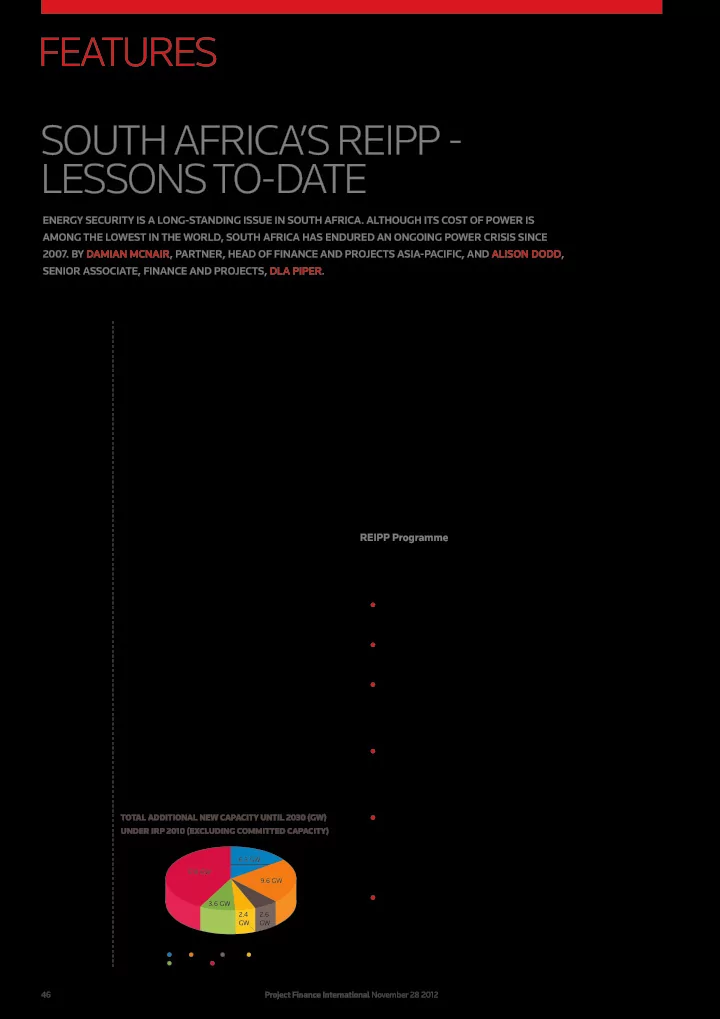
Coal Nuclear Hydro Gas-CCGT Peak-OCGT Renewables 15% 23% 6% 42% 9% 5% 17.8 GW 6.3 GW 9.6 GW 2.6 GW 2.4 GW 3.6 GW

TOTAL ADDITIONAL NEW CAPACITY UNTIL 2030 (GW) UNDER IRP 2010 (EXCLUDING COMMITTED CAPACITY)

slide-2
SLIDE 2

Project Finance International November 28 2012 47

SOUTH AFRICAN RENEWABLES

The bid submission date for Phase 1 of the REIPP Programme was November 4 2011, with 53 bids received. Of these, approximately 50% were for wind projects and 48% were for solar PV and CSP. The 28 preferred bidders were announced on December 7 2011, with projects comprising a total of 1,275MW of installed

  • capacity. Phase 1 preferred bidders were initially

required to finalise all of their contractual arrangements by May 22 2012, although this date was extended and the final date for financial close was November 16 2012. The “not to exceed” price cap for each technology that bidders were required to bid against for Phase 1 is set out below in Table 2. The Phase 1 projects will be delivered at a tariff

  • f R1.14 kW/h for wind, R2.76/kWh for solar PV

and R2.69/kWh for CSP. The competitive bid process under the REIPP Programme has resulted in reduced tariff prices bid for Phase 2 projects, and this downward trend of tariff pricing is expected to continue in Phase 3 and subsequent phases. The Phase 2 bid submission date was March 5 2012 and 19 preferred bidders were announced on May 21 2012. Preferred bidders were initially required to reach financial close by December 2012, but the date for financial close for Phase 2 has been extended to March 18–28 2013. The bid submission date for Phase 3 has also been extended from October 1 2012 to May 7 2013, with the financial close date for Phase 3 to be confirmed. On October 29 2012, the DoE announced that it intended to procure an additional 3,200MW of renewable energy capacity between 2017 and 2020, in addition to the 3,725MW currently being procured to 2016 under the REIPP Programme. It is generally understood that this additional capacity will be added to allocation available in the later phases of the REIPP Programme. Given that 2,460MW has been allocated during Phases 1 and 2

  • f the REIPP Programme, this additional amounts

means that a total of 4,360MW of capacity remains for allocation during Phases 3 to 5.

Contractual structure for projects under the REIPP Programme

Preferred bidders under the REIPP Programme are required to enter into the following (non-negotiable) documents in order to reach financial close:

A PPA with Eskom; An implementation agreement (IA) with the

DoE;

Transmission agreement or distribution

agreement with Eskom (depending on which network the facility will connect to); and

A direct agreements – (all together, the project

documents.) The DOE has issued a number of clarifications in the form of briefing notes to the versions of the project documents released with the RFP and the RFP documentation itself. These clarifications have related to a range of issues, including definitions such as “contracted capacity” used in the project

  • documents. Uncertainty still remains in relation to

some issues despite the Briefing Notes, such as the role of, and contractual arrangements relating to, the Independent Engineer in the testing regime established by the Project Documents.

Key project finance issues and lessons learned

Under the non-negotiable REIPP Programme project documents, the project company is entitled to relief in respect of a number of narrowly defined circumstances, including in respect of force majeure, compensation events (breaches by Eskom of its PPA obligations), system events (delays in connecting the facility to the grid and grid unavailability) and unforeseeable conduct (broadly equivalent to change in law risks). To minimise exposure to risk, lenders require project companies to ensure that their contracts “pass through” all relevant obligations to contractors and to ensure that contractors’ entitlements to extensions of time or costs are “back to back” with and limited to the project company’s limited entitlements under the project

  • documents. Where a pass-through of obligations

to contractors is not possible, project companies have looked to insurance or other sponsor support methods to mitigate risks under the project documents to the satisfaction of lenders. Forms of sponsor support utilised have included equity subscription agreements (base and standby equity), completion guarantees of whole or part

  • f the debt until commercial operation of the

facility, bank guarantees to support completion guarantees and cost overrun guarantees. Lenders have also paid particular attention to aligning, and minimising any gaps between, the provisions of the project documents and the EPC and O&M contracts regarding a range of issues including site risk, the exclusion of special or

TABLE 1 - TECHNOLOGY SPLIT Proposed Percentage Technology amount (MW) allocation (%) Onshore wind 1,850 49.7 Concentrated 200 5.3 solar power Solar photovoltaic 1,450 38.9 Biomass 12,5 0.3 Biogas 12,5 0.3 Landfill gas 25 0.7 Small hydro 75 2.0 (<10MW) Small projects IPP Total of 100 2.8 Total 3,725 100 TABLE 2 - PRICE CAPS Technology Commercial energy rate (R) (MWh) Onshore wind 1,150 Solar PV 2,850 Solar CSP 2.850 Biomass 1,070 Biogas 800 Landfill gas 840 Small hydro 1,030

slide-3
SLIDE 3

consequential loss and dispute resolution processes. The project documents also contain specific

  • bligations in relation to Corrupt Acts (as defined

under the Prevention and Combating of Corrupt Activities Act 2004) and Economic Development

  • Obligations. Lenders’ pass-through requirements

have included exceptions from any cap on liability

  • f a contractor under an EPC or O&M contract for

committing Corrupt Acts or failing to comply with Economic Development Obligations. Financial market concerns regarding “eurozone” issues have resulted in lenders paying close attention to the form of guarantee and the creditworthiness of the party providing guarantees under the Project Documents and other contracts. Similar concerns, coupled with a reduction in international demand due to uncertain government policies and increasing debt levels, have also resulted in recent downgrades to the credit ratings of a number of solar and wind equipment manufacturers.

Observations on project financing for Phase 1

The total debt funded section of the Phase 1 projects at financial close reached just under US$3bn. Debt financing of the REIPP Programme has been dominated to-date by domestic financiers and lenders. This is due in part to foreign exchange protection regarding the South African rand, thereby limiting the involvement of international lenders which are used to more flexibility. A number of the domestic lenders have provided debt finance to multiple projects under Phase 1 and Phase 2. The large volume of projects under the REIPP Programme has meant that many lenders have accepted risk across multiple projects, which has contributed to a more conservative attitude to passing-through or mitigating the risks in the Project Documents than might otherwise be expected. Equity capital has been contributed by investors from a range of locations including Italy, Germany, Spain, the US, the UK and Australia, along with domestic investors. In many projects equity investors have played an additional role in the project, such as EPC contractor or O&M contractor. Development finance institutions such as Development Bank of Southern Africa and Industrial Development Corporation have also involved in many projects under the REIPP Programme as lenders, financial advisers or equity investors. It is expected that more international investors, developers, contractors and manufacturers will be involved in Phase 3 and future rounds of the REIPP

  • Programme. This is partly due to the increased

certainty regarding the REIPP Programme following the successful completion of the Phase 1 financial close process. The high levels of expertise in Europe, combined with the parlous state of solar and wind markets in that region, are also expected to result in further interest from a range of participants.

Future challenges

Meeting and maintaining the Economic Development Obligations will present an ongoing challenge for developers and investors in the REIPP Programme. The DoE has declared that requirements for local content in each project will be increased with each successive bid phase. This will make it increasingly challenging to establish projects in areas of low population density or lacking the requisite skills and industry to satisfy these local content requirements. Attracting more international companies may also be increasingly difficult given the mandated local ownership requirements for the project

  • company. For example, for Phase 1 a 12%

minimum (with a target of 30%) of the shareholding of a project company was required to be held by black South African individuals or

  • enterprises. These local ownership levels, as well

as job creation, management control and other economic development requirements, will increase in future Phases. Ambitious procurement and construction deadlines, combined with a large number of projects, also have the potential to stretch sub- contractor resources that satisfy both the local content and local ownership thresholds required under the Economic Development Obligations in the Implementation Agreement. A matter that has the potential to create issues in future is the mismatch between the dispute resolution process mandated under the project documents (which provides for litigation in South Africa) and the accepted commercial practices of many international contractors (which will often refuse to accept domestic litigation and instead require international arbitration). As a result, many construction and operating and maintenance contracts (and related major subcontracts) provide for dispute resolution by international arbitration, rather than by litigation as under the project

  • documents. This has the potential to create delays

in the dispute resolution process and possible issues relating to the consolidation of claims. There are also concerns about the ability of Eskom to deliver the works necessary to connect project facilities to the grid to project companies to meet the timing obligations under the project documents where project companies have elected for Eskom to undertake these works. This risk may be mitigated to some extent by the ability of the project company to engage contractors to perform self-build or own-build works under standard form agreements with Eskom. However, the mismatching of some elements of risk and some key terminology (such as the definition of force majeure) between the standard form agreements provided by Eskom and the project documents has the potential to create future challenges. Despite these challenges, bid numbers and competition to enter the REIPP Programme continue to grow, indicating increased interest and confidence, with Phase 2 receiving 79 bids compared with 53 bids received in Phase 1. The recent announcement by the DoE regarding the additional 3,200MW to be allocated to Phases 3, 4 and 5 demonstrates the South African Government’s commitment to the REIPP Programme.

Project Finance International November 28 2012 48