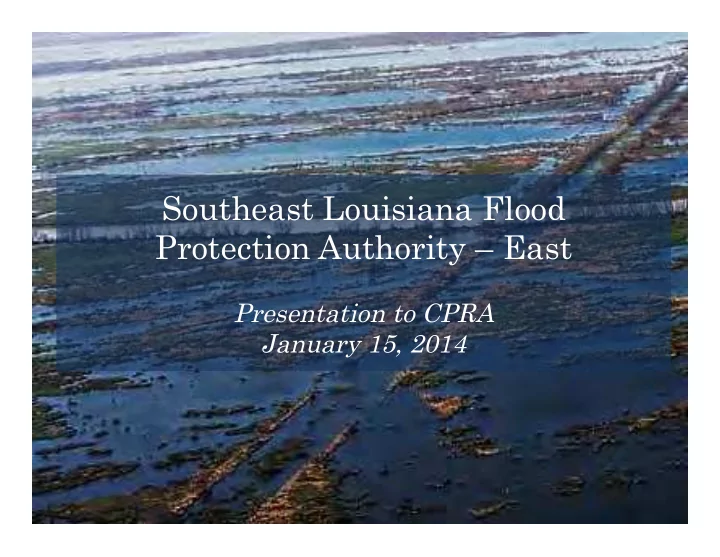
Southeast Louisiana Flood Protection Authority East Presentation - - PowerPoint PPT Presentation
Southeast Louisiana Flood Protection Authority East Presentation to CPRA January 15, 2014 Three Points Today I. SLFPA-Es lawsuit is based upon sound science and undisputed fact. II. We address Mr. Gravess criticisms of the lawsuit.
Three Points Today
- I. SLFPA-E’s lawsuit is based upon sound
science and undisputed fact.
- II. We address Mr. Graves’s criticisms of
the lawsuit. III.SLFPA-E’s lawsuit will bridge funding gaps in coastal restoration and hold the
- il & gas industry responsible for the
harm it caused.
2
Background
The Southeast Louisiana Flood Protection Authority - East
SLFPA-E’s Mission “[T]he protection of the entire territory of the authority from
- verflow.”
La. Rev. Stat. § 38:330.2(G).
The Buffer Zone
The Importance of the Buffer Zone
6
“Barrier arrier is islan ands ds, mars marshes es, an and swamps amps throug hroughou hout our
- ur coas
coast red reduce uce incom incoming ing stor torm surg urge, e, he helping lping to to red reduce uce floo lood imp impacts
- acts. If we continue to
lose these habitats, the vulnerability of communities, nationally important to navigation routes, and energy infrastructure will increase
- substantially. In addition, our
- ur flood
lood pr protec
- tection
tion system tems wil ill beco become me mor more vulnerab lnerable le as as the the lan and aroun around them them erodes
- des.”
The Buffer Zone
Delacroix
Land Loss in Delacroix
Delacroix 1956
Delacroix 1965 Canal dredged 1961
Delacroix 1972 Canal dredged 1971
Delacroix 1989 Canal dredged 1983
Devon Energy Murphy Oil
Delacroix 2008
Devon Energy Murphy Oil Devon
- n Energy Permit 1983 – Well abandon
doned ed 1994 “Upon abandonment of the well location, the spoil banks around the herein permitted canal shall be degraded to marsh level. The dredg dged ed material shall be returned ed to the canal or spread adjacen ent to existing marsh in open water areas to an elevation not more than 1’ above that of adjacent marsh in an effort to crea eate marsh and encou
- urage veget
etation
- n.”
“Upon abandonment of the well location the herein permitted canal shall be plugged with an earthen dam not less than 3’ MSL and topped with a 6” shell cap.” CZMA Regulation
- ns (1980)
“Mineral exploration and production sites shall be cleared, revegetated, detoxified, and … restored as near as practicable to their
- riginal
condition upon termination of operations to the maximum extent practicable.” LAC 43:I.719(M).
Delacroix 2008
Devon Energy Murphy Oil
Delacroix 2008
Delacroix 2008
Devon Energy Murphy Oil
Delacroix 2008
Devon Energy Murphy Oil
Rig Access Canals
Delacroix
Devon Energy Murphy Oil
Bayou Terre aux Boeufs
1956 - 2008
“So, why are we losing land? What’s going on here?”
- Garret Graves, presentation to SLFPA-E, Dec. 19, 2013.
20
The Big Question:
Oil and gas industry activities.
21
The Plain Answer:
- I. CPRA’s Lawsuit is Based on
Sound Science and Undisputed Fact.
Studies Conclude that Oil & Gas Activities Contributed to Coastal Loss
- L. St. Amant, 1971
US Bureau of Land Management, 1972 US Army Corps of Engineers (S.M. Gagliano), 1973 US Army Corps of Engineers, 1973 US Environmental Protection Agency, 1976 D.W. Davis, 1976 N.J. Craig et al., 1979 National Oceanic and Atmospheric Administration, 1980 Fruge, 1981 Johnson & Gosselink, 1982 US Fish and Wildlife Service, 1983 US Geological Survey, 1983 R.E. Turner et al., 1984 Louis isian ana Mid-Contin inent Oil and Gas Associat ciatio ion, 1985 Minerals Management Service, 1985 LSU Center for Wetland Resources, 1985 Louisiana Geological Survey, 1987 Mineral Management Service, 1987 US Fish and Wildlife Service, 1987 Americ ican an Petro roleum Instit itute, 1988 LA Dept of Natural Resources/US Fish and Wildlife Service, 1988 Minerals Management Service, 1989 Penland et al., 1990 Louisiana Geological Survey, 1991 US Environmental Protection Agency, 1992 US Department of the Interior, 1994 Penland et al., 1996 US Environmental Protection Agency, 1997 US Geological Survey, 2001 US Geological Survey, 2004 US Army Corps of Engineers, 2004 Louisiana Sea Grant, 2008 LACPR, USACE, 2009 Minerals Management Service, 2009 Gulf Coast Ecosystem Restoration Task Force, 2011
Shell’s Former Chief Offshore Engineer Agrees
- Robert Glenn Bea
- Former chief offshore engineer for Shell Oil Co.
- Head of the National Science Foundation study team on Hurricane Katrina
- 2006 Affidavit prepared for the State of Louisiana
24
Shell’s Former Chief Offshore Engineer Agrees
- Robert Glenn Bea
- Former chief offshore engineer for Shell Oil Co.
- Head of the National Science Foundation study team on Hurricane Katrina
- 2006 Affidavit prepared for the State of Louisiana
25
“There is clear evidence that pas ast an and cu curr rrent ent oil
- il and
nd gas as activ activit ities ies ha have made made and nd contin continue ue to to mak ake sub ubstant tantial ial contr contribu ibutions ions to to deg degradati radations
- ns
in the natural defenses against hurricane surges and waves in coastal Louisiana. . . . All of these works and activities have contr contribu buted ted sig ignif nificantly icantly to to the the los loss of
- f
na natural tural def efens enses es such ch as as ba barr rrier ier bea beaches ches, wetlands etlands, an and mars marshes
- hes. In several important cases, it was the
los
- ss of the
these na natural tural def defen enses es that that cont contributed ributed to to the the un unan anticip icipated ated breac breaches hes of
- f flood
lood prot rotect ection
- n facili
acilities ties that protected the greater New Orleans area during hurricane Katrina and led to repeated flooding during hurricane Rita.”
26
SLFPA-E’s Mission: “[T]he protection of the entire territory of the authority from
- ve
verflow.” La. Rev. Stat. § 38:330.2(G). Bea Affidavi vit:
“. . . It was the loss of these natural defenses that contributed to the un unan anticip icipated ated breache breaches of
- f flood
lood pr protec
- tection
tion faci acilit lities ies tha hat pr prote
- tect
cted ed the the greater reater New New Orleans rleans area area during hurricane Katrina and led to repeated flooding during hurricane Rita.”
27
One Result of Overflow – August 2005
- Mr. Graves Agrees
“No one is saying that historic oil and gas activities did not leave scars,” Graves said.
Jindal demands East Bank levee authority drop lawsuit against
- il,
gas, pipelines, Mark Schleifstein, www.nola.com, July 24, 2013.
28
- Mr. Graves Agrees Again
29
“The debate here is not about whether or not historic oil and gas activities in the coastal zone contributed to wetlands loss. Th The scars are there.”
- Letter, Garret Graves to Timothy P. Doody,
July 26, 2013.
- Mr. Graves Agrees Yet Again
“As I noted earlier, the historic energy production and activity that date back into the early 1900s, they contributed to land loss. Whe hethe ther it it’s the he pip ipeli eline ne can anals als, the he access ccess can anals als, the the ext xtra raction tion, they hey contrib ibut uted ed.”
- Garret
Graves, Testimony at Joint Transportation Committee hearing, Aug. 14, 2013.
30
- Mr. Graves Agrees Once More
“I will be the first one to admit, the here’s liabil ilit ity the there,” Graves said. “I’m not an apologist for the oil and gas industry, I’ll be the first to tell you that.”
- Jeff Adelson, Maneuvering for Levee Board seats begins
amid lawsuit controversy, THE ADVOCATE, Sept. 16, 2013.
31
32
CPRA Agrees, Too
33
34
August st 7, 2013 13 WHAT’S ’S CAUSIN ING THE CRIS ISIS? IS?
“Canal dre dredg dgin ing has ha had one ne of the he most dr dramatic ic effe fects ts
- n
wetla tland nd growth and nd regene neratio tion. In addition to directly des destr troyin ing marshe hes in the path of the canal, the plants are unable to recolonize, and thus the marsh is unable to regenerate itself. Once canals are dredged, most grow larger as the sustainable areas
- f
marsh subsequently decrease.”
35
August st 7, 2013 13
“IND NDUSTR USTRIAL IAL NEG NEGLIG IGENCE ENCE: ... and in the early to mid-20th century, oil and gas exploration activities incr ncrease sed the he dredg dging ng
- f canals
als.”
36
August st 7, 2013 13
“As the century continued, oil and gas became prominent economic drivers and critical resources for our nation. Access to these was provided by navi aviga gation tion can canals als and nd pip ipeli elines nes whi hich ch cris risscros scrossed sed Sou
- uth
th Lou Louis isiana ana marsh arshes es. Unfortunately, in the process the coastal marshes were lost when spoil banks were left randomly throughout the area, dis isas astrousl trously alter lterin ing the the natural hydrol rology
- gy of the region
- n.”
37
August st 7, 2013 13
Rig Access Canals Bayou Terre aux Boeufs
“. . .disastrously altering the natural hydrology . . . .”
Murphy Oil Devon Energy
Delacroix
1956 - 2008
- Mr. Graves Wants to Kill the Suit
“Asked if the state’s strategy could conceivably involve litigation against energy companies for historical wetlands damage, Mr. Graves said that was ‘no not our ur plan A, B, C, D or X.’”
- Facing Fire Over Challenge to Louisiana’s Oil Industry,
Campbell Robertson, New York Times, August 31, 2013.
40
“Canal dredging has had one of the most dramatic effects on wetland growth and regeneration. In addition to directly destroying marshes in the path of the canal, the plants are unable to recolonize, and thus the marsh is unable to regenerate itself. Once canals are dredged, most grow larger as the sustainable areas
- f
marsh subsequently decrease.”
41
“INDUSTRIAL NEGLIGENCE: ... and in the early to mid-20th century, oil and gas exploration activities increased the dredging of canals.”
42
“As the century continued, oil and gas became prominent economic drivers and critical resources for our nation. Access to these was provided by navigation canals and pipelines which crisscrossed South Louisiana marshes. Unfortunately, in the process the coastal marshes were lost when spoil banks were left randomly throughout the area, disastrously altering the natural hydrology of the region.”
43
The Litmus Test
“‘To be very clear, the governor has said that the the lawsuit is is a li litm tmus us te test.
- t. Pe
Perio iod,’ said Coastal Protection and Restoration Authority Chairman Garret Graves, who has been the administration’s chief spokesman in criticizing the lawsuit.”
- Jeff Adelson, Levee board suit supporters are likely to
lose seats, THE ADVOCATE, Sept. 16, 2013.
44
- II. Addressing Mr. Graves’s Criticisms.
Baseless Criticism and Misinformation
The following slides demonstrate that:
- A. Mr. Graves has recently minimized the
- il and gas industry’s role in causing
coastal land loss.
- B. Mr. Graves’s criticisms of the lawsuit,
lawyers, and SLFPA-E are incorrect and misleading.
46
Minimizing the Industry’s Role
“But I would consider the Corps
- f
Engineers implications as a heart attack; I would consider the BP implications as a major cut that needs to be stitched; and, comparatively, based upon science that’s been done
- ver
and
- ver
again, the the impacts ts of the the oil il and nd gas ind indus ustr try would uld be more like a scrape pe.”
- Garret
Graves, Interview with Garland Robinette, WWL, Nov. 19, 2013.
47
Minimizing the Industry’s Role
“I’ve had neighbors that have done things that have been offensive to me. I haven’t filed a lawsuit. I’ve gone
- ver and knocked on the door and
said, you know what, ca can yo you pick ck up the dog poop in my yard?”
- Garret Graves, presentation to SLFPA-E, Nov. 21, 2013.
48
Minimizing the Industry’s Role
- Mr. Graves has cited three reports to
suggest that oil and gas was not the problem:
- Department of Interior Report
- National Research Council Report
- White House Report
- Garret Graves, presentation to SLFPA-E, Dec. 19, 2013.
49
50
Setting the Record Straight: the Department of Interior Report
“Can anal al dredg edgin ing occ ccurs urs to to cre reate te or dee deepen pen chan channels ls for na navig igat ation ion an and to to em embed bed oil
- il an
and gas as pip pipel elines
- ines. The dredging
digs up sediment that is then deposited as spoil banks along the canals, thus filling existing wetlands. Can anal al dred redging ing an and spoil poil dep depos
- sits
its acc ccoun
- unted
ted for
- r betw
between een 30 30 an and 59 59 per percent cent
- f
- f the
the coa coasta tal wetl etlan and los losses es in Louis
- uisian
ana from rom 19 1956- 6-19 1978 78 (Turner and Cahoon 1988; Turner 1987). About 8200 miles
- f canals traverse the coastal wetlands....While the loss
from the initial construction of canals is significant, the the greates atest damage occur curs over the longer er run.”
“The Impact of Federal Programs on Wetlands, Vol II,” A Report to Congress by the Secretary of the Interior, p. 146 (1994).
51
Setting the Record Straight: the National Research Council Report
“Oil il an and gas as ex exploration,
- ration,
with ith its its as associa ciated ted cana canal dr dredg edging ing, peak peaked ed in in the the 19 1960 60s to to 19 1980
- 80s. Can
anals als, an and the the spoil poil ban anks form rmed ed during during th their ir cons construction, uction, alter alter local local water ater cir circula culation tion patt patterns erns an and sedim diment ent de depos
- sit
itiona ional pr proce
- cesses
- es. Spoi
Spoil ba bank nks imp impede ede the he flow low of
- f water
ater, cau causing ing an an inu inundat ndation ion that that may may be be furthe urther ex exacerbated acerbated by by sea ea lev level el ris rise.
- e. Thes
hese proc rocesses res result ult in the the dro rownin ning of
- f frag
ragile le ter terres restr trial ial veg egetat etation ion. Freshwater vegetation is also adversely affected by saltwater intrusion from sea level rise
- r along canals that provide a route for saltwater to intrude
into typically freshwater areas . . . .”
Dean, R., J. Benoit, et al., “DRAWING LOUISIANA'S NEW MAP: ADDRESSING LAND LOSS IN COASTAL LOUISIANA.” National Research Council
- f
the National Academies, p. 16 (2006).
Setting the Record Straight: the Position of the White House
- December 2011 Report of the Gulf Coast
- Ecosystem. Restoration Task Force, established
by President Obama.
- Cover letter signed by Garret Graves, Task Force
Vice–Chairman.
Conclusion, p.8:
52
“Channels and canals for naviga gation and oil and ga gas activi vity in Texas and Louisiana have allowed a greater inflow of salt water from the Gulf of Mexico into the estuaries. In some cases, this has cause sed saltwater intrusi sion into fresh shwater ma marshes and forest sted wetlands, s, st stress ssing these se habitats and converting them to open water.”
- Mr. Graves’s
Response to the Lawsuit
- 1. Suggested lawsuit was filed without
cooperation or information.
- 2. Said SLFPA-E had no authority to sue.
- 3. Attacked lawyers and contract.
- 4. Alleged interference with BP lawsuit.
- 5. Asserted that MRGO plan addresses
SLFPA-E’s flood protection needs.
- 6. Exaggerated adverse economic effects.
53
- 1. Failure to Cooperate?
54
“[A]ll this has -- has been happening behind closed doors for several months now without any
- pportunity
for discussion with -- with all the folks that truly have authority in this case . . . .”
- Garret Graves, Aug. 15, 2013 interview.
- Mr. Graves Was Well Informed
About SLFPA-E’s Lawsuit
- Decem
cember ber 4, 2012 – Mr. Graves met with SLFPA-E Board President Tim Doody and Vice-President John Barry and was informed of the suit. Mr. Graves requested that SLFPA-E meet with Jimmy Faircloth to discuss a suit against the Army Corps instead.
- January
ary 17, 2013 – Mr. Graves attended the SLFPA-E Board meeting, at which SLFPA-E’s counsel was present, during which he was further apprised of the suit.
- January
ary 2013-Marc March 2013 – Mr. Barry contacted Mr. Graves periodically to remind him of SLFPA-E’s continuing intent to proceed with the suit and to follow up on Mr. Graves’s request for a meeting with
- Mr. Faircloth to discuss the suit.
55
- Mr. Graves Was Well Informed
About SLFPA-E’s Lawsuit
- April
il 2, 2013 – Mr. Doody relayed the SLFPA-E’s intention to proceed with the suit to Jerome Zeringue,
- Mr. Graves’s deputy.
- July 12, 2013 – Mr. Doody discussed the suit directly
with Mr. Graves yet again.
- July 17, 2013 –Mr. Graves was advised of the suit at
the CPRA Board meeting, a week before the suit was filed.
- July 20, 2013 – Mr. Barry e-mailed Mr. Graves
confirming the SLFPA-E’s intention to file the suit that following Wednesday, July 24, 2013.
56
- 2. Disputing SLFPA-E’s Authority
“. . . Louisiana law provides a process ss for filing lawsu suits, s, hiring outside counse sel and for ma making significant decisions su such as filing a lawsuit against 100 companies. Louisiana law and our constitution
- rganize
government and place certain responsibilities with accountable
- entities. However, SLFPA-E’
E’s recent decision violates those se principles.”
- Garret Graves, Letter to SLFPA-E Board President Tim Doody,
July 26, 2013.
57
Setting the Record Straight
“The board ma may su sue and be su sued under the style
- f Board of Commissioners for the respective
district.”
- La. Rev. Stat. § 38:309(B).
SLFPA-E’s Mission: “[T]he protection of the entire territory of the authority from overflow.”
- La. Rev. Stat. § 38:330.2(G).
58
CPRA’s Attorney Disagrees with Mr. Graves
“The attorney ge general or his design gnee sh shall be the lega gal adviso sor to the [CPRA] A] board, shall counsel and advise the board, and shall represent the board in all legal proceedings.”
- La. Rev. Stat. §49:214.5.7.
“SLFPA and its levee districts often exercise the constitutional and legal rights the Legislature gave them to hire special counsel . . . . When SLFPA decided to sue 97 se separate oil and ga gas companies, s, they abided by the law.”
- Letter, Attorney General Caldwell to State Sen. Adley, Nov. 25,
2013.
59
- 3. Distorting the Contract
“. . . I don’t think that there’s anyt ything that would preve vent this contract from being inherited by the great, great, great, great, gr great grandchildren of the attorneys ys that are worki king
- n it now and in the future suing against
st recreational fisherma man 200 years from now. ” “ . . . you are now indentured servants . . . .”
- Garret Graves, presentation to SLFPA-E, Dec. 19, 2013.
60
- 3. Distorting the Contract
“. . . you could have an accum accumul ulat ating ing valu alue every time there’s a storm, ev every ry tim time there’ there’s a bird ird bor born, n, ev every ery time there’ re’s a fish that’ t’s hatched ched.” “So tod today ay it’ it’s oil
- il an
and gas as, tom tomorr rrow you
- u could
could go af after ter his histor toric ic tim timber ber – Cypress and Tupelo logging operations that happen in the Maurepas swamp or other areas but the scars are still there today. The he nex next da day you
- u coul
could go af after ter ship hipper pers who ho are are cr creat eatin ing wav ave energ energy in the coastal area which contributes to erosion.”
- Garret Graves, presentation to SLFPA-E, Nov. 21, 2013.
61
Setting the Record Straight
62
Setting the Record Straight
63
“We have agreed that we will not pursue entities . . . in in an any indus industr try
- ther
- ther than
than the the oi
- il,
l, gas as, an and pip pipel eline ine indus industr tries ies without the SLFPA-E’s prior approval . . . .”
Setting the Record Straight
64
“We have agreed that we will not pursue entities . . . in in an any indus industr try
- ther
- ther than
than the the oi
- il,
l, gas as, an and pip pipel eline ine indus industr tries ies without the SLFPA-E’s prior approval . . . .” “. . . if there is a settlement or . . . .” “. . . if there is a settlement or judgment that compels a defendant to undertake restoration and/or remediation efforts, the SLFPA-E sha hall ll not not be be res respon ponsible ble for pay paying ing an any attor attorney eys fees ees in in conne connect ction ion with ith tha that res resto torat ration ion an and/ d/or rem remedi diation ation . . . .”
Setting the Record Straight
65
“We have agreed that we will not pursue entities . . . in in an any indus industr try
- ther
- ther than
than the the oi
- il,
l, gas as, an and pip pipel eline ine indus industr tries ies without the SLFPA-E’s prior approval . . . .” “. . . if there is a settlement or . . . .” “. . . if there is a settlement or judgment that compels a defendant to undertake restoration and/or remediation efforts, the SLFPA-E sha hall ll not not be be res respon ponsible ble for pay paying ing an any attor attorney eys fees ees in in conne connect ction ion with ith tha that res resto torat ration ion an and/ d/or rem remedi diation ation . . . .” “. . . the fee payable by the SLFPA-E would be calculated on the amount of [any cash
- r
cash-equivalent] payment, not not on
- n th
the value lue of the the res restor toration ation
- r
- r
re remed mediation ation the defendant was
- rdered
to make . . . .”
Setting the Record Straight
66
“We have agreed that we will not pursue entities . . . in in an any indus industr try
- ther
- ther than
than the the oi
- il,
l, gas as, an and pip pipel eline ine indus industr tries ies without the SLFPA-E’s prior approval . . . .” “. . . if there is a settlement or . . . .” “. . . if there is a settlement or judgment that compels a defendant to undertake restoration and/or remediation efforts, the SLFPA-E sha hall ll not not be be res respon ponsible ble for pay paying ing an any attor attorney eys fees ees in in conne connect ction ion with ith tha that res resto torat ration ion an and/ d/or rem remedi diation ation . . . .” “. . . the fee payable by the SLFPA-E would be calculated on the amount of [any cash
- r
cash-equivalent] payment, not not on
- n th
the value lue of the the res restor toration ation
- r
- r
re remed mediation ation the defendant was
- rdered
to make . . . .” “. . . SLFPA-E shall have the the right ht to to ter terminate minate the the attor attorney neys for
- r
caus cause . . . .”
- 4. Interference with BP Lawsuit?
“. . . BP is going to pick up your allegations and they are going to argue, wait a minute, you can’t hold us accountable for this. You are on the state board over there saying that all this was a result of the oil and gas activity. They hey are are going going to us use you your sci science ence and nd your your argu rgumen ments ts to to dimini minish sh our ur case, case, so so you you are are doin
- ing work
- rk for
for BP righ right no
- now. That’s
what’s happening.”
- Garret Graves, presentation to SLFPA-E, Dec. 19, 2013.
67
Studies Conclude that Oil & Gas Activities Contributed to Coastal Loss
- L. St. Amant, 1971
US Bureau of Land Management, 1972 US Army Corps of Engineers (S.M. Gagliano), 1973 US Army Corps of Engineers, 1973 US Environmental Protection Agency, 1976 D.W. Davis, 1976 N.J. Craig et al., 1979 National Oceanic and Atmospheric Administration, 1980 Fruge, 1981 Johnson & Gosselink, 1982 US Fish and Wildlife Service, 1983 US Geological Survey, 1983 R.E. Turner et al., 1984 Louis isian ana Mid-Contin inent Oil and Gas Associat ciatio ion, 1985 Minerals Management Service, 1985 LSU Center for Wetland Resources, 1985 Louisiana Geological Survey, 1987 Mineral Management Service, 1987 US Fish and Wildlife Service, 1987 Americ ican an Petro roleum Instit itute, 1988 LA Dept of Natural Resources/US Fish and Wildlife Service, 1988 Minerals Management Service, 1989 Penland et al., 1990 Louisiana Geological Survey, 1991 US Environmental Protection Agency, 1992 US Department of the Interior, 1994 Penland et al., 1996 US Environmental Protection Agency, 1997 US Geological Survey, 2001 US Geological Survey, 2004 US Army Corps of Engineers, 2004 Louisiana Sea Grant, 2008 LACPR, USACE, 2009 Minerals Management Service, 2009 Gulf Coast Ecosystem Restoration Task Force, 2011
- 5. Federal Plan for
MRGO Is Not a Cure-All
“So here you are filing a lawsuit I'm concerned that is then trying to apportion blame to the energy industry for an area that Congress says and federal law says is the responsibility
- f
the Corps
- f
- Engineers. It’s their job to do this.”
- Garret Graves, presentation to SLFPA-E, Dec. 19, 2013.
69
CPRA Master Plan SLFPA-E Lawsuit MRGO Plan*
70
MRGO Plan Is Not a Cure-All
*$3 billion not appropriated
71
- 6. Misinformation About
Effects on Louisiana’s Economy
“Folks have indicated – and I don’t want to oversell this – a portion of the Shell decision was related to increased costs associated with litigation here.”
- Garret Graves, presentation to SLFPA-E, Dec. 19, 2013.
72
Setting the Record Straight
“Royal Dutch Shell Plc (RDSA), Europe’s biggest oil company, halted plans to build a $20 billion gas-to-liquids plant in Louisiana, citing the po poten ential cost and uncer ertainty abou
- ut fu
future crude de and natural gas prices.”
- Shell
Halts $20 Billion Louisiana Gas-to-Liquids Project, Bradley Olson, Bloomberg, Dec. 5, 2013.
73
74
75
“2013 marks Louisiana’s best year for economic development in six years, with projects that will result in 27,000 new jobs and $26.4 billion in new capital investment.”
- III. SLFPA-E’s Lawsuit
Will Provide Funding and Hold Oil & Gas Accountable.
76
Master Plan Budget – $50 Billion
77
“The master plan is based on a total budget of approximately $50 billion.”
$50 Billion Will Not Stop Land Loss
78
$50 Billion Will Not Stop Land Loss
79
Less Than $50 Billion Will Not Achieve Significant Results
80
“Although
- ur
funding analysis showed that Louis
- uisian
ana co could uld rec receiv eive an anywhe here re be betw tween een $2 $20 an and $5 $50 billion illion
- v
- ver
er the the nex next 50 years ars for coastal protection and restoration, we used ed the the top top end end of this this rang range to constrain our selection
- f
projects. We did this becau because we foun
- und th
that at the the low lower er en end of the the fun unding ding rang range did did not not pr prov
- vide
ide the the res resour
- urces
ces nee needed ded to to sig ignif nificantly icantly red reduce uce co coas astal al lan land los loss, no nor did did it it adequ quately tely reduce duce storm
- rm surge risk.”
$100 Billion Could Build Land
81
“[A]dditional funds would increase
- ur
ability to protect at risk communities and build coastal land. For example, by 2061 a budge get of $100 billion would allow us to achieve ve a net gain of land . . . .”
The Master Plan is Not Funded
“Do we have our eyes on all $50 billion that our master plan needs right now, no.”
- Garret
Graves, Interview with Garland Robinette, WWL, Nov. 19, 2013.
82
83
84
Funding Realities
- $50 billion – minimal plan, which does
not arrest land loss.
85
Funding Realities
- $50 billion – minimal plan, which does
not arrest land loss.
86
SOME FUNDS ARE NON-RECURRIN RING
- CIAP and State Surplus: revenues of $385
million out of $1.6 billion for FY 2015-2017.
- BP spill-related revenues: $835 million.
- CIAP + surplus + BP = $1.2 billion.
Funding Realities
- $50 billion – minimal plan, which does
not arrest land loss.
87
SOME FUNDS ARE NON-RECURRIN RING
- CIAP and State Surplus: revenues of $385
million out of $1.6 billion for FY 2015-2017.
- BP spill-related revenues: $835 million.
- CIAP + surplus + BP = $1.2 billion.
GOME MESA SA WILL LL NOT FULLY FUND THE MAST STER ER PLAN AN
- GOMESA
will generate $110 million/year, according to 2012 Master Plan. Other estimates range from $100 million - $200 million.
Funding Realities
- $50 billion – minimal plan, which does
not arrest land loss.
88
SOME FUNDS ARE NON-RECURRIN RING
- CIAP and State Surplus: revenues of $385
million out of $1.6 billion for FY 2015-2017.
- BP spill-related revenues: $835 million.
- CIAP + surplus + BP = $1.2 billion.
GOMESA SA IS NOT THE ANSWER
- GOMESA
will generate $110 million/year, according to 2012 Master Plan. Other estimates range from $100 million - $200 million.
COST ST-SH
- SHAR
ARING ADDS EXPEN PENSE SE
- Cost-sharing on levee repairs adds a $73
million annual expense starting in 2016.
Funding Realities
- $50 billion – minimal plan, which does
not arrest land loss.
89
SOME FUNDS ARE NON-RECURRIN RING
- CIAP and State Surplus: revenues of $385
million out of $1.6 billion for FY 2015-2017.
- BP spill-related revenues: $835 million.
- CIAP + surplus + BP = $1.2 billion.
GOMESA SA IS NOT THE ANSWER
- GOMESA
will generate $110 million/year, according to 2012 Master Plan. Other estimates range from $100 million - $200 million.
COST ST-SH
- SHAR
ARING ADDS EXPEN PENSE SE
- Cost-sharing on levee repairs adds a $73
million annual expense starting in 2016.
BP SUIT CANNOT BRIDGE THE GAP
- The gap of $48 billion - $98 billion is not going
to be funded by the BP litigation/RESTORE Act.
90
Proposed Master Plan Projects in Southeast Louisiana
Projects in Southeast Louisiana
91
Projects in Southeast Louisiana
92
Projects in Southeast Louisiana
93
Projects in Southeast Louisiana
94
Projects in Southeast Louisiana
95
Projects in Southeast Louisiana
96
97
Public Opinion Poll - Who Should Pay for Restoring the Wetlands Where Oil & Gas Companies Drilled?
Oil and Gas Companies - 90% Louisiana Taxpayers - 4% Don't Know - 6%
Source: Silas Lee & Assocs., Public Opinion Survey on Coastal Erosion, Flood Protection and Related Issues (Nov. 18, 2013).
Pursuing Our Options
“I think we sho hould ld seek just justic ice everywhe here we can find nd it it,” [Sen. Mary] Landrieu said. “In Baton Rouge, in Washington and in the courts, we must continue to try and keep our people above water and keep our communities from drowning.”
- Bruce Alpert, Sen. Landrieu: Louisiana should fight ‘everywhere,’
including courts, to stop wetlands loss, nola.com, July 24, 2013.
98
The Goals
- 1. Get oil and gas industry to acknowledge
its responsibility.
- 2. Convene a discussion with all
interested parties.
- 3. Develop a fair solution.
99
What CPRA Should Do
- 1. Cease efforts to protect oil and gas
industry.
- 2. Support formation of a task force to
address industry responsibility.
- 3. Seek funding from all sources, not just
taxpayers.
- 4. Support aggressive enforcement of
permits and regulations.
100