
SLIDE 1
Specification-based Testing
Software Engineering Gordon Fraser • Saarland University
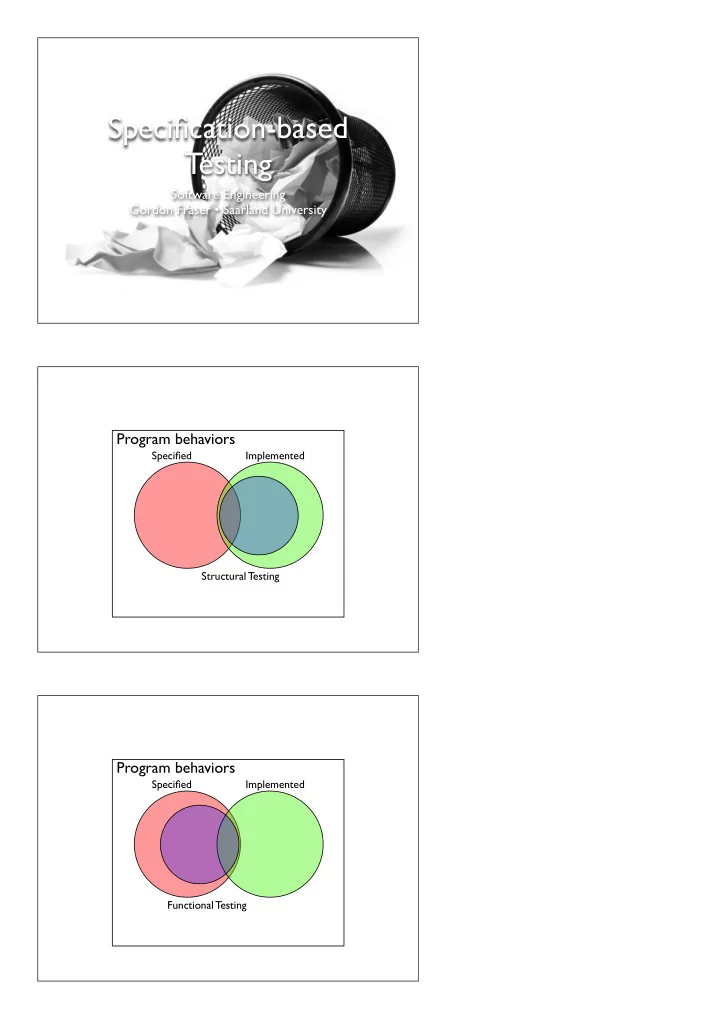
Program behaviors
Specified Implemented Structural Testing
Program behaviors
Specified Implemented Functional Testing
Specification-based Testing Software Engineering Gordon Fraser - - PDF document
Specification-based Testing Software Engineering Gordon Fraser Saarland University Program behaviors Specified Implemented Structural Testing Program behaviors Specified Implemented Functional Testing Program behaviors Specified
Software Engineering Gordon Fraser • Saarland University
Program behaviors
Specified Implemented Structural Testing
Program behaviors
Specified Implemented Functional Testing
Program behaviors
Specified Implemented Structural + Functional Testing
Structural
“white box”
Value Testing
Functional
“black box”
Functional specification Independently testable feature Representative values Model Test case specifications
identify derive identify derive
Test case
generate
Functional specification Independently testable feature Representative values Model Test case specifications
identify derive identify derive
Test case
generate
that are especially valuable
choosing representatives of equivalence classes that are apt to fail often or not at all
The main steps of a systematic approach to functional program testing (from Pezze + Young, “Software Testing and Analysis”, Chapter 10) The main steps of a systematic approach to functional program testing (from Pezze + Young, “Software Testing and Analysis”, Chapter 10)
maximum-1, maximum
Minimum-1, maximum+1
Boundary values for one, nominal values for others
All possible combinations
Failures occur rarely as the result of the simultaneous occurrence
((((((((234%"#)-*#"((((((((5$0$6-"-$((((((((((76#"-+-(
Case a b c Output 1 100 100 1 Isosceles 2 100 100 2 Isosceles 3 100 100 100 Equilateral 4 100 100 199 Isosceles 5 100 100 200 Invalid 6 100 1 100 Isosceles 7 100 2 100 Isosceles 8 100 100 100 Equilateral 9 100 199 100 Isosceles 10 100 200 100 Invalid 11 1 100 100 Isosceles 12 2 100 100 Isosceles 13 100 100 100 Equilateral 14 199 100 100 Isosceles 15 200 100 100 Invalid
Single-fault assumption - therefore
Input condition Equivalence classes
range
(larger and smaller)
specific value
(larger and smaller)
member of a set
boolean
One test per equivalence class per input
All combinations (cartesian product of equivalence classes)
Include invalid values
Test at boundaries of partitions
How do we choose equivalence classes? The key is to examine input conditions from the spec. Each input condition induces an equivalence class – valid and invalid inputs.
a,b,c form a triangle
a = b a = c b = c
Not a triangle
Scalene Isosceles Equilateral
F T T T T T T T T – T T T T F F F F – T T F F T T F F – T F T F T F T F X X X X X X
Impossible
X X X
a < b + c b < a + c c < a + b a = b a = c b = c
Not a triangle
Scalene Isosceles Equilateral Impossible
F T T T T T T T T T T F T T T T T T T T T F T T T T T T T T T T T T F F F F T T F F T T F F T F T F T F T F X X X X X X X X X X X
Each column represents one test case
binary
2N rules
explicit rules by implying the existence of non-explicitly stated rules.
if (pressure < 10) { // do something if (volume > 300) { // faulty code! BOOM! } else { // good code, no problem } } else { // do something else }
0,25 0,5 0,75 1 1 2 3 4 5 6
Medical device
0,25 0,5 0,75 1 1 2 3 4 5 6
Medical device Browser
0,25 0,5 0,75 1 1 2 3 4 5 6
Medical device Browser Server
0,25 0,5 0,75 1 1 2 3 4 5 6
Medical device Browser Server NASA distributed database
0,25 0,5 0,75 1 1 2 3 4 5 6
Medical device Browser Server NASA distributed database Network security
for studied applications was 6
This correlates to the number of branch statements
that maximum interaction strength for fault triggering is relatively small
then testing all t-way combinations can provide strong assurance
flaws
these tests?
interactions …
test, we need no more than 320 tests.
0 1 1 0 0 0 0 1 1 0
10 3
0 = effect off 1 = effect on
Plan: flt, flt+hotel, flt+hotel+car From: CONUS, HI, Europe, Asia … To: CONUS, HI, Europe, Asia … Compare: yes, no Date-type: exact, 1to3, flex Depart: today, tomorrow, 1yr, Sun, Mon … Return: today, tomorrow, 1yr, Sun, Mon … Adults: 1, 2, 3, 4, 5, 6 Minors: 0, 1, 2, 3, 4, 5 Seniors: 0, 1, 2, 3, 4, 5
Many values per variable Need to abstract values But we can still increase information per test
Use combinations here
System under test
Test data inputs
Test case OS CPU Protocol 1 Windows Intel IPv4 2 Windows AMD IPv6 3 Linux Intel IPv6 4 Linux AMD IPv4
Configuration
protocol, CPU, and DBMS
Test case OS CPU Protocol
1 Windows Intel IPv4 2 Windows AMD IPv6 3 Linux Intel IPv6 4 Linux AMD IPv4
for system configuration values
flexible, e.g., relatively easier to support parameter relations and constraints
test sets are not optimal
parameter relations and constraints
the first t + 1 parameters
parameter.
parameter:
value of the new parameter
Strategy In-Parameter-Order begin /* for the first t parameters p1, p2 , …, pt*/ T := {(v1, v2, …, vt) | v1, v2, …, vt are values of p1, p2, …, pt , respectively} if n = t then stop; /* for the remaining parameters */ for parameter pi, i = t + 1, …, n do begin /* horizontal growth */ for each test (v1, v2, …, vi-1) in T do replace it with (v1, v2, …, vi-1, vi), where vi is a value of pi /* vertical growth */ while T does not cover all the interactions between pi and each of p1, p2, …, pi-1 do add a new test for p1, p2, …, pi to T; end end
parameters and values:
A B A1 B1 A1 B2 A2 B1 A2 B2 A B C A1 B1 C1 A1 B2 C2 A2 B1 C3 A2 B2 C1 A B C A1 B1 C1 A1 B2 C2 A2 B1 C3 A2 B2 C1 A2 B1 C2 A1 B2 C3
Horizontal Growth Vertical Growth
VoIP software:
VoIP server, client
Caller Server Callee Win Lin Win Win Sun Mac Win Win Win Mac Lin Mac Mac Sun Win Mac Win Mac
tests to perform
represent the majority of combinatoric bugs
than ones that only happen with more variables
by hand.
might find some compared to testing all combinations, but not necessarily compared to testing just the combinations that matter. might or might not, depending on the actual dependencies among variables in the product. some , or less likely to happen, because user inputs are not uniformly distributed. except for the work of analyzing the product, selecting variables and values, actually configuring and performing the test, and analyzing the results.