
SLIDE 1
Nicki Shewring – English and Literacy Adviser
nicola.shewring@wiltshire.gov.uk
Spelling Matters
Wednesday 27th February Woodford Valley
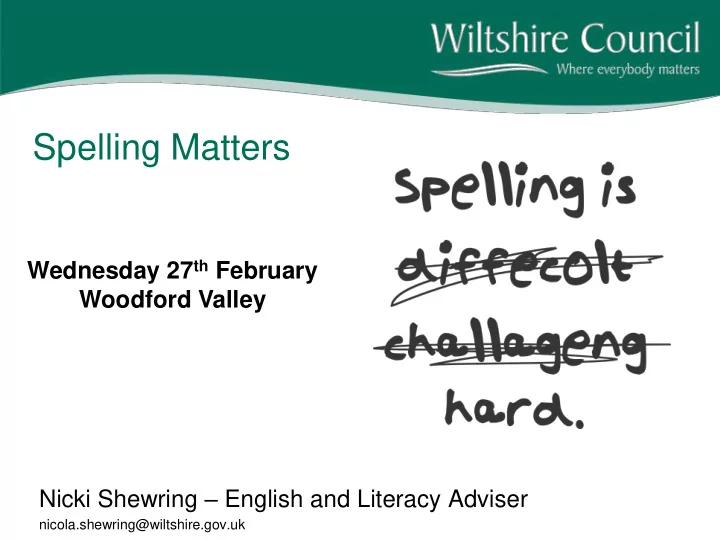
Spelling Matters Wednesday 27 th February Woodford Valley Nicki - - PowerPoint PPT Presentation
Spelling Matters Wednesday 27 th February Woodford Valley Nicki Shewring English and Literacy Adviser nicola.shewring@wiltshire.gov.uk Outcomes To understand the expectations for spelling in the primary phase of education To learn
Nicki Shewring – English and Literacy Adviser
nicola.shewring@wiltshire.gov.uk
Spelling Matters
Wednesday 27th February Woodford Valley
Outcomes
primary phase of education
speller at home
What we know about spelling
become better writers.
intelligence) based on our ability to spell
these helps us to spell unfamiliar words.
to apply different strategies (not a rote learning task)
The development of spelling As in all areas, there is a developmental process that children go through in order to become confident and accurate spellers.
4 ( c ) F
u s E d u c a t i
( U K ) L t d
Preliminary Spelling Semi- Phonetic Spelling Phonetic Spelling Transitional Spelling Independent Spelling
What is phonics?
the English language.
makes to be able to read and write.
Blending (combining the sounds)
Building words from phonemes to read. How many sounds are in this word?
Blending (combining the sounds)
Adding Phoneme buttons (sound buttons) really helps.
Segmenting (separate the sounds)
which supports spelling.
d
Segmenting (separate the sounds)
This can be put into a phoneme frame which helps to separate each sound .
Blending (combining the sounds)
How many sounds are in this word?
Blending (combining the sounds)
Add phoneme buttons and blend the phonemes together.
Blending (combining the sounds)
How many sounds are in this word?
Blending (combining the sounds)
Add phoneme buttons and blend the phonemes together.
Blending (combining the sounds)
How many sounds are in this word?
Blending (combining the sounds)
Add phoneme buttons and blend the phonemes together.
Segmenting (separate the sounds)
Alongside blending the children learn to segment the words which supports spelling.
r ai ai n
Segmenting (separate the sounds)
This can be put into a phoneme frame which helps to separate each sound .
Split digraphs
Split digraphs
Year 1 Phonics Screening
blend the sounds together. e.g. d-o-g – dog
word, with a corresponding alien image.
Word Examples
How can you help?
Encourage them to use their phonics skills when reading. Children can practise their phonics by playing games online. The children particularly like - * Buried Treasure * Picnic on Pluto www.phonicsplay.co.uk
How can you help?
Encourage your child to ‘sound out’ when reading or writing. Focusing particularly on spotting more unusual sound patterns. Eg Digraph- 2 letters making one sound cow - ow Trigraphs- 3 letters making one sound Night - igh Split digraphs- 2 vowels with a consonant in between. Used to be known as the magic e! spine - i-_e
Connect Four Y1 and 2
You need 4 people, one baseboard and two sets of cards (different colours.) Work with a partner to make a team of two. Place your cards in a pile facing down. Take it in turn to turn over your top card and try to think of a word. Write it on the back of the card with a washable pen and place it on the board where the vowels match The winning team is the first to get four in a row vertically, diagonally or horizontally..
Vowel phonemes ( c ) F
u s E d u c a t i
( U K ) L t d 2 5
Useful Definitions
PHONEME - smallest unit of sound GRAPHEME - written representation of the sound DIGRAPH - two letters making one sound e.g ee TRIGRAPH - three letters making one sound e.g igh SPLIT DIGRAPH - where two letters are not adjacent e.g a-e as in make
Useful websites
https://www.phonicsplay.co.uk/ http://www.bbc.co.uk/bitesize/ks1/literacy/phonics/play/ https://learn.readwithfonics.com/school/phonics-games https://www.phonicsbloom.com/ http://more2.starfall.com/n/level-a/learn-to-read/load.htm?f&redir=www
Common Exception Words
Learning the difficult bits in words
Learning the difficult bits in words
Learning the difficult bits in words
– Read it – Say it – Identify the tricky bit – Make up a rhyme or draw a picture – Think of word that rhyme – Write it
Statutory word lists
Year 6 SAT’s
Spelling is tested in two ways:
writing
Spelling Strategies
There are four main ways people use to process the spelling of words:
strings and thinks ‘Does it look right?’
between letters and groups of letters and their associated sounds
that?’
specific hand movements to produce letter strings
3 4 ( c ) F
u s E d u c a t i
( U K ) L t d
Activities to support spelling at home
Visual
definite
Definition Define Redefine Confine Confinement Refine Refinery Finite Finish Finishing Unfinished Definitely Indefinite Indefinitely Infinite Infinity
(c) Focus Education (UK) Ltd 69
Activities to support spelling at home
Auditory
Kinaesthetic
Mnemonics and memory aids These can be useful. However, make sure that the same aid is used across the school and that there are not too many!
3 8 ( c ) F
u s E d u c a t i
( U K ) L t d
Here, there and everywhere
Other resources
Say the word aloud Do you already know how to spell it? Split the word into
sounds and put in the sound buttons. Write down the bits that you know how to spell. Which part is the tricky part? What do you know about the tricky bit?
What could help? Spelling rules? Spelling patterns? Classroom displays? Spelling books?
Fill in your best guesses for the tricky bits. Does your best guess look right?
(c) Focus Education (UK) Ltd 40
(c) Focus Education (UK) Ltd 41
Are there any silent letters that I need to remember? Can I find it in a book we have read / a classroom display / my spelling journal? Does the word have the right number of letters? Does the word have the right shape/ length? Does the word I have written have a small word hiding inside it that I can spell? Have I cross- checked with another spelling strategy? Other possible steps in a routine
Quizzes
KS1
SUNSET?
words: ba – - thi – - ho- - su – - ? (2 answers)
1) get hold of 2) rabbit home 3) mark on wood 4) bring
an adjective to show it means ‘more’? e.g. more fast?
(c) Focus Education (UK) Ltd 42
KS2
OUGH that also rhyme with stuff.
inside REMEMBER.
capital city, a way of drinking, a cleaning tool and a flower.
OFTEN to make a new word?
Word building game
win wind windy winding winded
(c) Focus Education (UK) Ltd 43
kind kindly unkind unkindly kindness unkindness unkindliness
Useful Websites
www.phonicsplay.co.uk/ www.spellingplay.co.uk/ https://www.spellingcity.com/ www.woodlands-junior.kent.sch.uk/interactive/literacy.html www.spellzone.com/games/ http://www.howtospell.co.uk/spellingquiz.php
(c) Focus Education (UK) Ltd 44