Splashback radius as probes of cosmology, dark matter and galaxy - - PowerPoint PPT Presentation

splashback radius as probes of cosmology dark matter and
SMART_READER_LITE
LIVE PREVIEW

Splashback radius as probes of cosmology, dark matter and galaxy - - PowerPoint PPT Presentation

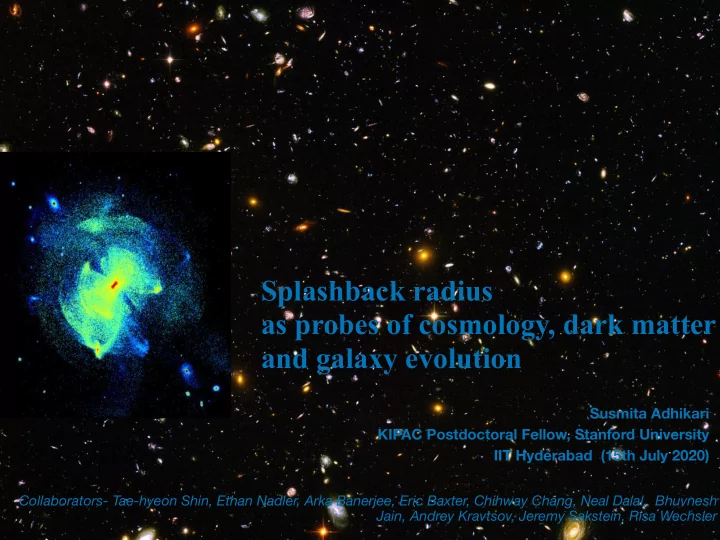
Splashback radius as probes of cosmology, dark matter and galaxy evolution Susmita Adhikari KIPAC Postdoctoral Fellow, Stanford University IIT Hyderabad (15th July 2020) Collaborators- Tae-hyeon Shin, Ethan Nadler, Arka Banerjee, Eric Baxter,


slide-1
SLIDE 1

Susmita Adhikari KIPAC Postdoctoral Fellow, Stanford University IIT Hyderabad (15th July 2020)

Splashback radius as probes of cosmology, dark matter and galaxy evolution

Collaborators- Tae-hyeon Shin, Ethan Nadler, Arka Banerjee, Eric Baxter, Chihway Chang, Neal Dalal, Bhuvnesh Jain, Andrey Kravtsov, Jeremy Sakstein, Risa Wechsler

slide-2
SLIDE 2

Image of the night sky taken with the Hubble Space telescope

Galaxies are formed by baryonic matter and are held together by gravity and hydrodynamic forces

clusters of bound galaxies

slide-3
SLIDE 3

Existence of thin disks

Galaxy rotation curves

Evidence for a dark component to gravity Velocity dispersion of Coma cluster -

Fritz Zwicky - 1933 Velocity dispersion was not consistent with viral theorem.

slide-4
SLIDE 4

Direct evidence for the existence of dark matter Merging clusters -The bullet cluster system

slide-5
SLIDE 5

What are Dark Matter Halos ?

  • Dark matter halos are

endpoints of all cosmological structure formation

  • Self-bound, virialized

structures

  • Harbor all stars, galaxies,

quasars

Via Lactea simulation

slide-6
SLIDE 6

Structure formation in the universe

Initial quantum fluctuations in the density of matter magnified by inflation The cosmic microwave background Density perturbations collapse gravitationally to form dark matter halos

slide-7
SLIDE 7

Density perturbations collapse gravitationally to form halos Structure formation in the universe

slide-8
SLIDE 8

credit: Buckley and Peter 2017

Small halos form first and merge to form more massive halos

Hierarchical structure formation

slide-9
SLIDE 9

Hierarchical structure formation

Dark matter particles that are orbiting in a central potential Halos grow hierarchically - small objects form first and fall into massive halos So halos contain subhalos that also harbor galaxies Baryonic matter in the form of diffuse stars, gas and galaxies Main components of a halo

slide-10
SLIDE 10
  • The density of halos is well described by the NFW profiles
  • Slope is -1 in the inner regions and rolls over to -3 in the outskirts of the halo.

“Aquarius” Springel et. al 2008

The density profiles of dark matter halos

slide-11
SLIDE 11
  • Deviation from NFW and

Einasto profile in the

  • uter regions of the halo
  • Slope of the local density

deviates in a narrow confined region Outer density profiles of Dark Matter Halos

Diemer & Kravtsov 2014

slide-12
SLIDE 12

The evolution of dark matter halos

slide-13
SLIDE 13

Phase space Diagram of Halo evolution

Splashback - corresponds to first apoapses passage after collapse

For spherical potential and smooth accretion

slide-14
SLIDE 14

−2 −1 1 2 x (h−1Mpc) −2 −1 1 2 y (h−1Mpc)

Γ = 0.8

Where is the boundary of a halo?

Diemer & Kravtsov 2014 More et al. 2015

slide-15
SLIDE 15
  • Phase space diagram of N-body

halos from the Multidark simulation

  • Halos stacked in the mass range
  • f 1-4e14 Msun
  • Position of splashback coincides

exactly with feature

Adhikari et al. 2014

Phase space boundary at the location of turnaround of the most recently accreted material

slide-16
SLIDE 16

Collapsing shells of matter around a dark matter over density

slide-17
SLIDE 17

Particle Orbits

  • For a constant potential the

subequent orbits are exactly the same

  • Mass accretion - potential

becomes deeper with time - Subsequent orbits shrink and become faster

turnaround splashback turnaround splashback

slide-18
SLIDE 18

Function of Accretion Rate and halo redshift

Faster a halo grows, the smaller is its splashback radius in units of R200. At a given accretion rate it is a function of redshift

slide-19
SLIDE 19
  • It forms the boundary of the halo
  • Physical definition of halo mass
  • The splashback radius probes growth history of the halo.
  • It forms at the boundary that separates the virialized

region of a halo from the infalling region.

  • Fundamental length scale in the halo structure, should be

present if there is a dark matter halo.

  • Simple to understand formed by the most recently

accreted material - that is not yet phase mixed.

  • Inner regions of halos are often dominated by baryons

Why is this feature interesting?

slide-20
SLIDE 20

The location of the splashback radius is set by simple physical principles - Gravitational collapse of cold dark matter in an expanding universe.

Second turnaround = Splashback radius v_r = 0 r = Rsp First turnaround

Credit : Chihway Chang

slide-21
SLIDE 21

Gravitational collapse of collisionless dark matter in an expanding universe

slide-22
SLIDE 22

Gravitational collapse of collisionless dark matter in an expanding universe

What happens if we change gravity? If dark matter self-interacts? If universe is not Lambda CDM?

slide-23
SLIDE 23

¨ a a = H0 p Ωma−3 + ΩDEa−3(1+w)

¨ r = GM r2 H2 2 ΩDE(1 + 3w)r−2−3w

  • 4
  • 3.5
  • 3
  • 2.5
  • 2
  • 1.5
  • 1

1 Γ=1.5

d log ρ/d log r r/r200m

w = -1.0 w = -2.0 w = -0.5

What happens to splashback if you change the equation of state parameter?

Splashback is a weak function of the w

Adhikari et al. 2018

slide-24
SLIDE 24

What happens if we change gravity? Large scales - Gravity is modified so that the universe accelerates Intermediate scales - Gravity is still modified by a fifth force Small scales - Solar system tests constrain gravity to normal GR

Screening mechanism : Chameleon screening. - Mass of scalar mode becomes large in dense regions (f(R)) Vainshtein screening - non-linear derivative of fifth force becomes large in dense regions (DGP)

slide-25
SLIDE 25

Does the location of splashback radius change in modified gravity?

What happens if we change gravity?

i) Extra force mediated by the scalar field ii) The enhanced gravity in the outskirts makes infall velocity higher.

slide-26
SLIDE 26

Second turnaround = Splashback radius v_r = 0 r = Rsp First turnaround

What happens to the subhalos?

Dynamical friction in subhalos

Faster a massive object moves, lower is the force of friction

Splashback of Substructure in modified gravity

slide-27
SLIDE 27
  • 4
  • 3.5
  • 3
  • 2.5
  • 2
  • 1.5
  • 1
  • 0.5

1 dlog ρ / dlogr r (Mpc h-1)

GR 1e11 F5 1e11 GR 8e12 F5 8e12 particles GR particles F5

Particle splashback radius Splashback for low mass subhalos High mass subhalos

High mass subhalos in feel lesser amount of dynamical friction in modified gravity - splashback at larger radius than their counterparts in GR

Adhikari et al. 2018

slide-28
SLIDE 28

Gravitational collapse of collisionless dark matter in an expanding universe

What happens if we change gravity? If dark matter self-interacts? If universe is not Lambda CDM?

slide-29
SLIDE 29

Self interacting dark matter and halo profiles

  • Particles lose energy their orbits are altered
  • Velocity dependent - subhalos and host are at different interaction cross-sections

Banerjee, Adhikari et al. 2019

slide-30
SLIDE 30

In the case of self-interacting dark matter we see effects on splashback radius in older halos The movement in splashback becomes more prominent when halos are split on accretion history

Banerjee, Adhikari et al. 2019

Old halos Young halos

slide-31
SLIDE 31

Observations of the splashback radius

slide-32
SLIDE 32

How do we observe dark matter halos?

We study the most massive bound structures in the universe Cluster mass halos 1014 − 1015 Msun They can be identified as “clusters” of galaxies in the sky

slide-33
SLIDE 33

Distribution of Galaxies Lensing of background galaxies

Galaxy clusters

Abell 2218

Study the distribution of galaxies that trace the potential of the parent dark matter halos Study the distortion of background galaxies due to massive halo in the line of sight

slide-34
SLIDE 34

Dark Energy Survey (DES)

Blanco 4m telescope in Chile 5000 sq. deg Observes millions of galaxies

https://www.darkenergysurvey.org/

slide-35
SLIDE 35

Galaxy Clusters in SDSS data selected with the RedMaPPer algorithm

at

Clusters with richness corresponds to 8648 RedMaPPer clusters 0.1 < z < 0.33

slide-36
SLIDE 36

Observations of Splashback radius

The Halo Boundary of Galaxy Clusters in the SDSS

Eric Baxter1?, Chihway Chang2, Bhuvnesh Jain1, Susmita Adhikari3, Neal Dalal3,4, Andrey Kravtsov2,5,6, Surhud More7, Eduardo Rozo8, Eli Rykoff9,10, Ravi K. Sheth1,11

DETECTION OF THE SPLASHBACK RADIUS AND HALO ASSEMBLY BIAS OF MASSIVE GALAXY CLUSTERS

Surhud More1, Hironao Miyatake1,2,3, Masahiro Takada1, Benedikt Diemer4, Andrey V. Kravtsov5,6,7, Neal K. Dalal1,8, Anupreeta More1, Ryoma Murata1,9, Rachel Mandelbaum10, Eduardo Rozo11, Eli S. Rykoff12, Masamune Oguri1,9,13, and David N. Spergel1,3

1

( )

á ñ á ñ á ñ á ñ

  • THE SPLASHBACK FEATURE AROUND DES GALAXY CLUSTERS:

GALAXY DENSITY AND WEAK LENSING PROFILES

  • C. Chang,1 E. Baxter,2 B. Jain,2 C. S´

anchez,2, 3 S. Adhikari,4, 5 T. N. Varga,6, 7 Y. Fang,2 E. Rozo,8

  • E. S. Rykoff,5, 9 A. Kravtsov,10, 11, 12 D. Gruen,5, 9 W. Hartley,13 E. M. Huff,14 M. Jarvis,2 A. G. Kim,15 J. Prat,3
  • N. MacCrann,16, 17 T. McClintock,8 A. Palmese,13 D. Rapetti,18, 19 R. P. Rollins,20 S. Samuroff,20 E. Sheldon,21
  • M. A. Troxel,16, 17 R. H. Wechsler,5, 9, 22 Y. Zhang,23 J. Zuntz,24 T. M. C. Abbott,25 F. B. Abdalla,13, 26
  • S. Allam,23 J. Annis,23 K. Bechtol,27 A. Benoit-L´

evy,13, 28, 29 G. M. Bernstein,2 D. Brooks,13 E. Buckley-Geer,23

  • A. Carnero Rosell,30, 31 M. Carrasco Kind,32, 33 J. Carretero,3 C. B. D’Andrea,2 L. N. da Costa,30, 31 C. Davis,5
  • S. Desai,34 H. T. Diehl,23 J. P. Dietrich,35, 36 A. Drlica-Wagner,23 T. F. Eifler,14, 37 B. Flaugher,23 P. Fosalba,38
  • J. Frieman,1, 23 J. Garc´

ıa-Bellido,39 E. Gaztanaga,38 D. W. Gerdes,40, 41 R. A. Gruendl,32, 33 J. Gschwend,30, 31

  • G. Gutierrez,23 K. Honscheid,16, 17 D. J. James,42 T. Jeltema,43 E. Krause,5 K. Kuehn,44 O. Lahav,13 M. Lima,30, 45
  • M. March,2 J. L. Marshall,46 P. Martini,16, 47 P. Melchior,48 F. Menanteau,32, 33 R. Miquel,3, 49 J. J. Mohr,7, 35, 36
  • B. Nord,23 R. L. C. Ogando,30, 31 A. A. Plazas,14 E. Sanchez,50 V. Scarpine,23 R. Schindler,9 M. Schubnell,41
  • I. Sevilla-Noarbe,50 M. Smith,51 R. C. Smith,25 M. Soares-Santos,23 F. Sobreira,30, 52 E. Suchyta,53
  • M. E. C. Swanson,33 G. Tarle,41 and J. Weller6, 7, 35

(DES Collaboration)

arXiv:1710.06808v2 [astro-ph.CO] 31 Jul 2018
slide-37
SLIDE 37

Cluster - galaxy cross correlation

Measurement - Number density of galaxy in projection as a function of radius

Σ(R) = Z hmax

−hmax

dh ρ( p R2 + h2) is the projected distance to the

ρ(r) = ρcoll(r) + ρinfall(r), ρcoll(r) = ρEin(r)ftrans(r) ρEin(r) = ρs exp ✓ − 2 α ✓ r rs ◆α − 1 ◆ ftrans(r) = " 1 + ✓ r rt ◆β#−γ/β , ρinfall(r) = ρ0 ✓ r r0 ◆−se ,

Stack clusters based on richness richness > 20 M > 1e14 Msun h-1

Diemer & Kravtsov 2014

slide-38
SLIDE 38

−1 −2 −3 −4

dlogρ(r)/dlogr

vp > 135 km/s vp > 178 km/s Data (galaxies) 0.2 0.5 1 2 5

r [h−1Mpc]

−1 −2 −3 −4

dlogρ(r)/dlogr

Particles Data (lensing)

Splashback radius in DES Y1 results

Galaxy number density Weak lensing around clusters Discrepancy persists in the lensing splashback radius as well

Chang,+, Adhikari et al.2017

First measurement in weak lensing around halos

slide-39
SLIDE 39

0.2 0.5 1 2 5

r [h−1Mpc]

−4 −3 −2 −1

dlogρ/dlogr Simulation

0.2 0.5 1 2 5

r [h−1Mpc]

−4 −3 −2 −1

dlogρ/dlogr Data

0.2 0.5 1 2 5

r [h−1Mpc]

−4 −3 −2 −1

dlogρ/dlogr

20 < λ < 100 0.2 < z < 0.4 0.4 < z < 0.55 0.55 < z < 0.75

Chang, Baxter, Jain, Sanchez, Adhikari et al.2017

No movement with galaxy magnitude No movement with redshift of host cluster Outstanding issues

slide-40
SLIDE 40

Why is splashback discrepant with simulations?

a) Dynamical Friction? b) New Physics? c) Observational bias? Cluster selection? Projection effects? (Busch & White 2017) Orientation bias? Aperture selection? (Busch & White 2017)

Different cluster selection method - SZ selected clusters

slide-41
SLIDE 41

Independent method of selecting clusters Clusters are selected based on SZ decrement S/N > 4 Total sample of ~300 clusters in the DES footprint Mean Mass <M500c> = 4.11e14 Msun Clusters between 0.25 < z < 0.7, <z>=0.486

Splashback in SZ selected clusters

Clusters seen as a temperature decrement in CMB

Splashback radius in SZ clusters from the South Pole telescope (SPT) and Atacama Cosmology telescope (ACT)

+10 +20 +30 +40 +50 +60 +70 +330 +340 +350

RA (deg)

−46 −38 −30 −21 −13 −5 +3 +11

Dec (deg) DES Y3 SPT-SZ ACTPol

slide-42
SLIDE 42

100 101 R[h−1Mpc] 10−1 100 101 102 Σg 10−1 100 101 r[h−1Mpc] −1 −2 −3 −4 d log ρ(r)/d log r SPT SPT ρcoll MDPL2 Vpeak > 190 km/s particles

Splashback radius in SPT SZ clusters, DES galaxies

Splashback radius SZ clusters are statistically consistent with simulations

Pink - Slope of the fitted density profile Black- Particles from MDPL2 Blue - Subhalos abundance matched

Hyeon-Shin, Adhikari et al. 2019

Consistent with Zuercher & More 2019 who did a similar analysis with Planck clusters

slide-43
SLIDE 43

100 101 R[h−1Mpc] 2 × 100 3 × 100 4 × 100 6 × 100 RΣg 10−1 100 101 r[h−1Mpc] −1 −2 −3 −4 d log ρ(r)/d log r SPT RM simulation ACT RM abundance match

Comparison with RedMaPPer

RM and SPT are consistent within 1 sigma, but RM is inconsistent with sims.

Hyeon-Shin, Adhikari et al. 2019

slide-44
SLIDE 44

863 clusters (subject to change) in the DES footprint having SNR>4, w/ 0.15 < z < 0.7 <M500c> = 3.0e14 Msun/h <z> = 0.44

New AdvACT cluster sample

slide-45
SLIDE 45

New AdvACT sample ~700 clusters above SNR >5

preliminary

(in prep)

Galaxy quenching in Dark Matter halos

slide-46
SLIDE 46

The splashback radius as a clock in the halo

Radial velocity distance Galaxies stop forming stars with time as they fall into a halo Blue star-forming galaxies turn into red and dead galaxies Minimum traces the time spent in the cluster by a population of galaxies Longer delay , shorter quenching

slide-47
SLIDE 47

The splashback radius as a clock in the halo

Radial velocity distance Galaxies stop forming stars with time as they fall into a halo Blue star-forming galaxies turn into red and dead galaxies Minimum traces the time spent in the cluster by a population of galaxies Short delay , long quenching

slide-48
SLIDE 48
slide-49
SLIDE 49

Summary

  • The structure of dark matter halos contain information about the history of the universe
  • The edges of halos can be understood through simple physical model
  • The location of the edge is traced by the splashback radius that can be measured observationally
  • Sensitive to modified gravity models
  • Sensitive to models of self interacting dark matter, potentially any model that can change the

energetics of dark matter particles

  • A distinct scale in a halo that can tell us about galaxy evolution