SPORE: Resource Extraction and Habitable Space Creation Ben Smith - - - PDF document

spore resource extraction and habitable space creation
SMART_READER_LITE
LIVE PREVIEW

SPORE: Resource Extraction and Habitable Space Creation Ben Smith - - - PDF document

SPORE: Resource Extraction and Habitable Space Creation Ben Smith - Lunar Homestead Abstract The Lunar surface is a hazardous and challenging environment, for both people and equipment. Lunar Homestead is working on the Shielded Pressurized


slide-1
SLIDE 1

SPORE: Resource Extraction and Habitable Space Creation

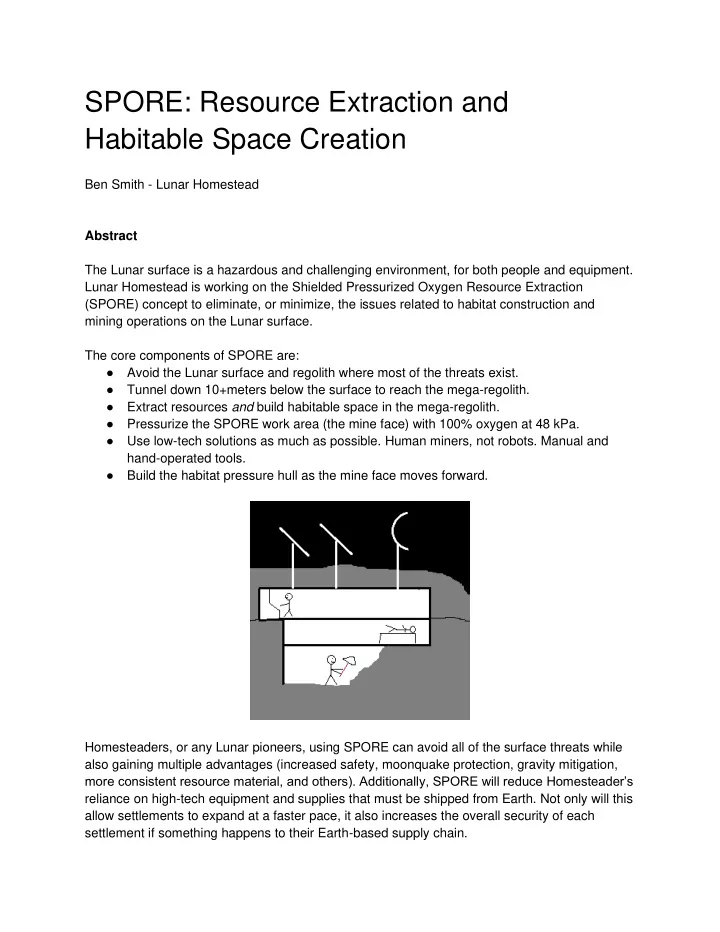
Ben Smith - Lunar Homestead Abstract The Lunar surface is a hazardous and challenging environment, for both people and equipment. Lunar Homestead is working on the Shielded Pressurized Oxygen Resource Extraction (SPORE) concept to eliminate, or minimize, the issues related to habitat construction and mining operations on the Lunar surface. The core components of SPORE are:

  • Avoid the Lunar surface and regolith where most of the threats exist.
  • Tunnel down 10+meters below the surface to reach the mega-regolith.
  • Extract resources and build habitable space in the mega-regolith.
  • Pressurize the SPORE work area (the mine face) with 100% oxygen at 48 kPa.
  • Use low-tech solutions as much as possible. Human miners, not robots. Manual and

hand-operated tools.

  • Build the habitat pressure hull as the mine face moves forward.

Homesteaders, or any Lunar pioneers, using SPORE can avoid all of the surface threats while also gaining multiple advantages (increased safety, moonquake protection, gravity mitigation, more consistent resource material, and others). Additionally, SPORE will reduce Homesteader’s reliance on high-tech equipment and supplies that must be shipped from Earth. Not only will this allow settlements to expand at a faster pace, it also increases the overall security of each settlement if something happens to their Earth-based supply chain.

slide-2
SLIDE 2

Finally, the name SPORE works on another level as well. In biology, spores are structures used by organisms to survive in unfavorable environments. SPORE technology and techniques (or just tech) could be modified for use on Mars, asteroids, gas giant moons, orbital space and

  • ther places humans will want to settle. SPORE could be one of the keys to unlocking the

floodgate of human settlement throughout the Solar system. Lunar Surface Challenges Before I get into the details of SPORE, let’s look at the reasons why SPORE is needed. The Lunar surface environment presents a number of challenges to human and robotic operations. Unfortunately, the current prevailing paradigm explicitly plans for building and mining on the

  • surface. This has proven to be an immensely difficult and expensive challenge; evidenced by

the lack of any Lunar development, or even human visitation, in the last 50+ years. Lunar regolith dust The Lunar regolith dust is one of the biggest obstacles to permanent settlement. All surface

  • perations (habitat construction, mining, exploration) are at risk as well as any habitats on the
  • surface. Any dust allowed into a habitat will pose a significant health risk to the occupants.

Issues with Lunar regolith dust include:

  • The dust is extremely fine. The median particle size (70 microns) is smaller than the

human eye can resolve [1, pg 478]. 10-20% (by weight) of it is finer than 20 microns [1, pg 478].

  • It’s very sharp and abrasive, much like fine-grained volcanic ash [1, pg 34].
  • It gets everywhere and sticks to most surfaces [1, pg 35].
  • The dust is also highly chemically reactive, making it toxic to humans [2].
  • Breathing it on a daily basis will probably cause chronic respiratory problems as the

microscopic particles accumulate in the lungs.

  • It quickly damages moving parts and fabrics [3, pg 5], such as spacesuits, and can

cause equipment to overheat [3, pg 6]. The kicker is that we still don’t really know a lot about regolith dust and we really don’t know much about its long-term effects. We have some ideas on how we could mitigate the dust threat

  • n the surface but none have been field-tested. We just don’t for sure know how we’re going to

deal with this problem. Radiation There are three major types of radiation we need to plan for: the Solar wind (which we can ignore if we design for the other two), Solar Particle Events from flares and Coronal Mass Ejections, and Galactic Cosmic Radiation (GCR) [4]. One source states that 20 g/cm2 of water

slide-3
SLIDE 3

equivalent material would be sufficient shielding for solar events [5]. However, “sufficient” isn’t

  • quantified. I assume it’s sufficient for a short-duration mission and based on Career Limits. It

certainly isn’t sufficient to stop GCR, which can penetrate through several meters of regolith [1, pg 48]. Vacuum Luna does have a very tenuous atmosphere, around 104 molecules/cm3 during the Lunar day [1, pg 40]. This is about 14 orders of magnitude less than Earth’s atmosphere and for our purposes it’s effectively a vacuum [1, pg 40]. In addition to being deadly to life, the Lunar vacuum is also hard on equipment. Organic materials, such as seals and insulation, can release volatile chemicals which end up as a thin film on nearby equipment [6]. Special lubricants that don’t sublimate are required for moving parts [6]. Vacuum welding can be a significant issue [6] and heat rejection can be tricky [7]. Thermal extremes Because of the lack of atmosphere, the Lunar surface can be an extremely hot or cold place. The Apollo 15 site registered temperatures ranging from -181°C (-293.8°F) to 101°C (213.8°F) [1, pg 34]. That’s a 282°C (507.6°F) temperature shift every Lunar day [1, pg 34]. The Apollo 17 site recorded temperatures that were about 10°C(18°F) higher [1, pg 34]. This thermal environment is hard on exposed equipment and facilities. Equipment in partial shade could experience a significant thermal gradient, causing stress and thermal fatigue in the material after many temperature cycles [8]. Sustained low temperatures can cause certain materials to become brittle and electronics can be damaged by temperature cycling [8]. Meteoroid impacts The Lunar surface is defined by impact events; from the large impact basins to the fine regolith

  • dust. A 1-gram impactor will form a crater approximately 3 centimeters deep in Lunar rocks [9].

The damage will be even worse if the target, such as a mining robot or habitat, has been structurally compromised by thermal cycling. While the chance of any particular spot getting hit by a meteoroid this size is between one in 106 to 108 for one cumulative year of exposure, eventually something important will get struck [1, pg 47]. Facilities and equipment can expect hits by 1-milligram impactors on a yearly basis [1, pg 46]. That’s a not-insignificant amount of energy considering that these objects will be moving at around 20 kilometers per second (12.5 miles per hour) on average [9]. SPORE Solutions “A clever person solves a problem. A wise person avoids it.” - Albert Einstein

slide-4
SLIDE 4

The current paradigm is to engineer for these challenges. The Lunar Homestead (and SPORE) paradigm is to avoid them as much as possible. Here’s how we can do it. Shielded Most everyone agrees that Lunar habitats need to have some sort of shielding to protect them from the Lunar environment. The typical solution is to pile regolith on top of the habitats using tele-operated robots. There are several problems with this strategy however. First, we need high-tech, reliable regolith-moving robots. Real-time tele-operation is also usually a requirement as well. This is obviously a significant challenge since we’ve been working on this for decades and still don’t have it completely solved. Second, pushing large amounts of regolith around is sure to make the dust problem worse. The light-weight Lunar rovers were notorious for their “rooster tails”. Heavy mining equipment will probably be much worse. Of course, we don’t have any experience with this so we don’t know just how bad it will get. Third, the proposed radiation shielding thickness is insufficient for permanent settlers. There’s lots of talk about Career Limits for radiation exposure. That’s fine for professionals planning on short stays. However, it’s an unacceptable metric for Homesteaders that are going to spend the rest of their lives there. Especially, if children are involved. As for impactor shielding, what would you rather have between you and a rock moving at 20 km/sec, 20 cm of loosely piled regolith or 10 meters of compacted regolith and mega-regolith? The SPORE solution is to avoid the regolith as much as possible. What we do is build the habitats AND conduct mining activities in the mega-regolith at least 10 meters BELOW the

  • surface. Why 10 meters? Because the median depth of the mare regolith is about 4 meters [10].

10 meters will put us solidly into the mega-regolith. If our Homesteaders find 10 meters isn’t deep enough for their site then they go down 15 or 20 meters. Whatever it takes to get past the regolith and its dust. Plus, 10 meters should completely protect the habitats from all external radiation and thermal sources, as well as most impactors. There are indications that concentrations of Lunar regolith dust decrease substantially with

  • depth. Most Apollo core samples showed a trend to coarser-grained samples with depth [1, pg

325]. Of course, the deepest sample we have only went down 298.6 cm so we really don’t know how much, if any, regolith dust in the mega-regolith [1, pg 325]. The lowest layers of regolith may transition into highly fragmented bedrock with regolith in the fractures [1, pg 337]. This is the start of the mega-regolith.

slide-5
SLIDE 5

This makes sense because the Lunar regolith dust is a product of millions of years of small- mass impactors “gardening” the surface. Most of the dust is found in the first couple of meters of regolith because impactors with enough energy to punch deeper than that are rare. The regolith found between the blocks of basalt ejecta should be free of dust as well, especially the deeper we go. In addition to regolith dust, 10+ meters of regolith and mega-regolith shield should eliminate

  • ther threats as well. 10 or more meters of shielding will eliminate radiation as a concern for

habitats and mining operations and eliminate the need for expensive radiation-hardened

  • electronics. As little as 30 cm of regolith is sufficient to eliminate monthly temperature

fluctuations [1, pg 38]. And it would take a 430-kilogram impactor, give or take, to punch through 10 meters of shielding [2]. This would be a very rare occurrence. Finally, by going underground we avoid the need for Lunar surface-rated robots. Robots are difficult to design because they need to operate reliably in a challenging environment with no maintenance for a reasonable amount of time. This is a very high bar. We could be waiting a long time for settlements if these robots are considered mandatory. And we don’t need robots.

slide-6
SLIDE 6

Humans have been digging tunnels and creating underground structures for a very long time. We’re rather good at it. Pressurized Oxygen Now that we’re underground and safe from most surface hazards, let’s eliminate the threats in

  • ur new environment.

Metal extraction processes are going to produce a lot of oxygen. Below are a few of the common Lunar minerals being considered for oxygen and metal production.

  • Ilmenite (FeTiO3)
  • Olivine ((Mg,Fe)2SiO4)
  • Clinopyroxene (Ca(Fe,Mg)Si2O6)
  • Orthopyroxene ((Mg,Fe)SiO3)
  • Anorthite (CaAl2Si2O8)

As you can see, oxygen is a major component of these minerals. While we can use oxygen for life support and rocket propellent, we can also use it to make the SPORE work environment habitable. The SPORE solution is to pressurize the SPORE work environment with 100% oxygen at 48 kPa (6.96 PSI). We’re using 100% oxygen because some unknown, and probably highly variable, amount of gas is going to leak away through the exposed mega-regolith mine face. We don’t want to lose the expensive nitrogen in our habitat breathing gas, so we’ll go with the cheaper pure oxygen. The SPORE work area pressure is 48 kPa because I’ve defined a 78% nitrogen/21% oxygen mix at 70 kPa as 1 Standard Lunar Homestead Atmosphere [11]. Atmospheric pressure can be halved without risking decompression injury or needing to pre- breathe oxygen for hours. Half of 70 kPa is 35 kPa, which is about what was used for all of the Mercury, Gemini, and Apollo missions (34.47 kPa) [12] and for ISS space suits (29.6 kPa) [13]. So, we know people can deal with it for several weeks at a time. 48 kPa gives us a solid safety margin if the pressure starts to fall faster than expected [14]. Homesteaders can immediately retreat to the safety of the connected habitat. People in the SPORE working area won’t directly breath the atmosphere, however. While spacesuits are not necessary because vacuum threat is minimized; Homesteaders will still need to wear some sort of full-face breathing gear to protect against mining dust. This Personal Protection Equipment (PPE) will probably be connected to an air supply by an umbilical. However, Homesteaders COULD survive in the work area if there is an issue with their PPE.

slide-7
SLIDE 7

At this pressure, Homesteaders can also freely move between the SPORE work area and the habitat without worrying about decompression injuries. Lunch and bio-breaks won’t require eating from a tube or using adult diapers (I’m looking at you spacesuits). There’s also no wasted time off-gassing nitrogen. It’s not just the regolith dust we need to worry about. Any mining operation is going to generate copious amounts of regular dust as well. We can still look into electrostatic or magnetic

  • techniques. They may work even better in a contained area. But with an actual atmosphere we

can explore other options such as air circulation and Lunar-made filters. We can even use a water spray to remove dust from the air. It may get a little messy but we might be able to recover almost all of it with clever planning. Finally, our mining equipment (and equipment in general) doesn’t have to be designed for the surface environment. Tools don’t have to be designed to operate in a vacuum or deal with thermal cycling. This allows us to explore other options, such as hand and pneumatic tools. The atmosphere will also help us manage the thermal environment. We can use air circulation and maybe portable water chillers to keep the work area a comfortable temperature. Resource Extraction The standard Lunar mining solution is basically open-pit mining of the regolith using robots. The two biggest problems with this strategy are that it takes place on the surface and actively engages with the regolith. We just went over why the surface is a tough place for equipment and how the regolith adds to the challenge. It’s also a dangerous place for people. Which is why we’re using robots in the first place. Unfortunately, robots that meet these demanding requirements just don’t exist yet. Another problem with surface mining is the low Lunar gravity. On Earth, we rely on gravity to provide enough traction for earth moving equipment to operate. It’s Newton’s third law (for every action, there is an equal and opposite reaction). A bulldozer pushes against the ground. The ground “pushes back” with equal and opposite force. But the bulldozer is really heavy so the push back has much less effect. On Luna, there’s 1/6 the gravity (1.62 m/sec2 vs 9.81 m/sec2) and therefore 1/6 the countering

  • force. We’ll have to greatly increase the mass of our machines (to increase their weight), secure

them to the surface (maybe with tethers), or be OK with them doing a lot less work (by exerting less force on the ground). All of these solutions come with their own problems. The SPORE solution is to avoid all of this mess. Avoid the regolith and go straight for the mega-

  • regolith. And use people to do it, not complicated robots. I’ve already explained why going

directly underground eliminates or minimizes most of the challenges associated with surface

  • perations. Homestead miners are protected from regolith dust, radiation, vacuum, thermal

extremes, and meteoroid impacts. They are also safer, in general, because they are working in a habitable environment and the habitat is literally meters away if anything goes wrong.

slide-8
SLIDE 8

By building the system around human miners instead of high-tech robots we take a lot of the uncertainty, complexity, and expense out of the equation. Sure, we have to provide life support, food, and all the other stuff humans need to survive. But we’re doing that anyway because we’re creating a settlement, not a robot farm. Now we don’t have to wait for the robot tech to advance. Homesteaders also aren’t relying on expensive tech that ties them to Earth. SPORE can use human miners because the work environment will be a protected, habitable space. SPORE could also be a solution to the low gravity problem. Operating in an enclosed, habitable space should give us more options. We may be able to temporarily secure the miners and mining equipment to the SPORE structure, allowing people and equipment to work more

  • efficiently. Tethering hard points or physical locking mechanisms (maybe similar to how ski

boots lock into snow skis) could be built into the SPORE structure. Access to a higher quality raw resource is another advantage of SPORE. Regolith formation and evolution is a complex process driven by the completely random destruction, and creation,

  • f material by impactors [1, pg 286]. Throw in excavation and ballistic sedimentation of existing

layers of regolith with the effects of solar and cosmic particles and the end result is “a regolith whose structure, stratigraphy, and history may vary widely, even between locations only a few meters apart” [1, pg 286]. It’s going to be hard to design equipment to process regolith when each shovel-full can be physically and chemically different from the next. Compare that to the large blocks of basalt bedrock (in the mare) ejecta that we think is the primary component of the mega-regolith. Sure, there will be some variation but not nearly as much as the regolith. Large chunks of basalt will be easier to design for than the huge variability

  • f regolith physical and chemical characteristics. A bonus is that Lunar and Earth basalt are

physically and chemically similar. We can do a lot of research and testing using common Earth basalt instead of having to develop exotic regolith simulants. Bypassing the regolith and focusing on the basalt bedrock ejecta of the mega-regolith will avoid a lot of complexity and

  • uncertainty. And save us loads of time and money.

The final component of SPORE Resource Extraction is low-tech tools. These may not be the most efficient tools for the job but they have several advantages: lower power requirements, easier maintenance, and local manufacture are just a few. It’s probably a lot easier to make a pickaxe out of Lunar iron than a tele-operated mining robot. Habitat Creation How does creating habitable space WHILE extracting resources sound? We can do that with SPORE. SPORE is a modified version of a Tunneling Shield.

slide-9
SLIDE 9

Public domain Tunneling Shields were first used in 1825 to excavate the Thames Tunnel. They are used primarily for ground that is soft or unstable and protect workers from falling materials and cave-

  • ins. The key feature is that as the excavation moves forward, a permanent structure is built to

line and support the tunnel left behind. With SPORE, that structure will be the habitat pressure hull. When enough hull has been built, we’ll seal it off. Then, presto! We have a potentially habitable space. Of course, we’ll have to install all the equipment necessary to actually make the space livable but that’s a whole other problem. My original idea was to use the iron we extract from basalt to make the pressure hull. That idea is still in the works, but I’ve also started looking into using the basalt itself as a pressure hull

  • material. Perhaps with cast basalt components.

The most important advantage of SPORE created habitats is that they are immediately protected as they are constructed. We don’t have to wait for robots to build up enough regolith

  • n top of them to allow people in or risk inadequate shielding. Seal them off from the SPORE

unit with an airlock, pump the right amount of breathing gas in, and you have a temporarily habitable space. Settlements will also be created (and expanded) faster because we’re extracting the resources necessary to create the settlement AND creating habitable space at the same time. Not only will this increase the overall efficiency of the Homestead; it should reduce the amount of equipment we need to ship from Earth. We can speed up settlement construction by skipping the resource processing/manufacturing steps and shipping habitat hull components directly from Earth.

slide-10
SLIDE 10

One problem most people don’t think about are moonquakes. And they should because these could be a significant issue for human settlements. The Apollo seismic network registered 28 shallow quakes between 1972 and 1977 [15]. Several of these were up to 5.5 on the Richter scale and some lasted more than 10 minutes [15]. These are considered “moderate” on Earth and powerful enough to damage poorly constructed buildings [16]. More importantly, on Earth even the biggest earthquakes stop after less than 2 minutes [15]. More than 10 minutes of shaking, even if it’s not very powerful, can put a lot of stress on

  • structures. It can cause fatigue that weakens the building materials and can create air leaks at

seams and seals. It’s also not going to be a very pleasant experience. Also, we really have no idea how moonquakes will affect surface mining operations. Pits and trenches in use could collapse, possibly burying equipment and personnel. Equipment could be knocked over and damaged. I’m not a civil engineer but from the few articles I’ve read it seems that surface structures are more affected because of the layers of soil they sit on. Each layer moves in its own unique way. Structures tied into the bedrock (like skyscrapers) are better protected. Structures inside the bedrock are even more protected. It’s unclear how Homestead habitats embedded in the mega- regolith, by using SPORE, will fare but it’s a safe guess that they will be more protected than any surface structure as they will move with the material surrounding them. Finally, tunneling Shields, underground mining, and basalt processing are mature technologies. We just need to adapt them to the new environment. There is no need for tele-operated robotic regolith movers, Lunar surface-rated 3D printers, inflatables, and other untried or undeveloped

  • technology. We don’t have to wait for technological break-throughs or decades of development.

We can start working on this NOW. Additional issues There are a few other problems with Lunar settlement that SPORE can help solve. The first is that SPORE can help mitigate the rocket plume propelled regolith challenge. The simple version of this is that rocket exhaust gases send loose regolith flying at high velocity. And it’s not just dust; some of the rocks can be pretty large depending on how powerful the rocket is. Obviously, fast moving rocks are a threat to surface structures and equipment. One of the “rules” for Lunar Homesteading is to place as much of the settlement underground as possible. SPORE can allow Homesteaders to create a lot of underground space. Underground structures and mines, unlike those on the surface, will not be affected by plume propelled rocks. I’ve also toyed with the idea of using SPORE to build sub-surface landing pads. Rockets would land and then be moved into a habitable space for unloading and maintenance. Again, avoiding the regolith altogether.

slide-11
SLIDE 11

The second advantage is that SPORE will lessen the settlement’s dependence on Earth. From excavation equipment to habitat pressure hulls, the more equipment Homesteaders can build and maintain themselves the better. The overall lower level of technology needed for SPORE should allow settlements to substantially reduce their need for supplies from Earth. SPORE can increase the economic viability and overall safety of Lunar settlements. Another advantage, that may not seem like much right now, is that SPORE will minimize the visual disturbance of the Lunar surface by human activities. A couple of small polar bases won’t make much of an impact, but large-scale open-pit mining of the regolith could experience significant public opposition. Start messing with how “their Moon” looks and we will see a

  • reaction. Almost everything associated with Lunar Homesteading is underground and surface

disturbance will be minimal. Finally, Lunar Settlement for Everyone. This is the Lunar Homestead slogan but what it really means is that:

  • Anyone can help move Lunar Settlement technology and techniques forward. You don’t

need lots of money or an expensive lab. You don’t have to have an advanced degree. Helping us consolidate our knowledge base is a useful form of research and desperately

  • needed. Conducting small-scale research projects in your home is feasible AND useful.
  • And Lunar settlement isn’t just for elite astronauts or select corporate employees. We’re

not going to create Lunar, Martian, or Solar civilizations by sending the chosen few on limited missions. For too long the vast majority of the space community has been relegated to being cheerleaders for government and industry. Lunar Homestead is working to create the tech needed to enable ANYONE to carve out their destiny on the Lunar Frontier. This research is within the capabilities

  • f anyone motivated to do the work. We’re not building rockets or industrial sized machines

here. Advantages of SPORE Let’s run through the various advantages SPORE offers over traditional surface operations. Shielded Advantages

  • Much less (if any) fine Lunar regolith dust
  • Total radiation protection
  • Thermal stability
  • Complete protection from small impactors
  • No need for high-tech surface-rated tele-operated robots

Pressurized Oxygen Advantages

slide-12
SLIDE 12
  • A habitable work area increases personnel safety
  • Minimal risk of decompression injuries and no need to pre-breathe oxygen
  • More options for regolith and mining dust mitigation
  • Simplifies the working environment for tool design
  • Better thermal management

Resource Extraction

  • Safety again!
  • We don’t have to wait for the robotic tech to be developed. Use human miners.
  • May mitigate the Lunar gravity issue
  • Avoids regolith heterogeneous complexity
  • Reduce the need for regolith simulants
  • Can use low-tech tools

Habitat Creation Advantages

  • Instant habitat protection
  • Faster habitat creation
  • Increased moonquake protection
  • Simpler technology

Other SPORE advantages

  • Mitigates rocket plume propelled regolith
  • Low-tech allows for faster self-reliance
  • Minimal visual impact of the Lunar surface
  • Lunar Settlement for Everyone, not the elite or wealthy

Conclusion Humans have spent a lot of time and money trying to engineer solutions to overcome the Lunar surface environment. We still don’t have “on-the-shelf” solutions to most of the problems yet. SPORE eliminates, or at least mitigates, these challenges and gives us a way to safely extract Lunar resources while creating habitable space. All while reducing the settlement’s reliance on expensive Earth imports. Additionally, SPORE could be one of the keys to opening the Lunar, and Solar, frontier for everyone willing to take the risk. We won’t have to rely on governments or businesses to make human expansion into space a reality. Thanks for reading! Ben Smith Lunar Homestead (www.lunarhomestead.com)

slide-13
SLIDE 13

ben@lunarhhomestead.com Resources

  • 1. Lunar and Planetary Institute - Lunar Sourcebook

(www.lpi.usra.edu/publications/books/lunar_sourcebook/)

  • 2. NASA - Impact of Dust on Lunar Exploration

(www.nasa.gov/centers/johnson/pdf/486014main_StubbsImpactOnExploration.4075.pdf)

  • 3. NASA - The Effects of Lunar Dust on EVA Systems During the Apollo Missions

(history.nasa.gov/alsj/TM-2005-213610.pdf)

  • 4. Lunar and Planetary Institute - Lunar Ionizing Radiation Environment

(www.lpi.usra.edu/wiki/lunaref/index.php/Lunar_Ionizing_Radiation_Environment)

  • 5. NASA - Spaceflight Radiation Health Program at JSC

(srag.jsc.nasa.gov/Publications/TM104782/techmemo.htm)

  • 6. NASA - Effect of Vacuum on Materials

(ntrs.nasa.gov/archive/nasa/casi.ntrs.nasa.gov/19690026573.pdf)

  • 7. NASA - Thermal Management In Space

(space.nss.org/settlement/nasa/spaceresvol2/thermalmanagement.htm)

  • 8. Auburn University - The Lunar Engineering Handbook

(www.eng.auburn.edu/~dbeale/ESMDCourse/Chapter5.htm)

  • 9. Lunar and Planetary Institute - Meteoroid Flux

(www.lpi.usra.edu/wiki/lunaref/index.php/Meteoroid_Flux)

  • 10. Lunar and Planetary Institute - Global Lunar Regolith Depths Revealed

(www.lpi.usra.edu/meetings/lpsc2011/pdf/2607.pdf)

  • 11. Lunar Homestead – Atmospheric and pressure composition

(lunarhomestead.com/2018/04/10/atmospheric-pressure-and-composition/)

  • 12. NASA - SP-368 Biomedical Results of Apollo - Chapter 5 (history.nasa.gov/SP-

368/s2ch5.htm)

  • 13. NASA - The Space Shuttle Extravehicular Mobility Unit (EMU)

(www.nasa.gov/pdf/188963main_Extravehicular_Mobility_Unit.pdf)

  • 14. Lunar Homestead – SPORE Oxygen Pressure (lunarhomestead.com/2020/05/20/spore-
  • xygen-pressure/)
  • 15. NASA – NASA Science – Moonquakes (science.nasa.gov/science-news/science-at-

nasa/2006/15mar_moonquakes)

  • 16. Wikipedia – Richter magnitude scale (en.wikipedia.org/wiki/Richter_magnitude_scale)