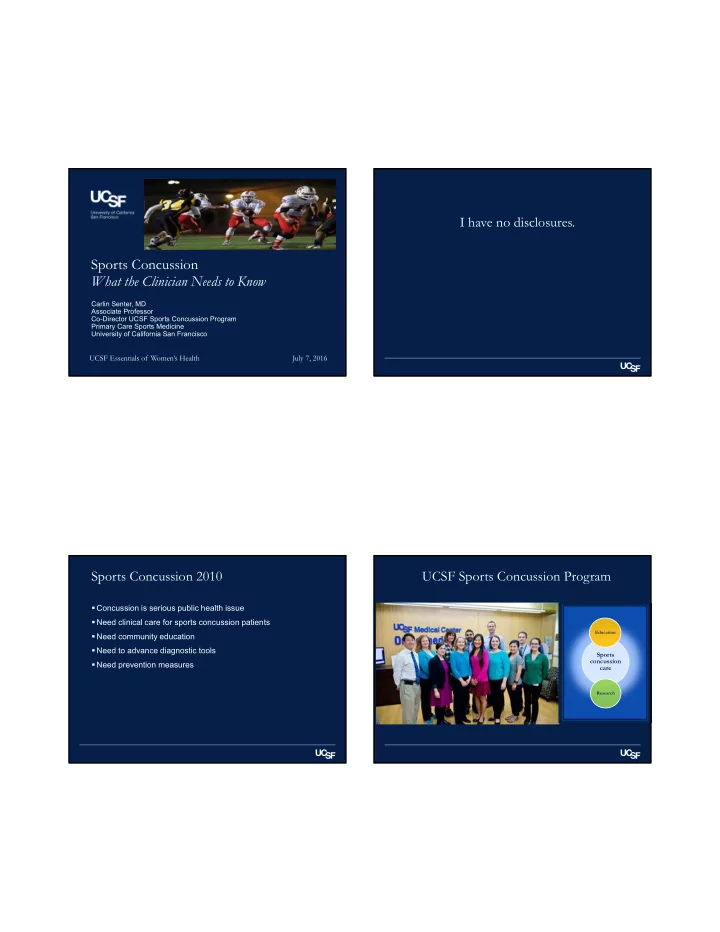
Sports Concussion What the Clinician Needs to Know Carlin Senter, - - PDF document

sports concussion what the clinician needs to know
SMART_READER_LITE
LIVE PREVIEW

Sports Concussion What the Clinician Needs to Know Carlin Senter, - - PDF document

I have no disclosures. Sports Concussion What the Clinician Needs to Know Carlin Senter, MD Associate Professor Co-Director UCSF Sports Concussion Program Primary Care Sports Medicine University of California San Francisco UCSF Essentials of


slide-1
SLIDE 1

Sports Concussion What the Clinician Needs to Know

Carlin Senter, MD Associate Professor Co-Director UCSF Sports Concussion Program Primary Care Sports Medicine University of California San Francisco

UCSF Essentials of Women’s Health July 7, 2016

I have no disclosures. Sports Concussion 2010

  • Concussion is serious public health issue
  • Need clinical care for sports concussion patients
  • Need community education
  • Need to advance diagnostic tools
  • Need prevention measures

UCSF Sports Concussion Program

Sports concussion care

Education Research

slide-2
SLIDE 2

UCSF PlaySafe

  • Athletic trainer at high school
  • M.D. on sideline and in clinic
  • Preparticipation

exams

  • Baseline testing
  • Education

Outline: Sports Concussion 2016

  • 1. Epidemiology
  • 2. Evaluation
  • 3. Treatment
  • How much rest?
  • Return to learn
  • Return to play
  • 4. Legislation
  • 5. How many concussions is too many?

Concussions are common Concussions are common

slide-3
SLIDE 3

Concussion numbers increasing

Marin JR et al. Trends in visits for traumatic brain injury to emergency departments in the United States. JAMA. 2014 May 14;311(18):1917-9.

Put these high school sports in order of highest to lowest incidence of concussion.

A. Soccer (boys) B. Soccer (girls) C. Basketball (girls) D. Wrestling (boys) E. Football (boys)

Rates of sports concussion in high school sports U.S. 2011-2012 Sport Rate per 1000 athletic exposures Football (boys) 0.94 Soccer (girls) 0.73 Wrestling (boys) 0.57 Soccer (boys) 0.41 Basketball (girls) 0.37

Rosenthal JA, Foraker RE, Collins CL, Comstock RD. National High School Athlete Concussion Rates From 2005-2006 to 2011-2012. Am J Sports Med. 2014 Jul;42(7):1710-5. Rosenthal JA, Foraker RE, Collins CL, Comstock RD. National High School Athlete Concussion Rates From 2005-2006 to 2011-2012. Am J Sports Med. 2014 Jul;42(7):1710-5.

slide-4
SLIDE 4

Concussion definition

  • Type of mild traumatic brain injury
  • Blow to head, neck, body  force to head
  • Rapid onset of neurologic impairment
  • Symptoms usually resolve in weeks,

spontaneously, but in some cases can be prolonged.

  • May or may not include loss of consciousness.
  • CT and MRI studies are normal

Physical Cognitive Emotional Sleep

Concussion symptoms Symptom Resolution

  • 50% recovered and returned to play in 1 week; 90% in 3

weeks (Collins et al. Neurosurgery, 2006.)

  • Recovery in athletes may be faster than recovery in
  • thers (Levin HS and Diaz-Arrastia RR. Lancet Neurol

2015; 14: 506-17.)

  • Recovery in kids may take longer than recovery in adults

Who is at risk for delayed return to play?

  • LOC > 1 minute
  • Amnesia
  • Convulsions
  • History of multiple

concussions

  • Injuries close together

in time

  • Repeat injuries with

less and less force

  • Younger age
  • Migraine headaches
  • Depression
  • ADHD
  • Sleep disorders

Broglio SP et al. NATA Position Statement on

  • Concussion. J of Athletic Training, 2014.
slide-5
SLIDE 5

Case #1

  • 16 y/o high school soccer goalie
  • Presents to you in urgent care with wrist pain
  • Also, she hit heads with teammate in practice earlier today and had

15 minutes of headaches and dizziness. She took a nap after practice as she felt unusually tired.

  • Now she has no headache: “I feel fine.”
  • What do you do next?

Case courtesy of Cindy Chang, MD Case courtesy of Cindy Chang, MD

3-pronged evaluation recommended

1. Self-reported symptom assessment 2. Motor control: Neurologic exam including balance. Balance Error Scoring System (BESS or modified BESS) 3. Mental status: Standardized Assessment of Concussion (SAC)

Broglio SP et al. NATA Position Statement on Concussion. J of Athletic Training, 2014. Consensus statement on concussion in sport: the 4th International Conference on Concussion in Sport held in Zurich, November 2012. Br J Sports Med. 2013 Apr;47(5):250-8

  • 1. Self-reported symptom assessment

Consensus statement on concussion in sport: the 4th International Conference on Concussion in Sport held in Zurich, November 2012. Br J Sports Med. 2013 Apr;47(5):250-8.

slide-6
SLIDE 6

Symptom norms

9th grade 10th grade 11th grade Symptom score 17 +/- 5 16 +/- 5 17 +/- 6

Valovich McLeod TC et al. Representative baseline values on the sport concussion assessment tool 2 (SCAT2) in adolescent athletes vary by gender, grade and concussion history. AJSM 2012.

  • 2. Neurological exam with balance

Balance Error Scoring System: BESS

http://paulhead.co.uk/wp-content/uploads/2013/11/balance.jpg

BESS scoring

  • Each error is counted as one point
  • Score = the sum of the error points for all six

trials

  • Errors
  • Eyes opening
  • Hands coming off the hips
  • Hip flexion or abduction of greater than 30
  • Changing foot placement from the stance
  • Remaining out of the test position for > 5

seconds

  • Max score 10 errors
  • Also if cannot maintain for minimum 5 seconds

then score = 10

BESS norms: ages 10-17

Khanna NK, Baumgartner K, LaBella CR. Balance Error Scoring System Performance in Children and Adolescents With No History of Concussion. Sports Health. 2015 Jul;7(4):341-5.

slide-7
SLIDE 7

BESS norms: adults

Iverson GL, Kaarto ML, Koehle MS. Normative data for the balance error scoring system: implications for brain injury evaluations. Brain Inj. 2008 Feb;22(2):147-52. Consensus statement on concussion in sport: the 4th International Conference on Concussion in Sport held in Zurich, November 2012. Br J Sports Med. 2013 Apr;47(5):250-8.

  • 3. Mental status

Case #2

  • 9 y/o boy playing ice hockey, slipped and hit back of his head.
  • Friends said he was “out” for 5 seconds.
  • When he came to he felt “fine” but stopped practicing due to neck

pain.

  • Mom brings him to see you the next day because at school he felt

“foggy” and had headache worse with noise. He says it’s hard to pay attention.

  • What tool should one use in evaluating a child with concussion?
  • When should he return to school?

Consensus statement on concussion in sport: the 4th International Conference on Concussion in Sport held in Zurich, November 2012. Br J Sports Med. 2013 Apr;47(5):250-8

slide-8
SLIDE 8

Can the Child SCAT3 be validated?

  • Cognition
  • Over 1/3 of all children didn’t know the date
  • 70% 5-7 yo, 39% 8-10 yo, 23% 11-13 yo
  • Concentration—days of week
  • 88% correct
  • Of 56 who couldn’t, 63% were 5-7 yo

Brooks et al. AMSSM Research Podium Presentation April 2015; publication pending

Can the Child SCAT3 be validated?

  • Balance (modified BESS)
  • Statistically significant differences between

males/females (males worse) and ages 5-9/10- 13 (younger worse)

  • Tandem Gait
  • Statistically significant differences between ages

5-9/10-13 (younger worse)

Brooks et al. AMSSM Research Podium Presentation April 2015; publication pending

Concussion treatment

  • Cognitive rest
  • Physical rest
  • Medication
  • Tylenol
  • Ibuprofen after first 72

hours

  • No driving
  • No Etoh

How much rest after a concussion?

  • 88 patients (11-22 y/o) seen at pediatric ED randomized
  • Strict rest x 5 days vs. “usual care” of 1-2 days rest, then stepwise

return to activity

  • Neurocognitive and balance outcomes same at 3 and 10d post

injury

  • Strict rest group had more daily post concussive symptoms and

slower symptom resolution over the 10d study period Thomas DG et al. Benefits of strict rest after acute concussion: a randomized controlled trial. Pediatrics. 2015 Feb;135(2):213-23. Slide courtesy of Cindy Chang, MD

slide-9
SLIDE 9

Return to learn after a concussion

  • Return to learn ASAP
  • Ok to return to learn with symptoms
  • Avoid disruptions to the student’s life with return to school
  • Physician should suggest academic adjustments if needed
  • Most concussions resolve within 3 weeks so 504 plan or IEP

usually not necessary Halstead ME et al. Pediatrics. 2013 Nov;132(5):948-57.

Team approach to return to learn

Halstead ME et al. Pediatrics. 2013 Nov;132(5):948-57.

Return to Learn BEFORE Return to Play Return to learn progression

No school. OK to do light reading, little bit TV, drawing, cooking as long as doesn’t worsen symptoms. 15 min cognitive activity at a time. Return to full day of school.

http://www.chop.edu/service/concussion-care- for-kids/returning-to-school.html

30 min schoolwork at a time until can do 1-2 hours. Return to ½ day of school.

slide-10
SLIDE 10

Concussion Information Sheet Acute Concussion Notification Form Graded Concussion Symptom Checklist Physician Letter to School After Concussion Visit Concussion Return to Learn (RTL) Protocol Physician Recommended School Accommodations Following Concussion Concussion Return to Play (RTP) Protocol

CIF: Physician letter to school Case #3

  • 15 y/o high school girls soccer player
  • Concussion f/u in clinic
  • Injured 2 weeks ago
  • Rested at home x 2 days then gradually returned to school with

RTL protocol

  • Tolerating school 100%
  • No concussion symptoms
  • Soccer championship game in 2 days. She requests your clearance

to play.

  • What do you recommend?

Follow gradual RTP progression

slide-11
SLIDE 11

Return to play progression

Light aerobic activity Sport specific activity Game play Non- contact training Full contact practice

Clinician clearance Asymptomatic

2nd International Conference on Concussion in Sport (2004). 2005 Br J Sport Med 39:196.

Return to play activity examples

Step Objective Activities 1 Recovery No activity 2 Light aerobic activity: Increase heart rate Walking, swimming, or stationary bike. < 70% max heart rate. No weights. 3 Sport Specific: Add movement Skating drills in hockey, running drills in

  • soccer. No head impact activities.

4 Non contact training: Add coordination and cognitive load More complex drills (passing). Can start weights. 5 Restore confidence and assess functional skills by coaching staff Full-contact practice 6 Normal game play Consensus statement on concussion in sport: the 4th International Conference on Concussion in Sport held in Zurich, November 2012. Br J Sports Med. 2013 Apr;47(5):250-8.

Concussion Information Sheet Acute Concussion Notification Form Graded Concussion Symptom Checklist Physician Letter to School After Concussion Visit Concussion Return to Learn (RTL) Protocol Physician Recommended School Accommodations Following Concussion Concussion Return to Play (RTP) Protocol

CIF: Return to play handout

slide-12
SLIDE 12

California concussion legislation

  • AB 25 –Concussion Law 2012
  • 3 parts (education, remove from play, written medical

note to return)

  • AB 1451—Coaches Concussion Training Law 2013
  • Mandatory education every 2 years
  • AB 2127 – Concussion Safety Law 2015
  • Limit FB full-contact practices
  • Mandatory RTP protocol of no less than 7 days from

the diagnosed date of concussion

  • RTP under the supervision of LHCP

Slide courtesy of Cindy Chang, MD

Hawaii concussion legislation

  • Act 197 enacted 7/3/2012
  • Hawaii High School Athletic Association members must

‒ Provide annual concussion training for coaches, faculty, staff, parents and students who play sports ‒ Immediate removal from play if signs or symptoms of concussion ‒ Student must be evaluated and cleared by LHCP prior to return to learn/play

Case #4

A 15 y/o lacrosse player presents to you 3 months after her 5th concussion sustained when she was elbowed in the head during a game. She has had a headache with light sensitivity since the injury. She and her father would like to know if and when she can return to lacrosse.

  • What is her diagnosis?
  • What do you do next?

Post Concussion Syndrome

  • Frequency unclear (0-15%).
  • Concussion symptoms persist x months, usually <1 year.
  • Patients benefit from multidisciplinary approach to treatment.
slide-13
SLIDE 13

Think about post concussion syndrome when…

  • Symptoms not improving after 2 weeks of treatment.
  • Unable to return to school or work after 1-2 weeks of treatment.
  • History of migraine, anxiety, depression, sleep disorder.
  • History of concussion.

Post concussion syndrome treatment: Multidisciplinary approach How Many Concussions is Too Many?

  • Individualized to athlete.
  • Concussion hx.
  • Number.
  • Less force.
  • More frequent.
  • Increased severity of sxs
  • Increased duration of sxs.
  • Age: possibly more consequences if younger at time of

concussion. Corrigan JD, Concussion webcast 10/18/2011.

Outline: Sports Concussion 2016

  • 1. Epidemiology
  • 2. Evaluation
  • 3. Treatment
  • How much rest?
  • Return to learn
  • Return to play
  • 4. Legislation
  • 5. How many concussions is too many?
slide-14
SLIDE 14

Keys to managing sports concussion in 2016

  • 3-pronged evaluation: Symptoms, Neuro/balance exam, Cognitive
  • Treatment is rest
  • Gradual return to learn
  • Return to play protocol at least 7 days since day of diagnosis (in

state of California)

  • Majority recover within 3 weeks
  • Consider referral for post concussion syndrome
  • Repeat injuries: individual approach

Concussion resources

  • California Interscholastic Federation

http://www.cifstate.org/sports-medicine/ concussions/index

  • Consensus statement on concussion in

sport, 2012.

http://bjsm.bmj.com/content/47/5/250.full

  • CDC concussion toolkit for physicians

www.cdc.gov/concussion/HeadsUp/physicians_tool_kit.html

Thank You!

Carlin Senter, M.D. Carlin.Senter@ucsf.edu UCSF Sports Medicine