Sri Lanka Presentation on Green Jobs Demonstration Project in Waste - - PDF document

sri lanka presentation on green jobs demonstration
SMART_READER_LITE
LIVE PREVIEW

Sri Lanka Presentation on Green Jobs Demonstration Project in Waste - - PDF document

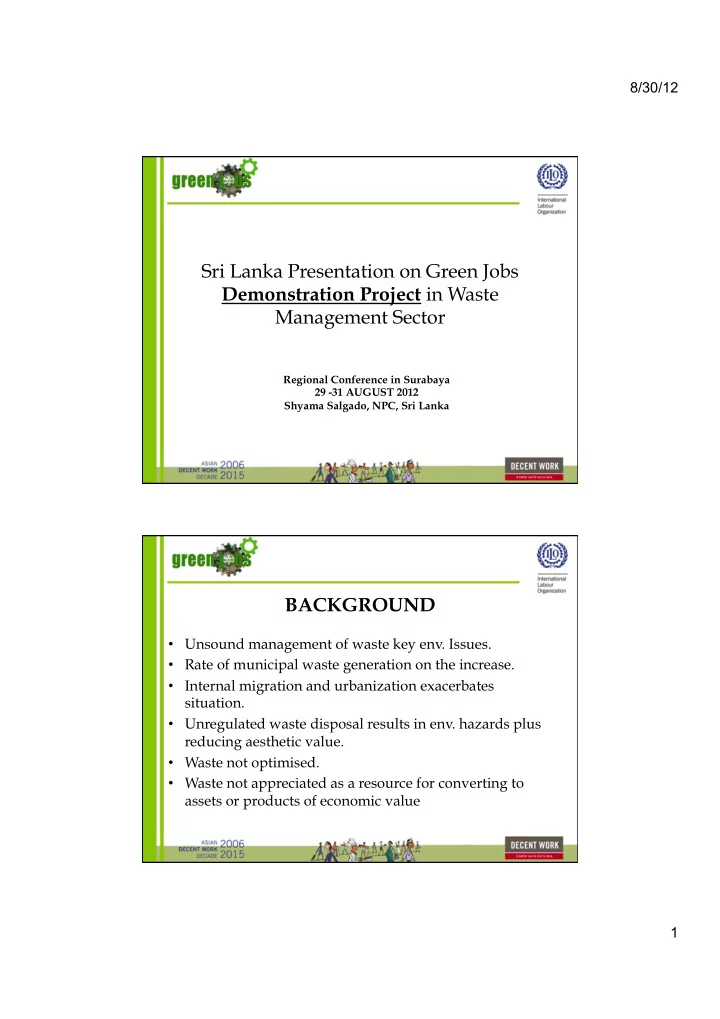
8/30/12 Sri Lanka Presentation on Green Jobs Demonstration Project in Waste Management Sector Regional Conference in Surabaya 29 -31 AUGUST 2012 Shyama Salgado, NPC, Sri Lanka BACKGROUND Unsound management of waste key env. Issues.


slide-1
SLIDE 1

8/30/12 1

Sri Lanka Presentation on Green Jobs Demonstration Project in Waste Management Sector

Regional Conference in Surabaya 29 -31 AUGUST 2012 Shyama Salgado, NPC, Sri Lanka

BACKGROUND

  • Unsound management of waste key env. Issues.
  • Rate of municipal waste generation on the increase.
  • Internal migration and urbanization exacerbates

situation.

  • Unregulated waste disposal results in env. hazards plus

reducing aesthetic value.

  • Waste not optimised.
  • Waste not appreciated as a resource for converting to

assets or products of economic value

slide-2
SLIDE 2

8/30/12 2

Background – working conditions

  • Politicized sector based on favor and run on fear.
  • Women marginalized and given menial tasks
  • nly.
  • Social values and education amongst workers

lend itself to aggressive behavior and unhealthy working conditions.

  • Most of the workers operate on an informal

basis and have irregular working patterns.

Background….

  • No minimum wage established for the sector.
  • No fixed cadre for workers…ad hoc recruitment.
  • No OSH sensitivity and enabling environment.
  • No facilities that support improved productivity.
  • Lack of basic amenities for workers. (toilets, rest rooms,

etc)

  • Gender insensitive work environment.
  • No systematic worker education programs to support

decent work.

  • Non unionized work force.
slide-3
SLIDE 3

8/30/12 3

PURPOSE OF PROJECT

  • Promote waste as a valuable asset.
  • Convert waste into products of economic value.
  • Product more marketable leading to…
  • Realize potential of waste as a source of income.
  • Western province – highest waste producer.
  • Promote/support youth entre. and female entre. in solid

waste business sector.

EMPLOYMENT MODEL

slide-4
SLIDE 4

8/30/12 4

OBJECTIVES & STRATEGIES

  • To transform waste recycling into green jobs/ decent

work, through improved working conditions by

– Supporting innovative partnerships, – Developing curricula for skills, – Promoting entrepreneurship, – Marketing, financial and business training, – Facilitating progressive formalization of jobs, – Mainstreaming OSH in the waste sector,

MAIN PARTNERS

  • National Institute of Occupational Safety and Health of

the Ministry of Labour & Labour Relations (NIOSH).

  • Trade unions.
  • Employers Federation of Ceylon (EFC).
  • Waste Management Authority of the Western Province

(WMA).

  • Start-&-Improve-Yr-Business Assoc. (SIYB)
  • Private Sector Development facilitators (PSD).
  • Plantation companies .
  • 48 local government authorities of the WP.
slide-5
SLIDE 5

8/30/12 5

ACTIVITIES

  • Waste sector value chain analysis
  • TOT on OSH/Work Adjustment for Recycling and

Managing Waste (WARM) for 300 waste sector peer educators

  • Cascading training for 4,000 waste operators on OSH/

WARM

  • Follow-up interventions in support of integrating OSH

into the sector (Personal Protective Equipment, First Aid kits, brochures for awareness raising)

ACTIVITIES

  • Mainstreaming OSH into training of waste sector

workers.

  • National Vocational Qualification (NVQ)Level 2

(operators) curriculum to include WARM as a learning tool to integrate OSH.

  • NVQ Level 4 (supervisors) competency standards

developed to facilitate upward mobility of waste sector workers aspiring for better jobs (in-country and outside).

slide-6
SLIDE 6

8/30/12 6

ACTIVITIES

  • SIYB training for 40 potential new entrepreneurs and 40

existing entrepreneurs .

  • New curriculum for SIYB in waste recycling as a business

adapted to local context and used as training manual and trainees’ guide: now a std tool for the SIYB Association.

  • Progressive registration and mapping of workers in the

informal sector within the 48 local government authorities.

  • Facilitation of ‘associations’ amongst workers on the

Karadiyana (model) site creating enabling env to legitimize their activities.

ACTIVITIES

  • D-base on plastic recyclers developed through LIRNEasia &

updated by PSD placed on website for information of stakeholders.

  • Study tour to cull good and wise practices and draw lessons

learned

  • Technical advice provided to design improvements to model

site for composting operations by PSD.

  • Market linkages facilitated between plantations and WMA for

compost sales.

  • D-base of public/pvt. players in composting sector being

developed.

slide-7
SLIDE 7

8/30/12 7 ACTIVITIES THAT HAVE COMMITMENTS TO BE CONTINUED

  • PPE’s provided to selected waste operators on the 3 demo sites (115

sets) and will be practiced by WMA per WARM guidelines.

  • OSH guidelines for wm sector being developed for adopting

through tripartite process.

  • Regional Plantation Companies/WMA market linkages being

pursued for compost supply to rubber plantations.

  • SC on value chain development can be sustained through the

WMA/MOLLR and tripartite initiatives.

KEY RESULTS

  • Coordination mechanism set-up to continue work on demo

model.

  • Pilots completed to take to scale.
  • Capacity built to integrate key decent work concepts into WM

sector.

  • TUs Introduced to informal sector hitherto neglected for

formalizing & raising worker awareness on decent work issues in the sector.

  • Key partnerships forged for continuation of initiative

(50%....More to go to reach strategic sustainability levels).

  • GJ for waste sector integrated into training at strategic points

(SIYB; NIOSH; WMA; TVEC).

slide-8
SLIDE 8

8/30/12 8

CHALLENGES

  • WMA does not fully understand the strength of

their mandate to implement changes to the sector.

  • Capacity ‘half’ built in WMA to carry on the

work…more to go.

  • Informal nature of WMA sector poses

constraints to systematic cascading training.

CHALLENGES

  • Time too short for promotion of attitudinal change

crucial to project success (though life-skills has been included as a

point to be considered by warm trainers).

  • Politicization of LG system does not augur well for

quality assurance & sustainability.

  • Household reluctance to change practices needs more

consistent advocacy.

  • Trade union contribution though well accepted raises

reservations on part of WMA for actual implementation

(viewed as a threat to stability of workplace).

slide-9
SLIDE 9

8/30/12 9

OPPORTUNITIES

  • Strong partnerships led by MOLLR (NIOSH-WMA-RPCs).
  • Committed partners – NIOSH/MOLLR; trade unions (who want to scale-up

both upstream and downstream work).

  • Policy and legal framework in place (80%) -GJ integrated into employment

policy as has youth employment and gender as cross-cutting – thus framework in place.

  • Potential for mainstreaming WM in both pvt. and public sectors (through

EFC membership and continuing with Phase I partners).

  • Continue the work improvements recommended under the value chain

analysis undertaken by PSD/ODI such as re-design of the compost plant to increase productivity (for which only technical support has been provided under this phase).

  • Introduction of the taxation incentive scheme agreed upon under Phase I.

OPPORTUNITIES

  • Extending WM to other sectors that have shown interest, particularly the

plantation sector in the Central, Sabaragamuwa and Uva provinces.

  • Strengthening the backwards and forwards market linkages for composting

and plastic recycling businesses.

  • Working to improving the value addition work started under Phase II for

composting and plastic recycling and promote waste recycling as a employment option in marginalized and poverty stricken areas.

  • Many tools for green jobs developed and can be used to promote models

initiated under the project.

  • Commitment from partners to take the model forward.
  • Donor interest…..?? To be researched further!
slide-10
SLIDE 10

8/30/12 10

WAY FORWARD

  • Build on existing model and partnerships.
  • Strengthen some of the downstream interventions.
  • Replicate in the plantations.
  • Use WM as a cross cutting issue in all emerging green sectors.
  • Capacity building of GJ as a strategic move for sustainability.
  • Link to Employment Policy Master Plan initiatives to gain

high level commitment for sustained interest and to ensure fiscal space

DISCUSSION!

Thank You

shyama@ilo.org