STOCHASTIC MODELLING OF UD AND 2D WOVEN COMPOSITE RESPONSE Martin B. - - PDF document

stochastic modelling of ud and 2d woven composite response
SMART_READER_LITE
LIVE PREVIEW

STOCHASTIC MODELLING OF UD AND 2D WOVEN COMPOSITE RESPONSE Martin B. - - PDF document

18 TH INTERNATIONAL CONFERENCE ON COMPOSITE MATERIALS STOCHASTIC MODELLING OF UD AND 2D WOVEN COMPOSITE RESPONSE Martin B. Whiteside 1* , Silvestre T. Pinho 1 1 Department of Aeronautics, Imperial College London, United Kingdom *Corresponding


slide-1
SLIDE 1

18TH INTERNATIONAL CONFERENCE ON COMPOSITE MATERIALS

1. Introduction Experimental characterisation of fibre reinforced polymer-matrix (FRP) composite materials reveals large variability of material properties – attributed to the complex inhomogeneous micro-structure and the abundance of manufacturing-induced defects. As a result, traditional design guidelines prescribe the application of substantial empirical KnockDown Factors (KDFs) on the design strength which translate to a significant increase in component weight/cost without any quantifiable increase in structural reliability. The motivation in developing stochastic approaches to failure prediction is to quantify this uncertainty, facilitating a better informed design process. 2. UD Composite Response The development of ply-level UD composite failure criteria is an active field of research within the engineering community aiming to accurately predict component strength in multi-axial loading conditions

[1-6]. Existing physically-based failure criteria have

successfully modeled the wide range of failure modes exhibited by composite materials in tri-axial stress states. In combining deterministic failure criteria with stochastic methodologies, the variability characterised from uni-axial strength experiments can be propagated into the multi-axial domain and used to provide a theoretical basis for values of KDF employed to account for complex loading conditions. 2.1 Methodology To appreciate the predictions made by a stochastic analysis it is essential to possess a thorough understanding of the underlying deterministic theory. The LaRC05 failure criteria [7-10] distinguishes explicitly between 4 failure modes; namely fibre tensile failure,

, matrix failure, , fibre

kinking,

and finally matrix splitting between

the fibres

. Upon subjecting a composite ply

to a given stress state, the criteria evaluates each failure index via derived analytical failure models and predicts global ply failure when the following condition is met: (1) Explanation of the analytical foundations of each failure mode is provided in [9]. Strength properties are represented herein by and for direct and shear stresses respectively. Superscripts + and –

STOCHASTIC MODELLING OF UD AND 2D WOVEN COMPOSITE RESPONSE

Martin B. Whiteside1*, Silvestre T. Pinho1

1Department of Aeronautics, Imperial College London, United Kingdom

*Corresponding Author: (martin.whiteside@imperial.ac.uk) Keywords: Unidirectional Composite, 2D Woven Composite, Monte Carlo Simulation, Finite Element Analysis, Reduced Unit Cell, Sensitivity Analysis

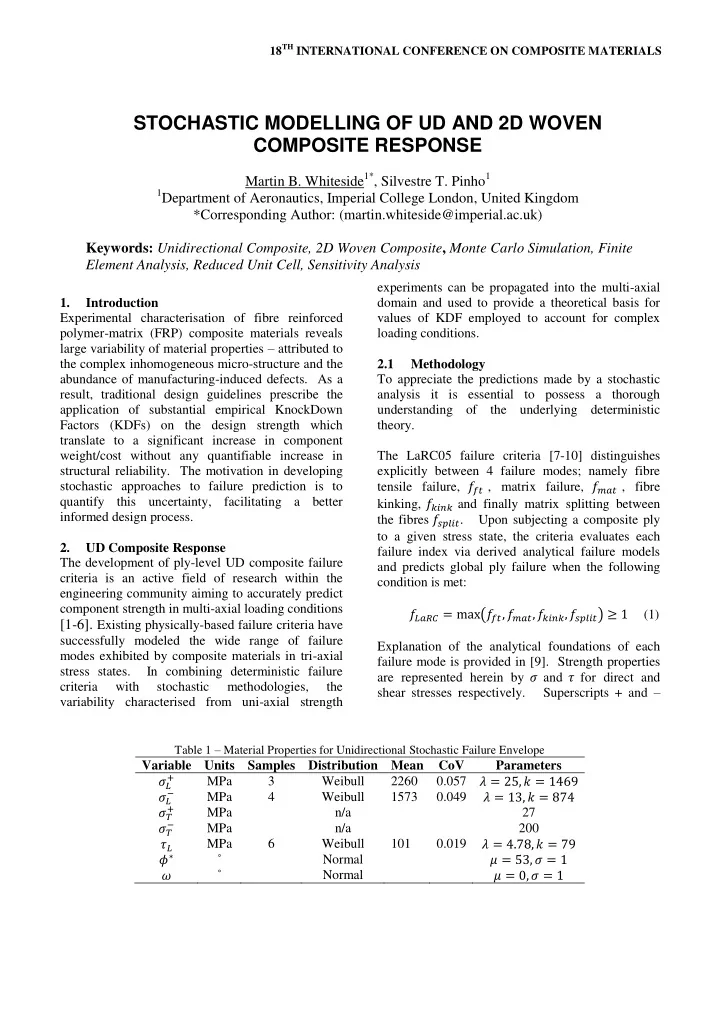
Table 1 – Material Properties for Unidirectional Stochastic Failure Envelope

Variable Units Samples Distribution Mean CoV Parameters MPa 3 Weibull 2260 0.057 MPa 4 Weibull 1573 0.049 MPa n/a 27 MPa n/a 200 MPa 6 Weibull 101 0.019 ˚ Normal ˚ Normal

slide-2
SLIDE 2

indicate tension and compression, and subscripts and symbolize the longitudinal and transverse directions with respect to the global fibre direction

  • respectively. Additional input variables used include

the matrix fracture angle under pure compression, and the global fibre misalignment angle, . 2.1.1 Uncertainty Analysis The stochastic failure envelopes are generated via parallelised Monte Carlo simulation

  • f

the deterministic LaRC05 criteria. The variability of each stochastic input parameter is modeled by defining each a probability density function PDF, and associated cumulative density function, CDF,

. The method propagates this uncertainty

through the deterministic LaRC model by repeated

  • sampling. For the purpose of modeling the
  • bserved strength characteristics (

, , , , )

2-parameter Weibull distributions, , are employed, Eq. 2. (2) where parameters and are evaluated through fitting the function to observed experimental results using the method

  • f

Maximum Likelihood Estimation (MLE) [11]. The remaining parameters ( , ) are assumed Normal, , Eq. (3). In this instance the Normal distribution represents a symmetrical distribution about the sample mean and characterised by the sample variance using the expression: (3) 2.1.2 Sensitivity Analysis Consider a deterministic model defined and square integrable in the unit hypercube . The function can be conceived to incorporate the mapping of to the true physical distributions of the input variables via their respective probability density functions. Sobol defines a main global sensitivity measure as the ratio [12]. (4) and are referred to as the main effects of - whom describe the expected reduction of model variance that would be achieved if the value of the parameter was fixed. An additional measure is introduced by Homma and Saltelli [13], namely the total effect written as:

Figure 1 : vs. stochastic failure envelope

α = 0.145

slide-3
SLIDE 3

3

(5) where represents a vector containing all variables other than . This measure describes the expected model variance that would remain if all

  • ther parameters aside from were fixed. Finally

an interaction effect can be defined as [13]: (6) which provides measure of how much is involved with interactions with any other input variable. The solution of main and total effects requires multidimensional integration, for which Monte Carlo schemes proposed by Saltelli [14] and Jansen [15] are employed respectively. Both UA and SA is performed for a finite distribution of stress ratios defined by (7) where and are user-defined biaxial plot axes.

(a) Main Effect (b) Total Effect (c) Interaction Effect

Si α α α Si

T

Si

Int

σL

+

SL w σL

  • σL

+

SL w σL

  • w

σL

+

SL w SL σL

  • 0.5

1.0 0.5 1.0 0.5 1.0

Figure 2a. main effect b. total effect and c. interaction effect corresponding to the SFE presented in Figure 1

slide-4
SLIDE 4

2.2 Results and Interpretation Bi-axial experimental characterisation of carbon epoxy T300/BSL914C was performed by Schelling and Aoki with results provided in [3]. The experimental failure data was obtained from three independent sets of specimens, dubbed Set 1 - 3, with each set comprising of axially wound filament tubes loaded in either combined tension/compression

  • r torsion/compression.

Weibull PDFs are fitted to the uni-axial experimental data provided for strengths (

)

using MLE. Since no further information on

besides the nominal states is provided,

these strengths are taken as deterministic. In an extension to the LaRC05 criteria [7-10] the presence

  • f a global in-plane misalignment, , is considered.

Figure 1 presents the vs. stochastic failure envelope and overlays biaxial experiment results provided by the WWFE [3]. In addition, total, main and interaction effect plots of are presented in Figures 2a, 2b and 2c respectively. As can be observed in Figure 1, the SFE begins to incorporate biaxial experimental results, previously considered erroneous in comparison to the underlying deterministic theory. The physical phenomenon underlying this result together with an analysis of the corresponding sensitivity results will discussed in the presentation. 3. 2D Woven Composite Woven or textile composites consist of individual fibres bundled into two sets of tows/yarns, which are interlaced perpendicularly to form a fabric. Traditionally, tows running the length in a roll of the fabric are named the warp yarns, whereas those than run crosswise to the roll are called the weft. The weave architecture has a significant influence on the material properties, including the drapeability, aesthetic appearance and isotropy of both strength and stiffness [16]. In comparison to UD composites, the presence of

  • ff-axis fibres increase the strength and stiffness

under in-plane biaxial loading conditions. The trade-

  • ff, however, is reduced relative strength and

stiffness under uni-axial loading due to the crimping

  • f fibres caused by the interlacing within the weave.

Moreover, the weave introduces further complexity to the composite structure and introduces further sources of uncertainty such as variable tow spacing and crimp angles. A stochastic framework is developed, integrating a novel deterministic FE unit-cell model to simulate the stiffness and strength properties of a 5-harness satin (5HS) 2D woven composite subjected to bi- axial loading conditions. The unit cells elected to represent the weave geometry is illustrated in Figure

  • 3a. Stochastic parameters in this instance are

relevant to the material geometry, specifically, variability in the crimp angle of the tows and stacking misalignment of the 2D woven plies. The aim is to create and analyse bi-axial stochastic failure envelopes through numerical Monte Carlo simulation of the FE model. The uni-axial stiffness and strength results can be compared directly to a stochastic strength characterisation of a 2D 5HS carbon fibre epoxy 6-ply laminate conducted at Imperial College London. Although the biaxial simulation results cannot be validated experimentally, owing to lack of available data at the time of writing, the development of SFEs permit qualitative hypotheses to be presented relating to potential consequences on the design process. 3.1 FE Model Development Abaqus is utilised to create a FE model of a reduced unit-cell of the woven composite, exploiting both rotational and translational symmetries. The creation

  • f the FE model is fully automated in Python - upon

specific input parameters regarding the structure and boundary conditions, the tow and matrix regions are automatically created and meshed. Loading is introduced via an applied strain, after which the UC stiffness can be determined and stresses in the tows

  • analysed. The modeled tow assembly is illustrated

in Figure 3b. Similar to the UD case, two of the LaRC05 failure criteria are implemented to predict failure initiation

  • f the tows, namely fibre tensile

and matrix

failure modes. The tows, therefore, are considered similar to a UD ply and the stresses used to compute the failure indices for each tow element are

slide-5
SLIDE 5

5

evaluated in the transformed co-ordinate system representative of the tow path. The material properties

  • f

the tow are computed from experimental characterisation of the constituents and applying an appropriate rule of mixtures. 3.2 Stochastic Analysis Variability in tow spacing, size, crimp and stacking

  • f the 5HS is characterised through image analysis
  • f pictures obtained through high resolution
  • microscopy. Appropriate probability distributions

are selected by means of the Kolomogorv-Smirnov test and the parameters determined through MLE. For each deterministic loading condition, a Monte Carlo simulation procedure propagates the uncertainty characterised by the input distributions throughout the structural model to construct the

  • utput distribution of both stiffness and strength.

The procedure is repeated for a range of biaxial loading conditions and the output is combined to create a vs SFE. Variability of the response

  • bserved due to the stochastic nature of the crimp

angle and stacking sequence is analysed. The sensitivity of the response to ply crimp angle and stacking alignment of the predicted response is

  • bserved through the local systematic variation of

each parameter. A global sensitivity analysis remains under development. The complete result sets, including full biaxial SFEs of the 5HS Satin will be presented at the conference and the implications of the results will be discussed.

  • 4. Conclusions

Stochastic methodologies are becoming increasing viable in terms of computational cost. Stochastic failure envelopes for both UD and woven composites through MCS highlight the importance

  • f considering the statistical behavior of failure

modes, given the discrepancy between stochastic predictions and their underlying deterministic

  • theory. Moreover, the propagation of uncertainty

into the bi-axial domains provides additional information to the engineer permitting more informed design decisions. Conclusions related to the detailed analysis of UD and 5H satin weave SFEs will be outlined and discussed at the conference. References [1] A.S. Kaddour, M.J. Hinton, P.D. Soden, A comparison of the predictive capabilities of current failure theories for composite laminates: additional contributions, Composites Science and Technology, 64 (2004) 449-476. [2] P. Soden, M. Hinton, A. Kaddour, Lamina properties, lay-up configurations and loading conditions for a range of fibre-reinforced composite laminates, Composites Science and Technology, 58

(a) (b)

Figure 3a. unit-cell definition b. corresponding meshed unit-cell

slide-6
SLIDE 6

(1998) 1011-1022. [3] P.D. Soden, M.J. Hinton, A.S. Kaddour, M.J. Hinton, A.S. Kaddour, P.D. Soden, Biaxial test results for strength and deformation of a range of E- glass and carbon fibre reinforced composite laminates: Failure exercise benchmark data, in: Failure Criteria in Fibre-Reinforced-Polymer Composites, Elsevier, Oxford, 2004, pp. 52-96. [4] M.J. Hinton, P.D. Soden, Predicting failure in composite laminates: the background to the exercise, Composites Science and Technology, 58 (1998) 1001-1010. [5] M.J. Hinton, A.S. Kaddour, P.D. Soden, A further assessment of the predictive capabilities of current failure theories for composite laminates: comparison with experimental evidence, Composites Science and Technology, 64 (2004) 549-588. [6] P.D. Soden, M.J. Hinton, A.S. Kaddour, A comparison of the predictive capabilities of current failure theories for composite laminates, Composites Science and Technology, 58 (1998) 1225-1254. [7] P. Camanho, C. Dávila, S. Pinho, L. Iannucci, P. Robinson, Prediction of in situ strengths and matrix cracking in composites under transverse tension and in-plane shear, Composites Part A, 37 (2006) 165- 176. [8] S. Pinho, C. Dávila, P. Camanho, L. Iannucci, P. Robinson, Failure models and criteria for FRP under in-plane or three-dimensional stress states including shear non-linearity, NASA Technical Memorandum, 213530. [9] S.T. Pinho, L. Iannucci, P. Robinson, Physically- based failure models and criteria for laminated fibre- reinforced composites with emphasis on fibre kinking: Part I: Development, Composites Part A: Applied Science and Manufacturing, 37 (2006) 63- 73. [10] S.T. Pinho, L. Iannucci, P. Robinson, Physically based failure models and criteria for laminated fibre-reinforced composites with emphasis

  • n

fibre kinking. Part II: FE implementation, Composites Part A: Applied Science and Manufacturing, 37 (2006) 766-777. [11] H. Harter, A. Moore, Maximum-likelihood estimation of the parameters of gamma and Weibull populations from complete and from censored samples, Technometrics, (1965) 639-643. [12] I. Sobol, Sensitivity analysis for non-linear mathematical models, Mathematical Modeling & Computational Experiment, 1 (1993) 407-414. [13] T. Homma, A. Saltelli, Importance measures in global sensitivity analysis

  • f

model

  • utput,

Reliability Engineering and System Safety, 52 (1996) 1-17. [14] A. Saltelli, P. Annoni, I. Azzini, F. Campolongo, M. Ratto, S. Tarantola, Variance based sensitivity analysis of model output. Design and estimator for the total sensitivity index, Computer Physics Communications, 181 (2010) 259-270. [15] M. Jansen, Analysis of variance designs for model output, Computer Physics Communications, 117 (1999) 35-43. [16] N. Naik, P. Shembekar, Elastic behavior of woven fabric composites: I—Lamina analysis, Journal of composite materials, 26 (1992) 2196.