Stress Factors for Disaster Victims Effects Future uncertainty - - PowerPoint PPT Presentation

stress factors for disaster victims
SMART_READER_LITE
LIVE PREVIEW

Stress Factors for Disaster Victims Effects Future uncertainty - - PowerPoint PPT Presentation

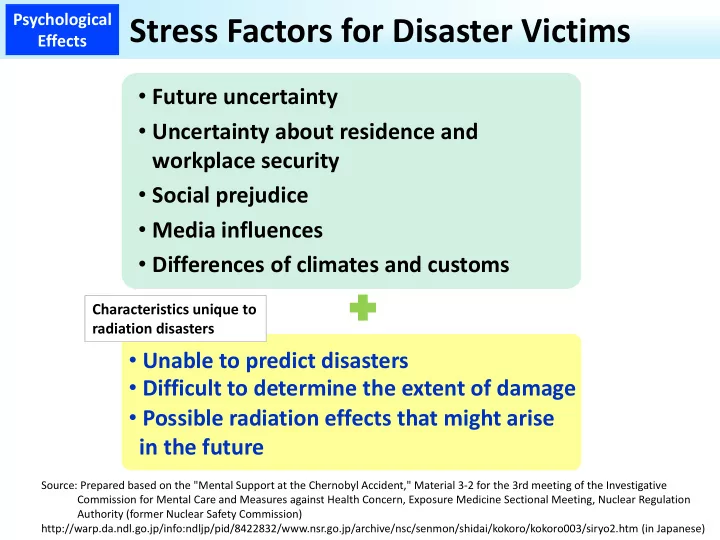
Psychological Stress Factors for Disaster Victims Effects Future uncertainty Uncertainty about residence and workplace security Social prejudice Media influences Differences of climates and customs Characteristics unique to


slide-1
SLIDE 1

Stress Factors for Disaster Victims

Source: Prepared based on the "Mental Support at the Chernobyl Accident," Material 3‐2 for the 3rd meeting of the Investigative Commission for Mental Care and Measures against Health Concern, Exposure Medicine Sectional Meeting, Nuclear Regulation Authority (former Nuclear Safety Commission) http://warp.da.ndl.go.jp/info:ndljp/pid/8422832/www.nsr.go.jp/archive/nsc/senmon/shidai/kokoro/kokoro003/siryo2.htm (in Japanese)

  • Future uncertainty
  • Uncertainty about residence and

workplace security

  • Social prejudice
  • Media influences
  • Differences of climates and customs
  • Unable to predict disasters
  • Difficult to determine the extent of damage
  • Possible radiation effects that might arise

in the future

Characteristics unique to radiation disasters

Psychological Effects

slide-2
SLIDE 2

Radiation Accidents and Health Concerns

Anxiety caused by radiation accidents

・Anxiety over health effects of radiation ・Anxiety over health effects on children now and in the future

Psychological effects from protracted anxiety

・Possibility that mental health may deteriorate ・Possibility that mothers' anxiety may affect the mental state and growth of children

Factors that increase anxiety

・Unable to acquire reliable information ・Confusion caused by scientifically inaccurate information ・Stigmas and stereotypes

Psychological Effects

slide-3
SLIDE 3

Possible psychological effects of radiation issues: ・Parents' anxiety over radiation proves that they are dedicated parents. ・Parents' excessive concern over radiation could affect children mentally and physically. Regarding fetal exposure and neuropsychological disorders caused by the Chernobyl accident: ・The results of studies on the neuropsychological disorders of children who were fetuses at the time of the accident are not coherent. ・Although there is a report that exposure affected the IQ of the fetuses, no correlation has been found between thyroid exposure doses and children's IQs. Possible psychological effects of radiation issues: ・Parents' anxiety over radiation proves that they are dedicated parents. ・Parents' excessive concern over radiation could affect children mentally and physically. Regarding fetal exposure and neuropsychological disorders caused by the Chernobyl accident: ・The results of studies on the neuropsychological disorders of children who were fetuses at the time of the accident are not coherent. ・Although there is a report that exposure affected the IQ of the fetuses, no correlation has been found between thyroid exposure doses and children's IQs.

Psychiatric Effects on Children

Source: ・A debriefing report from "Mental Health and Lifestyle Survey," Fukushima Health Management Survey in FY2014, Fukushima Medical University, June 2016 ・Kolominsky Y et al., J Child Psychol Psychiatry, 40 (2): 299‐305, 1999

Tendencies found through a survey using SDQ (Strengths and Difficulties Questionnaire) as an index to evaluate the mental health of children:

  • The percentage of respondents whose SDQ score was 16 or higher was 9.5% in a previous study

targeting the general Japanese population unaffected by any disasters. Compared with this, the survey revealed that the percentages of those scoring 16 or higher were high in both the 4‐6 age and 6‐12 age groups.

  • However, the same percentages tend to be lower in both the 4‐6 age and 6‐12 age groups in the

survey conducted in FY2014, compared to that in FY2011, i.e., the year of the accident. Tendencies found through a survey using SDQ (Strengths and Difficulties Questionnaire) as an index to evaluate the mental health of children:

  • The percentage of respondents whose SDQ score was 16 or higher was 9.5% in a previous study

targeting the general Japanese population unaffected by any disasters. Compared with this, the survey revealed that the percentages of those scoring 16 or higher were high in both the 4‐6 age and 6‐12 age groups.

  • However, the same percentages tend to be lower in both the 4‐6 age and 6‐12 age groups in the

survey conducted in FY2014, compared to that in FY2011, i.e., the year of the accident.

Regarding a questionnaire on the emotions and behavior of children in Fukushima

SDQ︓Strengths and Difficulties Questionnaire

Psychological Effects

slide-4
SLIDE 4

Source: Prepared based on Lochard, J (2012), the material for the 27th symposium of the Nuclear Safety Research Association

Conclusion from dialogue with the local residents 1

(View of the International Commission on Radiological Protection (ICRP))

Conclusion from dialogue with the local residents 1

(View of the International Commission on Radiological Protection (ICRP))

Response to the Accident at Tokyo Electric Power Company (TEPCO)'s Fukushima Daiichi Nuclear Power Station (NPS) and Local Communities (1/2)

  • Participants recognized the importance of developing radiation protection culture to

allow inhabitants to understand and evaluate the information on the consequences of the accident and to take informed actions for reducing radiological exposure.

  • They recognized the need for a more detailed characterisation of the radiological

situation to allow people to know where, when and how they are exposed.

  • They underlined their concern about the future demographic pattern due to an

acceleration in the younger generations leaving the prefecture and abandoning farming activities.

  • They discussed with great emotion the issue of discrimination of people in the affected

areas, especially for those of pre‐marital age to marry and have children .

  • The preservation of the traditional and popular activity of gathering wild vegetables

(sansai) was identified as culturally important in maintaining the cohesion of the Fukushima community. Psychological Effects

slide-5
SLIDE 5

Response to the Accident at Tokyo Electric Power Company (TEPCO)'s Fukushima Daiichi Nuclear Power Station (NPS) and Local Communities (2/2)

Conclusion from dialogue with the local residents 2

(View of the International Commission on Radiological Protection (ICRP))

Conclusion from dialogue with the local residents 2

(View of the International Commission on Radiological Protection (ICRP))

Source: Prepared based on Lochard, J (2012), the material for the 27th symposium of the Nuclear Safety Research Association

  • Develop a mechanism to support projects proposed by local communities and residents

to improve living conditions.

  • Support community expectations that decisions on recovery actions reflect their

priorities, be based on their knowledge of the local context, and support their current and future interests.

  • Continue efforts to monitor individual internal and external exposures, and to provide

information and tools in order to help people to make their own judgments.

  • Create a forum for a permanent dialogue between all concerned parties (producers,

distributers and consumers) on the issue of foodstuff.

  • Promote the involvement of parents, grand‐parents and teachers to develop radiation

protection culture among children.

  • Strengthen dialogue and cooperation with stakeholders elsewhere in Japan and abroad.

Psychological Effects

slide-6
SLIDE 6

Overview of Health Effects ‐ Chernobyl Accident ‐

Source: World Health Organization: Mental, psychological and central nervous system effects. Health effects of the UN Chernobyl accident and special health care programmes: report of the UN Chernobyl forum expert group "Health" (eds. Bennett B., et al), 93‐97, WHO, Geneva 2006

Summary of effects on mental health World Health Organization (WHO) Report issued in 2006 upon the 20th anniversary of the Chernobyl accident

  • Anxieties and medically unexplained physical

symptoms including depression and Post Traumatic Stress Disorders (PTSD) are increasing as stress‐related disorders among the group of disaster victims, compared to a control group.

  • The effects of the Chernobyl accident on mental health

have been the biggest health issue for the residents.

Psychological Effects

slide-7
SLIDE 7

Summary by WHO ‐ Chernobyl Accident ‐

(i) Stress‐related symptoms (ii) Concern over effects on brains in development (fetal effects) (iii) Effects on decontamination workers

  • High suicide rate
  • Some scholars point out concerns over functional brain

disorders

(i) Stress‐related symptoms (ii) Concern over effects on brains in development (fetal effects) (iii) Effects on decontamination workers

  • High suicide rate
  • Some scholars point out concerns over functional brain

disorders

Studies in the 2006 World Health Organization (WHO) Report Studies in the 2006 World Health Organization (WHO) Report (i) Stress‐related symptoms (ii) Concern over effects on brains in development (fetal effects) (iii) Effects on decontamination workers

  • High suicide rate
  • Some scholars point out concerns over functional brain

disorders

Studies in the 2006 World Health Organization (WHO) Report

Source: World Health Organization: Mental, psychological and central nervous system effects. Health effects of the UN Chernobyl accident and special health care programmes: report of the UN Chernobyl forum expert group "Health" (eds. Bennett B., et al), 93‐97, WHO, Geneva 2006

Psychological Effects

slide-8
SLIDE 8

Views of Expert Groups ‐ Chernobyl Accident ‐

Source: Bromet EJ, JM Havenaar, LT Guey. A 25 year retrospective review of the psychological consequences of the Chernobyl accident, Clin Oncol 23, 297‐305, 2011

(1)Among workers who participated in emergency work immediately after the accident and decontamination operations, a significant percentage is still suffering from depression and PTSD, even after the lapse of 20 years from the accident. (2) Different studies show different results about psychiatric effects

  • n children in the highly contaminated areas.

(3)Studies on general populations have found that the percentages of self‐reported health problems, clinical or preclinical depression, anxiety and PTSD are high. (4)Mothers remain in a psychiatric high‐risk group as they have been concerned about family health at all times.

Summary by Bromet et al. (2011)

Psychological Effects

slide-9
SLIDE 9

concerns have been raised over the decrease in international investigations since the 2006 WHO Report. (i) It has been pointed out that the physical effects and damage from the Chernobyl accident might be greater than the estimate in the WHO Report, and that it would be necessary to continue international investigations.*1 (ii) There has been a criticism that the WHO's view would make people less wary of foods from the contaminated areas and could impede future investigations and research.*2

*1: This view is based on the fact that in Rivne in Ukraine, the incidence of neural tube defects is 22.2 per 10,000 people, the highest throughout Europe. (Wertelecki, Pediatrics, 125, e836, 2010) However, it has not been clear what is causing this. *2: Holt, Lancet, 375, 1424 ‐ 1425, 2010

concerns have been raised over the decrease in international investigations since the 2006 WHO Report. (i) It has been pointed out that the physical effects and damage from the Chernobyl accident might be greater than the estimate in the WHO Report, and that it would be necessary to continue international investigations.*1 (ii) There has been a criticism that the WHO's view would make people less wary of foods from the contaminated areas and could impede future investigations and research.*2

*1: This view is based on the fact that in Rivne in Ukraine, the incidence of neural tube defects is 22.2 per 10,000 people, the highest throughout Europe. (Wertelecki, Pediatrics, 125, e836, 2010) However, it has not been clear what is causing this. *2: Holt, Lancet, 375, 1424 ‐ 1425, 2010

2006 World Health Organization (WHO) Report︓ Mental health such as anxiety is the biggest problem for regional healthcare. 2006 World Health Organization (WHO) Report︓ Mental health such as anxiety is the biggest problem for regional healthcare. Against this,

Psychological Effects

View Different from the 2006 WHO Report

‐ Chernobyl Accident ‐

slide-10
SLIDE 10

Relationship between Mental Health and Perception of Risks Concerning Health Effects of Radiation

Results of the Mental Health and Lifestyle Survey of the FY2011 Fukushima Health Management Survey

  • Overall trend

The majority answered that the possibility of acute effects is very low. Opinions vary with regard to late

  • effects. The largest number of respondents chose the option "very high" for next‐generation effects.
  • Among people with mental disorders

The percentages of respondents who chose the option "very high" were large for all three types of effects.

Prepared based on Suzuki Y, et. al., Bull World Health Organ, 2015 (http://dx.doi.org/10.2471/BLT.14.146498)

0.0 10.0 20.0 30.0 40.0 50.0 60.0 70.0

全体 (%) K6≧13 (%)

Acute effects Late effects

点点

(%)

*K6 is a self‐recording scale to measure general levels of mental health. Scores exceeding 13 show strong depression and anxiety symptoms.

Psychological Effects

Overall Next‐generation effects K6≧13

slide-11
SLIDE 11

Changes in Perception of Radiation Risks (Next‐generation Effects)

29.0 29.2 21.4 23.9 15.2 33.3 32.7 30.5 28.0 24.6 22.0 22.1 25.9 23.2 25.3 15.6 15.9 22.2 24.9 34.9 0% 20% 40% 60% 80% 100% FY2015 FY2014 FY2013 FY2012 FY2011 The possibility is very high. The possibility is very low.

Prepared based on the materials of the 29th Prefectural Oversight Committee Meeting for Fukushima Health Management Survey

Psychological Effects

slide-12
SLIDE 12

Increase in Induced Abortions in Europe

‐ Chernobyl Accident ‐

Sweden, Norway, Hungary: None

Source: Proceedings of the Symposium on the effects on pregnancy outcome in Europe following the Chernobyl accident. Biomedicine & Pharmacotherapy 45/No 6, 1991

The Chernobyl accident occurred on April 26, 1986. Increase in induced abortions in remote places Greece: sharp decline in birthrate in January 1987

⇒Induced abortions for 23% of fetuses in the early stage of fetation in May 1986 (estimation)

Italy: Approx. 28 to 52 unnecessary abortions per day for five months after the accident (estimation) Denmark: Slight increase

Psychological Effects

slide-13
SLIDE 13

Support for Helpers: Three Stages of Care

Self‐care Line care Sideline care

Systematic response

Special care by specialized units within an

  • rganization

Stress reduction through communications outside

  • f work

Adjusting pace of activities, self‐health management, etc.

To support helpers, line care within respective organizations they belong to is the most important. ・Doing activities as a pair or a team in order to avoid isolation ・Appropriate systematic management, such as careful understanding of stress symptoms by superiors and management Care by external specialized medical agencies, etc.

① ② ③

Support by the prefecture and the government

Prepared based on "Psychological Care to Disaster Victims, Prefecture‐Level Guidelines," Cabinet Office, March 2012; "Fukushima Psychological Care Manual," Fukushima Mental Health and Welfare Centre, 2012; "Manual on Post‐Disaster Psychological Care at Workplaces," Japan Labor Health and Welfare Organization, June 2005; "Current Situations and Issues with the Mental Health of Disaster Victims in Fukushima," Masaharu Maeda, Firefighting Science and Information

Fukushima and Psychological Care

slide-14
SLIDE 14

Stress Measures for Helpers

Source: "Fukushima Psychological Care Manual," Fukushima Mental Health and Welfare Centre, 2012

  • 1. Set work goals

・Clarify the importance and goals of jobs ・Keep daily reports, diary or a note of activities to organize thoughts

  • 2. Maintain the pace of life

・Get enough sleep, nutrition and water

  • 3. Take rest when possible
  • 4. Figure out how to get refreshed

・Take a deep breath, close eyes, meditate, do stretches ・Take a walk, do exercise, listen to music, have meals, take a bath, etc.

  • 5. Socialize as a way of relieving stress

・Contact family, friends, etc. when possible (preferably people unrelated to work)

Support for helpers within respective organizations

  • a. Avoid overworking
  • Know your limits and adjust the pace of activities
  • b. Be aware of stress
  • Manage your own health and detect stress symptoms

at an early stage c. Try to relieve stress

  • Relaxation, body care, refreshment
  • Communicate with people outside work (family,

friends, etc.)

  • d. Avoid isolation
  • Work as a pair or a team
  • e. See things differently

Self‐support of helpers

Fukushima and Psychological Care

slide-15
SLIDE 15

Signs of depression ‐ Signs you can notice yourselves ・Feel sad, gloomy, down ・Disinterested in everything, have no fun ・Easy to get tired, feeling unwell (lethargic) ・Feel weaker, less motivated, less focused (dull) ・Hard to sleep, get up earlier than usual in the morning ・Less appetite, in no mood to meet people ・Feel worse in the morning than in the evening ・Unable to get rid of worries, paranoid ・Unable to overcome failure, sorrow, disappointment ・Blame yourself, feel worthless, etc.

("Do you know what depression is like?" (pamphlet for the general public (draft)), Ministry of Health, Labour and Welfare; http://www.mhlw.go.jp/shingi/2004/01/s0126‐5d.html)

Consult a public health nurse, a nurse or a special institution nearby if you are aware of any change as follows in yourselves. It is important to share everything and be listened to.

Consultation service Phone number Business hours

Fukushima Mental Care Centre Telephone Counselling Service for Disaster Victims, Fukukoko Line 024‐925‐8322 9:00‐12:00 and 13:00‐17:00 from

  • Mon. to Fri. (except national holidays

and the year‐end and New Year holidays) Telephone Mental Health Counselling Service (For people residing in Fukushima Prefecture) (For people residing outside Fukushima Prefecture) 024‐535‐5560 0570‐064‐556 9:00‐17:00 from Mon. to Fri. (except national holidays) Fukushima Counselling Service 024‐536‐4343 10:00‐22:00 every day (open 365 days a year) Fukushima Mental Health and Welfare Centre 024‐535‐3556 9:00‐17:00 from Mon. to Fri. (except national holidays and the year‐end and New Year holidays)

Below are consultation services you can turn to when you have problems with yourselves or your family, such as worries, anxiety, loneliness and alcohol problems.

Child counseling (under age 18): If you have any concerns, turn to the nearest health center in your municipality.

Source: Prepared based on the "List of Other Counseling Services," Radiation Medical Science Center for the Fukushima Health Management Survey, Fukushima Medical University

Fukushima and Psychological Care When Feeling Depressed or Anxious

slide-16
SLIDE 16

Reference Materials on General Psychological Care (1/3)

General Information on Psychological Care

Title Issued by Issued in URL

(i) Psychological First Aid (PFA) Field Guide World Health Organization (WHO) Japanese translation: National Center of Neurology and Psychiatry, Care Miyagi, (Public Interest Incorporated Foundation) Plan Japan 2011

http://saigai‐ kokoro.ncnp.go.jp/pdf/wh

  • _pfa_guide.pdf

(ii) Guidelines for Local Mental Health Care Activities after a Disaster Ministry of Health, Labour and Welfare, Health and Labour Science Research Grants Health and Labor Science Special Research Program Updated in March 2011

http://saigai‐ kokoro.ncnp.go.jp/docum ent/medical_personnel05. html

(iii) Roadmap for Local Mental Health Care Activities after a Disaster National Center of Neurology and Psychiatry, National Information Center of Disaster Mental Health Updated in March 2011

http://saigai‐ kokoro.ncnp.go.jp/docum ent/pdf/mental_info_map .pdf

(iv) Mental Health Manual for Disaster Rescuers and Helpers National Center of Neurology and Psychiatry, National Information Center of Disaster Mental Health Updated in March 2011

http://saigai‐ kokoro.ncnp.go.jp/docum ent/pdf/mental_info_saig ai_manual.pdf

(v) Guide for Providing Psychological Support in the Event of a Nuclear Disaster ‐ How to Respond to Local Residents ‐ (Public Interest Incorporated Foundation) Nuclear Safety Research Association (Project commissioned by the Ministry of Education, Culture, Sports, Science and Technology) March 2009

http://saigai‐ kokoro.ncnp.go.jp/docum ent/pdf/mental_info_nucl ear.pdf

Psychological Care

slide-17
SLIDE 17

Reference Materials on General Psychological Care (2/3)

Post‐Disaster Care to Children

Title Purpose and Target Issued by Issued in URL

(i) Child‐friendly Space Guidebook, Part 1 (Key concepts) ・Purpose: To create a space where children can stay safe with peace of mind in an emergency and explain how to make preparations therefor and actual procedures to be followed ・Target: Children (Public Interest Incorporated Foundation) UNICEF Japan National Center of Neurology and Psychiatry, National Information Center of Disaster Mental Health Updated in December 2016 https://www.unicef.or.jp/kin kyu/japan/pdf/cfs.pdf (ii) To Those who Support Child Disaster Victims ‐ About Acute Psychological Support‐ ・Purpose: To provide psychological support to children immediately after the disaster ・Target: Children The Japanese Society for Child and Adolescent Psychiatry, Disaster Contingency Planning Committee March 2011 http://saigai‐ kokoro.ncnp.go.jp/documen t/pdf/mental_info_childs_02 .pdf (iii) To Those who Support Child Disaster Victims ‐ About Mid‐ and Long‐term Psychological Support ‐ ・Purpose: To provide mid‐ and long‐term support to child disaster victims ・Target: Children The Japanese Society for Child and Adolescent Psychiatry, Disaster Contingency Planning Committee July 2011 http://child‐adolesc.jp/wp‐ content/uploads/tebiki_chu uchouki.pdf (iv) To Helpers ‐ Guideline on How to Deal with Disabled Children after a Disaster ・Purpose: To deal with physical, psychological and behavioral issues in supporting disabled children after a disaster ・Target: Disabled children and their guardians The Japanese Society for Child and Adolescent Psychiatry March 2011 http://saigai‐ kokoro.ncnp.go.jp/documen t/pdf/mental_info_handicap ped_child.pdf

Psychological Care

slide-18
SLIDE 18

Reference Materials on General Psychological Care (3/3)

Post‐disaster Psychological Care for Each Disease

Title Purpose and Target Issued by Issued in URL

(i) A Manual on How to Promote Measures against Depression ‐ for Prefectural and Municipal Officials ‐ ・Purpose: To appropriately treat depression ・Target: Local residents Ministry of Health, Labour, and Welfare Regional Anti‐Depression Committee January 2004 http://www.mhlw.go.j p/shingi/2004/01/s012 6‐5.html#1 (ii) A Manual on How to Deal with Depression ‐ for Health and Medical Personnel ‐ ・Purpose: To appropriately treat depression ・Target: Local residents Ministry of Health, Labour, and Welfare Regional Anti‐Depression Committee January 2004 http://www.mhlw.go.j p/shingi/2004/01/s012 6‐5.html#2 (iii) Drinking Problems after Disasters ・Purpose: To treat people suffering from alcoholism ・Target: Alcohol addicts after a disaster National Center of Neurology and Psychiatry, National Information Center of Disaster Mental Health Updated in April 2011 http://saigai‐ kokoro.ncnp.go.jp/do cument/pdf/mental_i nfo_alcohol.pdf (iv) To Support People Inclined toward Suicide ‐ Guideline for Counselors ‐ ・Purpose: To confirm the basic knowledge and action guideline required for counseling and supporting activities ・Target: People inclined toward suicide, including survivors of suicide attempts, suicide repeaters, and people contemplating suicide Ministry of Health, Labour and Welfare, Health and Labour Science Research Grants Mental Health Science Research Program January 2009 http://www.mhlw.go.j p/bunya/shougaihoke n/jisatsu/dl/02.pdf (v) A Guideline on Evaluating and Supporting Social Recluses ・Purpose: It is created as a practical guideline on how to evaluate and support social recluses. ・Target: People who fall under the category of social recluses Ministry of Health, Labour and Welfare, Health and Labour Science Research Grants Mental Health Science Research Program May 2010 http://www.zmhwc.jp/ pdf/report/guidebook. pdf (vi) A Manual on How to Support Disaster Victims Suffering from Dementia and Their Family (for Medical Purposes) ・Purpose: For medical purposes ・Target: People with dementia living in evacuation centers and their family Japan Society for Dementia Research April 2016 http://dementia.umin .jp/iryou419.pdf (vii) A Manual on How to Support Disaster Victims Suffering from Dementia and Their Family (for Nursing Purposes) ・Purpose: For nursing purposes ・Target: People with dementia living in evacuation centers and their family and nursing personnel Japan Society for Dementia Research April 2016 http://dementia.umin .jp/kaigo419.pdf

Psychological Care