Stress Incontinence Mechanism, Prevention, and Treatment I have - - PowerPoint PPT Presentation

stress incontinence
SMART_READER_LITE
LIVE PREVIEW

Stress Incontinence Mechanism, Prevention, and Treatment I have - - PowerPoint PPT Presentation

Speaker Disclosure: Stress Incontinence Mechanism, Prevention, and Treatment I have nothing to disclose Kavita Mishra MD Female Pelvic Medicine & Reconstructive Surgery Division of ObGyn & Gyn Subspecialties October 18-20, 2017


slide-1
SLIDE 1

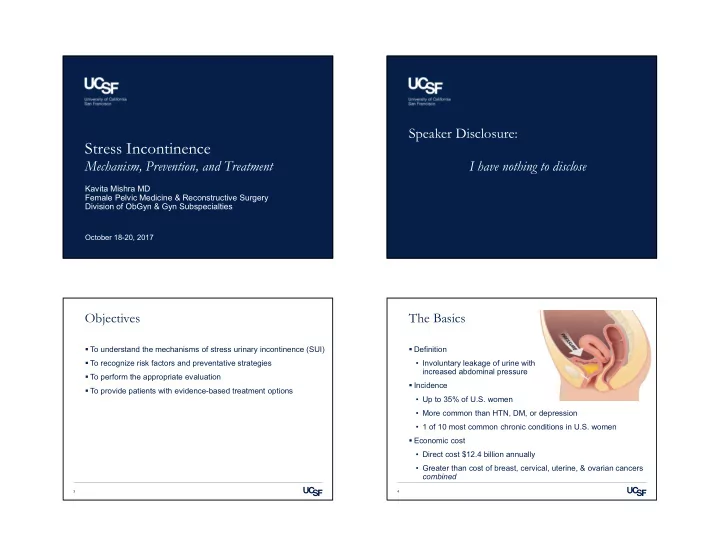
Stress Incontinence

Mechanism, Prevention, and Treatment

October 18-20, 2017

Kavita Mishra MD Female Pelvic Medicine & Reconstructive Surgery Division of ObGyn & Gyn Subspecialties

Speaker Disclosure: I have nothing to disclose

Objectives

  • To understand the mechanisms of stress urinary incontinence (SUI)
  • To recognize risk factors and preventative strategies
  • To perform the appropriate evaluation
  • To provide patients with evidence-based treatment options

3

The Basics

  • Definition
  • Involuntary leakage of urine with

increased abdominal pressure

  • Incidence
  • Up to 35% of U.S. women
  • More common than HTN, DM, or depression
  • 1 of 10 most common chronic conditions in U.S. women
  • Economic cost
  • Direct cost $12.4 billion annually
  • Greater than cost of breast, cervical, uterine, & ovarian cancers

combined

4

slide-2
SLIDE 2

10/18/2017 5

Continence and Mechanism of SUI

  • Lower urinary tract performs two functions
  • Storage of urine
  • Timely expulsion of urine
  • Coordination of both central and

peripheral nervous systems

  • Requires normal function of:
  • Bladder wall
  • Detrusor muscle
  • Urethra
  • Pelvic floor musculature

6

Elements of Continence

  • SUI: Anatomic or neurologic

defects

  • Simplistically – intraurethral

pressure must be greater than intravesical pressure at rest and during stress conditions

7

Elements of Continence

  • At rest
  • Interaction of urethral smooth muscle
  • Urethral wall elasticity and vascularity
  • Periurethral striated muscle
  • Each contributes 1/3rd of overall intraurethral pressure
  • Can be altered by – Age, Parity, Medications

8

slide-3
SLIDE 3

Elements of Continence

9

Pubourethral ligaments

  • Urethral support
  • Anterior vaginal wall
  • Lateral attachments to the

arcus tendineus fascia pelvis (ATFP)

  • Pubourethral ligaments insert

at midurethra – augment suburethral support during strain

Elements of Continence

10

  • Urethral Sphincter
  • Striated and somatic

muscle

  • Urethral Coaptation
  • Ability of urethral lumen

to “seal”

  • Levator Ani muscles
  • Pubococcygeus pulls

pelvic floor up/into pelvic cavity

Stress incontinence after childbirth

  • A. is as common after Cesarean section

as after vaginal delivery

  • B. is reported by more than 50% of

women in the first decade after having a baby

  • C. can be prevented by instrumental

delivery

  • D. may be related to pudendal nerve

injury

11

is as common after Cesare.. is reported by more than... can be prevented by ins... may be related to puden...

31% 7% 1% 61%

Risk Factors

13

slide-4
SLIDE 4

Risk Factors

  • Aging - Unclear mechanism
  • Loss of muscle tone
  • Long-term effects of

denervation injuries

  • Changes in hormonal

stimulation

  • Pregnancy and childbirth
  • Both CS and VD
  • Smoking
  • Obesity: both UUI and SUI
  • Prior pelvic surgery

14

Evaluation

  • History: Classify incontinence by type (+functional)
  • 2014 ACOG Practice Bulletin emphasizes identification of the

“uncomplicated SUI patient”

  • Typically has urethral mobility on exam
  • Exclude those with prior pelvic/SUI surgeries, voiding

dysfunction, recurrent UTIs, abnormal PVR, prolapse to hymen

15

Evaluation

16

Evaluation on Exam

  • Demonstrate immediate SUI on

cough stress test

  • Delayed urine loss may be

cough-induced detrusor overactivity

  • Sensitivity of CST increased with full bladder (300 cc) and

standing

  • If testing remains negative, urodynamics recommended
  • Assess for urethral mobility

Cotton swab test Aa value on POPQ Ultrasound Palpation or visualization

  • PVR assessment: if >150 cc, consider bladder emptying studies

17

slide-5
SLIDE 5

A 56-year-old P2 woman presents with stress urinary incontinence. She leaks with exercise every day and occasionally with coughing and laughing. On exam, the Aa value on POPQ is 0, PVR is 40 cc, and cough stress test was positive for leakage at 300 cc. Urinalysis was normal. You counsel her regarding her options and she desires surgical treatment. True or False: Your next step in her management is to perform urodynamic studies.

  • A. True
  • B. False

18 T r u e F a l s e

47% 53%

Urodynamic Studies

  • In the uncomplicated patient, simple

answer is “No”

  • Multicenter RCT of 630 women with

uncomplicated SUI randomized to UDS vs. basic office exam prior to sling

  • Subjective treatment success in 77%
  • f both UDS and office exam groups

(no significant difference)

  • Conclusion: Preop office exam was

non-inferior to UDS for outcomes at 1 year

20

Prevention: Pelvic Floor Exercises

  • Single-center, RCT of 230 primigravid women with bladder neck

mobility on ultrasound

  • PFME with monthly PT visits starting at 20 wks vs. verbal advice
  • 3 sets of 8 exercises (hold 6 sec; 2 min between sets) twice a day
  • Outcome: subjective SUI at 3 months postpartum
  • No difference in NSVD, VAVD, FAVD, or CS rates
  • Subjective SUI rates: 13% PT group vs. 33% control (RR 0.59, CI

0.37-0.92), no difference in pad tests Other studies have shown possible benefit with prenatal/postpartum PFMEs and PT.

21

Nonsurgical Treatments: Weight Loss

  • 5-10% weight loss in pts with T2DM improves UI incidence/sx’s
  • Bariatric surgery and associated weight loss  improvement in UI,

UUI, and SUI at 6 months

  • PRIDE study – 2009 NEJM, 2010 JUrol
  • 338 overweight or obese women with at

least 10 leakage episodes/wk enrolled in 18-month weight loss program vs. structured education

  • At 12 months: avg 7.5% weight loss vs. 1.7%
  • 65% reduction in weekly SUI episodes at 12 months (47% for

controls, p<0.001) Weight loss is an effective strategy for SUI treatment

22

slide-6
SLIDE 6

Nonsurgical Treatments: Medications

  • Duloxetine
  • 2005 Cochrane review showed improvement in QoL
  • Small effect size of subjective cure, meta-analysis of objective
  • utcome did not show any benefit
  • Adrenergic drugs
  • 2005 Cochrane review of 22 trials, 1099 women
  • Pad counts/weights: better than placebo
  • >25% had adverse effects

23

Nonsurgical Treatments: Estrogen Therapy

  • Clinical efficacy is controversial
  • Systemic ERT worsened UI compared to placebo
  • 2012 Cochrane review 17,642 women with UI
  • Local ERT (topical use) showed some benefits
  • 2014 systematic review, 44 studies
  • Low-quality evidence: improved max

urethral pressures

  • Moderate-level evidence: improved subjective SUI
  • PFMT superior to topical estrogen in one trial

Topical estrogen may be beneficial in treatment of SUI.

24

Nonsurgical Treatments: Pelvic Floor Muscle Exercises

  • Pelvic floor muscle exercises
  • 2014 Cochrane review, 21 trials,

1281 women

  • 56% cure rate with PFMT (8x improvement from no treatment)
  • Long-term effectiveness needs to be studied

This is the most effective, first-line therapy.

  • Vaginal cones
  • 2013 Cochrane review of 23 trials, 1800 women
  • Better than no treatment, no difference compared to PFME or

electrostimulation

25

Nonsurgical Treatments: Vaginal Laser Therapy

  • Systematic review: 13 studies

(2017 Int Urogyn J)

  • 818 SUI pts (no RCTs)
  • Mild to severe SUI, some

urodynamic findings

  • Subjective outcomes:

12.5-46% cure at 6 months

  • Range of objective measures: half had 50% reduction of pad weight

at 6 months

  • Adverse effects: few cases of mild pain, dysuria, irritation

Vaginal laser therapy may be a useful, minimally invasive approach for treating SUI. Cannot make firm conclusions.

26

slide-7
SLIDE 7

Nonsurgical Treatments: Vaginal Inserts

  • Poise Impressa Vaginal Inserts
  • Few studies
  • 60 women: 85% had ≥70% reduction

in pad weight gain

  • Improved QoL and high satisfaction
  • Incontinence rings/Pessaries
  • 2014 Cochrane review, 8 studies,

787 women

  • Different devices used, quantitative synthesis of data impossible
  • Inconclusive benefit

27

Surgical Treatments: Injectable Urethral Bulking

  • Synthetic and biological materials
  • Frequently used in recurrent SUI
  • Coaptation of urethral edges, increasing

urethral resistance

  • Few currently available –
  • Silicone particles (Macroplastique) -Ca Hydroxylaptite (Coaptite)
  • Porcine dermis (Permacol)
  • Gluteraldehyde cross-linked

bovine collagen (Contigen)

  • Success: 25-63% (~50%) at 12 months
  • Adverse events: transient urinary retention, de novo urge, dysuria

hematuria

28

A 56-year-old P2 woman presents with stress urinary incontinence. She leaks with exercise every day and occasionally with coughing and laughing. On exam, the Aa value on POPQ is 0, PVR is 40 cc, and cough stress test was positive for leakage at 300 cc. Urinalysis was normal. You counsel her regarding her options. Concerning sling operations for the treatment of stress incontinence, all of the following are true except:

  • A. They are accepted as first-line

management

  • B. They result in voiding dysfunction in up to

16% of women

  • C. Synthetic materials can result in erosion
  • D. They have good long-term success rates
  • E. Tension-free vaginal tape is a minimally

invasive procedure

29 T h e y a r e a c c e p t e d a s f i r s t . . . T h e y r e s u l t i n v

  • i

d i n g d y . . . S y n t h e t i c m a t e r i a l s c a n r . . . T h e y h a v e g

  • d

l

  • n

g

  • t

e r . . . T e n s i

  • n
  • f

r e e v a g i n a l t a p e . .

51% 19% 17% 10% 3%

Surgical Treatments: Pubo-vaginal Slings

  • Placement of fascial sling

at bladder neck level to correct hypermobility

  • 8-10 cm graft of rectus

fascia or fascia lata, fixed by fibrosis in retropubic space, tied across rectus fascia

  • Continence rates: 61-97%
  • Risk of de novo

urgency/UI: 2-20%

31

slide-8
SLIDE 8

Surgical Treatments: Mid-urethral Slings

  • 2017 Cochrane Review of 81 trials (12,113)

retropubic (RP) and transobturator (TO)

  • Subjective cure: Up to 80% at 5 years
  • Similar long-term (>5 years) outcomes

(RP 51-88%; TO 43-92%)

  • Adverse events:
  • Similar erosion rates: 2.1-2.4%
  • RP: voiding dysfunction, vascular/visceral injury, bladder perf,

suprapubic pain

  • TO: more likely to require repeat surgery, groin pain
  • Longer term data still required

32

Surgical Treatments: Single-Incision (Mini) Slings

  • Effort to avoid major injury, groin pain, and hematomas
  • TVT-Secur withdrawn from market by Gynecare, other are MiniArc,

Ajust, Ophira, CureMesh

  • 2017 Cochrane Review of 31 trials

3290 women

  • Higher incontinence rates after

surgery (41% vs. 26% RP)

  • No difference between other

mini-slings and in-out or out-in TO slings

  • Slightly lower groin/thigh pain, but not enough numbers

TVT-Secur is inferior to standard midurethral slings. There is not enough evidence to compare other mini-slings to RP or TO slings.

33

Surgical Treatments: Open Retropubic Colposuspension

  • 2017 Cochrane Review of 55 trials (5417 women)
  • Overall cure: 68-88%
  • 22 trials comparing open RP colposuspension to suburethral slings

(tradition, RP, and TO)  no difference at any time points

  • Traditional (fascial) slings more effective at 1-5 years postop
  • Lower risk of voiding dysfunction,

higher risk of POP Open retropubic colposuspension is effective for SUI, including long-term.

34

Surgical Treatments: Laparoscopic Retropubic Colposuspension

  • 2017 Cochrane review, 22 trials
  • Open vs. Laparoscopic:

no difference in patient-reported continence rates at short, medium, & long terms (but wide CI)

  • Slings appear to have better
  • bjective outcomes (1 year), same subjective cure (longer term)
  • Two paravaginal sutures on each side preferred
  • Longer OR times and hospital stays than slings

Laparoscopic colposuspension appears to be as good as open at 2

  • years. Vaginal slings appear to be superior to laparoscopic

colposuspension.

35

slide-9
SLIDE 9

Summary

  • SUI is the involuntary leakage of urine with increased

intraabdominal pressure

  • Evaluation is simple
  • History
  • Exam: PVR, Urinalysis, Urethral mobility assessment, Cough

stress test

  • UDS may not be necessary
  • Effective treatments include: PFMT, weight loss, vaginal inserts,

urethral bulking, pubovaginal slings, midurethral slings, and retropubic colposuspensions

36

References

  • “Evaluation of uncomplicated stress urinary incontinence in women before surgical treatment.” Committee Opinion No.
  • 603. The American College of Obstetricians and Gynecologists. Obstet Gynecol. 2014; 123:1403–7.
  • Alhasso A, Glazener CM, Pickard R, et al. “Adrenergic drugs for urinary incontinence in adults.” Cochrane Database

Syst Rev. 2005; (3):CD001842.

  • Bailly CG, Carlson KV. “The pubovaginal sling: Reintroducing an old friend.” Can Urol Assoc J. 2017;

11(6Supp2):S147.

  • Bump RC, Norton PA. “Epidemiology and natural history of pelvic floor dysfunction.” Obstet Gynecol Clin North
  • Am. 1998;25:723–746.
  • Cody JD, Jacobs ML, Richardson K, et al. “Oestrogen therapy for urinary incontinence in post-menopausal women.”

Cochrane Database Syst Rev. 2012; 10:CD001405. doi: 10.1002/14651858.CD001405.pub3.

  • Davis NF, Kheradmand F, Creagh T. “Injectable biomaterials for the treatment of stress urinary incontinence: their

potential and pitfalls as urethral bulking agents.” Int Urogynecol J. 2013; 24(6):913.

  • Dean N, Ellis G, Herbison GP, et al. “Laparoscopic colposuspension for urinary incontinence in women.” Cochrane

Database Syst Rev. 2017; 10.1002/14651858.CD002239.pub3

  • Dumoulin C, Hay-Smith EJC, Mac Habee-Seguin G. ”Pelvic floor muscle training versus no treatment, or inactive

control treatments, for urinary incontinence in women.” Cochrane Database Syst Rev. 2014; DOI: 10.1002/14651858.CD005654.pub3.

  • Ford AA, Rogerson L, Cody JD, et al. “Mid-urethral sling operations for stress urinary incontinence in women.”

Cochrane Database Syst Rev. 2017; 7:CD006375. doi: 10.1002/14651858.CD006375.pub4.

  • Lapitan MCM, Cody JD, Mashayekhi A. “Open retropubic colposuspension for urinary incontinence in women.”

Cochrane Database Syst Rev. 2017;7:CD002912. doi: 10.1002/14651858.CD002912.pub7.

  • Lipp A, Shaw C, Glavind K. “Mechanical devices for urinary incontinence in women.” Cochrane Database Syst Rev.

2014; (12):CD001756. doi: 10.1002/14651858.CD001756.pub6.

  • Mariappan P, Ballantyne Z, N’Dow JM, et al. “Serotonin and noradrenaline reuptake inhibitors (SNRI) for stress urinary

incontinence in adults.” Cochrane Database Syst Rev. 2005; (3):CD004742.

37

References

  • Nager CW, Brubaker L, Litman HJ, et al. “A randomized trial of urodynamic testing before stress-incontinence surgery.”

N Engl J Med. 2012; 366:1987.

  • Nambiar A, Cody JD, Jeffrey ST, et al. “Single-incision sling operations for urinary incontinence in women.” Cochrane

Database Syst Rev. 2017;7:CD008709. doi: 10.1002/14651858.CD008709.pub3.

  • Pergialiotis V, Prodromidou A, Perrea DN, et al. “A systematic review on vaginal laser therapy for treating stress

urinary incontinence: Do we have enough evidence?” Int Urogynecol J. 2017; doi: 10.1007/s00192-017-3437-x. [Epub ahead of print]

  • Phelan S, Kanaya AM, Subak LL, et al. “Weight loss prevents urinary incontinence in women with type 2 diabetes:

results from the Look AHEAD trial.” J Urol. 2012; 187(3):939.

  • Reilly ET, Freeman RM, Waterfield MR, et al. “Prevention of postpartum stress incontinence in primigravidae with

increased bladder neck mobility: a randomized controlled trial of antenatal pelvic floor exercises.” BJOG. 2014; 121(S7):58.

  • Rahn DD, Carberry C, Sanses TV, et al. “Vaginal estrogen for genitourinary syndrome of menopause: a systematic

review.” Obstet Gynecol. 2014; 124(6): 1147.

  • Rortveit G, Daltveit AK, Hannestad YS, et al. “Urinary Incontinence after Vaginal Delivery or Cesarean Section.” N Engl

J Med. 2003; 348: 900.

  • Ziv E, Stanton SL, Abarbanel J. " Efficacy and safety of a novel disposable intravaginal device for treating stress

urinary incontinence.” Am J Obstet Gynecol. 2008; 198(5): 594.

38

Thank you, and I welcome your QUESTIONS

39