
SLIDE 1
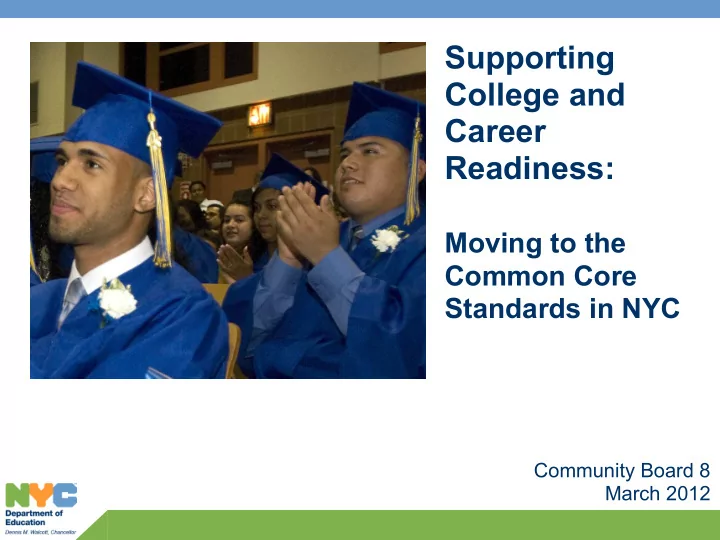
Supporting College and Career Readiness: Moving to the Common - - PowerPoint PPT Presentation
Supporting College and Career Readiness: Moving to the Common Core Standards in NYC Community Board 8 March 2012 PERCENT OF NYC STUDENTS EARNING LEVELS 3+4 IN MATH AND ELA: DISTRICT 2 AND CITYWIDE 2010 & 2011 Percent of Students
*
2010 & 2011 Percent of Students Meeting/Exceeding New York State Standards on New York State Grades 3-8 Tests (Levels 3+4)
Note; In 2010, NYSED increased the scale score required to meet each of the proficiency levels. In addition, in 2011, NYSED lengthened the exams by increasing the number of test questions.
2010 2011
2010 2011
2010 2011 2010 2011
*
Grade 3 Grade 4 Grade 5 Grade 6 Grade 7 Grade 8 Grades 3- 8
Grade
3 4 5 6 7 8 3-8
2010-11 Change MATH (pts.)
+0.5 +3.9 +3.2 +3.0 +2.9 +6.2 +3.3
10 11 10 11 10 11 10 11 10 11 10 11 10 11
In 2010, NYSED increased the scale score required to meet each of the proficiency levels. In addition, in 2011, NYSED lengthened the exams by increasing the number of test questions.
*
Grade
3 4 5 6 7 8 3-8
2010-11 Change MATH (pts.)
+0.8 +3.8 +0.7 +4.5 +3.3 +5.4 +3.1
10 11 10 11 10 11 10 11 10 11 10 11 10 11
Grade 3 Grade 4 Grade 5 Grade 6 Grade 7 Grade 8 Grades 3- 8
In 2010, NYSED increased the scale score required to meet each of the proficiency levels. In addition, in 2011, NYSED lengthened the exams by increasing the number of test questions.
*
10 11 10 11 10 11 10 11 10 11 10 11 10 11
Grade
3 4 5 6 7 8 3-8
2010-11 Change ELA (pts.)
+1.6 +5.4 +2.8 +3.5
+1.5
Grade 3 Grade 4 Grade 5 Grade 6 Grade 7 Grade 8 Grades 3- 8
In 2010, NYSED increased the scale score required to meet each of the proficiency levels. In addition, in 2011, NYSED lengthened the exams by increasing the number of test questions.
*
10 11 10 11 10 11 10 11 10 11 10 11 10 11
Grade
3 4 5 6 7 8 3-8
2010-11 Change ELA (pts.)
+2.3 +3.7
+5.0
+1.0 +1.2
Grade 3 Grade 4 Grade 5 Grade 6 Grade 7 Grade 8 Grades 3- 8
In 2010, NYSED increased the scale score required to meet each of the proficiency levels. In addition, in 2011, NYSED lengthened the exams by increasing the number of test questions.
*
Percent of Students in a Cohort Graduating from High School in 4 Years
Class of
1992-2002: + 0% 2002-2010: + 37% 1986-1992: + 9%
NYC Calculation Method NY State Calculation Method
Notes: NYC traditional calculation includes Local and Regents Diplomas, GEDs, Special Education diplomas, and August graduates. It does not include disabled students in self-contained classrooms or District 75 students. The NYS calculation, used since 2005, includes Local and Regents Diplomas and all disabled students. It does not include GEDs and Special Education diplomas.
2005-10 City Method: + 21% State Method: + 30%
NY State Calculation Method (Including August Grads)
*
1986 1988 1990 1992 1994 1996 1998 2000 2002 2004 2006 2008 2010
*
Percent of Students in a Cohort Graduating from High School in 4 Years
Notes: The NY State method, used since 2005, includes Local and Regents Diplomas and all disabled students. It does not include GEDs and Special Education
available for years 2008-2010.
*Includes August graduates.
*
Note: Totals reflect data available at the time of reporting provided by NYS; August graduate data is only available for cohorts 2004-2006 The overall rate may not equal the sum of each diploma type due to rounding. *Final year NYS did not include August graduates
August Graduation Rate
62.7 %
August Graduation Rate
60.7%
Graduation Rate
52.8%*
Graduation Rate
49.1%
Graduation Rate
46.5%
August Graduation Rate
65.1%
Percent of Students in a Cohort Graduating from High School in 4 Years
Regents Diploma with Advanced Designation Regents Diploma Local Diploma
65+ on 2 of 5 Regents & 55+ on 3 of 5 65+ on 3 of 5 Regents & 55+ on 2 out of 5 5 Regents at 65+ 55+ on 5 Regents 55+ on 5 Regents 55+ on 5 Regents 55+ on 5 Regents 5 Regents at 65+ 5 Regents at 65+ 5 Regents at 65+ 5 Regents at 65+ 5 Regents at 65+ 7-9 Regents at 65+ 7-9 Regents at 65+ 7-9 Regents at 65+ 7-9 Regents at 65+ 7-9 Regents at 65+ 7-9 Regents at 65+
Required Regents Exams are: English, Math, US History & Government, Global History, and Science; Additional Requirements for Regents with Advanced Designation: Science, Mathematics, and Language Other Than English (LOTE)
Class of ’ 05 Class of ’ 06 Class of ’ 07 Class of ’ 08 Class of ’ 09 Class of ’ 10
*
Note: Totals reflect data available at the time of reporting provided by NYS; August graduate data is only available for cohorts 2004-2006 The overall rate may not equal the sum of each diploma type due to rounding. *Final year NYS did not include August graduates
August Graduation Rate
66.2%
Graduation Rate
58.4%
Graduation Rate
54.6%
Graduation Rate
58.3%
Graduation Rate
58.6%
August Graduation Rate
67.5%
Percent of Students in a Cohort Graduating from High School in 4 Years
Regents Diploma with Advanced Designation Regents Diploma Local Diploma
65+ on 2 of 5 Regents & 55+ on 3 of 5 65+ on 3 of 5 Regents & 55+ on 2 out of 5 5 Regents at 65+ 55+ on 5 Regents 55+ on 5 Regents 55+ on 5 Regents 55+ on 5 Regents 5 Regents at 65+ 5 Regents at 65+ 5 Regents at 65+ 5 Regents at 65+ 5 Regents at 65+ 7-9 Regents at 65+ 7-9 Regents at 65+ 7-9 Regents at 65+ 7-9 Regents at 65+
Required Regents Exams are: English, Math, US History & Government, Global History, and Science; Additional Requirements for Regents with Advanced Designation: Science, Mathematics, and Language Other Than English (LOTE)
Class of ’ 05 Class of ’ 06 Class of ’ 07 Class of ’ 08 Class of ’ 09 Class of ’ 10
*
Source: CUNY Office of Institutional Research and Assessment, init_remedial_need_by_hs_type.xlsx, 07/21/11. *Includes all students who report to CUNY that they have graduated from a NYC high school (at any point in time).
Total Number of DOE Graduates* Enrolling in CUNY as First Time Freshman 2002-10
16,254 16,778 18,665 19,298 20,930 22,697
Senior Colleges Community Colleges
24,294 25,589 25,033
Note: In 2010, CUNY saw a decrease in overall first-time freshman enrollment following a change in enrollment policy: from rolling admissions to a formalized application deadline.
Percent of DOE Graduates* Enrolling in CUNY as First Time Freshman In Need of Remedial Coursework** 2002-10
Source: CUNY Office of Institutional Research and Assessment, init_remedial_need_by_hs_type.xlsx, 07/21/11. *Includes all students who report to CUNY that they have graduated from a NYC high school (at any point in time). **Students in need of remedial coursework did not meet CUNY proficiency standards or pass the CUNY Assessment tests. In 2008, CUNY instituted more rigorous requirements for requiring remediation. http://www.cuny.edu/academics/testing/cuny-assessment-tests/faqs.html#1; http://qcpages.qc.edu/provost/Cur_stud/SBotman-memo.pdf
Note: Students entering baccalaureate programs at senior colleges who initially needed remediation completed remediation over the summer
programs.
CUNY INCREASED REMEDIATION CRITERIA IN 2008**
*
*
*
*
*
*
*
NYS tests remain similar to 2010-11 NYS tests begin to integrate Common Core standards NYS tests fully aligned to Common Core standards
*
*
com/a/nycempowerment.org/eso2yuet/isora-s-notes/accountability/common-core-standards
http://corestandards.org
Guides to the Common Core from the National Parent Teacher Association (PTA): http: //ta.org/4446.htm
*