
SLIDE 1
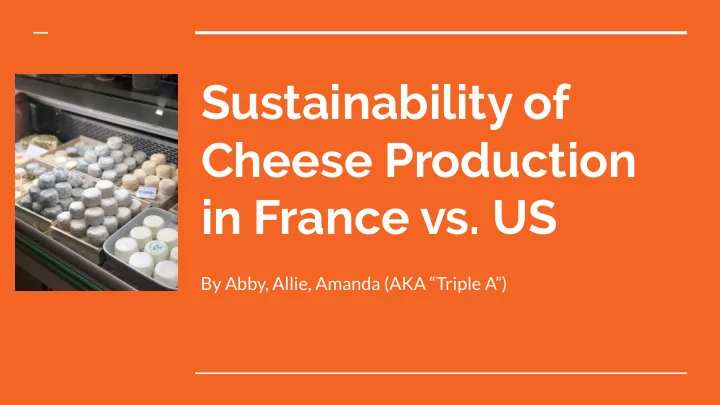
Sustainability of Cheese Production in France vs. US
By Abby, Allie, Amanda (AKA “Triple A”)
Sustainability of Cheese Production in France vs. US By Abby, - - PowerPoint PPT Presentation
Sustainability of Cheese Production in France vs. US By Abby, Allie, Amanda (AKA Triple A) Introduction Cheesemaking accidentally discovered by Egyptians, who salted curdled milk and added fruit juices 1 French value of artisanal
By Abby, Allie, Amanda (AKA “Triple A”)
Egyptians, who salted curdled milk and added fruit juices 1
consumption and waste in US vs. France
○ 38.3% grazed grass, 26.3% conserved grass, 19.4% silage corn, 5.4% grain and 2.5% soy cake 2 ○ Pasture fed during spring, summer and fall ○ Cereals and man-made food during winter
○ At least 40% forage, such as hay, and at most 60% grain, such as wheat or oats 2 ○ May need more synthetic pesticides and complex waste management systems
microorganisms, cooled to 90℉
and develops complex flavors
from curd, whey drained off
weeks to 24 months or prepared for distribution 3
processed, semi-hard, semi-soft, soft, fresh and soft-ripened 4
can be added to create a spotted or veined pattern 4
contributes to aging process
pasteurized
costly and is not pasteurized
○ $3.5 billion exported 5, $1.7 billion imported 6, $1.8 billion net export in 2017 ○ 6th largest country to export cheese in world with majority of exports going to US 7 ○ Regional AOC label marks authenticity
○ $1.5 billion exported 5, $1.23 billion imported 6, $270 million net export in 2017 ○ No national authenticity requirements
comparison to Americans and their diet consists of higher amount of saturated fats yet they have lower cardiovascular mortality rate 9
○ Potassium, magnesium, calcium, phosphorus, vitamin D, B6 and peptides in milk may lower blood pressure ○ Higher amounts of butyric acid associated with lower risk of obesity and can lead to faster metabolism
would argue this number could be as high as 1,000 if sub-varieties are included
maps of France”
○ Soft cheese ○ Semi soft cheese ○ Hard cheese ○ Semi hard cheese ○ Goat cheeses
Mimolette- Hard Cheese (Cow Milk) Brie- Soft Cheese (Cow Milk) Portnenay (Blue Cheese from Goat) Soft Cheese, Morbier: Semi-Soft Cheese (cow milk) Ossau: Semi-Hard Cheese (Sheep Milk)
○ 0.03 tonnes, or 66 pounds, of food waste per person per year 10 ○ About 67 million person population ○ Supermarket food waste legislation ○ Edible rind replaces need for packaging ○ Small scale family farms may be inhibited by taxation and limited vacation opportunities ○ Machine washable plastic molds more efficient than clay pots
○ 612 pounds of food waste per person per year 10 ○ About 300 million person population ○ Plastic or wax packaging for mass produced varieties ○ Large scale farms
influences bottom-up approach to sustainability throughout production, in comparison to US’s top-down approach, in hopes of preserving culinary artform for future generations
○ What do you think of cheese making process in France versus US? ○ How do you think we can take what we learned in France and apply it to the US?
1.
https://nationalhistoriccheesemakingcenter.org/history-of-cheese/ 2. http://idele.fr/?eID=cmis_download&oID=workspace://SpacesStore/10b22a31-862e-440f-a0 79-c1710d964e72 3. http://www.milkfacts.info/Milk%20Processing/Cheese%20Production.htm 4. https://www.nationaldairycouncil.org/sitecore/content/dg/home/content/2016/cheese-types-w hat-you-need-to-know-about-cheese 5. http://www.worldstopexports.com/cheese-exports-country/
6.
http://www.worldstopexports.com/cheese-imports-by-country/ 7. https://atlas.media.mit.edu/en/profile/country/fra/ 8. http://www.lactimed.eu/en/France-cheese-consumption. 9. http://eda.euromilk.org/fileadmin/user_upload/Public_Documents/EDA_Position_papers_-_ Fact_Sheets/Fact_sheets/CNIEL-Questions_sur_les_produits_laitiers.pdf 10. https://www.npr.org/sections/thesalt/2018/02/24/586579455/french-food-waste-law-changin g-how-grocery-stores-approach-excess-food