Sympathetic activity and functional sympatholysis Stefan P. - - PDF document

sympathetic activity and functional sympatholysis
SMART_READER_LITE
LIVE PREVIEW

Sympathetic activity and functional sympatholysis Stefan P. - - PDF document

20-05-2019 Control of blood flow in skeletal muscle: Sympathetic activity and functional sympatholysis Stefan P. Mortensen, DMSc Department of Cardiovascular and Renal Research University of Southern Denmark Muscle sympathetic nerve activity


slide-1
SLIDE 1

20-05-2019 1

Control of blood flow in skeletal muscle:

Sympathetic activity and functional sympatholysis

Stefan P. Mortensen, DMSc Department of Cardiovascular and Renal Research University of Southern Denmark

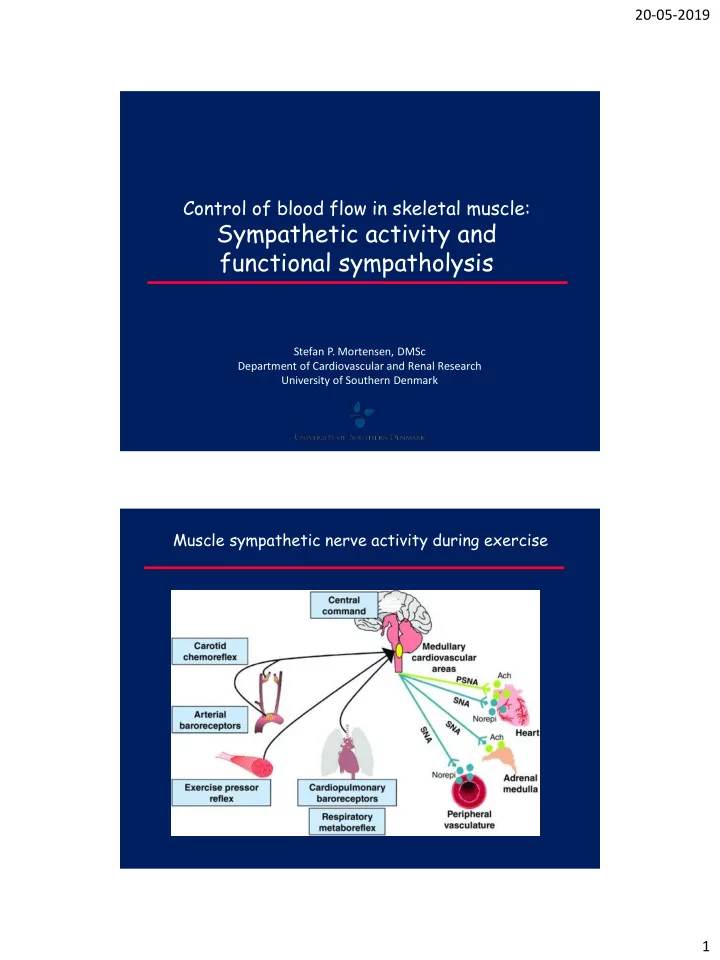
Muscle sympathetic nerve activity during exercise

slide-2
SLIDE 2

20-05-2019 2

Exercising muscle Resting muscle

Interstitial Norepinephrine (nM)

5 10 15 20

Rest Recovery 18W 37W

* * * *

Muscle sympathetic nerve activity during exercise

Mortensen et al. JAP 2009

Sympathetic Vasocontriction

Contracting Muscle fiber

Afferent signaling Local vasoactive substances Arteriole NE

slide-3
SLIDE 3

20-05-2019 3

O2

Smooth muscle Sympathetic nerve ending Metabolites NE a-receptor

Arteriole

Functional sympatholysis

Remensnyder et al. Circ Res. 1962

Rest Exercise 2 Exercise 1

Functional sympatholysis – initial studies

slide-4
SLIDE 4

20-05-2019 4 Methods to increase SNA

Muscle sympathetic nerve activity (units min-1) 200 400 600 800 1000 1200 1400 Leg blood flow (l min-1) 1 2 3 4 Leg ex Leg ex + SHG Leg ex + SHG + F I

Strange JPhysiol 1999 Lower body negative pressure Cold pressor Static and/or ischemic exercise

Exercise and ATP-induced vasodilation overrides increases in vasoconstrictor activity

Rosenmeier et al. J Physiol 2004

1 2 3 4 5

Leg blood flow (L/min)

Rest Hyperemia Tyramine Exercise ATP Adenosine * Leg blood flow (L/min)

α

NE Tyramine

slide-5
SLIDE 5

20-05-2019 5

α

NE Tyramine

Dinenno & Joyner Circ 2002

Tyramine induced norepinephrine release – effect of age Tyramine induced norepinephrine release – effect of training status

Plasma norepinephrine (nmol L-1) 5 10 15 20

Young men Sedentary elderly men Active elderly men

† † †¤

¤ ¤ ¤

Rest 12 W 45% WLmax

¤ ¤ ¤ ¤ ¤ * * α

NE Tyramine

After training Change in venous norepinephrine (mmol/l) 1 2 3 4 Normotensive subjects Hypertensive subjects Before training

Mortensen et al. 2012 & 2014

slide-6
SLIDE 6

20-05-2019 6

Control leg Immobilized leg Trained leg

Exercise training improves functional sympatholysis

Mortensen et al. AJP 2012

% reduction in leg blood flow 10 20 30 40 % reduction in leg vascular conductance 10 20 30 40 Exercise (24 W)

#

¤ ¤

#

Leg blood flow (l/min) 0.0 0.5 1.0 1.5 2.0 2.5 3.0 3.5 Leg vascular conductance (ml/min/mmHg) 10 20 30 40 Rest Exercise Exercise + tyramine

§

#

§

¤ ¤

* * * * * * * * * * * *

Impaired functional sympatholysis with ageing

Dinenno & Joyner 2005

slide-7
SLIDE 7

20-05-2019 7

Mortensen et al. J Physiol 2012

Leg blood flow (l*/min) 1 2 3 4

Young Sedentary elderly Active elderly

† † †

* * * * * * * * * * *

¤

*

¤ ¤ ¤ ¤

Rest 12 W 45% WLmax

Impaired functional sympatholysis with ageing

Vongpatanosin et al. J Physiol 2012

Functional sympatholysis is impaired in the forearm

  • f hypertensive patients
slide-8
SLIDE 8

20-05-2019 8

Functional sympatholysis is impaired in untrained normo- and hypertensive individuals and normalized with training

Normotensive individuals Normotensive individuals with tyramine Hypertensive individuals Hypertensive individuals with tyramine Leg vascular conductance (ml/min/mmHg) 5 10 15 20 25 30 35 Rest 6W 12W 18W Rest 6W 12W 18W # # # # # # Exercise Exercise Before training After training

Leg blood flow (l/min) 0.0 0.5 1.0 1.5 2.0 2.5 Healthy COPD 10W 10W 10W + tyramine

* *

Functional sympatholysis in COPD

Change in leg blood flow (l/min) 0.0 0.1 0.2 0.3 0.4 0.5

10W Tyramine 11 min 5 8

slide-9
SLIDE 9

20-05-2019 9 Inefficient functional sympatholysis is an overlooked cause of malperfusion in contracting skeletal muscle?

Tissue perfusion O2 delivery Anaerobic metabolism Stimulation of afferent fibres SNA Functional sympatholysis

Vongpatanosin et al. J Physiol 2012

Potential mediators of functional sympatholysis

slide-10
SLIDE 10

20-05-2019 10 NO plays a role in mediating functional sympatholysis in rats

Thomas & Victor JPhysiol 1998

Role of NO in functional sympatholysis

Dinenno & Joyner JPhysiol 2003 Rosenmeier et al. JAP 2003

slide-11
SLIDE 11

20-05-2019 11

Hearon et al. JPhysiol 2016

Smooth muscle muscle

Intraluminal space space α

O2

O2 O2 Hb

O2

O2 O2 HbO2

Skeletal muscle cell

Arterial vasculature Capillary

ATP ATP NA

P2

Endothelial cells

Role of ATP in functional sympatholysis

slide-12
SLIDE 12

20-05-2019 12

Interstitial ATP (µmol/L) 1 2 3 4 5 6 % reduction in leg vascular conductane 5 10 15 20

Could interstitial ATP mediate functional sympatholysis?

Control leg Immobilized leg Trained leg Interstitial ATP (µmol/L) 2 4 6 8 10 % reduction in leg vascular conductane 10 20 30 40 Young men Active elderly men Sedentary elderly men

After training Change in leg blood flow (l/min)

  • 0.5
  • 0.4
  • 0.3
  • 0.2
  • 0.1

0.0 Change in leg vascular conductance (ml/min/mmHg)

  • 4
  • 3
  • 2
  • 1

Change in venous norepinephrine (mmol/l) 1 2 3 4 Before training ¤ ¤ After training Before training After training Before training

Normotensive subjects Hypertensive subjects

Exercise training reduces postjunctional α-adrenergic vasoconstrictor responsiveness

Mortensen et al. J Physiol 2014

slide-13
SLIDE 13

20-05-2019 13

Conclusions

The ability for functional sympatholysis is tightly coupled to the training status of the muscle Functional sympatholysis is impaired with ageing Functional sympatholysis does not appear to be impaired in the leg of individuals with essential hypertension or COPD compared to age-matched controls Nitric oxide does not appear to be obligatory for functional sympatholysis in humans (but may play a role along with other substances) Reduced postjunctional α-adrenergic vasoconstrictor responsiveness may play a role in mediating functional sympatholysis

Thank you for your attention!