SYMPOSIUM: VALIDATION OF THE MAPA NG LOOB, ITS ENGLISH VERSION, AND - - PowerPoint PPT Presentation

symposium validation of the mapa ng loob its english
SMART_READER_LITE
LIVE PREVIEW

SYMPOSIUM: VALIDATION OF THE MAPA NG LOOB, ITS ENGLISH VERSION, AND - - PowerPoint PPT Presentation

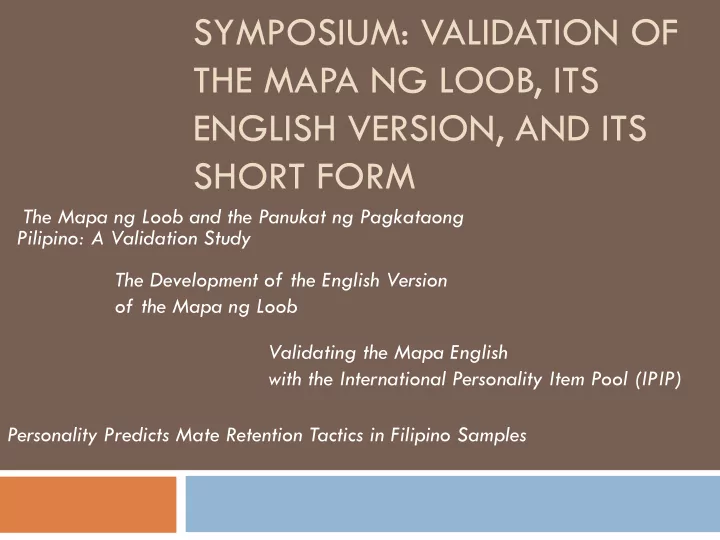
SYMPOSIUM: VALIDATION OF THE MAPA NG LOOB, ITS ENGLISH VERSION, AND ITS SHORT FORM The Mapa ng Loob and the Panukat ng Pagkataong Pilipino: A Validation Study The Development of the English Version of the Mapa ng Loob Validating the Mapa


slide-1
SLIDE 1

SYMPOSIUM: VALIDATION OF THE MAPA NG LOOB, ITS ENGLISH VERSION, AND ITS SHORT FORM

The Mapa ng Loob and the Panukat ng Pagkataong Pilipino: A Validation Study The Development of the English Version

  • f the Mapa ng Loob

Validating the Mapa English with the International Personality Item Pool (IPIP) Personality Predicts Mate Retention Tactics in Filipino Samples

slide-2
SLIDE 2

THE MAPA NG LOOB AND THE PANUKAT NG PAGKATAONG PILIPINO: A VALIDATION STUDY

Gregorio E. H. del Pilar and Anna Margarita F. Mangahas Personality Research Laboratory University of the Philippines Diliman 53rd Annual Convention

Psychological Association of the Philippines Fontana Convention Center , Clark Freeport Zone, Pampanga September 14, 2016

slide-3
SLIDE 3

The Masaklaw na Panukat ng Loob (Mapa ng Loob)

 Started in 2010, completed in 2013: 5 semesters  Administered to more than 4,000 participants

during scale development

 Total sample mostly of students from UP Diliman, but

final sample made up also of students from 3 other institutions in Metro Manila and Luzon, plus an adult sample: N=576

 188 items: 22 scales with 8 items each, 12-item

Social Desirability scale

slide-4
SLIDE 4

The Mapa ng Loob: based on the Five-Factor Model

  • f personality traits

 The Five-Factor Model : A breakthrough model

 Put an end to 40 years of inquiry into the structure of

the trait universe: Neuroticism, Extraversion, Openness to Experience, Agreeableness, Conscientiousness

 A powerful model, comprehensive and consensual, that

has organized findings related to work, health, intimate relationships, creativity, political attitudes, problem behaviors, psychopathology, etc.

slide-5
SLIDE 5

Scales of the Mapa ng Loob

 Neuroticism – Hina ng Loob, Pagkamaramdamin,

Pagkamapag-alala, Pagkasumpungin

 Extraversion – Pagkamasayahin, Pagkapalakaibigan,

Pagkamasigla, Pagkamadaldal

 Openness to Experience – Kakaibang pag-iisip, Hilig sa

Bagong Kaalaman, Pagkamakasining, Pagkamaharaya

 Agreeableness – Pagkadimayabang, Pagkamapagtiwala,

Pagkamaunawain, Pagkamapagparaya

 Conscientiousness – Pagkamasikap, Pagkamapagplano,

Pagkaresponsable, Pagkamaingat

 Also: NA Dalas Makaramdam ng Galit; AC Pagkamatapat;

Social Desirability

slide-6
SLIDE 6

The Panukat ng Pagkataong Pilipino

 Created by Annadaisy J. Carlota in 1985  Made up of 19 scales, 15 of which were based on

asking a sample of 360 participants to describe a person they liked, a person they disliked, and themselves; the other 4 measured traits related to creativity

 Two hundred ten (210) items: scales of varying length

(6-14 items)

 Originally, the Mapa was meant to be an update of the

PPP as a five-factor instrument. This idea was abandoned, and all overlap between the two instruments have been removed.

slide-7
SLIDE 7

Significance of the study

 The Mapa: sought to measure its target constructs,

but also the five factors

 The PPP: sought only to measure its target constructs  To what extent has the Mapa succeeded in validly

measuring its target constructs, despite the constraints imposed by the Five-Factor model?

slide-8
SLIDE 8

Constraints imposed by the Five-Factor Model

 Note: Four facet scales make up each of the domain

scales

 Constraints: 1) for some scales, items were selected

  • n the basis of high convergent correlations with the
  • ther scales that make up the target domain, and

low discriminant correlations with scales belonging to the other domains; 2) the inventory was considered completed only when a five-factor structure was obtained

slide-9
SLIDE 9

PCA of the Mapa ng Loob after the final item selection study N=576

slide-10
SLIDE 10

Method

slide-11
SLIDE 11

Method

 Participants: Two hundred forty-five (245)

introductory psychology students from UP Diliman, 71% were female; Mean age: 19.01 (1.66)

 Instruments: the Mapa ng Loob and the PPP  Procedure: The participants were administered the

  • nline version of the Mapa at the beginning of the
  • semester. The PPP was administered towards the

end of the semester.

slide-12
SLIDE 12

Scales hypothesized to correlate

Mapa ng Loob Panukat ng Pagkataong Pilipino

N1 Hina ng Loob Pagkamahinahon (-) N2 Pagkamaramdamin Pagkamaramdamin E1 Pagkamasayahin Pagkamasayahin E2 Pagkapalakaibigan Pagkapalakaibigan O1 Kakaibang Pag-iisip Pagkamalikhain A1 Pagkadimayabang Pagkamapagkumbaba A3 Pagkamaunawain Pagkamaunawain C1 Pagkamasikap Pagkamasikap C3 Pagkaresponsable Pagkaresponsable NA Dalas Makaramdam ng Galit Pagkamahinahon (-) AC Pagkamatapat Pagkamatapat

slide-13
SLIDE 13

The poles of Pagkamahinahon

Pagkamahinahon Hina ng Loob (N) Dalas Makaramdam ng Galit (NA)

slide-14
SLIDE 14

Reliability Factor structure of the Mapa Convergent-discriminant correlations

RESULTS

slide-15
SLIDE 15

Internal Consistency Reliability N=245

Mapa ng Loob Panukat ng Pagkataong Pilipino SCALE

Reliability

SCALE

Reliability N1 Hina ng Loob .70 Pagkamahinahon (-) .80 N2 Pagkamaramdamin .76 Pagkamaramdamin .72 E1 Pagkamasayahin .81 Pagkamasayahin .78 E2 Pagkapalakaibigan .88 Pagkapalakaibigan .90 O1 Kakaibang Pag-iisip .80 Pagkamalikhain .76 A1 Pagkadimayabang .79 Pagkamapagkumbaba .80 A3 Pagkamaunawain .77 Pagkamaunawain .79 C1 Pagkamasikap .73 Pagkamasikap .48 C3 Pagkaresponsable .80 Pagkaresponsable .68 NA Dalas Makraramdam ng Galit .77 Pagkamahinahon (-) .80 AC Pagkamatapat .68 Pagkamatapat .69 MEAN .77 MEAN .74

slide-16
SLIDE 16

PCA of the Mapa ng Loob, N=245

slide-17
SLIDE 17

Validity: intercorrelation matrix

Mapa PPP Hin PPP Ram PPP Say PPP Kai PPP Lik PPP Baba PPP Una PPP Sik PPP Res PPP Hin* PPP Tap HL

  • .48

.35

  • .36
  • .25
  • .42
  • .22
  • .23
  • .23
  • .14
  • .48
  • .13

Ram

  • .59

.63

  • .29
  • .15
  • .23
  • .42
  • .34
  • .15
  • .16
  • .59
  • .27

Say .12

  • .19

.75 .65 .25

  • .10

.26 .25

  • .02

.12 .03 Kai .08

  • .09

.59 .83 .33

  • .16

.13 .32 .08 .08

  • .00

KPI .07 .02 .20 .18 .61

  • .13
  • .04

.23 .04 .07 .07 Dim .31

  • .43
  • .11
  • .24
  • .02

.64 .34

  • .09

.05 .31 .37 Una .46

  • .44

.12 .08 .15 .47 .66 .07 .11 .46 .34 Sik .10

  • .04

.20 .17 .36 .15 .14 .50 .32 .10 .26 Res .18

  • .07

.21 .17 .39 .16 .11 .48 .42 .18 .25 DMG

  • .66

.55

  • .16
  • .03
  • .20
  • .55
  • .61
  • .16
  • .11
  • .66
  • .28

Tap .27

  • .31

.22 .02 .12 .44 .31 .18 .20 .27 .45

slide-18
SLIDE 18

Validity: intercorrelation matrix

Mapa PPP Hin PPP Ram PPP Say PPP Kai PPP Lik PPP Baba PPP Una PPP Sik PPP Res PPP Hin* PPP Tap HL

  • .48

.35

  • .36
  • .25
  • .42
  • .22
  • .23
  • .23
  • .14
  • .48
  • .13

Ram

  • .59

.63

  • .29
  • .15
  • .23
  • .42
  • .34
  • .15
  • .16
  • .59
  • .27

Say .12

  • .19

.75 .65 .25

  • .10

.26 .25

  • .02

.12 .03 Kai .08

  • .09

.59 .83 .33

  • .16

.13 .32 .08 .08

  • .00

KPI .07 .02 .20 .18 .61

  • .13
  • .04

.23 .04 .07 .07 Dim .31

  • .43
  • .11
  • .24
  • .02

.64 .34

  • .09

.05 .31 .37 Una .46

  • .44

.12 .08 .15 .47 .66 .07 .11 .46 .34 Sik .10

  • .04

.20 .17 .36 .15 .14 .50 .32 .10 .26 Res .18

  • .07

.21 .17 .39 .16 .11

.48 .42

.18 .25 DMG

  • .66

.55

  • .16
  • .03
  • .20
  • .55
  • .61
  • .16
  • .11
  • .66
  • .28

Tap .27

  • .31

.22 .02 .12 .44 .31 .18 .20 .27 .45

ns

slide-19
SLIDE 19

Convergent and discriminant validity correlations

Mapa ng Loob Panukat ng Pagkataong Pilipino Validity coefficients Mean |discriminant validity|

N1 Hina ng Loob Pagkamahinahon (-)

  • .48

.26 N2 Pagkamaramdamin Pagkamaramdamin .63 .26 E1 Pagkamasayahin Pagkamasayahin .75 .21 E2 Pagkapalakaibigan Pagkapalakaibigan .83 .20 O1 Kakaibang Pag-iisip Pagkamalikhain .61 .11 A1 Pagkadimayabang Pagkamapagkumbaba .64 .22 A3 Pagkamaunawain Pagkamaunawain .66 .25 C1 Pagkamasikap Pagkamasikap .50 .19 C3 Pagkaresponsable Pagkaresponsable .42 .23 NA Dalas Makaramdam ng Galit Pagkamahinahon (-)

  • .66

.29 AC Pagkamatapat Pagkamatapat .45 .23

slide-20
SLIDE 20

Convergent validity correlations: validity coefficients

Mapa ng Loob Panukat ng Pagkataong Pilipino Validity coefficients

N1 Hina ng Loob Pagkamahinahon (-)

  • .48

N2 Pagkamaramdamin Pagkamaramdamin .63 E1 Pagkamasayahin Pagkamasayahin .75 E2 Pagkapalakaibigan Pagkapalakaibigan .83 O1 Kakaibang Pag-iisip Pagkamalikhain .61 A1 Pagkadimayabang Pagkamapagkumbaba .64 A3 Pagkamaunawain Pagkamaunawain .66 C1 Pagkamasikap Pagkamasikap .50 C3 Pagkaresponsable Pagkaresponsable .42 NA Dalas Makraramdam ng Galit Pagkamahinahon (-)

  • .66

AC Pagkamatapat Pagkamatapat .45

slide-21
SLIDE 21

Why only a moderate correlation between N1 Hina ng Loob and PPP Pagkamahinahon?

slide-22
SLIDE 22

The poles of Pagkamahinahon

Pagkamahinahon Hina ng Loob (N) Dalas Makaramdam ng Galit (NA)

slide-23
SLIDE 23

Why only a moderate correlation between Mapa Pagkamatapat and PPP Pagkamatapat?

slide-24
SLIDE 24

Mapa Pagkamatapat = Sincerity PPP Pagkamatapat = Honesty

slide-25
SLIDE 25

Why only a moderate correlation between C3 Pagkaresponsable and PPP Pagkaresponsable?

slide-26
SLIDE 26

 Pagkaresponsable

 the ability to carry out

  • ne's tasks on one's own

initiative

 does not procrastinate in

completing assigned tasks

  • Pagkaresponsable

The tendency to have the desire and ability

Pagkaresponsable

The tendency to have the desire and ability to carry out one's duties and to fulfill one's commitments. High scorers try their best to finish assigned tasks on time, and seek to overcome problems standing in the way of fulfilling

  • bligations. Low scorers find it difficult

to honor their commitments, and are unable to summon enough will power to complete assigned tasks.

  • commitments. High scorers try their best to finish assigned tasks on time, and seek to
  • vercome problems standing in the way of fulfilling obligations. Low scorers find it difficult

to honor their commitments, and are unable to summon enough will power to complete assigned tasks.

Mapa PPP

slide-27
SLIDE 27

PCA of PPP Pagkaresponsable: Number of components

Factor 1 – Agarang Pagtatrabaho Factor 2 – Pananagutan Factor 3 - Kusa

slide-28
SLIDE 28

PCA of Mapa Pagkaresponsable

slide-29
SLIDE 29

Internal Consistency Reliability N=245

Mapa ng Loob Panukat ng Pagkataong Pilipino SCALE

Reliability

SCALE

Reliability N1 Hina ng Loob .70 Pagkamahinahon (-) .80 N2 Pagkamaramdamin .76 Pagkamaramdamin .72 E1 Pagkamasayahin .81 Pagkamasayahin .78 E2 Pagkapalakaibigan .88 Pagkapalakaibigan .90 O1 Kakaibang Pag-iisip .80 Pagkamalikhain .76 A1 Pagkadimayabang .79 Pagkamapagkumbaba .80 A3 Pagkamaunawain .77 Pagkamaunawain .79 C1 Pagkamasikap .73 Pagkamasikap .48

C3 Pagkaresponsable .80 Pagkaresponsable .68

NA Dalas Makraramdam ng Galit .77 Pagkamahinahon (-) .80 AC Pagkamatapat .68 Pagkamatapat .69 MEAN .77 MEAN .74

slide-30
SLIDE 30

“Karagdagang Katanungan 1”

 Gaanong kaingat ang naging pagsagot mo sa

palatanungang ito?

 1 – walang kaingat-ingat, kung anu-ano lang

nilagay ko

 2 - di gaanong maingat  3 - maingat  4 - maingat na maingat

slide-31
SLIDE 31

Spearman’s rho correlation with Karagdagang Katanungan 1 PPP Pagkaresponsable Mapa Pagkaresponsable

.26

p < .001

.15

p < .05

p < .05

slide-32
SLIDE 32

Summary of findings

 Of eleven Mapa scales which have equivalents or

similar scales in the Panukat ng Pagkataong Pilipino, eight have high, and three have moderate convergent validity correlations with the PPP scales.

 All convergent validity correlations are the highest

correlations for each of the eleven scales, except for Pagkaresponsable, which is lower than the correlation for Pagkamasikap, though not significantly.

 Moreover, the means of the absolute value of the

discriminant validity correlations of each scale is markedly lower than the convergent validity correlation.

slide-33
SLIDE 33

Summary of findings

 The moderate correlations are consistent with

somewhat different conceptualizations of the corresponding traits.

 In the case of Pagkaresponsable, the differing

breadth of conceptualization has not resulted in an inferior correlation with a meaningful criterion, namely, the care with which the participant claimed to have answered the Mapa ng Loob in a research setting.

slide-34
SLIDE 34

Conclusion

 It appears from the present study that the

constraints imposed on the development of the Mapa scales as a five-factor inventory have not impacted the validity of its scales negatively.

slide-35
SLIDE 35

fin

slide-36
SLIDE 36

Summary of findings

 The moderate correlation of Pagkaresponsable with

PPP Pagkaresponsable seems due to the wider scope of the latter, which incorporates the tendency to work on tasks immediately, initiative, as well as responsibility to others.

 All convergent validity correlations are the highest

correlations for each of the eleven scales, except for Pagkaresponsable, which is lower than the correlation for Pagkamasikap, though not significantly.

slide-37
SLIDE 37

Summary of findings

 The moderate correlations are consistent with

somewhat different conceptualizations of the corresponding traits.

 In the case of Pagkaresponsable, the differing

breadth of conceptualization has not resulted in an inferior correlation with a meaningful criterion, namely, the care with which the participant claimed to have answered the Mapa ng Loob.