Synthesis of Acid-Base Indicators (2020/05/08 revised) Wash clean 3 - - PowerPoint PPT Presentation

synthesis of acid base indicators
SMART_READER_LITE
LIVE PREVIEW

Synthesis of Acid-Base Indicators (2020/05/08 revised) Wash clean 3 - - PowerPoint PPT Presentation

Synthesis of Acid-Base Indicators (2020/05/08 revised) Wash clean 3 test tubes and hand to TA and dry in oven Collect test tube holder, latex gloves, and dropper Concentrated sulfuric acid, phenol and guaiacol are in the fume hood


slide-1
SLIDE 1

1

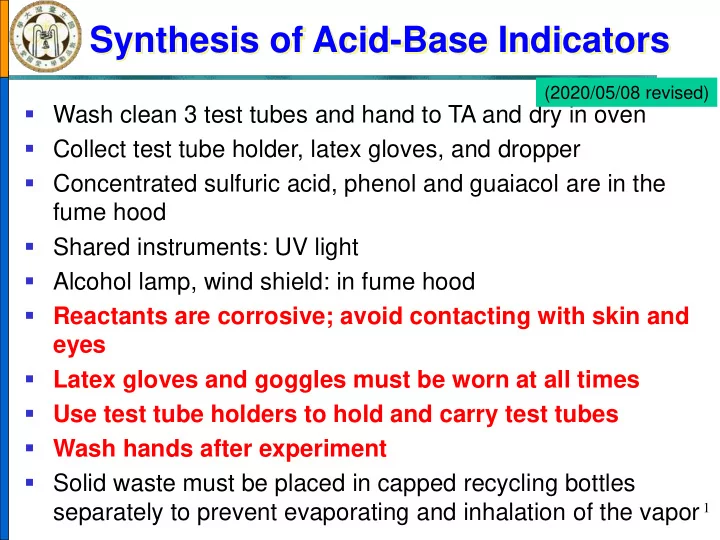
Synthesis of Acid-Base Indicators

  • Wash clean 3 test tubes and hand to TA and dry in oven
  • Collect test tube holder, latex gloves, and dropper
  • Concentrated sulfuric acid, phenol and guaiacol are in the

fume hood

  • Shared instruments: UV light
  • Alcohol lamp, wind shield: in fume hood
  • Reactants are corrosive; avoid contacting with skin and

eyes

  • Latex gloves and goggles must be worn at all times
  • Use test tube holders to hold and carry test tubes
  • Wash hands after experiment
  • Solid waste must be placed in capped recycling bottles

separately to prevent evaporating and inhalation of the vapor

(2020/05/08 revised)

slide-2
SLIDE 2

2

Objective

 Learn the chemical structure of the acid-base indicator phenolphthalein, its preparation, and the chemistry of its color change  Change the substituent in the structure of phenolphthalein to change its color  Use the similar procedures to prepare the fluorescent yellow and highlighters

slide-3
SLIDE 3

3

Preparation of Phenolphthalein

C O C O O

+

OH

2

C O C O OH HO

+ H2O

Phthalic anhydride Phenol Phenolphthalein

  • Conc. H2SO4

(catalyst) Protonated phthalic anhydride (electrophilic)

C O C O O

+ H+

C O C O O

H

Phthalic anhydride

Conc. sulfuric acid

I.

slide-4
SLIDE 4

4

Color of Phenolphthalein Indicator

C O C OH HO

OH- H+

C C O O OH O

+ H2O

O

OH- H+

C C O O O O

+ H2O

Phenolphthalein in acidic soln (colorless) Phenolphthalein in neutral soln (light yellow) Phenolphthalein in basic soln (magenta)

slide-5
SLIDE 5

5

C O C O O

+

OH

2

C O C O OH HO

+ H2O

OCH3 H3CO OCH3

Effect of Substituent on Color

Phthalic anhydride Guaiacol Diguaiacol phthalein

Conc. H2SO4

C O C O O + OH

2

HO C O C O O OH HO

Fluorescent Yellow Resorcinol

II. III.

Phthalic anhydride

Conc. sulfuric acid

slide-6
SLIDE 6

6

Color of Diguaiacol Phthalein

C O C O OCH3 OH HO H3CO

2OH- 2H+

C O C O OCH3 O O H3CO

+ 2H2O

Diguaiacol phthalein in acidic soln (colorless) Diguaiacol phthalein in basic soln (blue)

II.

slide-7
SLIDE 7

7

Synthesis of Fluorescent Yellow

C O C O O + OH

2

HO C O C O OH HO OH OH

+ H2O

Conc. H2SO4

H2SO4

  • H2O

C O C O O OH HO O C O HO C OH O O C O O C O O

+ 2H2O

Fluorescent Yellow Tautomer Green fluorescing substance in basic soln

2OH- 2H+

III.

Phthalic anhydride Resorcinol

slide-8
SLIDE 8

8

Flow Chart I

½ spoon Phthalic anhydride 2 d phenol 2 d Conc. H2SO4

Stir and mix  Heat on flame  React  Color change  Solid disappear Orange

2 d guaiacol

Purple

½ spoon resorcinol

Dark brown

C O C O O

OH

OCH3

OH HO

OH

React Product Operate in hood

slide-9
SLIDE 9

Phenol Add 3 mL H2O  Stir and mix  Product precipitate out  Decant supernatant and get solid product Obtain some solid product  Dissolve in 95% ethanol Add NaOH(aq)  Add HCl(aq)  Observe color change Guaiacol Resorcinol

9

Acid-base test Add H2O in hood

Flow Chart II

Product from

slide-10
SLIDE 10

Step 1 Preparation

One 250 mL beaker

  • 1. One dry test tube with ½

spoon phthalic anhydride

  • 2. A test tube with 3 mL H2O
  • 3. Glass rod
  • 4. Test tube holder

10

slide-11
SLIDE 11

11

Step 2 Synthesis of Phenolphthalein

  • Phenol and

sulfuric acid are corrosive.

  • Wear gloves

Heat on flame for 5 s. Move out of flame Stir and heat repeatedly Stop heating after all solids have dissolved Record color change Add 3 mL distilled water Stir to mix and product precipitate out Decant the supernatant Transfer a portion of solid to test tube Dissolve with 95% ethanol Add drops of 1 M NaOH to observe the color change Add drops of 1 M HCl Record color change reversibly Obtain dry test tube Add 1/2 spoon of phthalic anhydride 2 d phenol and 2 d.

  • conc. sulfuric acid

Mix thoroughly with glass rod

slide-12
SLIDE 12

12

Step 3 Synthesis of Diguaiacol Phthalein

Caution:

  • Mix the reactants thoroughly
  • Heat on flame for 5 s
  • Leave out of flame and mix

again

  • Repeat the operation till color

change and solid reactant disappear

  • Reaction is faster than phenol

and avoid overheating

  • Product is sticky with dark blue

to purple color

Obtain dry test tube Add 1/2 spoon of phthalic anhydride Add 2-3 d guaiacol and 2 d conc. sulfuric acid Heat to synthesize Separate products by adding water

slide-13
SLIDE 13

13

Step 4 Synthesis of Fluorescent Yellow

Caution: The fluorescent yellow decomposes at 315°C. Test tube should be moved in-and-out of flame to avoid over heating

Obtain 2~3 d of soln. A into another test tube Dilute with 10% ethanol until light yellow Obtain a portion of product Dissolve with 95% ethanol (soln. A) Obtain dry test tube Add 1/2 spoon of phthalic anhydride Add 1/2 spoon of resorcinol 2 d conc. sulfuric acid Heat to synthesize Separate products by adding water

slide-14
SLIDE 14

14

Step 5 Fluorescence Observation

Add drops of 1 M NaOH Use black paper as background Observe fluorescence under UV lamp (with long / short wavelength) Take portions of soln. A Add polyvinyl alcohol glue Stir with glass rod to write on paper

Caution: Avoid exposing your eyes and skin to UV light

Fluorescence under UV light

slide-15
SLIDE 15

Fluorescent Plastic

  • The chain of polyvinyl alcohol (PVA) can be

cross-linked by borate to form an elastomer

15

Cross-linking with covalent bonding Cross-linking with hydrogen-bonding

slide-16
SLIDE 16

Step 6 Fluorescent Plastic

  • Add 3 d. fluorescent yellow

(soln. A) in 100 mL beaker

  • Add 1 d. of 1 M NaOH

16

  • Add 4 mL PVA glue
  • Mix with glass rod
  • Add borate soln. drop

by drop

  • Mix thoroughly with

glass rod

  • Observe the change

in color and viscosity

slide-17
SLIDE 17

17

Notice

  • Phenol, conc. sulfuric acid…etc. are corrosive; gloves

and goggles should be worn at all times

  • Do not take more than 2 d. of conc. sulfuric acid
  • Limit the use of chemicals. The amount of chemicals used in

this experiment does not need to be precise.

  • Take small amounts of chemicals into test tube and give out

excess chemicals to others

  • Mix reactants thoroughly before heating
  • Hold test tube with test tube holder, heat the reactants for ca.

5 s., and move out of flame continuously to avoid overheating

  • Avoid exposing eyes and skin to UV light
  • After experiment, clean test tubes with 10% alcohol, pour the

first rinsed waste liquid into recycling bin then clean with water

Condensed report

slide-18
SLIDE 18

18

T1 - Alcohol Lamp

  • Inspect the lamp before each use to make sure there are no

cracks, chips or defects in the glass body.

  • Adjust the wick height to about 3 mm from the top of the metal cap.
  • Fill the lamp with denatured or 95% ethanol through a suitable

funnel to about ½ to 2/3 volume.

  • Light the alcohol lamp using a match.
  • Use the lamp only in an upright position.
  • Keep all combustible materials (clothing, paper, books, chemicals,

etc.) away from the lamp when in use.

  • Never use book or other items to raise the alcohol lamp.

T1 Video on YouTube (Click)

  • Use windshield to block wind and do not use books. Do not tilt lamp to avoid alcohol leakage

while heating.

  • Adjust device upon heating to an appropriate height.
  • After use, cap should be put on to insulate air and extinguish the flame instead of blow it out.

If lamp will not be used for a long time, alcohol inside should be returned to storage bottle.

  • If lamp is overturned and cause small fire, cover the fire quickly with a wet rag and do not

remove the rag immediately while extinguished, or flame may ignite again. Use fire extinguisher instead if a big fire happens. Inform teacher as soon as possible in such emergency and after fire is extinguished, immediately open doors, windows and exhausts to expel alcohol vapor in lab.