
SLIDE 1
Speaker
Mr Donovan Rypkema
President, Heritage Strategies International Lecturer, University of Pennsylvania
Moderator
Mr Ho Weng Hin
Partner & Director, Studio Lapis Adjunct Senior Lecturer, NUS
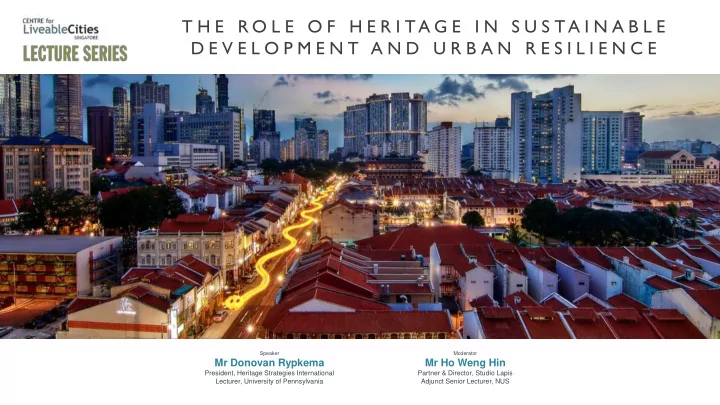
T H E R O L E O F H E R I T A G E I N S U S T A I N A B L E D E - - PowerPoint PPT Presentation
T H E R O L E O F H E R I T A G E I N S U S T A I N A B L E D E V E L O P M E N T A N D U R B A N R E S I L I E N C E Speaker Moderator Mr Donovan Rypkema Mr Ho Weng Hin President, Heritage Strategies International Partner &
Speaker
Mr Donovan Rypkema
President, Heritage Strategies International Lecturer, University of Pennsylvania
Moderator
Mr Ho Weng Hin
Partner & Director, Studio Lapis Adjunct Senior Lecturer, NUS
Efficient Economic return Efficient land use Form of Tenure Quality of Transportation Access Maintenance of fabric Functional adaptability
Cultural adaptability Cultural importance Lovability Construction legislation Occupation legislation Local amenities Quality of work environment
Environmental standards Energy consumption Embodied energy Hazardous/deleterious Environmental quality Ecological Technological adaptability
20 – 40% reduction in Vehicle Miles Traveled Reduction of travel related CO₂ Emissions by 92 – 123 Metric Tons CO₂ “saved” = 18,700 to 22,000 gallons of gasoline Embodied energy retained 55,000 MBTU Greenfield land preserved 5.2 acres Less construction debris in landfills 2500 Tons Infrastructure investment saved $500,000 to $800,000
Passive Street Life Active Street Life Personal attachment to the city The informal economy
0% 5% 10% 15% 20% 25% 30% 35% 40% Less than $25,000 $25,000 - $49,999 $50,000 - $74,999 $75,000 - $99,999 $100,000 - $149,999 $150,000 +
San Antonio Historic Districts
68.5% 75.0% 6.9% 6.8% 23.0% 16.0%
0% 10% 20% 30% 40% 50% 60% 70% 80% 90% 100% San Antonio Historic Districts
White African-American Asian Other
63.0% 60.3% 37.0% 39.7% 0% 10% 20% 30% 40% 50% 60% 70% 80% 90% 100% San Antonio Historic Districts
Hispanic Non-Hispanic
23.1% 24.9% 21.3% 20.9% 17.0% 16.0% 13.0% 12.2% 25.6% 26.0% Rest of the State Local Historic Districts
More than $100,000 $75,000- 100,000 $50,000-75,000 $25,000- $50,000 Less than $25,000
81% 81% 6% 7% 4% 3% 9% 9%
0% 10% 20% 30% 40% 50% 60% 70% 80% 90% 100% Local Districts Rest of Rhode Island
Other Asian Black White Alone
Average Walk Score Designation Raleigh 29 Car-dependent Local historic districts 82 Very walkable National Register historic districts 64 Somewhat walkable All historic districts 73 Very walkable
3.5 4.0 8.7 10.4 14.9 18.1 Automobile Manufacturing Computer Manufacturing Air Transportation Poultry Processing New Construction Historic Rehabilitation
Historic Buildings 46% Older Buildings 22% New Construction 32%
Historic Buildings Older Buildings New Construction
50 100 150 200 250 300 350 400
Rest of Savannah Cuyler-Brownsville Mid-City Savannah HD Victorian
40.0 60.0 80.0 100.0 120.0 140.0 160.0 180.0 200.0 220.0 240.0 260.0
2003 2015
58.1% 47.3% 41.9% 52.7% OVERNIGHT VISITORS DAY VISITORS
Heritage Visitors Non-Heritage Visitors
$0 $10 $20 $30 $40 $50 $60 Lodging Transportation within San Antonio Food & beverage Retail Recreation
Heritage Visitors Other Visitors
3.6% 16.2% 21.0% 28.2% 0% 5% 10% 15% 20% 25% 30%
Local Historic Districts and Job Attraction - Indianapolis
Land Area Jobs Accommodation & Food Service Professional/Scientific/Technical Services
0.0% 2.0% 4.0% 6.0% 8.0% 10.0% 12.0% Lots Private Sector Jobs Small Firm Jobs Start-up Firm Jobs Young Firm Jobs
3.4% 8.0% 9.9% 10.1% 10.9%
Street Performers Arts Districts Artists & the Creative Class Public gathering space
8.0% 10.4% 13.8% 14.0% 20.3% Share of All Jobs Professional, Scientific, and Technical Services Information Educational Services Arts, Entertainment, and Recreation
By 2030, ensure that all learners acquire the knowledge and skills needed to promote sustainable development, including, among others, through education for sustainable development and sustainable lifestyles, human rights, gender equality, promotion of a culture of peace and non-violence, global citizenship and appreciation of cultural diversity and of culture’s contribution to sustainable development (4.7) By 2030, devise and implement policies to promote sustainable tourism that creates jobs and promotes local culture and products (8.9) Develop and implement tools to monitor sustainable development impacts for sustainable tourism that creates jobs and promotes local culture and products (12b)
Total expenditure (public and private) per capita spent on the preservation, protection and conservation of all cultural and natural heritage, by type of heritage (cultural, natural, mixed and World Heritage Centre designation), level of government (national, regional and local/municipal), type of expenditure (operating expenditure/investment) and type of private funding (donations, in kind, private, non-profit sector and sponsorship)
MR DESMOND LEE SPECIAL ENVOY OF THE PRIME MINISTER TO HABITAT III 18 OCTOBER 2016
heritage in cities and human settlements, as appropriate, both tangible and intangible, through integrated urban and territorial policies and adequate investments at the national, sub-national, and local levels, to safeguard and promote cultural infrastructures and sites, museums, indigenous cultures and languages, as well as traditional knowledge and the arts, highlighting the role that these play in the rehabilitation and revitalization of urban areas, and as a way to strengthen social participation and the exercise of citizenship.
as well as resource-efficient and resilient infrastructure, promoting sustainable and inclusive industrial development, and sustainable consumption and production patterns, and fostering an enabling environment for businesses and innovation, as well as livelihoods.
to higher productivity through high-value-added sectors, promoting diversification, technological upgrading, research, and innovation, including the creation of quality, decent, and productive jobs, including through promoting cultural and creative industries, sustainable tourism, performing arts, and heritage conservation activities, among others.
renewal, regeneration, and retrofitting of urban areas, as appropriate, including upgrading of slums and informal settlements, providing high-quality buildings and public spaces, promoting integrated and participatory approaches involving all relevant stakeholders and inhabitants, avoiding spatial and socio- economic segregation and gentrification, while preserving cultural heritage and preventing and containing urban sprawl.
strategies in the adoption of planning instruments, including master plans, zoning guidelines, building codes, coastal management policies, and strategic development policies that safeguard a diverse range of tangible and intangible cultural heritage and landscapes, and will protect them from potential disruptive impacts of urban development.
urban development, and recognize its role in stimulating participation and responsibility, and promote innovative and sustainable use of architectural monuments and sites with the intention of value creation, through respectful restoration and adaptation. We will engage indigenous peoples and local communities in the promotion and dissemination of knowledge of tangible and intangible cultural heritage and protection of traditional expressions and languages, including through the use of new technologies and techniques.
Urban Resilience: The capacity of individuals, communities, institutions, businesses, and systems within a city to survive, adapt, and grow no matter what kinds of chronic stresses and acute shocks they experience. Resilient City: A municipality that has developed capacities to help absorb future shocks and stresses to its social, economic, and technical systems and infrastructure so that it can maintain essentially the same functions, structures, systems, and identity.
Luxembourg Canada Australia Hong Kong
0% 5% 10% 15% 20% 25% 30%
11.1% 11.2%
25.5%
10 20 30 40 50 60 70 80 90 100 Local Historic Districts National Register Districts City of Raleigh
4.2% 5.2% 6.9% 8.7% 9.6% 11.3% 11.9% 12.6% 14.6% 14.6% Mission Lavaca Monte Vista All Historic Districts King William Dignowity Hill Olmos Park Terrace Tobin Hill Monticello Park San Antonio
50 100 150 200 250 300 350 400 1999 2000 2001 2002 2003 2004 2005 2006 2007 2008
Historic Districts Rest of Savannah
40 50 60 70 80 90 100 110 120 2008 2009 2010 2011 2012 2013 2014
Historic Districts Rest of Savannah
45.0% 55.0% 62.6% 37.4%
0.0% 10.0% 20.0% 30.0% 40.0% 50.0% 60.0% 70.0% Historic Districts Non Historic District
Share of Population Share of Growth
801444 697197 641071 562994 574283 589141 617594 100,000 200,000 300,000 400,000 500,000 600,000 700,000 800,000 900,000 1950 1960 1970 1980 1990 2000 2010
Historic Districts Share of Population Historic Districts Share of Growth
Principle 7: Enhancing people’s quality of life leveraging on the regeneration and renewal of public and private housing including landscape, historical, and cultural heritage. Rationale: Reusing and adapting existing buildings is the environmentally, socially, and culturally responsible course of action…the rehabilitation of heritage buildings has been a consistent element in the success stories of urban regeneration.