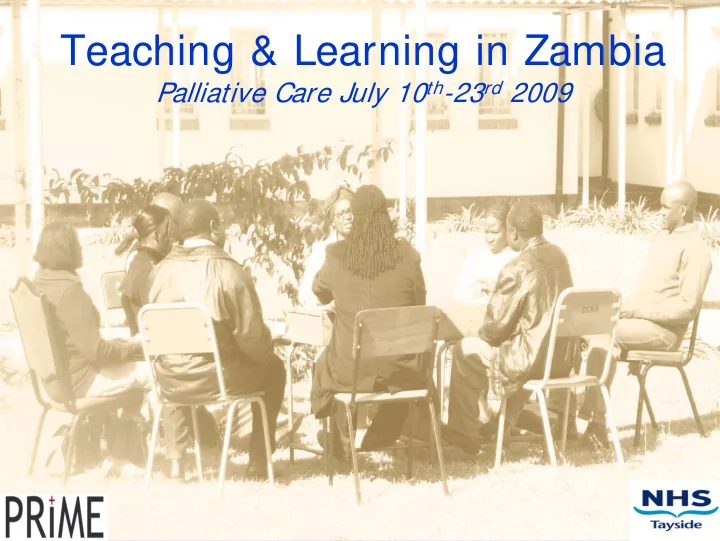
Teaching & Learning in Zambia Palliative Care July 10 th -23 rd - - PowerPoint PPT Presentation

teaching learning in zambia
SMART_READER_LITE
LIVE PREVIEW

Teaching & Learning in Zambia Palliative Care July 10 th -23 rd - - PowerPoint PPT Presentation

Teaching & Learning in Zambia Palliative Care July 10 th -23 rd 2009 Background More than one million people in Zambia are living with HIV/AIDS. Between 60 80% will experience significant pain during the last phase of their illness.


slide-1
SLIDE 1

Teaching & Learning in Zambia

Palliative Care July 10th-23rd 2009

slide-2
SLIDE 2

Background

More than one million people in Zambia are living

with HIV/AIDS. Between 60 –80% will experience significant pain during the last phase of their illness.

University Teaching Hospital (UTH) in Lusaka,

diagnose more than 2000 cases of cervical cancer each year.

In men commonest cancer is kaposi sarcoma Country wide situational analysis Oct 2007-March

2008 identified gaps in pain /symptom management

13 hospices & variety of home based palliative care

programmes in operation

slide-3
SLIDE 3

Current situation

Country wide team advocate morphine use-

Memorandum of Understanding so that hospices can issue morphine – 2 new jobs just advertised via PCAZ to run pilot

Morphine fact book July 2009 Over 2000 Health professionals received

training short course pall care

Gaps around management of chronic pain and

  • ther symptoms
slide-4
SLIDE 4

Our Role

Provide a 35 hr training programme for nursing

lecturers/Drs/social workers (n=30) on all aspects of palliative care.

Facilitate sharing of experience and learning Raise awareness of pain & symptom

management

Partnership working with Palliative Care

Association of Zambia, PCAZ, and Chainima college

slide-5
SLIDE 5

Teaching

Modified lecture Experiential learning Small Group Work Case studies Role Play/ Sculpting Field visit Discussions Meet local clinicians

slide-6
SLIDE 6

Shared Learning

slide-7
SLIDE 7

Raising Public Awareness at Radio Phoenix

  • What palliative care means
  • Use of morphine
  • Spiritual care
  • Emotional support
  • Impact of illness and grief
  • Role of the nurse & support

for caregivers

slide-8
SLIDE 8

Visit to Cancer Diseases Hospital

(opened 2007-out patients only)

slide-9
SLIDE 9

Visit to the Oncology Ward (UHT)

  • One nurse on duty for 19 patients
  • Main diagnosis cancer of the cervix
  • Patients stay in for months
  • Nutrition variable
  • Our students had never visited this ward before
slide-10
SLIDE 10

Learning during Hospice Visit

“Mickey” is 33 yrs old and has 3 children. He had been diagnosed with HIV 4 years previously. While taking anti-retroviral treatment had remained very well, managing to work. He had a new partner and didn’t want her to see him taking medicines- so stopped treatment. Within a couple of months he was admitted as an emergency with severe headaches, vomiting and bilateral leg weakness Diagnosis of TB meningitis now bed bound- on 17 tabs day- not responding to second line treatment.

slide-11
SLIDE 11

A Wish List from Students

slide-12
SLIDE 12

Evaluation: Students’ Self- Assessment Questionnaires

2 4 6 8 10 W h

  • l

e P e r s

  • n

C a r e S p i t i t u a l c a r e L i s t e n i n g B r e a k i n g b a d n e w s S h a r i n g G r i e f P a i n r e l i e f C

  • n

f i d e n c e r e M

  • r

p h i n e B r e a t h l e s s n e s s T e a m w

  • r

k P e r s

  • n

a l S u p p

  • r

t

score Day 1 Day 5 Day 10

slide-13
SLIDE 13

What the NHS Can Learn

Reality check re how good our services are and reminder not

to waste resources

Teamwork & respect for others- different cultures Importance of keeping health promotion at forefront not just

disease management

Not to over complicate – reduce red tape & limit bureaucracy Using lay carers, peer educators, adherence support workers Stress importance of Self Care/Enablement models/

Community involvement

Increase our knowledge about non-cancer palliative care

slide-14
SLIDE 14

Unexpected benefits

  • During visit to the Cancer Disease Hospital the nursing
  • fficer mentioned that every Monday pm they held

family meetings and required social work input. One of

  • ur students (social worker) responded and her offer

was accepted and acted on that same day.

  • After the visit some students arranged to support their

local hospice by offering regular financial and practical help.

  • The Director of Human Resources at the college is

arranging for senior nursing students to have work placements at the hospices

slide-15
SLIDE 15

Some hope for the future