Teilchenphysik mit hchstenergetischen Beschleunigern (Higgs & - - PowerPoint PPT Presentation

teilchenphysik mit h chstenergetischen beschleunigern
SMART_READER_LITE
LIVE PREVIEW

Teilchenphysik mit hchstenergetischen Beschleunigern (Higgs & - - PowerPoint PPT Presentation

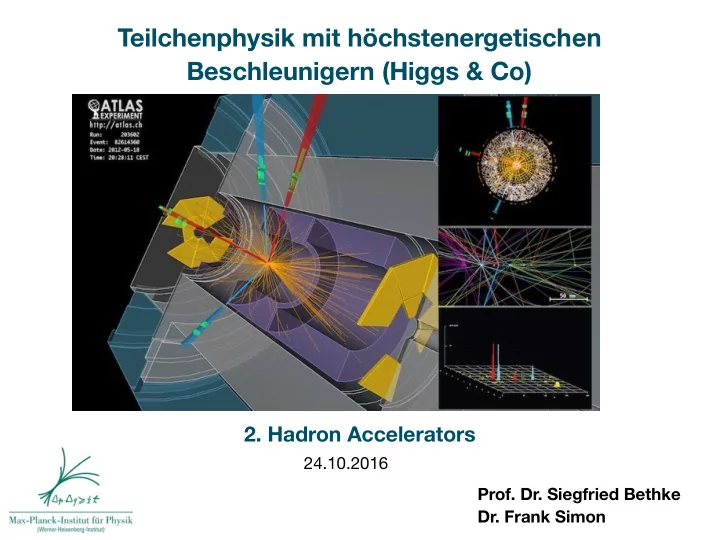
Teilchenphysik mit hchstenergetischen Beschleunigern (Higgs & Co) 2. Hadron Accelerators 24.10.2016 Prof. Dr. Siegfried Bethke Dr. Frank Simon Overview Historical Introduction Accelerator Basics The Tevatron The Large


slide-1
SLIDE 1
  • Prof. Dr. Siegfried Bethke
  • Dr. Frank Simon

Teilchenphysik mit höchstenergetischen Beschleunigern (Higgs & Co)

24.10.2016

  • 2. Hadron Accelerators
slide-2
SLIDE 2

Frank Simon (fsimon@mpp.mpg.de) Teilchenphysik mit höchstenergetischen Beschleunigern: WS 16/17, 02: Hadron Accelerators

Overview

  • Historical Introduction
  • Accelerator Basics
  • The Tevatron
  • The Large Hadron Collider

2

slide-3
SLIDE 3

Frank Simon (fsimon@mpp.mpg.de) Teilchenphysik mit höchstenergetischen Beschleunigern: WS 16/17, 02: Hadron Accelerators

100 Years ago: How it started

  • Uranium as natural “accelerator” 


MeV - scale particles from 
 radioactive decay

3

  • 1911 Rutherford discovered the atomic nucleus by experiments with α

particles on a thin Gold foil

slide-4
SLIDE 4

Frank Simon (fsimon@mpp.mpg.de) Teilchenphysik mit höchstenergetischen Beschleunigern: WS 16/17, 02: Hadron Accelerators

Motivation for Accelerators

  • Initially, accelerators were only used for basic research:


To look into the structure of matter, you need short wavelengths, e.g. high energies

4

1 GeV probes the size of the proton!

slide-5
SLIDE 5

Frank Simon (fsimon@mpp.mpg.de) Teilchenphysik mit höchstenergetischen Beschleunigern: WS 16/17, 02: Hadron Accelerators

Motivation for Accelerators

  • Initially, accelerators were only used for basic research:


To look into the structure of matter, you need short wavelengths, e.g. high energies

4

1 GeV probes the size of the proton!

  • To create new, previously unknown particles, you need energy
slide-6
SLIDE 6

Frank Simon (fsimon@mpp.mpg.de) Teilchenphysik mit höchstenergetischen Beschleunigern: WS 16/17, 02: Hadron Accelerators

Motivation for Accelerators

  • Initially, accelerators were only used for basic research:


To look into the structure of matter, you need short wavelengths, e.g. high energies

4

1 GeV probes the size of the proton!

  • To create new, previously unknown particles, you need energy
  • If you are looking for something that is rare (small cross-section!), you need


 Intensity

slide-7
SLIDE 7

Frank Simon (fsimon@mpp.mpg.de) Teilchenphysik mit höchstenergetischen Beschleunigern: WS 16/17, 02: Hadron Accelerators

Applications

  • Basic research in high energy physics
  • Sources of synchrotron radiation for material science, chemistry, biology
  • Radiation Therapy
  • Production of radio isotopes for medical diagnostics
  • Ion implantation in semiconductor industry
  • ...

5

slide-8
SLIDE 8

Frank Simon (fsimon@mpp.mpg.de) Teilchenphysik mit höchstenergetischen Beschleunigern: WS 16/17, 02: Hadron Accelerators

Applications

  • Basic research in high energy physics
  • Sources of synchrotron radiation for material science, chemistry, biology
  • Radiation Therapy
  • Production of radio isotopes for medical diagnostics
  • Ion implantation in semiconductor industry
  • ...

5

Bill Barletta in Physics Today, 02/2010: Estimated 26 000 accelerators world-wide 1% are research machines with energies above 1 GeV; about 44% are for radiotherapy, 41% for ion implanters and surface modification of materials, 9% for industrial processing and research, 4% for biomedical and other lower-energy research, and 1% for making medical radioisotopes

slide-9
SLIDE 9

Frank Simon (fsimon@mpp.mpg.de) Teilchenphysik mit höchstenergetischen Beschleunigern: WS 16/17, 02: Hadron Accelerators

Historical Overview

  • 1928: R. Wideroe reports the operation of the first linear accelerator 


(Ka and Na-Ions)

  • 1931: Van de Graaff constructs the first high voltage generator
  • 1932: Lawrence and Livingston present first proton beams from a 1.2 MeV Cyclotron
  • 1939: Hansen, Varian and Varian invent the Klystron
  • 1941: Kerst and Serber introduce the Betatron


Touschek and Wideroe invent the principle of ring accelerators

  • 1947: Alvarez develops the first proton linear accelerator
  • 1950 Christofilos formulates the concept of strong focusing

6

E.O. Lawrence

slide-10
SLIDE 10

Frank Simon (fsimon@mpp.mpg.de)

Accelerator Basics

7

Teilchenphysik mit höchstenergetischen Beschleunigern: WS 16/17, 02: Hadron Accelerators

slide-11
SLIDE 11

Frank Simon (fsimon@mpp.mpg.de) Teilchenphysik mit höchstenergetischen Beschleunigern: WS 16/17, 02: Hadron Accelerators

The Basics of Particle Acceleration

  • The underlying equations: Maxwell-Equations

8

The key: Lorentz-Force

! F = q ! E + ! v × ! B

( )

n.b.: The Lorentz-force is non-conservative for time-dependent fields!

slide-12
SLIDE 12

Frank Simon (fsimon@mpp.mpg.de) Teilchenphysik mit höchstenergetischen Beschleunigern: WS 16/17, 02: Hadron Accelerators

Basic Accelerator Types: Cyclotron, Linac

  • Cyclotron:
  • Magnetic field to bend particles
  • Alternating electric field for acceleration

9

slide-13
SLIDE 13

Frank Simon (fsimon@mpp.mpg.de) Teilchenphysik mit höchstenergetischen Beschleunigern: WS 16/17, 02: Hadron Accelerators

Basic Accelerator Types: Cyclotron, Linac

  • Cyclotron:
  • Magnetic field to bend particles
  • Alternating electric field for acceleration

9

  • Linear accelerator:
  • Alternating electric field for acceleration
slide-14
SLIDE 14

Frank Simon (fsimon@mpp.mpg.de) Teilchenphysik mit höchstenergetischen Beschleunigern: WS 16/17, 02: Hadron Accelerators

Basic Accelerator Types: Synchrotron

  • Synchrotron:
  • Magnetic bending field gets ramped up with particle energy: Particles can stay on fixed

path

  • Magnetic field only needed locally
  • Same accelerating cavities get passed many times

10

credit:EPSIM 3D/JF Santarelli, Synchrotron Soleil

accelerating cavity bending magnet focusing magnet

slide-15
SLIDE 15

Frank Simon (fsimon@mpp.mpg.de) Teilchenphysik mit höchstenergetischen Beschleunigern: WS 16/17, 02: Hadron Accelerators

Functional Parts of Ring Accelerators

11

Dipole to keep circular track Quadrupole for focusing RF cavity for acceleration Sextupole for higher

  • rder focusing,

additional beam line elements: beam pipe, pumps, …

slide-16
SLIDE 16

Frank Simon (fsimon@mpp.mpg.de) Teilchenphysik mit höchstenergetischen Beschleunigern: WS 16/17, 02: Hadron Accelerators

Limits for Ring Accelerators: Bending Power

  • Strong dipole magnets keep particles on their track in a synchrotron


Magnetic field and radius define energy!

12

Lorentz force acts on moving charge It forces the particle on a circular track: Often, the term “stiffness” is used: LHC : (Bρ)~23000 Tm

Maximum dipole field and radius define maximum energy

slide-17
SLIDE 17

Frank Simon (fsimon@mpp.mpg.de) Teilchenphysik mit höchstenergetischen Beschleunigern: WS 16/17, 02: Hadron Accelerators

∆E = 8.85 × 10⁻⁵ E4[GeV4] ρ[km] MeV

Limits for Ring Accelerators: Synchrotron Radiation

  • Energy loss of electrons per turn in a storage ring

13

  • Charged particles loose energy when accelerated:

P = 1 6⇤⇥0 e2a2 c3 4 a = v2 ρ

ρ: bending radius

scales with γ4, at constant energy with 1/m4 ➫ Electrons loose 1013 times more energy than protons!

slide-18
SLIDE 18

Frank Simon (fsimon@mpp.mpg.de) Teilchenphysik mit höchstenergetischen Beschleunigern: WS 16/17, 02: Hadron Accelerators

∆E = 8.85 × 10⁻⁵ E4[GeV4] ρ[km] MeV

Limits for Ring Accelerators: Synchrotron Radiation

  • Energy loss of electrons per turn in a storage ring

13

∆E = 7.8 × 10⁻⁶ E4[TeV4] ρ[km] MeV

  • Energy loss of protons
  • Charged particles loose energy when accelerated:

P = 1 6⇤⇥0 e2a2 c3 4 a = v2 ρ

ρ: bending radius

scales with γ4, at constant energy with 1/m4 ➫ Electrons loose 1013 times more energy than protons!

slide-19
SLIDE 19

Frank Simon (fsimon@mpp.mpg.de) Teilchenphysik mit höchstenergetischen Beschleunigern: WS 16/17, 02: Hadron Accelerators

∆E = 8.85 × 10⁻⁵ E4[GeV4] ρ[km] MeV

Limits for Ring Accelerators: Synchrotron Radiation

  • Energy loss of electrons per turn in a storage ring

13

∆E = 7.8 × 10⁻⁶ E4[TeV4] ρ[km] MeV

  • Energy loss of protons
  • Example: 100 GeV electrons in LHC-tunnel (ρ ~ 4.3 km), e.g. LEP: ΔE ~ 2 GeV
  • Charged particles loose energy when accelerated:

P = 1 6⇤⇥0 e2a2 c3 4 a = v2 ρ

ρ: bending radius

scales with γ4, at constant energy with 1/m4 ➫ Electrons loose 1013 times more energy than protons!

slide-20
SLIDE 20

Frank Simon (fsimon@mpp.mpg.de) Teilchenphysik mit höchstenergetischen Beschleunigern: WS 16/17, 02: Hadron Accelerators

∆E = 8.85 × 10⁻⁵ E4[GeV4] ρ[km] MeV

Limits for Ring Accelerators: Synchrotron Radiation

  • Energy loss of electrons per turn in a storage ring

13

∆E = 7.8 × 10⁻⁶ E4[TeV4] ρ[km] MeV

  • Energy loss of protons
  • Example: 100 GeV electrons in LHC-tunnel (ρ ~ 4.3 km), e.g. LEP: ΔE ~ 2 GeV
  • Example: 7 TeV protons in LHC-tunnel (ρ ~ 4.3 km): ΔE ~ 4.4 keV
  • Charged particles loose energy when accelerated:

P = 1 6⇤⇥0 e2a2 c3 4 a = v2 ρ

ρ: bending radius

scales with γ4, at constant energy with 1/m4 ➫ Electrons loose 1013 times more energy than protons!

slide-21
SLIDE 21

Frank Simon (fsimon@mpp.mpg.de) Teilchenphysik mit höchstenergetischen Beschleunigern: WS 16/17, 02: Hadron Accelerators

∆E = 8.85 × 10⁻⁵ E4[GeV4] ρ[km] MeV

Limits for Ring Accelerators: Synchrotron Radiation

  • Energy loss of electrons per turn in a storage ring

13

∆E = 7.8 × 10⁻⁶ E4[TeV4] ρ[km] MeV

  • Energy loss of protons
  • Example: 100 GeV electrons in LHC-tunnel (ρ ~ 4.3 km), e.g. LEP: ΔE ~ 2 GeV
  • Example: 7 TeV protons in LHC-tunnel (ρ ~ 4.3 km): ΔE ~ 4.4 keV

➫ Highest energies are not possible with electrons using synchrotrons!

  • Charged particles loose energy when accelerated:

P = 1 6⇤⇥0 e2a2 c3 4 a = v2 ρ

ρ: bending radius

scales with γ4, at constant energy with 1/m4 ➫ Electrons loose 1013 times more energy than protons!

slide-22
SLIDE 22

Frank Simon (fsimon@mpp.mpg.de) Teilchenphysik mit höchstenergetischen Beschleunigern: WS 16/17, 02: Hadron Accelerators

Strong Focusing

  • Strong Focusing, or Alternating Gradient Synchroton: Breakthrough that

allowed to reach high energies of 10 GeV and more

14

1 f = 1 f1 + 1 f2 − d f1f2

  • Two crossed quadrupole fields have a net focusing

effect, if they are placed at the right distance d (smaller than the focal length) - Just like a lens system in optics!

slide-23
SLIDE 23

Frank Simon (fsimon@mpp.mpg.de) Teilchenphysik mit höchstenergetischen Beschleunigern: WS 16/17, 02: Hadron Accelerators

High Energies: Colliders

  • The first experiments with accelerators were fixed-target experiments:


(Relatively) easy to manage: Shoot a beam at a target


  • Much higher energy can be obtained in collider mode:


Two beams collider, the center of mass can be at rest in the laboratory

15

Ecm = 2E = 2γm pc2 Ecm = 2 γ +1

( )mpc2

For colliding protons

slide-24
SLIDE 24

Frank Simon (fsimon@mpp.mpg.de) Teilchenphysik mit höchstenergetischen Beschleunigern: WS 16/17, 02: Hadron Accelerators

Key Collider Parameters

  • Event Rate

16

R = L ⋅σ

  • Luminosity

L = f n1n2 4πσ xσ y

σy: vertical beam size ni: Number of particles in bunch i f: Collision frequency σx: horizontal beam size

... assuming a gaussian beam profile and perfect overlap

slide-25
SLIDE 25

Frank Simon (fsimon@mpp.mpg.de) Teilchenphysik mit höchstenergetischen Beschleunigern: WS 16/17, 02: Hadron Accelerators

Key Collider Parameters

  • Event Rate

16

R = L ⋅σ

  • Luminosity

L = f n1n2 4πσ xσ y

σy: vertical beam size ni: Number of particles in bunch i f: Collision frequency σx: horizontal beam size

... assuming a gaussian beam profile and perfect overlap

  • Luminosity is often expressed in terms of the “β function” at the collision

point and in terms of “emittance”

  • β* is related to the beam optics
  • ε is related to the beam quality, and gives the phase space of the beam

particles (units length * angle)

L = f n1n2 4 εxβx

*εyβy *

slide-26
SLIDE 26

Frank Simon (fsimon@mpp.mpg.de) Teilchenphysik mit höchstenergetischen Beschleunigern: WS 16/17, 02: Hadron Accelerators

Evolution of Energy - The Livingston Plot

17

Comparison of Colliders at the Energy Frontier s

10

  • 1

1 10 10 2 10 3 1960 1970 1980 1990 2000 2010 2020 2030 Year of First Physics Constituent Center-of-Mass Energy [GeV] ISR SppS Tevatron LHC LEP2 ILC CLIC VEP-1 VEP-2 ACO Adone Spear Doris Spear2 PETRA CESR PEP Tristan LEP, SLC

e+e− colliders Hadron colliders

HERA LHeC 2040…

KEK-B PEP-II DAFNE

LHC

SuperKEKB HL-LHC Running

? ILC - Future e+e- linear collider

slide-27
SLIDE 27

Frank Simon (fsimon@mpp.mpg.de) Teilchenphysik mit höchstenergetischen Beschleunigern: WS 16/17, 02: Hadron Accelerators

Colliders - Now and Then

  • 29 Colliders built, 7 work ”now”

18

… 7 Work “Now”

VEPP-2000 VEPP-4M LHC DAFNE BEPC-II KEK-B RHIC

slide-28
SLIDE 28

Frank Simon (fsimon@mpp.mpg.de)

The Tevatron

19

Teilchenphysik mit höchstenergetischen Beschleunigern: WS 16/17, 02: Hadron Accelerators

slide-29
SLIDE 29

Frank Simon (fsimon@mpp.mpg.de) Teilchenphysik mit höchstenergetischen Beschleunigern: WS 16/17, 02: Hadron Accelerators

Fermilab Tevatron

20

(H– to 750 keV) (H– to 400 MeV) (p to 8 GeV after 20000 turns) (p and anti-p to 150 GeV; 120 GeV p for anti-p target; injection into Tevatron) (120 GeV p to Ni target)

slide-30
SLIDE 30

Frank Simon (fsimon@mpp.mpg.de) Teilchenphysik mit höchstenergetischen Beschleunigern: WS 16/17, 02: Hadron Accelerators

The Fermilab Accelerator Complex

21

slide-31
SLIDE 31

Frank Simon (fsimon@mpp.mpg.de) Teilchenphysik mit höchstenergetischen Beschleunigern: WS 16/17, 02: Hadron Accelerators

The Fermilab Accelerator Chain

22

Cockcroft-Walton DC accelerator LINAC Booster Main Injector Tevatron Antiproton Source

slide-32
SLIDE 32

Frank Simon (fsimon@mpp.mpg.de) Teilchenphysik mit höchstenergetischen Beschleunigern: WS 16/17, 02: Hadron Accelerators

Why Antiprotons?

  • Can fly in opposite direction of protons using the same magnetic fields in one

beam pipe: One ring instead of two!

  • Up to energies of 3 TeV the production cross sections for many particularly

interesting processes are higher for proton - antiproton collisions than for pp collisions (valence-quark annihilation!)

23

slide-33
SLIDE 33

Frank Simon (fsimon@mpp.mpg.de) Teilchenphysik mit höchstenergetischen Beschleunigern: WS 16/17, 02: Hadron Accelerators

Why Antiprotons?

  • Can fly in opposite direction of protons using the same magnetic fields in one

beam pipe: One ring instead of two!

  • Up to energies of 3 TeV the production cross sections for many particularly

interesting processes are higher for proton - antiproton collisions than for pp collisions (valence-quark annihilation!)

23

But: Antiprotons have to be produced first!

slide-34
SLIDE 34

Frank Simon (fsimon@mpp.mpg.de) Teilchenphysik mit höchstenergetischen Beschleunigern: WS 16/17, 02: Hadron Accelerators

Antiproton Production

24

800 Billionen USD / g !

slide-35
SLIDE 35

Frank Simon (fsimon@mpp.mpg.de) Teilchenphysik mit höchstenergetischen Beschleunigern: WS 16/17, 02: Hadron Accelerators

The Antiproton Source

25

Debuncher & Accumulator

slide-36
SLIDE 36

Frank Simon (fsimon@mpp.mpg.de) Teilchenphysik mit höchstenergetischen Beschleunigern: WS 16/17, 02: Hadron Accelerators

The Antiproton Debuncher

  • transfer of large energy- and small time spread to small energy spread with

long time structure

26

slide-37
SLIDE 37

Frank Simon (fsimon@mpp.mpg.de) Teilchenphysik mit höchstenergetischen Beschleunigern: WS 16/17, 02: Hadron Accelerators

Stochastic Cooling

  • Nobel prize to Simon van der Meer (1984)
  • Reduction of transversal phase space of antiprotons, carried out in debuncher

(retention time 1.5 sec) and in accumulator (several hours)

27

amplification of pick-up signal by 150 dB (1015).

slide-38
SLIDE 38

Frank Simon (fsimon@mpp.mpg.de) Teilchenphysik mit höchstenergetischen Beschleunigern: WS 16/17, 02: Hadron Accelerators

Superconducting Magnets in Tevatron

28

slide-39
SLIDE 39

Frank Simon (fsimon@mpp.mpg.de) Teilchenphysik mit höchstenergetischen Beschleunigern: WS 16/17, 02: Hadron Accelerators

Tevatron Magnets

29

slide-40
SLIDE 40

Frank Simon (fsimon@mpp.mpg.de) Teilchenphysik mit höchstenergetischen Beschleunigern: WS 16/17, 02: Hadron Accelerators

Superconducting Magnets

30

slide-41
SLIDE 41

Frank Simon (fsimon@mpp.mpg.de) Teilchenphysik mit höchstenergetischen Beschleunigern: WS 16/17, 02: Hadron Accelerators

Superconducting Magnets

30

slide-42
SLIDE 42

Frank Simon (fsimon@mpp.mpg.de) Teilchenphysik mit höchstenergetischen Beschleunigern: WS 16/17, 02: Hadron Accelerators

Superconducting Magnets

30

slide-43
SLIDE 43

Frank Simon (fsimon@mpp.mpg.de) Teilchenphysik mit höchstenergetischen Beschleunigern: WS 16/17, 02: Hadron Accelerators

Tevatron: Integrated Luminosity

  • Project termination on September 30, 2011

31

peak luminosity ~ 1032 cm-2s-1

slide-44
SLIDE 44

Frank Simon (fsimon@mpp.mpg.de)

The Large Hadron Collider

32

Teilchenphysik mit höchstenergetischen Beschleunigern: WS 16/17, 02: Hadron Accelerators

slide-45
SLIDE 45

Frank Simon (fsimon@mpp.mpg.de) Teilchenphysik mit höchstenergetischen Beschleunigern: WS 16/17, 02: Hadron Accelerators

The LHC: Visions (1980ies)

  • particle accelerator with the highest collision energies aiming at:
  • test of the Standard Model beyond energies of 1 TeV
  • finding the missing pieces of the SM: top quark
  • investigate the mechanism of electroweak symmetry breaking: 


find the Higgs boson

  • search for New Physics beyond the Standard Model 


(Supersymmetry, large extra dimensions, …)

  • find the unexpected

33

slide-46
SLIDE 46

Frank Simon (fsimon@mpp.mpg.de) Teilchenphysik mit höchstenergetischen Beschleunigern: WS 16/17, 02: Hadron Accelerators

The Challenges

34

  • “fast“ and „cheap“

use existing LEP tunnel and pre-accelerators

  • f CERN

slide-47
SLIDE 47

Frank Simon (fsimon@mpp.mpg.de) Teilchenphysik mit höchstenergetischen Beschleunigern: WS 16/17, 02: Hadron Accelerators

The Challenges

34

  • “fast“ and „cheap“

use existing LEP tunnel and pre-accelerators

  • f CERN

  • highest energies at

given radius of tunnel accelerate protons (instead of electrons at LEP)

slide-48
SLIDE 48

Frank Simon (fsimon@mpp.mpg.de) Teilchenphysik mit höchstenergetischen Beschleunigern: WS 16/17, 02: Hadron Accelerators

The Challenges

34

  • “fast“ and „cheap“

use existing LEP tunnel and pre-accelerators

  • f CERN

  • highest energies at

given radius of tunnel accelerate protons (instead of electrons at LEP)

  • collision energies of

constituents of ~TeV Proton energies of at least 5 TeV

slide-49
SLIDE 49

Frank Simon (fsimon@mpp.mpg.de) Teilchenphysik mit höchstenergetischen Beschleunigern: WS 16/17, 02: Hadron Accelerators

The Challenges

34

  • “fast“ and „cheap“

use existing LEP tunnel and pre-accelerators

  • f CERN

  • highest energies at

given radius of tunnel accelerate protons (instead of electrons at LEP)

  • collision energies of

constituents of ~TeV Proton energies of at least 5 TeV

  • Proton energies of

at least 5 TeV superconducting magnets at ~ 8 Tesla

slide-50
SLIDE 50

Frank Simon (fsimon@mpp.mpg.de) Teilchenphysik mit höchstenergetischen Beschleunigern: WS 16/17, 02: Hadron Accelerators

The Challenges

34

  • “fast“ and „cheap“

use existing LEP tunnel and pre-accelerators

  • f CERN

  • highest energies at

given radius of tunnel accelerate protons (instead of electrons at LEP)

  • collision energies of

constituents of ~TeV Proton energies of at least 5 TeV

  • Proton energies of

at least 5 TeV superconducting magnets at ~ 8 Tesla

  • generate objects of

very high masses need high luminosity (L ~1034 cm-2 s-1)

slide-51
SLIDE 51

Frank Simon (fsimon@mpp.mpg.de) Teilchenphysik mit höchstenergetischen Beschleunigern: WS 16/17, 02: Hadron Accelerators

The Challenges

34

  • “fast“ and „cheap“

use existing LEP tunnel and pre-accelerators

  • f CERN

  • highest energies at

given radius of tunnel accelerate protons (instead of electrons at LEP)

  • collision energies of

constituents of ~TeV Proton energies of at least 5 TeV

  • Proton energies of

at least 5 TeV superconducting magnets at ~ 8 Tesla

  • generate objects of

very high masses need high luminosity (L ~1034 cm-2 s-1)

  • L ~1034 cm-2 s-1

high data rates; radiation damage

slide-52
SLIDE 52

Frank Simon (fsimon@mpp.mpg.de) Teilchenphysik mit höchstenergetischen Beschleunigern: WS 16/17, 02: Hadron Accelerators

The Large Hadron Collider LHC

  • Proton-proton collider in a

27 km tunnel at CERN

35

p ⇒ ⇐ p

7 TeV 7 TeV

  • Highest collision energies
  • Highest luminosity
  • 4 large experiments:
  • ATLAS & CMS (general purpose p+p)
  • ALICE (Heavy Ion collisions)
  • LHCb (heavy quark physics)

constructed & operated in collaboration
 with ~ 40 nations

  • Start of operations 2009 (originally planned for 2005), running until ~ 2035
slide-53
SLIDE 53

Frank Simon (fsimon@mpp.mpg.de) Teilchenphysik mit höchstenergetischen Beschleunigern: WS 16/17, 02: Hadron Accelerators

The LHC Complex at CERN

36

slide-54
SLIDE 54

Frank Simon (fsimon@mpp.mpg.de) Teilchenphysik mit höchstenergetischen Beschleunigern: WS 16/17, 02: Hadron Accelerators

The Full CERN Accelerator Complex

37

slide-55
SLIDE 55

Frank Simon (fsimon@mpp.mpg.de) Teilchenphysik mit höchstenergetischen Beschleunigern: WS 16/17, 02: Hadron Accelerators

LHC: Parameters

38

Proton – Proton collisions: 2835 x 2835 bunches distance: 7.5 m ( 25 ns) 1011 protons / bunch collision rate: 40 million / second Luminosity: L = 1034 cm-2 s-1 Proton-Proton collisions: ~109 / s (pile-up of 20-30 pp-interactions for each beam crossing) ~1600 charged particles in detector ⇒ highest demands on detectors

slide-56
SLIDE 56

Frank Simon (fsimon@mpp.mpg.de) Teilchenphysik mit höchstenergetischen Beschleunigern: WS 16/17, 02: Hadron Accelerators

Production Cross Sections: Physics Expectations

39

0.1 1 10 10

  • 7

10

  • 6

10

  • 5

10

  • 4

10

  • 3

10

  • 2

10

  • 1

10 10

1

10

2

10

3

10

4

10

5

10

6

10

7

10

8

10

9

10

  • 7

10

  • 6

10

  • 5

10

  • 4

10

  • 3

10

  • 2

10

  • 1

10 10

1

10

2

10

3

10

4

10

5

10

6

10

7

10

8

10

9

WJS2009

jet(ET

jet > 100 GeV)

jet(ET

jet > s/20)

jet(ET

jet > s/4)

Higgs(MH=120 GeV)

200 GeV

LHC Tevatron

events / sec for L = 10

33 cm

  • 2s
  • 1

b tot

proton - (anti)proton cross sections

W Z t

500 GeV

!"nb# s (TeV)

Nevents /s = σ x L Nevents = σ x ∫ L dt 1 nb = 10-33 cm2 calculus (example): End of 2010: ∫Ldt = 40 pb-1 = 40 x103 nb-1

  • corresp. to ~ 4 x10³ top-quark-

events (σt ~ 10-1 nb at 7 TeV)

  • corresp. to ~200 Higgs-evts.

with MH =120 GeV at 7 TeV data sample 2011: ~ 5 fb-1 data sample 2012: ~20 fb-1 10 orders of magnitude

slide-57
SLIDE 57

Frank Simon (fsimon@mpp.mpg.de) Teilchenphysik mit höchstenergetischen Beschleunigern: WS 16/17, 02: Hadron Accelerators

Production Rates at LHC

40

  • Inelastic Proton-Proton collisions: 1 Billion / second
  • Quark -Quark/Gluon scatterings with ~100 Millions/ sec

large transverse momenta (> 20 GeV)

  • b-Quark pairs 5 Millions / sec
  • top-Quark pairs 8 / sec
  • W → e ν 150 / sec
  • Z → e e 15 / sec
  • Higgs (Mass = 150 GeV) 0.2 / sec
  • Gluino, Squarks (Mass = 1 TeV) 0.03 / sec
  • Interesting physics processes are extremely rare:

⇒ high luminosities ! extremely powerful detectors (to suppress background)

slide-58
SLIDE 58

Frank Simon (fsimon@mpp.mpg.de) Teilchenphysik mit höchstenergetischen Beschleunigern: WS 16/17, 02: Hadron Accelerators

LHC Parameters: Technical Details

41

slide-59
SLIDE 59

Frank Simon (fsimon@mpp.mpg.de) Teilchenphysik mit höchstenergetischen Beschleunigern: WS 16/17, 02: Hadron Accelerators

The LHC Magnets

  • Superconducting main dipoles
  • biggest challenge: magnetic field of ~ 9 T
  • overall 1300 main dipoles, each 15 m long
  • operated at 1.9 K (superfluid helium)

42

slide-60
SLIDE 60

Frank Simon (fsimon@mpp.mpg.de) Teilchenphysik mit höchstenergetischen Beschleunigern: WS 16/17, 02: Hadron Accelerators

The LHC Magnets

43

slide-61
SLIDE 61

Frank Simon (fsimon@mpp.mpg.de) Teilchenphysik mit höchstenergetischen Beschleunigern: WS 16/17, 02: Hadron Accelerators

LHC Installation

44

Lowering of the first dipole into the tunnel (March 2005) Installation of dipoles in the LHC ring

slide-62
SLIDE 62

Frank Simon (fsimon@mpp.mpg.de) Teilchenphysik mit höchstenergetischen Beschleunigern: WS 16/17, 02: Hadron Accelerators

LHC Installation

45

Interconnection of the dipoles and connection to the cryoline A view of the tunnel…

slide-63
SLIDE 63

Frank Simon (fsimon@mpp.mpg.de) Teilchenphysik mit höchstenergetischen Beschleunigern: WS 16/17, 02: Hadron Accelerators

LHC Installation

46

slide-64
SLIDE 64

Frank Simon (fsimon@mpp.mpg.de) Teilchenphysik mit höchstenergetischen Beschleunigern: WS 16/17, 02: Hadron Accelerators

LHC Status

  • 09.09.2008: first stable „beam“ in LHC
  • 19.09.2008: technical problems with large impact:


destruction of parts of LHC ring; repair of ~1 Jahr.

  • 20.11.2009: restart after repair; first collisions!
  • 11.12.2009: world record: collisions at 2.36 TeV! (2·1.18 TeV)
  • 30.03.2010: collisions at 7 TeV (2 · 3.5 TeV)
  • Nov. 2011: 5 fb-1 at 7 TeV per experiment
  • 2012:
  • collisions at 8 TeV

  • until Dec: ~20 fb-1 

  • 4. July 2012: a new Boson ...
  • 2013/14: long shut-down (LS1);
  • 2015: operation at 13 TeV; 25 ns bunch spacing

47

slide-65
SLIDE 65

Frank Simon (fsimon@mpp.mpg.de) Teilchenphysik mit höchstenergetischen Beschleunigern: WS 16/17, 02: Hadron Accelerators

LHC Status

  • 09.09.2008: first stable „beam“ in LHC
  • 19.09.2008: technical problems with large impact:


destruction of parts of LHC ring; repair of ~1 Jahr.

  • 20.11.2009: restart after repair; first collisions!
  • 11.12.2009: world record: collisions at 2.36 TeV! (2·1.18 TeV)
  • 30.03.2010: collisions at 7 TeV (2 · 3.5 TeV)
  • Nov. 2011: 5 fb-1 at 7 TeV per experiment
  • 2012:
  • collisions at 8 TeV

  • until Dec: ~20 fb-1 

  • 4. July 2012: a new Boson ...
  • 2013/14: long shut-down (LS1);
  • 2015: operation at 13 TeV; 25 ns bunch spacing

47

slide-66
SLIDE 66

Frank Simon (fsimon@mpp.mpg.de) Teilchenphysik mit höchstenergetischen Beschleunigern: WS 16/17, 02: Hadron Accelerators

LHC Operations: Always an Adventure

48

WEASEL PS MAIN POWER SUPPLY SPS BEAM DUMP

  • Limited to 96 bunches

per injection

  • 2076 bunches per beam
  • cf. 2750
slide-67
SLIDE 67

Frank Simon (fsimon@mpp.mpg.de) Teilchenphysik mit höchstenergetischen Beschleunigern: WS 16/17, 02: Hadron Accelerators

LHC Luminosity

  • Design luminosity reached end of June 2016

49

1 J D n 1 J D n 1 J D n 1 J D n 1 J D n 1 J D n

DDte (87C)

5 10 15 20

3eDk DelLveUed LuPLnoVLty (Hz/nb)

× 10

DDtD included fUom 2010-03-30 11:22 to 2016-10-19 10:10 UTC 2010, 7 7eV, PDx. 203.8 Hz/µb 2011, 7 7eV, PDx. 4.0 Hz/nb 2012, 8 7eV, PDx. 7.7 Hz/nb 2015, 13 7eV, PDx. 5.1 Hz/nb 2016, 13 7eV, PDx. 15.3 Hz/nb 5 10 15 20

CMS PeDk LuPLnosLty Per DDy, SS

LHC design goal: 1034 cm-2s-1
slide-68
SLIDE 68

Frank Simon (fsimon@mpp.mpg.de) Teilchenphysik mit höchstenergetischen Beschleunigern: WS 16/17, 02: Hadron Accelerators

Measuring the Luminosity

  • Different techniques in use - the most “basic” one: Van der Meer - Scans

50

ℒ=nb f r n1n2∬ρ1(x , y)ρ2(x , y)dxdy=nbf r n1n2 2πΣx Σy

Bunch 1 Bunch 2 ρ1(x,y) ρ2(x,y) n1 n2

number of bunches revolution frequency

  • no. of protons per bunch

beam width

slide-69
SLIDE 69

Frank Simon (fsimon@mpp.mpg.de) Teilchenphysik mit höchstenergetischen Beschleunigern: WS 16/17, 02: Hadron Accelerators

Measuring the Luminosity

  • Different techniques in use - the most “basic” one: Van der Meer - Scans

50

ℒ=nb f r n1n2∬ρ1(x , y)ρ2(x , y)dxdy=nbf r n1n2 2πΣx Σy

Bunch 1 Bunch 2 ρ1(x,y) ρ2(x,y) n1 n2

number of bunches revolution frequency

  • no. of protons per bunch

beam width

Scan determines beam width bunch population from external measurement Accuracy on the 2% level

slide-70
SLIDE 70

Frank Simon (fsimon@mpp.mpg.de) Teilchenphysik mit höchstenergetischen Beschleunigern: WS 16/17, 02: Hadron Accelerators

LHC Integrated Luminosity

51

1 ASU 1 0Dy 1 Jun 1 JuO 1 AuJ 1 6eS 1 2ct 1 1ov 1 Dec

DDte (87C)

10 20 30 40 50

7otDO ,nteJUDted LumLnoVLty (fb−1 )

× 50

DDtD included fUom 2010-03-30 11:22 to 2016-10-19 10:10 UTC 2010, 7 7eV, 45.0 pb−1 2011, 7 7eV, 6.1 fb−1 2012, 8 7eV, 23.3 fb−1 2015, 13 7eV, 4.2 fb−1 2016, 13 7eV, 37.8 fb−1 10 20 30 40 50

CMS ,ntegrated LumLnosLty, SS

slide-71
SLIDE 71

Frank Simon (fsimon@mpp.mpg.de) Teilchenphysik mit höchstenergetischen Beschleunigern: WS 16/17, 02: Hadron Accelerators

A Consequence: Pile-Up

  • High luminosity results in multiple interactions per bunch crossing

52

Mean Number of Interactions per Crossing 5 10 15 20 25 30 35 40 45 50 /0.1]

  • 1

Delivered Luminosity [pb 20 40 60 80 100 120 140 160 180 200 =13 TeV s Online, ATLAS

  • 1

Ldt=33.5 fb

> = 13.7 µ 2015: < > = 24.2 µ 2016: < > = 22.9 µ Total: <

7/16 calibration

Day in 2016 13/04 17/05 20/06 25/07 28/08 02/10 05/11 Peak Interactions/BX 10 20 30 40 50 60 70

= 13 TeV s

ATLAS Online Luminosity

LHC Stable Beams

7/16 calibration

Example: Z->µµ process, in an event with 25 reconstructed interaction vertices

~ 5 cm

slide-72
SLIDE 72

Frank Simon (fsimon@mpp.mpg.de) Teilchenphysik mit höchstenergetischen Beschleunigern: WS 16/17, 02: Hadron Accelerators

LHC Long Term Plan

  • Continuing current run until 2018
  • “mild” luminosity upgrade (injector upgrade) 2019/20
  • HighLuminosity LHC upgrade 2024-26: 


4 - 7 x 1034 cm-2s-1 peak luminosity

53

slide-73
SLIDE 73

Frank Simon (fsimon@mpp.mpg.de) Teilchenphysik mit höchstenergetischen Beschleunigern: WS 16/17, 02: Hadron Accelerators

HL-LHC: Luminosity Levelling

  • A key “feature” to limit excessive pileup: Luminosity levelling

54

gure 3. Left: Luminosity profile for a single long fill: starting at nominal peak luminosity (black line), wi

  • Allows longer running at high luminosity per fill, only mild impact on average

luminosity, with substantial gain in terms of experimental conditions

slide-74
SLIDE 74

Frank Simon (fsimon@mpp.mpg.de) Teilchenphysik mit höchstenergetischen Beschleunigern: WS 16/17, 02: Hadron Accelerators

Summary

  • Accelerators are key instruments in particle physics - with many applications

beyond fundamental research


  • Proton synchrotrons in “collider mode” reach the highest energies - limited by

accelerator radius and main dipole field

  • The Large Hadron Collider LHC is the current energy record holder - and has

just exceeded its design luminosity

  • Physics program with luminosity upgrade extending to 2035

55

slide-75
SLIDE 75

Frank Simon (fsimon@mpp.mpg.de) Teilchenphysik mit höchstenergetischen Beschleunigern: WS 16/17, 02: Hadron Accelerators

Summary

  • Accelerators are key instruments in particle physics - with many applications

beyond fundamental research


  • Proton synchrotrons in “collider mode” reach the highest energies - limited by

accelerator radius and main dipole field

  • The Large Hadron Collider LHC is the current energy record holder - and has

just exceeded its design luminosity

  • Physics program with luminosity upgrade extending to 2035

55

Next Lecture: 07.11., “Detectors I”, F . Simon

slide-76
SLIDE 76

Frank Simon (fsimon@mpp.mpg.de) Teilchenphysik mit höchstenergetischen Beschleunigern: WS 16/17, 02: Hadron Accelerators

Summary

  • Accelerators are key instruments in particle physics - with many applications

beyond fundamental research


  • Proton synchrotrons in “collider mode” reach the highest energies - limited by

accelerator radius and main dipole field

  • The Large Hadron Collider LHC is the current energy record holder - and has

just exceeded its design luminosity

  • Physics program with luminosity upgrade extending to 2035

55

Next Lecture: 07.11., “Detectors I”, F . Simon

Attention: No lecture next week on Monday, October 31!

slide-77
SLIDE 77

Frank Simon (fsimon@mpp.mpg.de) Teilchenphysik mit höchstenergetischen Beschleunigern: WS 16/17, 02: Hadron Accelerators

Schedule

1. Introduction 17.10. 2. Accelerators 24.10.

  • ---------- no lecture -------------

31.10. 3. Particle Detectors I 07.11. 4. Particle Detectors II 14.11. 5. Trigger, Data Acquisition, Computing 21.11. 6. Monte Carlo Generators and Detector Simulation 28.11. 7. QCD, Jets, Proton Structure 05.12. 8. Tests of the Standard Model 12.12 9. Top Physics 07.12.

  • ---------- Christmas ---------------------

10. Higgs Physics I 09.01. 11. Higgs Physics II 16.01. 12. Physics beyond the SM 23.01. 13. LHC Outlook & Future Collider Projects 30.01

  • ---------- no lecture -------------

06.02

56