The ATLAS tracker upgrade towards the SLHC era 5 Collisions (0.2 x 10 - - PowerPoint PPT Presentation

the atlas tracker upgrade towards the slhc era
SMART_READER_LITE
LIVE PREVIEW

The ATLAS tracker upgrade towards the SLHC era 5 Collisions (0.2 x 10 - - PowerPoint PPT Presentation

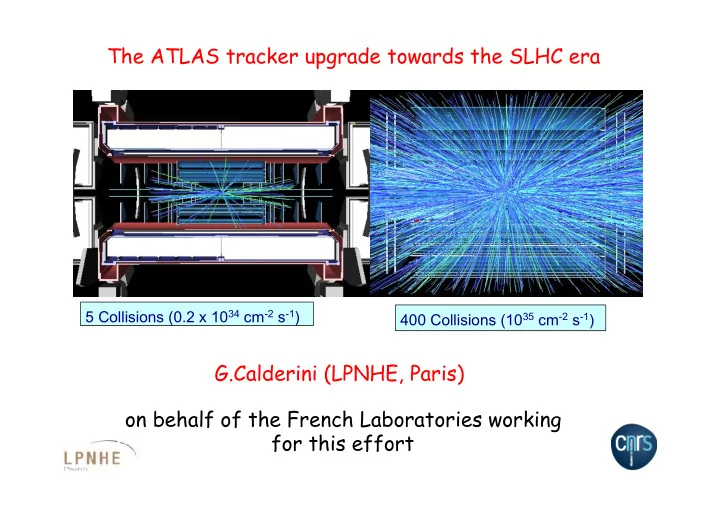
The ATLAS tracker upgrade towards the SLHC era 5 Collisions (0.2 x 10 34 cm -2 s -1 ) 400 Collisions (10 35 cm -2 s -1 ) G.Calderini (LPNHE, Paris) on behalf of the French Laboratories working for this effort Why working now for the upgrade?


slide-1
SLIDE 1

5 Collisions (0.2 x 1034 cm-2 s-1) 400 Collisions (1035 cm-2 s-1)

The ATLAS tracker upgrade towards the SLHC era G.Calderini (LPNHE, Paris)

  • n behalf of the French Laboratories working

for this effort

slide-2
SLIDE 2

Why working now for the upgrade?

Every time that people think about the luminosity upgrade, there is the impression that its a very distant phase in the future So, why to bother with it now? (General answer) Everybody who took part to the design of an experiment knows that it takes several years (the construction and installation itself is typically 5-6 years, after the R&D and design phase is finished) Time flows fast! (Not-so-obvious-to-everybody answer) LHC will not be the same between now and 2020 Radical improvements making it impossible to run until then with the initial detector (Phase I upgrade)

1 G.Calderini – LHC France Annecy 2013

slide-3
SLIDE 3

The LHC roadmap

See talk L. Ponce

2 G.Calderini – LHC France Annecy 2013

slide-4
SLIDE 4

Just a reminder of the present Silicon Tracker ~ 50 Mrads ! •

80M channels

  • Temperature: T=-5 / -13 C by evaporative (C3F8) cooling

3 G.Calderini – LHC France Annecy 2013

slide-5
SLIDE 5

A FE-I3 based pixel module

4 G.Calderini – LHC France Annecy 2013

slide-6
SLIDE 6

First tracker upgrade: the IBL

The present tracker (especially the layer_0) will be in trouble at a certain point due to radiation damage and occupancy Behavior of leakage current normalized at 0C as a function of date Module de-synchronizations at the beginning of each fill (FE-I3)

5 G.Calderini – LHC France Annecy 2013

slide-7
SLIDE 7

The IBL: Insertable B-Layer

Fourth hit in pixel tracking Small radius 3.3 cm (beam pipe 2.65 cm) Low material budget of 1.9% X0 Smaller segmentation (50x250 um) Higher dose tolerance (FE-I4, 250 Mrad) 14 staves with 32 FE-I4 chips per stave Planar n-in-n (double chips) 3D n-in-p (one chip) at high-eta

6 G.Calderini – LHC France Annecy 2013

slide-8
SLIDE 8

Planar pixels n-in-n

  • The same technology used in the present trackers
  • Well known and tested

Two sensor technologies co-exist in the IBL

3D Pixels:

  • Here the electrodes are columns passing from one face to the other
  • In this way the electric field is parallel to the face of the sensor and the

charge drift evolves in a few tens of um

  • Intrinsically more radiation hard

7 G.Calderini – LHC France Annecy 2013

slide-9
SLIDE 9

Upgraded readout electronics: the FE-I4

8 G.Calderini – LHC France Annecy 2013

slide-10
SLIDE 10

Fittings and Ti pipes Design of PP1 connections

  • No industrial solution fitting the IBL envelope (and PP1!)
  • Leak tight @ 20bars CO2, radhard (no organic), reliable

design much more relaible

  • f the present ATLAS fitting

Electron beam welding, laser welding, brazing techniques under investigation (already good results)

Big French contribution in the design of services

9 G.Calderini – LHC France Annecy 2013

slide-11
SLIDE 11

IBL status

Two staves (0A and 0B) already produced and tested Now entering ‘factory’ mode

Access for installation has started

Pixel detector will be brought to the surface and undergo maintenance (4% of dead modules should be hopefully repaired)

10 G.Calderini – LHC France Annecy 2013

slide-12
SLIDE 12

The long-term upgade: ‘Phase-II’

Physics

  • Higgs: BRs, self-coupling
  • WW, ZZ scattering
  • W’, Z’, quark substructure

Completely new tracker (more pixels layers + strips)

  • LOI in preparation for running after Phase-II (-2030, 3000 fb-1)
  • Innermost layers should be rad-hard up to 1 Grad
  • Leveled luminosity of 5 x 1034 cm-2 s-1

Critical R&D necessary

  • Sensors
  • Electronics
  • Strong dependence on the general design

11 G.Calderini – LHC France Annecy 2013

slide-13
SLIDE 13

Sensors

As mentioned, a big effort has been made on n-in-n and 3D pixels, already at this time for the IBL construction. This will go on. In parallel, n-in-p planar pixels are also being developed

  • Promising technology
  • p-type doesnt invert with dose

We think n-in-p will become very important in view of tracker replacement Need to go to radiation hard -> 2x10¹⁶ thin -> < 200 µm cheap -> n-in-p (?), new bonding techniques ? efficient -> reduce the inactive region at the edge

  • cheaper (pixel and GR on the same side)

12 G.Calderini – LHC France Annecy 2013

slide-14
SLIDE 14

Thin sensors to reduce the material budget and optimize the charge collection efficiency

75 um n-in-p sensors

A.Macchiolo et al, arXiv: 1210.7933

150 um n-in-p sensors

In a partial depletion regime, the undepleted region is just acting as a charge trap

13 G.Calderini – LHC France Annecy 2013

slide-15
SLIDE 15

Active edge planar pixel sensors

14 G.Calderini – LHC France Annecy 2013

slide-16
SLIDE 16

15 G.Calderini – LHC France Annecy 2013

slide-17
SLIDE 17

arXiv: 1212.3580

slide-18
SLIDE 18

Electronics

Huge work on the readout electronics to improve performance and radiation hardness Going to deep-submicron process (now 65nm, then more) 3D/Vertical Integration R&D Intrinsically more radiation hard Allows smaller segmentation Save space Allow separation of functionalities (analog vs digital)

17 G.Calderini – LHC France Annecy 2013

slide-19
SLIDE 19

65 nm prototype, 25 x 125 65 nm test pixel matrix 16col x 32 rows 65 nm threshold 65 nm noise

18 G.Calderini – LHC France Annecy 2013

slide-20
SLIDE 20

FE-electronics: 3D 130nm pixel 50x125 µm

Analog tier Thr=2200e Sthr=150e noise=46e

FE-TC4P1 demonstrator

19 G.Calderini – LHC France Annecy 2013

slide-21
SLIDE 21

Monolithic sensor+electronics 180nm HV2FEI4 ATLAS chip with capacitive coupling to FEI4 subpixel 33x125 µm

irradiated prototype HV2FEI4 demonstrator

HV CMOS

slide-22
SLIDE 22

A.Rozanov Montreux 2.10.2012

22

Outer Pixels

Most probably planar pixels Large area: work on costs

  • cheap process (n-in-p?)
  • multi-sensor modules
  • alternative bonding techniques
slide-23
SLIDE 23
  • Classical layout – only barrel cylinders and disks
  • Radius of the PST R=34.5 cm bigger than current radius R=24.5 cm
  • 2 innermost pixel layers should be replaceable in IST R=11 cm
  • Full pixel package should be replaceable

LoI layout

PST IST

20 G.Calderini – LHC France Annecy 2013

slide-24
SLIDE 24

LoI pixel layout

  • Innermost pixel layer: 3.9 cm, second 7.8 cm
  • Outer pixel layers at 16 - 25 cm
  • Eta pixel coverage up to 2.7 to match muons
  • Barrel part of 4 pixel layers
  • 6 pixel disks z=88-168 cm
  • Up to 8 pixel hits at high η > 2.0 – reinforced
  • Inner+Outer+Disk= 0.8+4.3+3.1= 8.2 m2
  • 638 Millions of pixels

21 G.Calderini – LHC France Annecy 2013

slide-25
SLIDE 25

Some design allows to reduce the surface

Some aggressive design to extend it to more than 4

LoI coverage up to n=2.5-2.7

22 G.Calderini – LHC France Annecy 2013

slide-26
SLIDE 26
  • “Alpine staves” in LoI layout
  • Possibility to reducing number of disks

23 G.Calderini – LHC France Annecy 2013

slide-27
SLIDE 27

Conclusions

Remarkable French contribution to the ATLAS tracker upgrade effort The calendar between now and 2020 is already very tight and dense. Time flows fast ! Move quickly ! LHC started in an impressive way We cannot afford having detectors which don’t keep the pace of the machine ! In exchange for high luminosity, running conditions could be different from design ! We need safety margin ! Most likely not enough funding to have independent CMS and ATLAS R&D programs We need to work together !

24 G.Calderini – LHC France Annecy 2013