The author has no financial Planning and 3D Printing in interest in - - PowerPoint PPT Presentation

the author has no financial
SMART_READER_LITE
LIVE PREVIEW

The author has no financial Planning and 3D Printing in interest in - - PowerPoint PPT Presentation

12/2/2016 Computerized Preoperative The author has no financial Planning and 3D Printing in interest in the subject of the Repair of Complicated this presentation Periorbital Fractures Paul D. Langer, MD, FACS Professor of Ophthalmology


slide-1
SLIDE 1

12/2/2016 1

Computerized Preoperative Planning and 3D Printing in the Repair of Complicated Periorbital Fractures

Paul D. Langer, MD, FACS Professor of Ophthalmology Director, Division of Ophthalmic Plastic, Orbital and Reconstructive Surgery Rutgers New Jersey Medical School

The author has no financial interest in the subject of this presentation

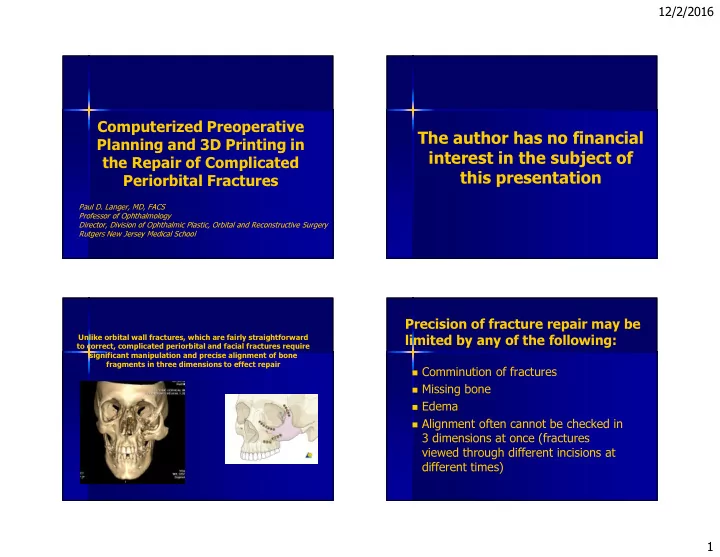
Unlike orbital wall fractures, which are fairly straightforward to correct, complicated periorbital and facial fractures require significant manipulation and precise alignment of bone fragments in three dimensions to effect repair

Precision of fracture repair may be limited by any of the following:

Comminution of fractures Missing bone Edema Alignment often cannot be checked in

3 dimensions at once (fractures viewed through different incisions at different times)

slide-2
SLIDE 2

12/2/2016 2 1) Virtual, computer-assisted manipulation

  • f bone fragments allows for precise,

preoperative alignment of fragments 2) 3-dimensional models and intraoperative guides are produced with stereolithography that assist in translating the precise virtual repair to the actual repair

Pre-operative Planning

Additive Manufacturing

Now synonymous with “3-D printing” Any manufacturing process that transforms a 3D

model into a physical object

Joins successive layers of the same material under

automated control

Contrasts with traditional manufacturing techniques,

which are “subtractive”

Traditional “subtractive” manufacturing:

Additive Manufacturing

  • Term encompasses many different technologies including sintering,

laminated object manufacturing, fused deposition modelling, and stereolithography, among others

  • All have an essential manufacturing principle in common: a machine

reads a design from a 3D printable file (“STL file”) and lays down successive layers of liquid, powder, paper or sheet material to build the model from a series of cross sections

  • These layers (corresponding to the virtual cross sections from the CAD

model) are joined or automatically fused to create the final shape.

  • The primary advantage of this technique is its ability to create almost

any shape or geometric feature

Fused deposition modelling: 1 – nozzle ejecting molten plastic, 2 – deposited material (modeled part), 3 – controlled movable table

Additive Manufacturing

Advantages: No need for molds/dyes—prototypes made

  • n demand, design changes made without

adding cost Design changes enacted quickly and easily— tooling/machining constraints eliminated
slide-3
SLIDE 3

12/2/2016 3

Stereolithography

  • A laser beam traces a cross section of the part over the surface of a

photoreactive resin (photopolymer) which lies in a vat

  • Immediately upon contact with the UV light, the resin is “cured”

(hardended)

  • After the pattern is traced, the part descends into the vat by the

thickness of a “single layer;” the process is then repeated, with the laser drawing out the next cross section, which hardens and is joined to the layer beneath

  • At the end of the process, the entire object is

formed and completely submerged in the tank

1) Virtual, computer-assisted manipulation

  • f bone fragments allows for precise,

preoperative alignment of fragments 2) 3-dimensional models and intraoperative guides are produced with stereolithography that assist in translating the precise virtual repair to the actual repair

Pre-operative Planning

Pre-operative Planning

Maxillofacial CT scan of the patient (1.25mm cuts

maximum) is sent to 3-D printing company (Materialise), which converts it to STL

3-D virtual model is created on a computer In conference call, bone fragments can be moved

  • n the computerized 3-D image in any direction,

rotated, removed, etc, to effect final desired result

slide-4
SLIDE 4

12/2/2016 4

slide-5
SLIDE 5

12/2/2016 5 1) Virtual, computer-assisted manipulation

  • f bone fragments allows for precise,

preoperative alignment of fragments 2) 3-dimensional models and intraoperative guides are produced with stereolithography that assist in translating the precise virtual repair to the actual repair

Pre-operative Planning

slide-6
SLIDE 6

12/2/2016 6

slide-7
SLIDE 7

12/2/2016 7

slide-8
SLIDE 8

12/2/2016 8

slide-9
SLIDE 9

12/2/2016 9

slide-10
SLIDE 10

12/2/2016 10

slide-11
SLIDE 11

12/2/2016 11

Pre-operative Planning

Advantages

  • Allows for presurgical preparedness
  • Promotes precise surgical alignment and reduces

guesswork

  • Promotes flexibility in surgical options
  • Reduces surgical time

Disadvantages

Cost (several thousand dollars) Time (need 5 working days for all models and planning)

Pre-operative Planning

Future Directions

Computerized 3-dimensional reconstruction

programs are not proprietary—each hospital will have one

3D printers are cheaper each year Once pre-operative computerized planning

becomes commonplace, hospitals will likely purchase own computer programs, have biomedical engineers in-house, and print own models