The Basic Ideas of Tree-thinking Nothing in biology makes sense - - PDF document

the basic ideas of tree thinking
SMART_READER_LITE
LIVE PREVIEW

The Basic Ideas of Tree-thinking Nothing in biology makes sense - - PDF document

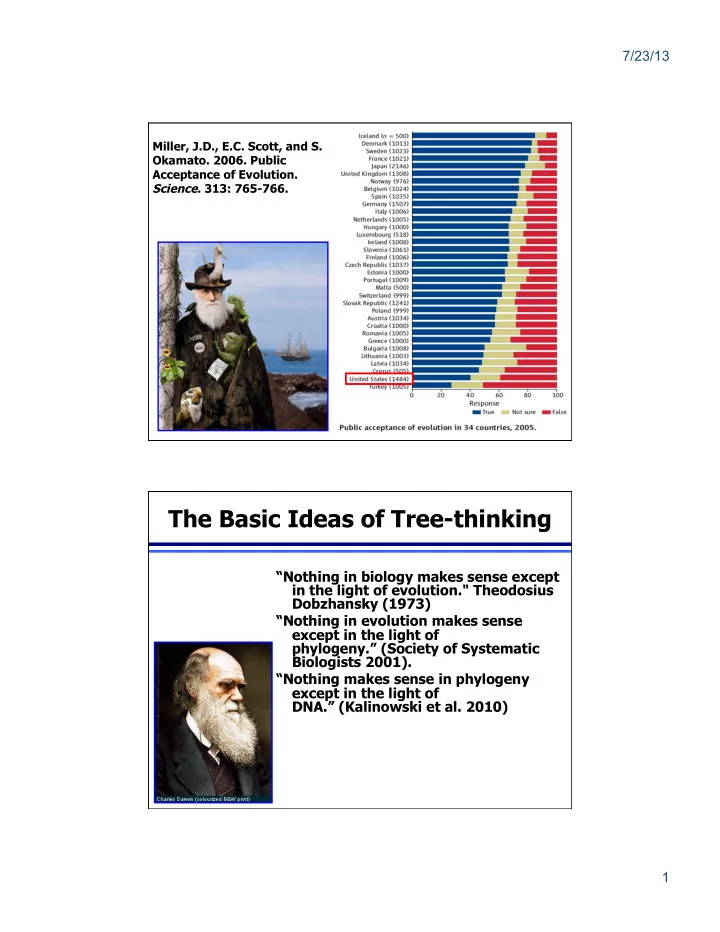
7/23/13 Miller, J.D., E.C. Scott, and S. Okamato. 2006. Public Acceptance of Evolution. Science . 313: 765-766. The Basic Ideas of Tree-thinking Nothing in biology makes sense except in the light of evolution." Theodosius Dobzhansky


slide-1
SLIDE 1

7/23/13 1

Miller, J.D., E.C. Scott, and S.

  • Okamato. 2006. Public

Acceptance of Evolution.

  • Science. 313: 765-766.

The Basic Ideas of Tree-thinking

“Nothing in biology makes sense except in the light of evolution." Theodosius Dobzhansky (1973) “Nothing in evolution makes sense except in the light of phylogeny.” (Society of Systematic Biologists 2001). “Nothing makes sense in phylogeny except in the light of DNA.” (Kalinowski et al. 2010)

slide-2
SLIDE 2

7/23/13 2

Tree-Thinking Tree-Thinking

slide-3
SLIDE 3

7/23/13 3

  • Question #1: What is the relationship between

ability to read phylogenetic trees relate and acceptance of evolution?

  • Question #2: How does student understanding of

natural selection and genetics relate to understanding and acceptance of evolution?

  • Question #3: Will a tree-thinking based curriculum

using active learning modules improve student understanding and acceptance of evolution and evolutionary theory?

What we want to know

BIOL 1134 Evolution, Ecology, & Diversity

  • 1. Encourage understanding and appreciation for major, modern

biological thought and theories: – Unity and diversity of life (DNA and genetic variation) – History of life (evolution and phylogeny) – Relationship between structure and function (adaptation) – Focus on life at the individual, population, community, and ecosystem levels (hierarchical organization, interdependence) 2. Develop student skills, understanding, and appreciation for the nature of science. – Thinking, reasoning, and problem-solving in biology. – Prediction and hypothesis testing in science. – Data collection, analysis, and interpretation – Group collaboration and interactions.

slide-4
SLIDE 4

7/23/13 4

DNA & Genetics Inheritance & Pedigrees Evolution Concepts & Mechanisms Phylogenetics Read & Construct Trees Application (Biodiversity surveys, adaptations, speciation etc.)

Tree-thinking Curriculum Structure

Components of the curriculum.

  • Genetic basis of phylogeny & tree

thinking: genetics, inheritance, and population genetics

  • Principles of tree-thinking: how-to of

phylogeny construction and interpretation

  • Application of tree-thinking: opportunities to

collect and analyze data, processes of hypothesis development and testing

  • Modules: Case study, group inquiry, active

learning

slide-5
SLIDE 5

7/23/13 5

Pedigree Analysis & Genetics

Phylogeny of Domestic Dog Breeds – Result of Artificial Selection

slide-6
SLIDE 6

7/23/13 6

Platypus Reproduction & Mammalian Evolution Pollination and Floral Evolution

slide-7
SLIDE 7

7/23/13 7

Assessment & Evaluation

  • Measure of the Acceptance of the Theory
  • f Evolution (MATE): 20 question Likert-scale

survey (Rutledge & Sadler 2007)

  • Tree-thinking Challenge, Understanding

Phylogenetic Trees, Tree Thinking Concept Inventory Variety of questions to read and construct phylogenetic trees. (Baum et al. 2005, Meir et al. 2007, Neagle 2009)

  • Concept Inventory of Natural Selection,

Genetics Concept Assessment (Anderson & Fisher 2002, Smith et al. 2008)

0.0 20.0 40.0 60.0 80.0 100.0 F09 pre F09 post S10 pre S10 post F10 pre F10 post S11 pre S11 post

* * *

MATE pre-post Comparison

slide-8
SLIDE 8

7/23/13 8

Tree Reading Assessments

5 10 15 20 25 F09 pre F09 post S10 pre S10 post F10 pre F10 post S11 pre S11 post 20 40 60 80 100 120 5 10 15 20 25 MATE score Tree-Thinking Concept Inventory score Pre-test Post-test

MATE & TTCI Spring 2011

slide-9
SLIDE 9

7/23/13 9

20 40 60 80 100 120 5 10 15 20 25 30 35 40 MATE Score Genetics & Natural Selection Concept Inventory Score Pre-test Post-test

MATE, Natural Selection & Genetics

  • 0.2

0.2 0.4 0.6 0.8 1

F09 S10 F10 S11 Normailized Gain Curriculum TRA/TTCI MATE

Normalized Learning Gain

slide-10
SLIDE 10

7/23/13 10

Acknowledgements

  • National Science Foundation

– DUE #0940835

  • The University of Oklahoma

– College of Arts and Sciences, Department of Botany and Microbiology, Department of Zoology

  • J. Cooper, M. Jones, S. Rhodes, A.

Makowicz, C. Poindexter, M. Gibson,

  • D. Washecheck

All research conducted under OU IRB# 12682