The Bench Marks Foundation MARIKANA: TWO YEARS ON, A COMMUNITY - - PowerPoint PPT Presentation

the bench marks foundation
SMART_READER_LITE
LIVE PREVIEW

The Bench Marks Foundation MARIKANA: TWO YEARS ON, A COMMUNITY - - PowerPoint PPT Presentation

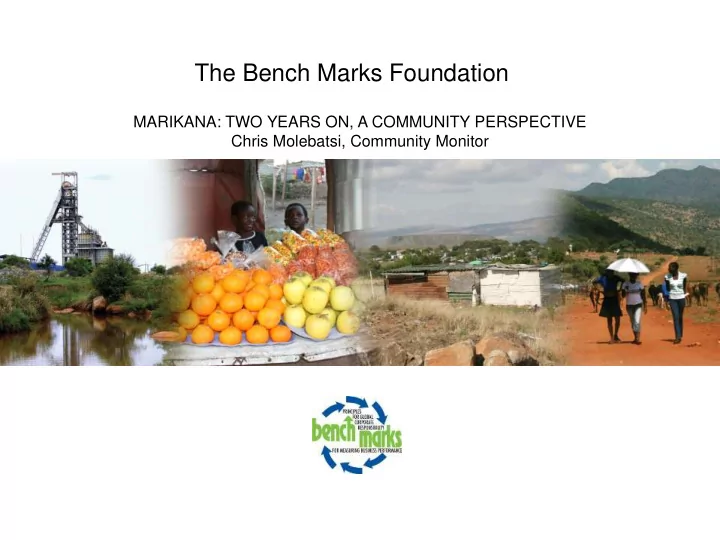
The Bench Marks Foundation MARIKANA: TWO YEARS ON, A COMMUNITY PERSPECTIVE Chris Molebatsi, Community Monitor Contents Who are We as Monitors? Overview of Marikana since the Massacre Issues: Housing Sanitation Electricity Education Youth


slide-1
SLIDE 1

The Bench Marks Foundation

MARIKANA: TWO YEARS ON, A COMMUNITY PERSPECTIVE Chris Molebatsi, Community Monitor

slide-2
SLIDE 2

Contents

Who are We as Monitors? Overview of Marikana since the Massacre Issues: Housing Sanitation Electricity Education Youth Health Migrant Labour

slide-3
SLIDE 3

Community Monitoring Action Project

The Community Activist School is an action

  • riented education programme for community

members to better monitor the accountability of private corporations’ and government’s actions. The aim of the School is to train a number of community activists to report on corporate abuse and environmental neglect through ways such as blogging, wall newspapers, videos and exhibitions. In 2009 the School project was conducted in North West, Limpopo and Gauteng provinces.

slide-4
SLIDE 4

Who are We, the Monitors?

  • We are representatives of independent community organisations;
  • We are free to associate with which ever civil society, labour, political or

civil society organisations we choose;

  • We are trained in the monitoring school to do basic research, reporting

and monitoring of the environmental, social and economic impacts of mining on our communities

  • We advise and inform our communities and negotiate alongside them

with government and mining corporations

  • We are the link between our communities and wider society through the

media, through internet, through academic institutions and through our engagements and activism.

slide-5
SLIDE 5

OVERVIEW MARIKANA SINCE 2012

Since the fateful day of 16 August 2012 the communities around Lonmin’s mines in Marikana:

  • have not seen peace.
  • no justice have been done
  • killings have continued unabated, and
  • Those who benefit from this conflict between mine workers, and between

communities and mine workers and between unions are continuing to amass wealth unashamedly from the super exploitation of cheap labour and by externalising costs

  • f their operations onto the backs of the poorest communities.
  • The communities live in constant fear for their lives.
  • We celebrated the heroic five month long challenge by the working class in our

communities in the face of brutal capitalism.

slide-6
SLIDE 6

Overview Continued

We learnt one lesson: A Fear for Times Beyond Mining:

  • The emergence of informal child labour;
  • A destroyed environment
  • Polluted and poised rivers and water systems
  • Barren soil
  • Unattended mine waste
  • Massive unemployment
  • Spiralling violence and crime
  • Conflict

This is the legacy of the mine!

slide-7
SLIDE 7
slide-8
SLIDE 8

Housing Lonmin employs 28 000 permanent mine workers and a further 8 000 who are employed through sub-contractors and labour brokers. Less than 5 000 live in formal housing in hostels and in an around Marikana and Mooinooi, the rest are shack-dwellers in squatter

  • camps. There is a clear class distinction in housing reflecting the

hierarchy of power in the operations. The lowest paid workers live in shacks, supervisory workers get places in hostels and management live in the verdant luxurious mining town of Mooinooi, and the suburbs of Rustenburg and Hartebeespoort dam. There is also still a close correlation between race and class, despite the powerful political links between Lonmin and our Deputy President.

slide-9
SLIDE 9

Housing cont.

  • Lonmin has swiftly shifted responsibility to the government to build houses

for its workers – thus externalising a cost associated with mining thereby reducing production costs and maximising profit. The government ever in awe of mining corporations, made a commitment to build 2 000 houses. However, during the State of the Nation Address it became clear that the government would only build 292 houses this year.

  • Lonmin claimed that it donated land to the government for the purpose of

constructing these houses. However the MPRDA clearly states that mines do not own surface rights in traditional areas and only rent underground mineral rights from the government. The surface land must be negotiated with local traditional communities. Thus Lonmin is giving land to the government that does not belong to it.

slide-10
SLIDE 10
slide-11
SLIDE 11
slide-12
SLIDE 12

SANITATION

  • The formal township and RDP houses in Marikana continues to see a

mushrooming of backyard dwellings and shacks overloading bulk water supply, illegal electricity connections and a breakdown of the bulk sewage system due to the failure of Lonmin and Government to provide formal housing for mine workers.

  • The shack community and much of the township community still have to

rely on pit latrines for sanitation.

  • Water remains a problem as most households in the township and street

taps in the informal settlement have to wait until midnight for the water pressure to be sufficient for them to access water. Lonmin’s operations have preferential rights over water it seems

slide-13
SLIDE 13
slide-14
SLIDE 14
slide-15
SLIDE 15
slide-16
SLIDE 16
slide-17
SLIDE 17

Electricity

  • Electricity remains a luxury. More than 60% of households have no
  • electricity. As with water, it seems as if our government cares more for

the corporation than for those who elected it into power.

  • The majority of households have to rely on toxic fuel sources such as

paraffin, coal and wood. The community consumption of wood out of necessity further strains environmental resources.

  • This energy deprivation exists despite the huge
  • Eskom sub-station located right next to the community, but supplying

the mining operations of Lonmin.

slide-18
SLIDE 18
slide-19
SLIDE 19
slide-20
SLIDE 20

EDUCATION

  • There are only six very overcrowded schools in the area and one model see

school for the children of management in Mooinooi.

  • The overcrowding is due to the fact that migrant mine workers are either

bringing their families from labour sending areas, or they start new families in the surrounding communities.

  • The learners from the Eastern Cape, Mozambique, Zimbabwe and elsewhere

come from non-Tswana speaking areas into Marikana schools which the Department of Education has designated as Tswana schools, staffed by Tswana speaking teachers, and supplied with Tswana learning materials. This has led to high student failure.

  • Despite promises to the contrary after the May 2011 uprisings by the

community, the mining company still refuses to employ significant numbers of local youth.

  • High youth unemployment of people who predominantly have completed

matric has swollen youth criminality and the Rustenburg Prison has now been turned into juvenile prison. Instead of going to universities and colleges our youth graduate into prison.

slide-21
SLIDE 21
slide-22
SLIDE 22

Youth

The youth on the platinum belt, due to lack of employment, education and economic opportunities have become demoralised and despondent. The CSR opportunities for youth development offered by the mines impact on such small numbers that these programs are in fact meaningless. Mine procurement policies are not only rigid, but also function in a nepotistic corrupt manner by word of mouth. Only those with political connections or those with familial relations to relevant managers can access tenders.

slide-23
SLIDE 23
slide-24
SLIDE 24
slide-25
SLIDE 25

HEALTH

Marikana has only two clinics and the Lonmin Andrew Saffey Hospital and mine clinics at every shaft. Thus the general public are forced to visit overcrowded public clinics which are only open from 06h00 to 14h00, five days per week. Patients stand for many hours in long ques only to be sent back home due to shortages of medicine. The Lonmin Hospital and clinics can only be accessed by mine workers who are on medical aid schemes. The families of mine workers have to rely on the overcrowded public clinics. Contract workers have to go to public clinics even for ewm-ployment medical check ups. The Lance Research report in which the monitors and Bench Marks participated revealed high levels of respiratory and HIV and Aids problems in the Wonderkop area. Air and dust pollution is a major problem because of the smelter and the untarred road surfaces. The Department of Environmental Affairs has declared the Bojanala District a National Priority Air as a result of the poor air quality there.

slide-26
SLIDE 26
slide-27
SLIDE 27

MIGRANT LABOUR

Job creation feature centrally in all mine social and labour plans and make it possible to claim a social licence to operate thereby justifying their mining licence applications. However, due to the weak monitoring and regulation of these social and labour plans by government they are never

  • implemented. Consequently near mine communities live in abject poverty

and are faced with massive youth unemployment, escalating crime and substance abuse and disease.

slide-28
SLIDE 28