SLIDE 1 ARCH222 / 27.04.17 / Şeyma Akcan
The City: Its Growth, Its Decay, Its Future (1943) Eliel Saarinen
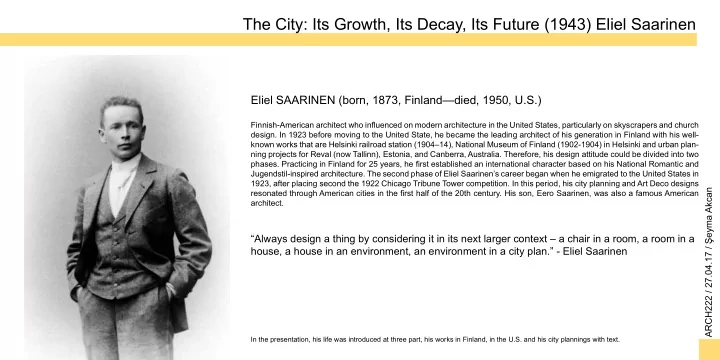
Eliel SAARINEN (born, 1873, Finland—died, 1950, U.S.)
Finnish-American architect who infmuenced on modern architecture in the United States, particularly on skyscrapers and church
- design. In 1923 before moving to the United State, he became the leading architect of his generation in Finland with his well-
known works that are Helsinki railroad station (1904–14), National Museum of Finland (1902-1904) in Helsinki and urban plan- ning projects for Reval (now Tallinn), Estonia, and Canberra, Australia. Therefore, his design attitude could be divided into two
- phases. Practicing in Finland for 25 years, he fjrst established an international character based on his National Romantic and
Jugendstil-inspired architecture. The second phase of Eliel Saarinen’s career began when he emigrated to the United States in 1923, after placing second the 1922 Chicago Tribune Tower competition. In this period, his city planning and Art Deco designs resonated through American cities in the fjrst half of the 20th century. His son, Eero Saarinen, was also a famous American architect.
“Always design a thing by considering it in its next larger context – a chair in a room, a room in a house, a house in an environment, an environment in a city plan.” - Eliel Saarinen
In the presentation, his life was introduced at three part, his works in Finland, in the U.S. and his city plannings with text.
SLIDE 2 ARCH222 / 27.04.17 / Şeyma Akcan
Eliel SAARINEN
In his childhood, he lived in the Russian territory of Ingermanland near St. Petersburg. Thus, the closeness of St. Petersburg pro- vided the young Eliel Saarinen with a unique urban experience in more rural Finland. He had essentially wished to be a painter, but in 1893, he entered the Helsinki Polytechnic Institute, graduating from the Depart- ment of Architecture in 1897. In 1986, he was incorporated in the practice of architecture with Herman Gesellius and Armas Lindgren who were Institute class- mates beginning practice together even before graduation. The Gesellius, Lindgren and Eliel Saarinen offjce continued until 1905 when Lindgren left the partnership; Gesellius and Eliel Saarinen stayed to practice together for two further years. The Saarinen-Ge- sellius-Lindgren partnership got its fjrst commission the same year Saarinen graduated, for the Tallberg Apartments in Helsinki. The Gesellius Lindgren Saarinen partnership achieved early fame for its design of the Finnish pavilion at the Paris International Exposition of 1900. This followed an important commission in 1899 for the offjce of a large insurance company in Helsinki. Their design of the Finnish National Museum in 1902 was another important commission. In 1904, Saarinen married Gesellius’s sister, Louise, with whom he had two children - a daughter, Eva-Lisa, and a son, Eero. After his partnership with both Lindgren and Gesellius ended, Eliel Saarinen expanded his practice to interest in city planning proj- ects as well as building design.Saarinen gained international prominence two years later as an individual competitor, he won the competition for the design of the Helsinki railway station. Finland
- St. Peterburg in end of 1800’s
Finnish Natjonal Museum by Eliel Saarinen
1
SLIDE 3 ARCH222 / 27.04.17 / Şeyma Akcan
In 1911, he began the important projects of his city planner career. Saarinen met with city planning experts in Budapest to study that city’s plan, and he wrote a de- tailed criticism that appeared the following year. Late in 1911 he also served as a consultant to the Town Planning Committee of the City of Tallinn, Estonia advising on conditions for a town planning competition. He entered the competition and was announced the winner for his plan of Tallinn in 1913. In 1912, Saarinen took part in the international city planning competition for the new Australian capital-to-be, Canberra, he designed new capital only 19 days because he learned compertition too late so he did not fjnish in detail, he won second prize while the winner was an American-born architect Walter Burley Griffjn. He had important contributions for Helsinki in the city planing. In between 1911-1915 he completed a detailed design for the Munkkiniemi Haaga District that was a region
- f nearly 2,000 acres to be developed by a private company. Part of the street plan
and the design of some of the squares and buildings of this area owe their origins to Saarinen’s proposals. By the way, Saarinen began work on a master plan for the whole Helsinki metropol- itan area. This project could not be supported by the municipality of Helsinki or any
- ther governmental agency but his master plan was exhibited in 1915.
City Planing
Eliel SAARINEN
Plan of Tallinn
Haage Distinct
Canberra Plan
2
SLIDE 4 ARCH222 / 27.04.17 / Şeyma Akcan
In 1922, Saarinen took second prize in a design competition for the Chicago Tribune Tower that was internationally regard- ed as a considerable solution to skyscraper architecture and made his name better known in America. He and his family emigrated to the United States where his career would focus on education as well as architectural practice the following
- year. However, he continued to spend his summers in Finland where he maintained an architectural offjce.
In 1925, Saarinen was asked by George G. Booth to design buildings for the Cranbrook Educational Center in Michigan, a project Booth planned to be similar to the Bauhaus idea in Germany and the American Academy in Rome. At his new home, he designed most of the buildings for the Cranbrook Institute of Arts which he worked as the president from 1932 to 1946. Between 1925 and 1945, at Cranbrook Eliel Saarinen completed the School for Boys, the Kingswood Schools for Girls, the Academy of Art, the Institute of Science, the museum and library, faculty housing, and the resident. From 1932 until his death, he was director of the Institute’s graduate programs in city planning, urban design, and architec-
- ture. He presented his urban planning theories in his book, The City, Its Growth, Its Decay, Its Future, published in 1943.
Beginning in 1936 Saarinen was in partnership with his son, Eero and J. Robert F. Swanson, his former student from Mich- igan . His best-known works from the latter years of his life include the Tabernacle Church of Christ (1942), and the Christ Lutheran Church (1949). He was honored with the gold medals of the American Institute of Architects and the Royal Institute of British Architects, decorated by the Finish government, elected a member of several national academies and other societies, and awarded numerous honorary degrees, Saarinen enjoyed his productive career until his death at the age of seventy seven. In 1950, Eliel Saarinen died in Michigan, and is buried at Hvitträsk, Finland.
Eliel SAARINEN
Christ Lutheran Church Tabernacle Church of Christ
America 3
SLIDE 5 ARCH222 / 27.04.17 / Şeyma Akcan
The Gesellius Lindgren Saarinen partnership
Gesellius, Lindgren and Saarinen collaborated professionally for almost ten years and achieved remarkable success in nu- merous architectural competitions. Their growing name led to a large number of private commissions besides public architec- tural projects. They designed many of Finland’s best-known buildings of the early 20th century, such as Hvitträsk, their shared studio and residence the Suur-Merijoki manor building, the buildings of the Pohjola insurance company and the Pohjoismaiden Osakepankki bank, as well many villas and apartment buildings at Kasarmitori Square and Katajanokka in Helsinki. In 1905 Lindgren became head of the architecture school at Helsinki University of Technology and withdrew from this collaboration. Gesellius and Saarinen continued as partners until 1907.After 1907 all three worked separately. The trio’s buildings were the exact example of the national romantic architecture of Finland, also in their early works Jugend- stil infmuence was appeared clearly. The residential building at Sazamakatu 7 in Helsinki, as does their Finnish Pavillion. The Finnish pavilion, however, was an amalgam of Jugendstil elements with clearly recognizable derivatives from the tradition of Finnish medieval stone church architecture, while the overall approach to ornamentation suggested a move towards a dis- tinctly Finnish character. With their imposing Pohjola Insurance Company Headquarters in Helsinki(1900-01) they successfully introduced the national romantic style into Finnish commercial architecture. The design for the Suur- Merijoki Manor house arguably the fjnest example of national romantic domestic architecture. Another good example of the partnership Hvittrask was built by the partners to serve as their studio and home. Gesellius, Lindgren, and Saarinen began work on major commission that focused public attention on the national romantic architecture with the design of the Finnish National Museum. Class of 1893 at the Polytechnical Institute: Armas Lindgren, Eliel Saarinen, Albertina Östman and Herman Gesellius.
“Tallberg” Satamakatu 7 Suur- Merijoki Manor house
Finnish Pavillion
4
SLIDE 6 ARCH222 / 27.04.17 / Şeyma Akcan
Hvittrask located on a steep hillside outside Helsinki the compound is ordered about a courtyard within a series of ter- raced gardens. Presented as a reinterpretation of Finland’s vernacular past, the picturesque massing of the complex is articulated with a rustic stone base and stuccoed or shingled walls, has upper stories of log construction, and is capped by a tiled roof. The interior spaces of the Eliel Saarinen house contain a variety of images and detail qualities: the great hall alludes to vernacular farmhouses and a sitting area incorporates motifs from medieval churches; inglenooks and sleeping rooms are executed in the arts-and-crafts style. These spaces are furnished with appointments designed by either the Saarinens or their artist friends. Suur-Merijoki, a splendid country house located near Viipuri, contains the bestdeveloped Eliel Saarinen interiors of his early career. Moreover, these interiors demonstrate a realized total artistic conception facilitated by the close working relationship between architect, artist, and artisan. The Central Railroad Station, Helsinki (built 1910-1914) is antitraditional, with spacious interiors and monumental pro- portions, similar in character to the smaller buildings of Richardson and Sullivan.
The Central Railroad Station Hvittrask Hvittrask interior design
5
SLIDE 7 ARCH222 / 27.04.17 / Şeyma Akcan
Herman Gesellius (1874 – 1916) Finnish architect Gesellius’s the most famous work projected under his own name is the Wuorio House in Helsinki. Gesellius designed it from 1908 to 1909, and Lindgren completed it from 1913 to 1914. It highlights ar- chitectural sculpture designed by Felix Nylund (1878–1940). Gesellius remove from architectural work in 1912 because of serious illness Armas Lingren (1874, 1929) Finnish Architect In 1902–12 Lindgren was the Arts Director of the Central School of Applied Arts. He wrote a textbook on styles of building and decora- tion, published in 1914. In 1919 he was appointed Professor of Archi- tecture at Helsinki University of Technology. As a professor, he taught and infmuenced the notable Finnish architect Alvar Aalto. Armas Lindgren’s work with old buildings continued through his whole
- life. He made numerous aquarelles on churches, mainly the wooden
churches of the 17th and 18th century, and was one of the fjrst ar- chitects who understood the architectural value of Finnish wooden churches. Lindgren’s solo work includes the Kaleva insurance company build- ing in Helsinki and several dwelling houses. His dwellings include the Ribbinghof row houses in Kulosaari and the Kone ja Silta construction company’s housing (together with Bertel Liljequist) in Vallila, Helsinki. The designs made by the offjce Lindgren–Liljequist in 1914–26 in- clude Hanko Town Hall and Säynätsalo Church.
Herman Gesellius Armas Lingren
6
SLIDE 8 ARCH222 / 27.04.17 / Şeyma Akcan
National Romantic Architecture and Finland
In this period, Finland was undergoing a period of national self-awareness, a nationalism founded
- n the desire to search out and understand traditional Finnish cultural origins.Finnish national archi-
tecture expresses a strong historical bent rooted in medieval imagery with some references also to Art Noveau or Jungsteil. While National Romanticism paralleled the Arts and Crafts movement in En- gland, and Art Nouveau, Secessionism and Jugendstil on the Continent, it was together effective in the Finns defjning their national character and aspirations. Formally, National Romantic architecture is characterized by several features. It is profoundly composed, with irregular asymmetrical plans and
- masses. Mass and volume, rather than surface, are emphasized. It also employs tactile materials:
granite or soapstone (left uncut or often crudely dressed), hand-molded or specially made bricks, rough-hewn logs, and wooden siding, shingles, and roofjng tiles. Thus ragged and irregular building masses and profjles are complemented by the use of heavily rusticated masonry surfaces, protruding log ends, and numerous textural variation in materials. While the forms and images comprising Na- tional Romantic architecture contained both national and international precedents, the ornamentation featured motifs of a specifjcally national character derived from Finnish nature and folklore. It was common that the architect would design not only the house but also decorations such as doors and statues.There are dozens of beautiful and funny details in the national romantic buildings of Helsinki such as frogs, squirrels, and owls.
The Central Railroad Station
7
SLIDE 9 ARCH222 / 27.04.17 / Şeyma Akcan
With the reasons that interrupted by the First World War changing tastes and economic prob- lems in Finland because of Finland becoming an independent nation (declared from Russia), after his design for the Tribune Tower in Chicago was placed second, Saarinen moved along the United States and settled in Bloomfjeld Hills, Michigan. Especially, most of the competi- tion-winning buildings were never built but competition considered the beginning of the Modern- ist movement in America. In Saarinen’s proposal was not based on any recognizable historical style, its fmuent vertical lines its rhythmic setbacks evocative of medievel tower. It was Europe style supplied answers to aeshetic problem of the American skyscrapers. His application of ver- ticality to an aerodynamic modern design won praise from across the US and infmuenced many
- ther architects in their designs for the early generation of skyscrapers; even Louis Sullivan.
America and Chicago Turbine Factory
The determinative factor that affects developing American modernism and design was the huge migration of foreign talent. More than a third of the designers in American Modern were immigrants drawn by economic opportunity or escape from political oppression. Even these artists radical new design styles were not yet widely understood in the US, the US was a coun- try that accepted initiatives. Eliel Saarinen brought new elegance, delicacy and sophistication to American modernist design. While he working in the US through the 1940s, his style shaped and evolved Art Deco into the stripped back, West Coast style that would defjne mid-centu- ry Los Angeles, Chicago and San Francisco. He is one of the precursor designer that refmected the Europe art deco to American modernist
- architecture. The sophisticated design relies on geometric forms, with fjne proportions offset-
ting simple decoration. From his broad city plans and architecture to his detailed furniture and silverware designs, Eliel Saarinen sought balance between geometry and nature.
His Proposal of the Tribune Tower in Chi- cago Tea Urn and Tray Design of Eliel Saarinen
8
SLIDE 10 ARCH222 / 27.04.17 / Şeyma Akcan
Cranbrook Academy of Art, known as the cradle of American modernism, was founded by George Booth. He and his wife’s plans were made for an academy
- f art based on the American Academy in Rome. George Booth approached
Eliel Saarinen with this idea when he was a professor at the University of Mich-
- igan. Both were inspired by the vision of English the Arts and Crafts move-
ment, soon spread to the United States so they began to work together quick-
- ly. Informal art education began at the Academy in the late 1920s, in studios
built for the artists and crafts people working with Saarinen. The Academy of Art was offjcially sanctioned in 1932 with Saarinen placed as president. He continued to design new buildings for the campus with Academy student as-
- sistants. The original Cranbrook Institute of Science building was completed
in 1937 and the Academy art museum and library in 1942. The campus which has been described as an “architectural and horticultural treasure” was dedi- cated as a National Historic Landmark in 1989, considered a complete exam- ple of Saarinen’s genius. He also headed the department of architecture and city planning there. His son Eero was helping his father design furniture and fjxtures for the Cranbrook campus by the time he was in his teens. Eero also studied and taught at Cranbrook, worked on furniture designs, and practiced architecture with his father.
Cranbrook Academy
Charles Eames (behind camera), Eero Saarinen to the left of Eliel Saarinen (center with hat) and architecture students on peristyle steps of the Cranbrook Art Museum, 1941 Cranbrook School and Art Academy studios, 1938
9
SLIDE 11
ARCH222 / 27.04.17 / Şeyma Akcan
The American Academy in Rome The American Academy in Rome is a leading American overseas cen- ter for independent studies and advanced research in the fjne arts and humanities. The Cranbrook Academy of Art Cranbrook Academy of Art is devoted solely to graduate study in the arts, offering master’s degree programs in fjne arts and architecture. Areas of study include architecture, ceramics, design, fjbre arts, met- alsmithing, painting, photography, printmaking, and sculpture. The fac- ulty consists of an artist-in-residence in each department; visiting artists also lecture, conduct workshops, and evaluate student work.
10
SLIDE 12
ARCH222 / 27.04.17 / Şeyma Akcan
Cranbrook Academy of Art Museum and Library
The buff yellow brick and Mankato limestone-clad building consist of two rectangular wings separated by a large open propylaeum (defjned as the structure forming the entrance to a temple) that shelters the entrances to the museum and library wings. The museum block to the west is almost window-less by necessity, while the library wing possesses a bank of windows along the north elevation that provides natural light to the two-story reading room.
11
SLIDE 13 ARCH222 / 27.04.17 / Şeyma Akcan
Eero Saarinen (1910 – 1961)
Son of pioneering Finnish architect Eliel Saarinen, he gained fame as one of the leaders of the International Style, especially, he carried his father’s later rational Art Deco into a new futurist internationalism, regularly using sweeping curves and abundant glass. Eero followed in the family tra- dition, studying design under his father at Cranbrook Acad- emy of Art before moving to study in Paris. In 1929, Eero left for Paris where he studied sculpture then he began the Yale architecture program the following year. He worked for, and in collaboration with, his father from 1936 to 1950. The two Saarinens designed the group of 25 buildings that make up the General Motors Tech- nical Center (1945-1956). It is important for Eero because creating a rational steel and glass design different from anything designed by Eliel Saarinen, Eero Saarinen found himself sought after by other major US companies. The leadership of Eliel seems to have been dominant. “As his partner,” said Eero, “I often contributed tech- nical solutions and plans, but only within the concept he created.” His fjrst signifjcant move out of his father’s shadow came in 1947 when, still working at Eliel’s practice, Eero entered his own design into the competition to design St Louis’ Gateway Arch and ultimately won the commission. The me- morial is a stainless-steel arch in the shape of an inverted weighted catenary curve.
General Motors Technical Center Eero Saarinen with model and sketches
12
SLIDE 14 ARCH222 / 27.04.17 / Şeyma Akcan
The City: Its Growth, Its Decay, Its Future
The book is based his city planning town-building ideas especially about organic decentral- ization that is his theoretical system. Also, the book follows the organic growth of the cities from the beginning of civilization until twentieth-century, cities were suffered by urban dis- ease, before ‘toward the future’ the cure of this disease: cleaning, rebuilding and modern principles of traffjc organization and hygiene. It was prepared for discussions at Cranbrook. In the text, there were some keywords ‘organic order, concentration&decentralization and
- rganic decentralization. he explained their two analysises of town-building. First analysis
about reasons town-buildings success and failure, according to him, whether or not it is successful depends on organic order, this is essential and imperative one. I understood that the behind reason of town buildings success related to quite connection with organ- ic order. In the second part of analysis town-building contemporary and future problems should be solved with architectural principles of organic order.
13
SLIDE 15
ARCH222 / 27.04.17 / Şeyma Akcan
Organic order could be learned from past experiences in town building. Faced some problems in almost all phases of town building, these problems are quite new to previous experiences, things that were not in the previous periods. I think he mentioned technical problems or new transportation problems etc. about town buildings. Concentration and decentralization was opposite terms. When the cities grow quickly, con- centration increases. With this growth decentralization causes existence suburbs, satellite towns, neighbor communities, and all sorts of miscellaneous settlements about the core of the original concentralization. Concentralization in the overgrown cities has caused com- pactness and disorder and though these, deteriotation and spread of slums. So this prob- lems can be solved with organic decentralization.
14
SLIDE 16 ARCH222 / 27.04.17 / Şeyma Akcan
Organic Order
According to his book The Search for Form in Art and Architecture (same analysis with the City) he mentioned organic
- rder with these sentences:
The principles of an organic order have often been referred to. It has been referred to particularly because of its close relation to the structural consistency of the universe. And in view of this fact, we preferred the principles as the fun- damental principles of architecture. Expression and correlation are daughter principle of the universal principle of the
The expression is that natural form richness is established through a certain signifjcative order different each case and expressive of the meaning behind the form. Correlation is our subject of study was the landscape, we learned that in the landscape there must exist a trend to cor- relation so as to keep things together and to make the whole an integrality of correlated order.
15
SLIDE 17 ARCH222 / 27.04.17 / Şeyma Akcan
Organic Decentralization
Organic Decentralization Theory concerns urban development and spatial layout structure of Eliel Saarinen, developed to dealing with the various problems of over-expansion of the big cit-
- ies. According to Saarinen, cities take a piece step by step: new towns do not suddenly separate
from the central city but move away organically. A city is also made up of many cells with certain gaps in between. This gaps aim was to control cells growth so the growth of the cellings more fmexible and less dangerous. This approach of theory cames from living organism. Saarinen maintains that to control the decay of modern cities and promote urban development, three goals should be achieved. First, transfer all kinds of activities of the run-down area to suit- able places according to a proposed plan. Second, restore the above-mentioned emptied area and convert it for other most suitable purposes. Third, protect the value in use of both the old and the new (contrast idea of Le Corbusier Radiant city). Therefore, organic decentralization is to divide the crowded areas of the big city into a couple of centralized units and then organize them into “correlated and functional concentrated points in activities”. Organic Decentralization Theory holds that some public and urban administrative department must be distributed at the center of the city. Both heavy and light industries should be removed
- ut of the urban center. Thus, a lot of empty land of large acreage in the city center should be
used to increase green land and supply housing for those who have to work at the central area
After World War II, many big cities in the West guided by Saarinen’s Organic De- centralization Theory adjusted their urban development strategies and formed a healthy and orderly development mode. Greater London Plan and Grand Paris Plan are considered to be the most famous examples.
16
SLIDE 18 ARCH222 / 27.04.17 / Şeyma Akcan
Helsinki City Planning
In 1915, Saarinen and Bethel Jung made an expansion plan of 170,000 people for a Finnish Helsinki New Town Munkkiniemi-Haaga, also known as the “Greater Helsinki” plan. Conforming to the Organic Decentralization Theory, it states that quasi-independent towns should be set up near to Helsinki, and the city should be given directed guidance to control its further expansion. Alos, concerned that there was not enough space in the core of the city for the expanding commercial center, with a suggestion that the Helsinki railway station be moved three kilometres northwards to create space for a new ‘City’.Following his idea, Saarinen and Jung planned an entirely new city center northwest of the old neo-classical center.
Eliel Saarinen’s Munkkiniemi–Haaga town plan Eliel Saarinen’s plans for the decentralization of Greater Helsinki, Finland (left), and Greater Tallin, Estonia (right)
17
SLIDE 19 ARCH222 / 27.04.17 / Şeyma Akcan
Camillo Sitte/ City Planning according to Artistic Principles
City Planning according to Artistic Principles is not purely an attack on the modern planning sys- tems of the time, but an attempt to defjne a unity between modern and artistic methods through the creation of suitable public space. He maintains that the key element of successful city planning is the plaza or public square. There exists a context and history of use in these public spaces which make them vital to cities. These public spaces concentrated all the prominent buildings of their type in one pure space within the city where all distraction and unnecessary elements could be excluded. Sittes’s city planning ideas (sittesque vision) infmuenced Eliel Saarinen. Based on Sitte’s work, Eliel Saarinen was able to combine medieval and baroque organizational notions into fully developed spatial ensembles that had uniquely urban qualities.
Le Corbusier/ Radiant City
The Radiant City (well-known name Ville Radieuse) is an unrealized urban mas- terplan by Le Corbusier. Designed to contain effective means of transportation, as well as an abundance of green space and sunlight, Le Corbusier’s city of the future would not only provide residents with a better lifestyle, but would contrib- ute to creating a better society. Though radical, strict and nearly totalitarian in its
- rder, symmetry and standardization, Le Corbusier’s proposed principles had
an extensive infmuence on modern urban planning and led to the development
- f new high-density housing typologies. However, for application of this plan
required massive destruction but based Eliel Saarinen organic order and decen- tralization theory, the city’s old properties protected or repaired.
Sketch of Radiant City
Le Corbusier and Eliel Saarinen
18
SLIDE 20
ARCH222 / 27.04.17 / Şeyma Akcan
Bonus
There was track with name Eliel Saarinen from Elements of an Incomplete Map Pt. II by NORTH of AMERICA, his and son had huge contributions on modern American Architecture. Link: https://northofamerica.bandcamp.com/track/eliel-saarinen Note: I am aware of the presentation longness but Eliel Saarinen was so productive architect so it was out of my control, I want to mention his important works and ideas in detail. Thanks.
19