The Coin Exchange Problem of Frobenius Matthias Beck San Francisco - - PowerPoint PPT Presentation
The Coin Exchange Problem of Frobenius Matthias Beck San Francisco State University math.sfsu.edu/beck The problem Given coins of denominations a 1 , a 2 , . . . , a d (with no common factor), what is the largest amount that cannot be
The problem
Given coins of denominations a1, a2, . . . , ad (with no common factor), what is the largest amount that cannot be changed?
The ”Coin Exchange Problem” of Frobenius Matthias Beck 2
The problem
Given coins of denominations a1, a2, . . . , ad (with no common factor), what is the largest amount that cannot be changed? Current state of affairs: ◮ d = 2 solved (probably by Sylvester in 1880’s)
The ”Coin Exchange Problem” of Frobenius Matthias Beck 2
The problem
Given coins of denominations a1, a2, . . . , ad (with no common factor), what is the largest amount that cannot be changed? Current state of affairs: ◮ d = 2 solved (probably by Sylvester in 1880’s) ◮ d = 3 solved algorithmically (Herzog 1970, Greenberg 1980, Davison 1994) and in not-quite-explicit form (Denham 2003, Ramirez-Alfonsin 2005)
The ”Coin Exchange Problem” of Frobenius Matthias Beck 2
The problem
Given coins of denominations a1, a2, . . . , ad (with no common factor), what is the largest amount that cannot be changed? Current state of affairs: ◮ d = 2 solved (probably by Sylvester in 1880’s) ◮ d = 3 solved algorithmically (Herzog 1970, Greenberg 1980, Davison 1994) and in not-quite-explicit form (Denham 2003, Ramirez-Alfonsin 2005) ◮ d ≥ 4 computationally feasible (Kannan 1992, Barvinok-Woods 2003),
- therwise: completely open
The ”Coin Exchange Problem” of Frobenius Matthias Beck 2
The Frobenius problem is well defined
If g is the greatest common divisor of a and b then we can find integers m and n such that g = ma + nb .
The ”Coin Exchange Problem” of Frobenius Matthias Beck 3
The Frobenius problem is well defined
If g is the greatest common divisor of a and b then we can find integers m and n such that g = ma + nb . (Euclidean Algorithm)
The ”Coin Exchange Problem” of Frobenius Matthias Beck 3
The Frobenius problem is well defined
If g is the greatest common divisor of a and b then we can find integers m and n such that g = ma + nb . (Euclidean Algorithm) In particular, if a and b have no common factor then there are integers m and n such that 1 = ma + nb .
The ”Coin Exchange Problem” of Frobenius Matthias Beck 3
The Frobenius problem is well defined
If g is the greatest common divisor of a and b then we can find integers m and n such that g = ma + nb . (Euclidean Algorithm) In particular, if a and b have no common factor then there are integers m and n such that 1 = ma + nb . In this case, any integer t can be written as an integral linear combination
- f a and b:
t = (tm)a + (tn)b .
The ”Coin Exchange Problem” of Frobenius Matthias Beck 3
The Frobenius problem is well defined
If g is the greatest common divisor of a and b then we can find integers m and n such that g = ma + nb . (Euclidean Algorithm) In particular, if a and b have no common factor then there are integers m and n such that 1 = ma + nb . In this case, any integer t can be written as an integral linear combination
- f a and b:
t = (tm)a + (tn)b . One of the coefficients tm and tn is negative.
The ”Coin Exchange Problem” of Frobenius Matthias Beck 3
The Frobenius problem is well defined
If g is the greatest common divisor of a and b then we can find integers m and n such that g = ma + nb . (Euclidean Algorithm) In particular, if a and b have no common factor then there are integers m and n such that 1 = ma + nb . In this case, any integer t can be written as an integral linear combination
- f a and b:
t = (tm)a + (tn)b . One of the coefficients tm and tn is negative. Claim: If t is sufficiently large then we can express it as a nonnegative integral linear combination of a and b.
The ”Coin Exchange Problem” of Frobenius Matthias Beck 3
The Frobenius problem is well defined
Given two positive integers a and b with no common factor, we can write the (positive) integer t as an integral linear combination t = ma + nb .
The ”Coin Exchange Problem” of Frobenius Matthias Beck 4
The Frobenius problem is well defined
Given two positive integers a and b with no common factor, we can write the (positive) integer t as an integral linear combination t = ma + nb . Once we have one such representation of t we can find many more: t = (m + b)a + (n − a)b .
The ”Coin Exchange Problem” of Frobenius Matthias Beck 4
The Frobenius problem is well defined
Given two positive integers a and b with no common factor, we can write the (positive) integer t as an integral linear combination t = ma + nb . Once we have one such representation of t we can find many more: t = (m − b)a + (n + a)b .
The ”Coin Exchange Problem” of Frobenius Matthias Beck 4
The Frobenius problem is well defined
Given two positive integers a and b with no common factor, we can write the (positive) integer t as an integral linear combination t = ma + nb . Once we have one such representation of t we can find many more: t = (m + 34b)a + (n − 34a)b .
The ”Coin Exchange Problem” of Frobenius Matthias Beck 4
The Frobenius problem is well defined
Given two positive integers a and b with no common factor, we can write the (positive) integer t as an integral linear combination t = ma + nb . Once we have one such representation of t we can find many more: t = (m + 81b)a + (n − 81a)b .
The ”Coin Exchange Problem” of Frobenius Matthias Beck 4
The Frobenius problem is well defined
Given two positive integers a and b with no common factor, we can write the (positive) integer t as an integral linear combination t = ma + nb . Once we have one such representation of t we can find many more: t = (m − 39b)a + (n + 39a)b .
The ”Coin Exchange Problem” of Frobenius Matthias Beck 4
The Frobenius problem is well defined
Given two positive integers a and b with no common factor, we can write the (positive) integer t as an integral linear combination t = ma + nb . Once we have one such representation of t we can find many more: t = (m + 92b)a + (n − 92a)b .
The ”Coin Exchange Problem” of Frobenius Matthias Beck 4
The Frobenius problem is well defined
Given two positive integers a and b with no common factor, we can write the (positive) integer t as an integral linear combination t = ma + nb . Once we have one such representation of t we can find many more: t = (m − 46b)a + (n + 46a)b .
The ”Coin Exchange Problem” of Frobenius Matthias Beck 4
The Frobenius problem is well defined
Given two positive integers a and b with no common factor, we can write the (positive) integer t as an integral linear combination t = ma + nb . Once we have one such representation of t we can find many more: t = (m + 29b)a + (n − 29a)b .
The ”Coin Exchange Problem” of Frobenius Matthias Beck 4
The Frobenius problem is well defined
Given two positive integers a and b with no common factor, we can write the (positive) integer t as an integral linear combination t = ma + nb . Once we have one such representation of t we can find many more: t = (m − 74b)a + (n + 74a)b .
The ”Coin Exchange Problem” of Frobenius Matthias Beck 4
The Frobenius problem is well defined
Given two positive integers a and b with no common factor, we can write the (positive) integer t as an integral linear combination t = ma + nb . Once we have one such representation of t we can find many more: t = (m + 57b)a + (n − 57a)b .
The ”Coin Exchange Problem” of Frobenius Matthias Beck 4
The Frobenius problem is well defined
Given two positive integers a and b with no common factor, we can write the (positive) integer t as an integral linear combination t = ma + nb . Once we have one such representation of t we can find many more: t = (m − 95b)a + (n + 95a)b .
The ”Coin Exchange Problem” of Frobenius Matthias Beck 4
The Frobenius problem is well defined
Given two positive integers a and b with no common factor, we can write the (positive) integer t as an integral linear combination t = ma + nb . Once we have one such representation of t we can find many more: t = (m + 22b)a + (n − 22a)b .
The ”Coin Exchange Problem” of Frobenius Matthias Beck 4
The Frobenius problem is well defined
Given two positive integers a and b with no common factor, we can write the (positive) integer t as an integral linear combination t = ma + nb . Once we have one such representation of t we can find many more: t = (m − 63b)a + (n + 63a)b .
The ”Coin Exchange Problem” of Frobenius Matthias Beck 4
The Frobenius problem is well defined
Given two positive integers a and b with no common factor, we can write the (positive) integer t as an integral linear combination t = ma + nb . Once we have one such representation of t we can find many more: t = (m + 84b)a + (n − 84a)b .
The ”Coin Exchange Problem” of Frobenius Matthias Beck 4
The Frobenius problem is well defined
Given two positive integers a and b with no common factor, we can write the (positive) integer t as an integral linear combination t = ma + nb . Once we have one such representation of t we can find many more: t = (m − 42b)a + (n + 42a)b .
The ”Coin Exchange Problem” of Frobenius Matthias Beck 4
The Frobenius problem is well defined
Given two positive integers a and b with no common factor, we can write the (positive) integer t as an integral linear combination t = ma + nb . Once we have one such representation of t we can find many more: t = (m − 42b)a + (n + 42a)b . There is a unique representation t = ma + nb for which 0 ≤ m ≤ b − 1.
The ”Coin Exchange Problem” of Frobenius Matthias Beck 4
The Frobenius problem is well defined
Given two positive integers a and b with no common factor, we can write the (positive) integer t as an integral linear combination t = ma + nb . Once we have one such representation of t we can find many more: t = (m − 42b)a + (n + 42a)b . There is a unique representation t = ma + nb for which 0 ≤ m ≤ b − 1. So if t is large enough, e.g., ≥ ab, then we can find a nonnegative integral linear combination of a and b.
The ”Coin Exchange Problem” of Frobenius Matthias Beck 4
A well-defined homework
Prove that the Frobenius problem is well defined for d > 2.
The ”Coin Exchange Problem” of Frobenius Matthias Beck 5
A closer look for two coins
Given two positive integers a and b with no common factor, we say the integer t is representable if we can find nonnegative integers m and n such that t = ma + nb.
The ”Coin Exchange Problem” of Frobenius Matthias Beck 6
A closer look for two coins
Given two positive integers a and b with no common factor, we say the integer t is representable if we can find nonnegative integers m and n such that t = ma + nb. We have seen already that we can always write t as an integral linear combination t = ma + nb for which 0 ≤ m ≤ b − 1.
The ”Coin Exchange Problem” of Frobenius Matthias Beck 6
A closer look for two coins
Given two positive integers a and b with no common factor, we say the integer t is representable if we can find nonnegative integers m and n such that t = ma + nb. We have seen already that we can always write t as an integral linear combination t = ma + nb for which 0 ≤ m ≤ b − 1. If (and only if) we can find such a representation for which also n ≥ 0 then t is representable.
The ”Coin Exchange Problem” of Frobenius Matthias Beck 6
A closer look for two coins
Given two positive integers a and b with no common factor, we say the integer t is representable if we can find nonnegative integers m and n such that t = ma + nb. We have seen already that we can always write t as an integral linear combination t = ma + nb for which 0 ≤ m ≤ b − 1. If (and only if) we can find such a representation for which also n ≥ 0 then t is representable. Hence the largest integer t that is not representable is t = ♣ a + ♥ b .
The ”Coin Exchange Problem” of Frobenius Matthias Beck 6
A closer look for two coins
Given two positive integers a and b with no common factor, we say the integer t is representable if we can find nonnegative integers m and n such that t = ma + nb. We have seen already that we can always write t as an integral linear combination t = ma + nb for which 0 ≤ m ≤ b − 1. If (and only if) we can find such a representation for which also n ≥ 0 then t is representable. Hence the largest integer t that is not representable is t = (b − 1)a + ♥ b .
The ”Coin Exchange Problem” of Frobenius Matthias Beck 6
A closer look for two coins
Given two positive integers a and b with no common factor, we say the integer t is representable if we can find nonnegative integers m and n such that t = ma + nb. We have seen already that we can always write t as an integral linear combination t = ma + nb for which 0 ≤ m ≤ b − 1. If (and only if) we can find such a representation for which also n ≥ 0 then t is representable. Hence the largest integer t that is not representable is t = (b − 1)a + (−1)b .
The ”Coin Exchange Problem” of Frobenius Matthias Beck 6
A closer look for two coins
Given two positive integers a and b with no common factor, we say the integer t is representable if we can find nonnegative integers m and n such that t = ma + nb. We have seen already that we can always write t as an integral linear combination t = ma + nb for which 0 ≤ m ≤ b − 1. If (and only if) we can find such a representation for which also n ≥ 0 then t is representable. Hence the largest integer t that is not representable is t = ab − a − b , a formula most likely known already to Sylvester in the 1880’s.
The ”Coin Exchange Problem” of Frobenius Matthias Beck 6
A homework with several representations
Given two positive integers a and b with no common factor, we say the integer t is k-representable if there are exactly k solutions (m, n) ∈ Z2
≥0 to
t = ma + nb.
The ”Coin Exchange Problem” of Frobenius Matthias Beck 7
A homework with several representations
Given two positive integers a and b with no common factor, we say the integer t is k-representable if there are exactly k solutions (m, n) ∈ Z2
≥0 to
t = ma + nb. We define gk as the largest k-representable integer. (So g0 is the Frobenius number.)
The ”Coin Exchange Problem” of Frobenius Matthias Beck 7
A homework with several representations
Given two positive integers a and b with no common factor, we say the integer t is k-representable if there are exactly k solutions (m, n) ∈ Z2
≥0 to
t = ma + nb. We define gk as the largest k-representable integer. (So g0 is the Frobenius number.) Prove: ◮ gk is well defined.
The ”Coin Exchange Problem” of Frobenius Matthias Beck 7
A homework with several representations
Given two positive integers a and b with no common factor, we say the integer t is k-representable if there are exactly k solutions (m, n) ∈ Z2
≥0 to
t = ma + nb. We define gk as the largest k-representable integer. (So g0 is the Frobenius number.) Prove: ◮ gk is well defined. ◮ gk = (k + 1)ab − a − b
The ”Coin Exchange Problem” of Frobenius Matthias Beck 7
A homework with several representations
Given two positive integers a and b with no common factor, we say the integer t is k-representable if there are exactly k solutions (m, n) ∈ Z2
≥0 to
t = ma + nb. We define gk as the largest k-representable integer. (So g0 is the Frobenius number.) Prove: ◮ gk is well defined. ◮ gk = (k + 1)ab − a − b ◮ Given k ≥ 2, the smallest k-representable integer is ab(k − 1).
The ”Coin Exchange Problem” of Frobenius Matthias Beck 7
Further consequences
Let N(t) = #
- (m, n) ∈ Z2 : m, n ≥ 0, ma + nb = t
- The ”Coin Exchange Problem” of Frobenius
Matthias Beck 8
Further consequences
Let N(t) = #
- (m, n) ∈ Z2 : m, n ≥ 0, ma + nb = t
- If the positive integer t is representable then we can find m, n such that
t = ma + nb and 0 ≤ m ≤ b − 1, n ≥ 0 .
The ”Coin Exchange Problem” of Frobenius Matthias Beck 8
Further consequences
Let N(t) = #
- (m, n) ∈ Z2 : m, n ≥ 0, ma + nb = t
- If the positive integer t is representable then we can find m, n such that
t = ma + nb and 0 ≤ m ≤ b − 1, n ≥ 0 . Starting from this representation, we can obtain more... t = (m + b)a + (n − a)b
The ”Coin Exchange Problem” of Frobenius Matthias Beck 8
Further consequences
Let N(t) = #
- (m, n) ∈ Z2 : m, n ≥ 0, ma + nb = t
- If the positive integer t is representable then we can find m, n such that
t = ma + nb and 0 ≤ m ≤ b − 1, n ≥ 0 . Starting from this representation, we can obtain more... t = (m + 2b)a + (n − 2a)b
The ”Coin Exchange Problem” of Frobenius Matthias Beck 8
Further consequences
Let N(t) = #
- (m, n) ∈ Z2 : m, n ≥ 0, ma + nb = t
- If the positive integer t is representable then we can find m, n such that
t = ma + nb and 0 ≤ m ≤ b − 1, n ≥ 0 . Starting from this representation, we can obtain more... t = (m + 3b)a + (n − 3a)b
The ”Coin Exchange Problem” of Frobenius Matthias Beck 8
Further consequences
Let N(t) = #
- (m, n) ∈ Z2 : m, n ≥ 0, ma + nb = t
- If the positive integer t is representable then we can find m, n such that
t = ma + nb and 0 ≤ m ≤ b − 1, n ≥ 0 . Starting from this representation, we can obtain more... t = (m + 4b)a + (n − 4a)b
The ”Coin Exchange Problem” of Frobenius Matthias Beck 8
Further consequences
Let N(t) = #
- (m, n) ∈ Z2 : m, n ≥ 0, ma + nb = t
- If the positive integer t is representable then we can find m, n such that
t = ma + nb and 0 ≤ m ≤ b − 1, n ≥ 0 . Starting from this representation, we can obtain more... t = (m + 5b)a + (n − 5a)b
The ”Coin Exchange Problem” of Frobenius Matthias Beck 8
Further consequences
Let N(t) = #
- (m, n) ∈ Z2 : m, n ≥ 0, ma + nb = t
- If the positive integer t is representable then we can find m, n such that
t = ma + nb and 0 ≤ m ≤ b − 1, n ≥ 0 . Starting from this representation, we can obtain more... t = (m + 6b)a + (n − 6a)b
The ”Coin Exchange Problem” of Frobenius Matthias Beck 8
Further consequences
Let N(t) = #
- (m, n) ∈ Z2 : m, n ≥ 0, ma + nb = t
- If the positive integer t is representable then we can find m, n such that
t = ma + nb and 0 ≤ m ≤ b − 1, n ≥ 0 . Starting from this representation, we can obtain more... t = (m + 7b)a + (n − 7a)b
The ”Coin Exchange Problem” of Frobenius Matthias Beck 8
Further consequences
Let N(t) = #
- (m, n) ∈ Z2 : m, n ≥ 0, ma + nb = t
- If the positive integer t is representable then we can find m, n such that
t = ma + nb and 0 ≤ m ≤ b − 1, n ≥ 0 . Starting from this representation, we can obtain more... t = (m + kb)a + (n − ka)b until n − ka becomes negative.
The ”Coin Exchange Problem” of Frobenius Matthias Beck 8
Further consequences
Let N(t) = #
- (m, n) ∈ Z2 : m, n ≥ 0, ma + nb = t
- If the positive integer t is representable then we can find m, n such that
t = ma + nb and 0 ≤ m ≤ b − 1, n ≥ 0 . Starting from this representation, we can obtain more... t = (m + kb)a + (n − ka)b until n − ka becomes negative. But then t + ab = (m + kb)a + (n − ka)b + ab = (m + kb)a + (n − (k − 1)a) b has one more representation
The ”Coin Exchange Problem” of Frobenius Matthias Beck 8
Further consequences
Let N(t) = #
- (m, n) ∈ Z2 : m, n ≥ 0, ma + nb = t
- If the positive integer t is representable then we can find m, n such that
t = ma + nb and 0 ≤ m ≤ b − 1, n ≥ 0 . Starting from this representation, we can obtain more... t = (m + kb)a + (n − ka)b until n − ka becomes negative. But then t + ab = (m + kb)a + (n − ka)b + ab = (m + kb)a + (n − (k − 1)a) b has one more representation, i.e., N(t + ab) = N(t) + 1 .
The ”Coin Exchange Problem” of Frobenius Matthias Beck 8
A geometric interlude
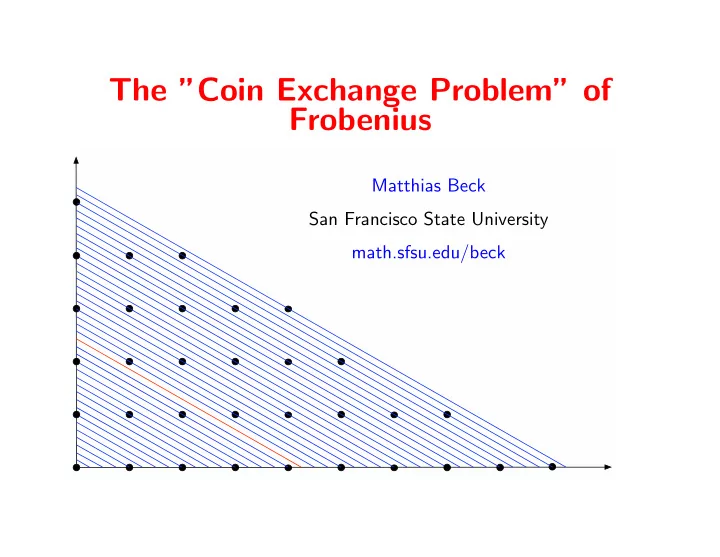
N(t) = #
- (m, n) ∈ Z2 : m, n ≥ 0, ma + nb = t
- counts integer points
in R2
≥0 on the line ax + by = t.
The ”Coin Exchange Problem” of Frobenius Matthias Beck 9
A geometric interlude
N(t) = #
- (m, n) ∈ Z2 : m, n ≥ 0, ma + nb = t
- counts integer points
in R2
≥0 on the line ax + by = t.
The ”Coin Exchange Problem” of Frobenius Matthias Beck 9
Shameless plug
- M. Beck & S. Robins
Computing the continuous discretely Integer-point enumeration in polyhedra To appear in Springer Undergraduate Texts in Mathematics Preprint available at math.sfsu.edu/beck MSRI Summer Graduate Program at Banff (August 6–20)
The ”Coin Exchange Problem” of Frobenius Matthias Beck 10
Generating functions
Given a sequence (ak)∞
k=0 we encode it into the generating function
F(x) =
- k≥0
ak xk
The ”Coin Exchange Problem” of Frobenius Matthias Beck 11
Generating functions
Given a sequence (ak)∞
k=0 we encode it into the generating function
F(x) =
- k≥0
ak xk Example: Fibonacci sequence f0 = 0, f1 = 1, and fk+2 = fk+1 + fk for k ≥ 0 .
The ”Coin Exchange Problem” of Frobenius Matthias Beck 11
Generating functions
Given a sequence (ak)∞
k=0 we encode it into the generating function
F(x) =
- k≥0
ak xk Example: Fibonacci sequence f0 = 0, f1 = 1, and fk+2 = fk+1 + fk for k ≥ 0 .
- k≥0
fk+2 xk =
- k≥0
fk+1 xk +
- k≥0
fk xk
The ”Coin Exchange Problem” of Frobenius Matthias Beck 11
Generating functions
Given a sequence (ak)∞
k=0 we encode it into the generating function
F(x) =
- k≥0
ak xk Example: Fibonacci sequence f0 = 0, f1 = 1, and fk+2 = fk+1 + fk for k ≥ 0 .
- k≥0
fk+2 xk =
- k≥0
fk+1 xk +
- k≥0
fk xk 1 x2
- k≥2
fk xk = 1 x
- k≥1
fk xk +
- k≥0
fk xk
The ”Coin Exchange Problem” of Frobenius Matthias Beck 11
Generating functions
Given a sequence (ak)∞
k=0 we encode it into the generating function
F(x) =
- k≥0
ak xk Example: Fibonacci sequence f0 = 0, f1 = 1, and fk+2 = fk+1 + fk for k ≥ 0 .
- k≥0
fk+2 xk =
- k≥0
fk+1 xk +
- k≥0
fk xk 1 x2
- k≥2
fk xk = 1 x
- k≥1
fk xk +
- k≥0
fk xk 1 x2 (F(x) − x) = 1 xF(x) + F(x)
The ”Coin Exchange Problem” of Frobenius Matthias Beck 11
Generating functions
Given a sequence (ak)∞
k=0 we encode it into the generating function
F(x) =
- k≥0
ak xk Example: Fibonacci sequence f0 = 0, f1 = 1, and fk+2 = fk+1 + fk for k ≥ 0 .
- k≥0
fk+2 xk =
- k≥0
fk+1 xk +
- k≥0
fk xk 1 x2
- k≥2
fk xk = 1 x
- k≥1
fk xk +
- k≥0
fk xk 1 x2 (F(x) − x) = 1 xF(x) + F(x) F(x) = x 1 − x − x2 .
The ”Coin Exchange Problem” of Frobenius Matthias Beck 11
A Fibonacci homework
Expand F(x) =
- k≥0
fk xk = x 1 − x − x2 into partial fractions...
The ”Coin Exchange Problem” of Frobenius Matthias Beck 12
A Fibonacci homework
Expand F(x) =
- k≥0
fk xk = x 1 − x − x2 into partial fractions... fk = 1 √ 5
- 1 +
√ 5 2 k −
- 1 −
√ 5 2 k .
The ”Coin Exchange Problem” of Frobenius Matthias Beck 12
My favorite generating function
The geometric series
- k≥0
xk = 1 1 − x, suspected to converge for |x| < 1.
The ”Coin Exchange Problem” of Frobenius Matthias Beck 13
My favorite generating function
The geometric series
- k≥0
xk = 1 1 − x, suspected to converge for |x| < 1. Example: ak =
- 1
if 7|k
- therwise
The ”Coin Exchange Problem” of Frobenius Matthias Beck 13
My favorite generating function
The geometric series
- k≥0
xk = 1 1 − x, suspected to converge for |x| < 1. Example: ak =
- 1
if 7|k
- therwise
- k≥0
ak xk =
- j≥0
x7j
The ”Coin Exchange Problem” of Frobenius Matthias Beck 13
My favorite generating function
The geometric series
- k≥0
xk = 1 1 − x, suspected to converge for |x| < 1. Example: ak =
- 1
if 7|k
- therwise
- k≥0
ak xk =
- j≥0
x7j = 1 1 − x7
The ”Coin Exchange Problem” of Frobenius Matthias Beck 13
Frobenius generatingfunctionology
Given positive integers a and b, recall that N(t) = #
- (m, n) ∈ Z2 : m, n ≥ 0, ma + nb = t
- .
The ”Coin Exchange Problem” of Frobenius Matthias Beck 14
Frobenius generatingfunctionology
Given positive integers a and b, recall that N(t) = #
- (m, n) ∈ Z2 : m, n ≥ 0, ma + nb = t
- .
Consider the product of the geometric series 1 (1 − xa) (1 − xb) =
m≥0
xma
n≥0
xnb .
The ”Coin Exchange Problem” of Frobenius Matthias Beck 14
Frobenius generatingfunctionology
Given positive integers a and b, recall that N(t) = #
- (m, n) ∈ Z2 : m, n ≥ 0, ma + nb = t
- .
Consider the product of the geometric series 1 (1 − xa) (1 − xb) =
m≥0
xma
n≥0
xnb . A typical term looks like xma+nb for some m, n ≥ 0
The ”Coin Exchange Problem” of Frobenius Matthias Beck 14
Frobenius generatingfunctionology
Given positive integers a and b, recall that N(t) = #
- (m, n) ∈ Z2 : m, n ≥ 0, ma + nb = t
- .
Consider the product of the geometric series 1 (1 − xa) (1 − xb) =
m≥0
xma
n≥0
xnb . A typical term looks like xma+nb for some m, n ≥ 0, and so 1 (1 − xa) (1 − xb) =
- t≥0
N(t) xt is the generating function associated to the counting function N(t).
The ”Coin Exchange Problem” of Frobenius Matthias Beck 14
More Frobenius generatingfunctionology
Recall that N(t + ab) = N(t) + 1
The ”Coin Exchange Problem” of Frobenius Matthias Beck 15
More Frobenius generatingfunctionology
Recall that N(t + ab) = N(t) + 1
- t≥0
N(t + ab) xt =
- t≥0
(N(t) + 1) xt
The ”Coin Exchange Problem” of Frobenius Matthias Beck 15
More Frobenius generatingfunctionology
Recall that N(t + ab) = N(t) + 1
- t≥0
N(t + ab) xt =
- t≥0
(N(t) + 1) xt 1 xab
- t≥ab
N(t) xt =
- t≥0
N(t) xt +
- t≥0
xt
The ”Coin Exchange Problem” of Frobenius Matthias Beck 15
More Frobenius generatingfunctionology
Recall that N(t + ab) = N(t) + 1
- t≥0
N(t + ab) xt =
- t≥0
(N(t) + 1) xt 1 xab
- t≥ab
N(t) xt =
- t≥0
N(t) xt +
- t≥0
xt 1 xab
t≥0
N(t) xt −
ab−1
- t=0
N(t) xt = 1 (1 − xa) (1 − xb) + 1 1 − x
The ”Coin Exchange Problem” of Frobenius Matthias Beck 15
More Frobenius generatingfunctionology
Recall that N(t + ab) = N(t) + 1
- t≥0
N(t + ab) xt =
- t≥0
(N(t) + 1) xt 1 xab
- t≥ab
N(t) xt =
- t≥0
N(t) xt +
- t≥0
xt 1 xab
t≥0
N(t) xt −
ab−1
- t=0
N(t) xt = 1 (1 − xa) (1 − xb) + 1 1 − x 1 xab
- 1
(1 − xa) (1 − xb) −
ab−1
- t=0
N(t) xt
- =
1 (1 − xa) (1 − xb) + 1 1 − x
The ”Coin Exchange Problem” of Frobenius Matthias Beck 15
More Frobenius generatingfunctionology
Recall that N(t + ab) = N(t) + 1
- t≥0
N(t + ab) xt =
- t≥0
(N(t) + 1) xt 1 xab
- t≥ab
N(t) xt =
- t≥0
N(t) xt +
- t≥0
xt 1 xab
t≥0
N(t) xt −
ab−1
- t=0
N(t) xt = 1 (1 − xa) (1 − xb) + 1 1 − x 1 xab
- 1
(1 − xa) (1 − xb) −
ab−1
- t=0
N(t) xt
- =
1 (1 − xa) (1 − xb) + 1 1 − x
ab−1
- t=0
N(t) xt + xab 1 − x = 1 − xab (1 − xa) (1 − xb)
The ”Coin Exchange Problem” of Frobenius Matthias Beck 15
More Frobenius generatingfunctionology
ab−1
- t=0
N(t) xt + xab 1 − x = 1 − xab (1 − xa) (1 − xb)
The ”Coin Exchange Problem” of Frobenius Matthias Beck 16
More Frobenius generatingfunctionology
ab−1
- t=0
N(t) xt + xab 1 − x = 1 − xab (1 − xa) (1 − xb)
ab−1
- t=0
N(t) xt +
- t≥ab
xt = 1 − xab (1 − xa) (1 − xb)
The ”Coin Exchange Problem” of Frobenius Matthias Beck 16
More Frobenius generatingfunctionology
ab−1
- t=0
N(t) xt + xab 1 − x = 1 − xab (1 − xa) (1 − xb)
ab−1
- t=0
N(t) xt +
- t≥ab
xt = 1 − xab (1 − xa) (1 − xb) For 0 ≤ t ≤ ab − 1, N(t) is 0 or 1, and so
- t representable
xt = 1 − xab (1 − xa) (1 − xb)
The ”Coin Exchange Problem” of Frobenius Matthias Beck 16
More Frobenius generatingfunctionology
ab−1
- t=0
N(t) xt + xab 1 − x = 1 − xab (1 − xa) (1 − xb)
ab−1
- t=0
N(t) xt +
- t≥ab
xt = 1 − xab (1 − xa) (1 − xb) For 0 ≤ t ≤ ab − 1, N(t) is 0 or 1, and so
- t representable
xt = 1 − xab (1 − xa) (1 − xb) and
- t not representable
xt = 1 1 − x − 1 − xab (1 − xa) (1 − xb) .
The ”Coin Exchange Problem” of Frobenius Matthias Beck 16
A higher-dimensional homework
We say that t is representable by the positive integers a1, a2, . . . , ad if there is a solution (m1, m2, . . . , md) in nonnegative integers to m1a1 + m2a2 + · · · + mdad = t
The ”Coin Exchange Problem” of Frobenius Matthias Beck 17
A higher-dimensional homework
We say that t is representable by the positive integers a1, a2, . . . , ad if there is a solution (m1, m2, . . . , md) in nonnegative integers to m1a1 + m2a2 + · · · + mdad = t Prove
- t representable
xt = p(x) (1 − xa1) (1 − xa2) · · · (1 − xad) for some polynomial p.
The ”Coin Exchange Problem” of Frobenius Matthias Beck 17
Corollaries
- t not representable
xt = 1 1 − x − 1 − xab (1 − xa) (1 − xb)
The ”Coin Exchange Problem” of Frobenius Matthias Beck 18
Corollaries
- t not representable
xt = 1 1 − x − 1 − xab (1 − xa) (1 − xb) = 1 − xa − xb + xa+b −
- 1 − x − xab + xab+1
(1 − x) (1 − xa) (1 − xb)
The ”Coin Exchange Problem” of Frobenius Matthias Beck 18
Corollaries
- t not representable
xt = 1 1 − x − 1 − xab (1 − xa) (1 − xb) = 1 − xa − xb + xa+b −
- 1 − x − xab + xab+1
(1 − x) (1 − xa) (1 − xb) = x − xa − xb + xa+b + xab − xab+1 (1 − x) (1 − xa) (1 − xb)
The ”Coin Exchange Problem” of Frobenius Matthias Beck 18
Corollaries
- t not representable
xt = 1 1 − x − 1 − xab (1 − xa) (1 − xb) = 1 − xa − xb + xa+b −
- 1 − x − xab + xab+1
(1 − x) (1 − xa) (1 − xb) = x − xa − xb + xa+b + xab − xab+1 (1 − x) (1 − xa) (1 − xb) This polynomial has degree ab + 1 − (1 + a + b) = ab − a − b.
The ”Coin Exchange Problem” of Frobenius Matthias Beck 18
Corollaries
- t not representable
xt = 1 1 − x − 1 − xab (1 − xa) (1 − xb) = 1 − xa − xb + xa+b −
- 1 − x − xab + xab+1
(1 − x) (1 − xa) (1 − xb) = x − xa − xb + xa+b + xab − xab+1 (1 − x) (1 − xa) (1 − xb) This polynomial has degree ab + 1 − (1 + a + b) = ab − a − b. The number of non-representable positive integers is lim
x→1
x − xa − xb + xab + xa+b − xab+1 (1 − x) (1 − xa) (1 − xb)
The ”Coin Exchange Problem” of Frobenius Matthias Beck 18
Corollaries
- t not representable
xt = 1 1 − x − 1 − xab (1 − xa) (1 − xb) = 1 − xa − xb + xa+b −
- 1 − x − xab + xab+1
(1 − x) (1 − xa) (1 − xb) = x − xa − xb + xa+b + xab − xab+1 (1 − x) (1 − xa) (1 − xb) This polynomial has degree ab + 1 − (1 + a + b) = ab − a − b. The number of non-representable positive integers is lim
x→1
x − xa − xb + xab + xa+b − xab+1 (1 − x) (1 − xa) (1 − xb) = (a − 1)(b − 1) 2 .
The ”Coin Exchange Problem” of Frobenius Matthias Beck 18
Another homework with several representations
Recall: Given two positive integers a and b with no common factor, we say the integer t is k-representable if there are exactly k solutions (m, n) ∈ Z2
≥0
to t = ma + nb.
The ”Coin Exchange Problem” of Frobenius Matthias Beck 19
Another homework with several representations
Recall: Given two positive integers a and b with no common factor, we say the integer t is k-representable if there are exactly k solutions (m, n) ∈ Z2
≥0
to t = ma + nb. Prove: ◮ There are exactly ab − 1 integers that are uniquely representable.
The ”Coin Exchange Problem” of Frobenius Matthias Beck 19
Another homework with several representations
Recall: Given two positive integers a and b with no common factor, we say the integer t is k-representable if there are exactly k solutions (m, n) ∈ Z2
≥0
to t = ma + nb. Prove: ◮ There are exactly ab − 1 integers that are uniquely representable. ◮ Given k ≥ 2, there are exactly ab k-representable integers.
The ”Coin Exchange Problem” of Frobenius Matthias Beck 19
Beyond d=2
Given integers a1, a2, . . . , ad with no common factor, let F(x) =
- t representable
xt = p(x) (1 − xa1) (1 − xa2) · · · (1 − xad) .
The ”Coin Exchange Problem” of Frobenius Matthias Beck 20
Beyond d=2
Given integers a1, a2, . . . , ad with no common factor, let F(x) =
- t representable
xt = p(x) (1 − xa1) (1 − xa2) · · · (1 − xad) . ◮ (Denham 2003) For d = 3, the polynomial p(x) has either 4 or 6 terms, given in semi-explicit form.
The ”Coin Exchange Problem” of Frobenius Matthias Beck 20
Beyond d=2
Given integers a1, a2, . . . , ad with no common factor, let F(x) =
- t representable
xt = p(x) (1 − xa1) (1 − xa2) · · · (1 − xad) . ◮ (Denham 2003) For d = 3, the polynomial p(x) has either 4 or 6 terms, given in semi-explicit form. ◮ (Bresinsky 1975) For d ≥ 4, there is no absolute bound for the number
- f terms in p(x).
The ”Coin Exchange Problem” of Frobenius Matthias Beck 20
Beyond d=2
Given integers a1, a2, . . . , ad with no common factor, let F(x) =
- t representable
xt = p(x) (1 − xa1) (1 − xa2) · · · (1 − xad) . ◮ (Denham 2003) For d = 3, the polynomial p(x) has either 4 or 6 terms, given in semi-explicit form. ◮ (Bresinsky 1975) For d ≥ 4, there is no absolute bound for the number
- f terms in p(x).
◮ (Barvinok-Woods 2003) For fixed d, the rational generating function F(x) can be written as a “short” sum of rational functions.
The ”Coin Exchange Problem” of Frobenius Matthias Beck 20
What else is known
◮ Frobenius number and number of non-representable integers in special cases: arithmetic progressions and variations, extension cases
The ”Coin Exchange Problem” of Frobenius Matthias Beck 21
What else is known
◮ Frobenius number and number of non-representable integers in special cases: arithmetic progressions and variations, extension cases ◮ Upper and lower bounds for the Frobenius number
The ”Coin Exchange Problem” of Frobenius Matthias Beck 21
What else is known
◮ Frobenius number and number of non-representable integers in special cases: arithmetic progressions and variations, extension cases ◮ Upper and lower bounds for the Frobenius number ◮ Algorithms
The ”Coin Exchange Problem” of Frobenius Matthias Beck 21
What else is known
◮ Frobenius number and number of non-representable integers in special cases: arithmetic progressions and variations, extension cases ◮ Upper and lower bounds for the Frobenius number ◮ Algorithms ◮ Generalizations: vector version, k-representable Frobenius number
The ”Coin Exchange Problem” of Frobenius Matthias Beck 21
Open problems
◮ d = 3
The ”Coin Exchange Problem” of Frobenius Matthias Beck 22
Open problems
◮ d = 3 ◮ d ≥ 4
The ”Coin Exchange Problem” of Frobenius Matthias Beck 22
Open problems
◮ d = 3 ◮ d ≥ 4 ◮ Good upper bounds
The ”Coin Exchange Problem” of Frobenius Matthias Beck 22
Open problems
◮ d = 3 ◮ d ≥ 4 ◮ Good upper bounds ◮ Practical algorithms
The ”Coin Exchange Problem” of Frobenius Matthias Beck 22
A few references
◮
- J. Ramirez Alfonsin The Diophantine Frobenius problem Oxford
University Press (to appear) ◮
- H. Wilf generatingfunctionology Academic Press
www.math.upenn.edu/ wilf/DownldGF.html ◮ M. Beck & S. Robins Computing the continuous discretely— Integer-point enumeration in polyhedra Springer UTM (to appear), math.sfsu.edu/beck
The ”Coin Exchange Problem” of Frobenius Matthias Beck 23