The cost of global trade is estimated at $1.8 trillion annually 1 - - PowerPoint PPT Presentation

the cost of global trade is estimated at 1 8 trillion
SMART_READER_LITE
LIVE PREVIEW

The cost of global trade is estimated at $1.8 trillion annually 1 - - PowerPoint PPT Presentation

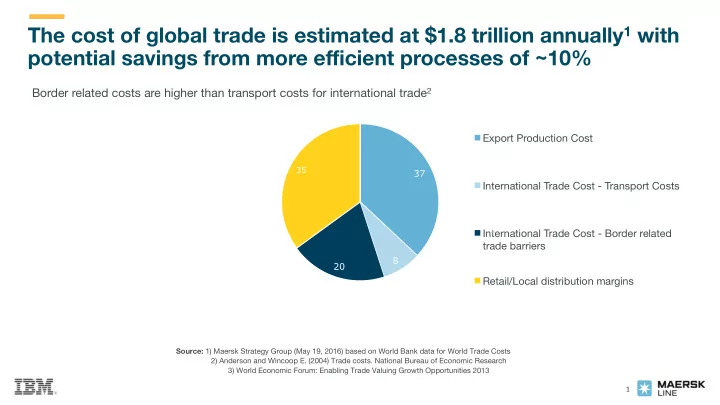
The cost of global trade is estimated at $1.8 trillion annually 1 with potential savings from more efficient processes of ~10% Border related costs are higher than transport costs for international trade 2 Export Production Cost 35 37


slide-1
SLIDE 1

37 8 20

35

Border related costs are higher than transport costs for international trade2

Export Production Cost International Trade Cost - Transport Costs International Trade Cost - Border related trade barriers Retail/Local distribution margins

1

The cost of global trade is estimated at $1.8 trillion annually1 with potential savings from more efficient processes of ~10%

Source: 1) Maersk Strategy Group (May 19, 2016) based on World Bank data for World Trade Costs 2) Anderson and Wincoop E. (2004) Trade costs. National Bureau of Economic Research 3) World Economic Forum: Enabling Trade Valuing Growth Opportunities 2013

4,7% 14,5 %

slide-2
SLIDE 2

The case for a better way

2

TODAY

§ Inconsistent information across organizational boundaries and “blind spots” throughout the supply chain hinder the efficient flow of goods § Complex, cumbersome, and costly peer-to-peer messaging § Manual, time-consuming, paper-based processes; high air courier expense and delays § Risk assessments often lack sufficient information; clearance processes subject to fraud § The administrative cost of handling a container shipment is comparable to the cost of the actual physical transport

TOMORROW

§ Instant, secure access to end-to-end supply chain information; single source of the truth § Assurance of the authenticity and immutability of digital documents; trusted cross-organizational workflows § Better risk assessments and fewer unnecessary interventions § Far lower administrative expenses and elimination of costs to move physical paper across international borders § Estimated global savings from more efficient sharing of information: $27 billion

Exporter Authority Authority Authority Authority Forwarder Carrier Consignee Authority Terminal Exporter Trucker Rail Authority Authority Forwarder Carrier

Consignee

Terminal

The Platform

slide-3
SLIDE 3

3

Platform

Customs Systems Logistic actors internal systems Supply Chain Visibility Systems Port Community Systems; Terminal Operating Systems Transportation Management. Authorities Trade Associations Ocean Carriers Shippers / Supply Chain Actors Supply Chain / Transportation Management systems Ports and Terminals Freight Forwarders

1

Shipping Information Pipeline (SIP) Will provide end-to-end supply chain visibility that enables all actors involved in a global shipping transaction to securely and seamlessly exchange shipment events in real time Paperless Trade Will digitize and automate paperwork filings for the import and export of goods by enabling end users to securely submit, stamp and approve documents across national and organizational boundaries

2

The Platform will be built on an open technology stack and is underpinned by Blockchain technology

The Platform will come with two launch products

Reducing global trade barriers and increasing efficiency across international supply chains

slide-4
SLIDE 4

This will be an industry platform that connects and provides benefits to the supply chain ecosystem

4

This is not just a product offering; it will also be a global network of interconnected shipping corridors linking the ports and terminals, customs authorities, shipping lines, 3PLs, inland transportation, shippers, and other actors Ports and Terminals

Provide information about the disposition of shipments within the boundaries of the port / terminal Benefit from pre-built connections to shipping lines and other actors, end-to-end visibility across shipping corridors, and real-time access to more information to enrich port collaboration and improve terminal planning

Shipping Lines

Provide information about the disposition of shipments across the ocean leg Benefit from pre-built connections to customers and ports / terminals around the world and real-time access to end-to-end supply chain events

Customs Authorities

Provide information about the export and import clearance status for shipments into and out of the country Benefit from more informed risk assessments, better information sharing, less manual paperwork, and easier connections to national single window platforms

Freight Forwarders / 3PL

Provide the transportation plan, inland transportation events, information on intermodal handoffs, and document filings Benefit from pre-built connections to the ecosystem, improved tools for customs clearance brokerage function, and real-time access to the end–to-end supply chain data to improve effectiveness of track-and-trace tools

Intermodal Transport

Provide information on the disposition of shipments carried on trucks, rail, barges, etc. Benefit from improved planning and utilization of assets (e.g., less queuing) given real-time access to end-to-end supply chain events for shipments

Shippers

Engage with GTD as a customer and user of SIP and Paperless Trade Benefit from a streamlined and improved supply chain allowing for greater predictability, early notification of issues, full transparency to validate fees and surcharges, and less safety stock inventory