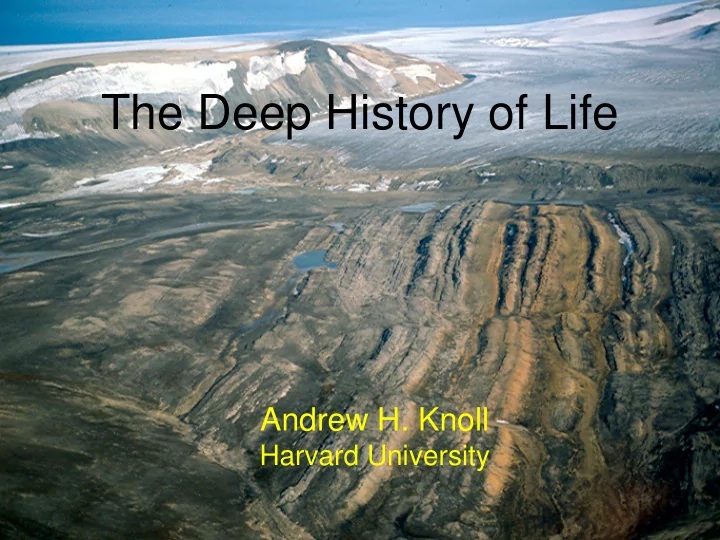
SLIDE 1
Andrew H. Knoll
Harvard University
The Deep History of Life
SLIDE 2
James Hutton (1788): Earth is a dynamic Planet
SLIDE 3
Charles Darwin (1859): Populations are also dynamic.
SLIDE 4
Percival Lowell (1908): Planetary change is directional.
SLIDE 5
Earth preserves a record of its biological and environmental history.
SLIDE 6 Comparative biology and evolutionary history
Teilhardina magnoliana
SLIDE 7 Haikouichthys, ca. 520 Ma Yunnanozoan, ca. 520 Ma
542
SLIDE 8
Earliest evidence of animals
SLIDE 9
End of the trail for animals What happened back here?
SLIDE 10
Comparative biology suggests a potentially long pre-animal history of life.
SLIDE 11
Can a microbial history be captured by the fossil record?
SLIDE 12
those deposited today on Bahama Banks
comparable to laminae formed today by microbial mats
indicate exposed tidal flat
nodules preserve microfossils (below, each spheroid is ca. 4 microns)
SLIDE 13 Microfossil Interpretation
- Diagnostic Form
- Life Cycle
- Behavior (Orientation)
- Environmental Setting
- Taphonomy
- Distinctive stalk-
forming fossils preserved in tidal flat cherts
specific crusts
SLIDE 14 Ancient-Modern Comparison
- Modern Bahama Banks: close environmental
analog
- Find stalk-forming cyanobacteria that build
crusts
- Very close morphological, life cycle and
environmental comparison across 750-800 million years
SLIDE 15
Microfossils record a broad diversity of life in the late Proterozoic ocean
SLIDE 16
Stromatolites
SLIDE 17 Modern stromatolites guide interpretation of ancient
Shark Bay, Australia; Cross- section courtesy of J.W. Schopf
SLIDE 18 Biomarker Molecular Fossils
- Preserved molecules
- f known biosynthetic
- rigin
- DNA and proteins
rarely preserved, and not known from Precambrian rocks
SLIDE 19 Biological Influence on the Isotopic Composition of Seawater
take up CO2 containing 12C in preference to 13CO2 – a kinetic isotope effect
difference between the isotopic composition of C in carbonate and C in co-
preserves a record of biology
- Sulfur isotopes preserve a
similar biogeochemical record
SLIDE 20
- Modern microbial ecosystems provide keys
to the physical and biological interpretation
- f sedimentary rocks deposited before the
evolution of animals.
- In 750-800 million year old rocks of
Spitsbergen, the fingerprints of biology are everywhere
- What do we see in older rocks?
SLIDE 21
Bil’yakh Group, northern Siberia (~1500 Ma)
SLIDE 22
Widespread Evidence of Life
C and S isotopic signatures, molecular biomarkers
SLIDE 23
North Pole, Australia: The Warrawoona Group (3.45 Ga)
SLIDE 24
Stromatolites (plus C and S isotopes)
SLIDE 25
suggests that life
Earth history
few hard facts about the nature of early life
worked without
SLIDE 26 Several lines of evidence indicate
- xygenation 2.4 Ga
- Banded iron formation
- Detrital uraninite, siderite,
and pyrite
- Paleosols
- Sulfur isotopes
Our hero
SLIDE 27 How much O2 accumulated?
Lyons et al. (2014)
SLIDE 28 Life at Middle Age: Abundant and diverse cyanobacteria
* * * * * * * * * * * * * *
* Known from mid-Proterozoic rocks (Tomitani et al., 2006)
SLIDE 29 50 µm
Early Eukaryotes
Satka favosa Valeria lophostriata
Tappania plana
50 µm Grypania spiralis
SLIDE 30
Building Diversity
SLIDE 31 Animals: 800 Ma origin but diversification after 600 Ma
Erwin et al. (2011)
SLIDE 32 When did atmosphere/ocean begin its transition to a more modern state?
Partin et al. (2013)
SLIDE 33 Carnivory links oxygen and ecology
Sperling et al. (2013)
SLIDE 34
SLIDE 35 Animals Anaerobic Bacteria and Archaea Eukaryotes Aerobic Metabolism
Surface OMZ High O2 Low O2 No O2 O2 Fe Fe (HS-) Fe
SLIDE 36
Evolution plays out on a dynamic planet
SLIDE 37 The Evolutionary Present
Jim Barry (MBARI)