The direct detection of dark matter WIMP current status and future - - PowerPoint PPT Presentation

the direct detection of dark matter
SMART_READER_LITE
LIVE PREVIEW

The direct detection of dark matter WIMP current status and future - - PowerPoint PPT Presentation

The direct detection of dark matter WIMP current status and future prospects Andrew Brown, Nikhef, Netherlands abrown@nikhef.nl Revealing the history of the universe with underground particle and nuclear research 11 th - 13 th of May, 2016


slide-1
SLIDE 1

The direct detection of dark matter

Andrew Brown, Nikhef, Netherlands

Revealing the history of the universe with underground particle and nuclear research 11th - 13th of May, 2016

current status and future prospects

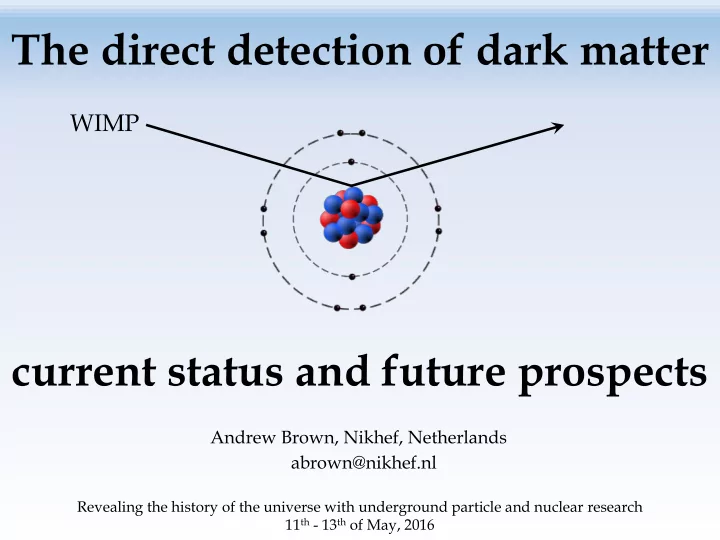
WIMP

abrown@nikhef.nl

slide-2
SLIDE 2
  • Dark matter WIMPs could scatter of terrestrial atomic nuclei

– Speeds of O(200 km/s), approximate rotation speed of sun in galaxy – Masses ~ 10 − 104 GeV/c2 - recoil energies ~< 10 keVnr

  • Interactions rare

– Density ~ 0.3 GeV / cm3 , about half a kg in the earth at any one time – cross-section very low < 0.6 × 10-45 cm2 @ ~30 GeV/c2 – Very low rates, less than 10s of events per tonne and year

Elastic WIMP interactions

Andrew Brown, University of Tokyo, 11th - 13th of May, 2016 2

slide-3
SLIDE 3

Direct detection signatures

  • Small nuclear recoils (~<10 keV)

– Electronic recoil models also exist

  • SI or SD interactions
  • Exponential shape
  • Modulates across year
  • Directionality of signal

– See N. Spooner talk! – See NEWAGE talk!

3 Andrew Brown, University of Tokyo, 11th - 13th of May, 2016

slide-4
SLIDE 4

Direct DM, showing the results

  • Cross-section translated to expected rate

– (non) observation sets limit

  • Mass vs. cross section limits on interaction strength

– Strongly affected by target nuclear mass, threshold and exposure

4 Andrew Brown, University of Tokyo, 11th - 13th of May, 2016

WIMP Mass A Threshold “Light” DM

Astropart.Phys. 6 (1996) 87-112 JCAP04(2016)027

Exposure

slide-5
SLIDE 5

History of detection limits

  • Factor 10 improvement every 2-3 years this century

5 Andrew Brown, University of Tokyo, 11th - 13th of May, 2016

slide-6
SLIDE 6

Detector backgrounds

  • Natural radioactive contaminants

– Uranium and Thorium decay chains, potassium-40, Krypton-85… – Give gamma and beta decays, leading to electronic recoils – Can also cause (α,n) neutron production leading to nuclear recoils

  • Cosmic rays

– Muons can produce neutrons by interactions with detector surroundings

  • All experiments attempt to reduce these backgrounds

– Careful selection of detector materials for low-radioactivity – Online purification – Locating experiments deep underground

6 Andrew Brown, University of Tokyo, 11th - 13th of May, 2016

slide-7
SLIDE 7

Detector locations

  • All direct DM experiments located underground

– Reduces cosmic ray muon flux – Usually > 2km water equivalent

7 Andrew Brown, University of Tokyo, 11th - 13th of May, 2016

slide-8
SLIDE 8

Detector types

  • Three commonly used detection channels

– Many detectors use a combination of two of these channels

  • Bubble chambers offer a separate method

ER

Charge Phonons

DarkSide, XENON, LUX

CRESST-II

CDMS EDELWEISS DAMA/LIBRA, XMASS

Photons

CoGeNT

CRESST-I

8 Andrew Brown, University of Tokyo, 11th - 13th of May, 2016

Bubble Chamber

PICO

slide-9
SLIDE 9

DAMA

  • NaI scintillation detectors
  • Annual modulation observed

– 9.3σ significance in 2 – 6 keV range – Collected over 14 years

9 Andrew Brown, University of Tokyo, 11th - 13th of May, 2016

  • Eur. Phys. J. C 73 (2013) 2648
slide-10
SLIDE 10

DAMA

  • Elastic SI DM ruled out by half a dozen experiments
  • Many explanations offered, also ruled out

– Leptophillic DM excluded by XENON100

  • CsI expt (KIMS) has partially excluded DAMA

– Further NaI expts (e.g. DM-ICE, KamLAND-Pico) to probe same region

10 Andrew Brown, University of Tokyo, 11th - 13th of May, 2016

slide-11
SLIDE 11

CRESST-II

  • Cryogenic scintillating CaWO4 crystals

– Measure light and phonon signals – Electronic and nuclear recoils cause different light/phonon ratios

  • Allows discrimination

– Several 300g detectors held at mK temperatures

  • Located in LNGS, Italy, first science data since 2007

11 Andrew Brown, University of Tokyo, 11th - 13th of May, 2016

  • Eur. Phys. J. C 74 (2014) 3184
slide-12
SLIDE 12
  • In 2012 CRESST-II saw hints of a positive signal (brown region)

– In mild conflict with earlier run (pink)

  • Later results (red dashed and red solid) have ruled out signal
  • Capable of reaching an extremely low threshold (307eV)

– Allows world’s strongest SI elastic limits below 2 GeV/c2

12 Andrew Brown, University of Tokyo, 11th - 13th of May, 2016

  • Eur. Phys. J. C 76 (2016) 25

CRESST-II

slide-13
SLIDE 13

SuperCDMS/CDMSLite

  • Cryogenic germanium detectors

– iZIP detector configuration, looking at phonon and ionization signals

  • Capable of extremely low thresholds

– CDMSLite 2015 - 56 eVee

13 Andrew Brown, University of Tokyo, 11th - 13th of May, 2016

  • Phys. Rev. Lett. 112, 241302 (2014)
slide-14
SLIDE 14
  • Produced strongest limits in ~ 2 - ~6 GeV/c2 range
  • SuperCDMS SNOLAB – future expansion up to 400kg target

– Focus on light WIMP searches < 10 GeV/c2

SuperCDMS/CDMSLite

14 Andrew Brown, University of Tokyo, 11th - 13th of May, 2016

  • Phys. Rev. Lett. 116, 071301 (2016)
  • Phys. Rev. Lett. 116, 071301 (2016)
slide-15
SLIDE 15

Andrew Brown, University of Tokyo, 11th - 13th of May, 2016 15

PICO-2L / PICO-60

  • Bubble chamber experiment

– Listens to “sounds” of bubbles

  • Threshold experiment
  • Gamma/beta do not produce bubbles
  • Produce very strong SD-Proton limits

– New clean run of PICO-60 in near term

  • Phys. Rev. D 93, 052014 (2016)
slide-16
SLIDE 16

Liquid noble gas detectors

  • Currently the most promising technology at high mass

– Frequently use liquid xenon or argon as a target – Many different experiments, dual phase and single phase – Large, scalable target masses

16 Andrew Brown, University of Tokyo, 11th - 13th of May, 2016

LUX DarkSide-50 XMASS

slide-17
SLIDE 17

Single phase

  • Detect prompt scintillation signal (S1) with very high efficiency

– Position reconstruction on S1 allows surface event removal – Pulse shape discrimination possible for LAr

  • Pursued in both LXe (e.g. XMASS) and LAr (e.g. DEAP 3600)

17 Andrew Brown, University of Tokyo, 11th - 13th of May, 2016

DEAP-3600

slide-18
SLIDE 18

Dual phase

  • Many DM detectors follow the “dual phase” noble gas TPC design

– Liquid as a target with gas used to generate secondary signal

  • Most detectors aiming at masses (>50GeV/c2) are of this design

– DarkSide, LUX/LZ, XENON

  • LUX most sensitive of all detectors

– Subject of next talk!

18 Andrew Brown, University of Tokyo, 11th - 13th of May, 2016

slide-19
SLIDE 19

Liquid noble gas TPC principles

Andrew Brown, University of Tokyo, 11th - 13th of May, 2016 19

slide-20
SLIDE 20

20

  • Interactions in TPC give two signals

Liquid noble gas TPC principles

Andrew Brown, University of Tokyo, 11th - 13th of May, 2016

slide-21
SLIDE 21
  • Interactions in TPC give two signals
  • Prompt (S1)

Liquid noble gas TPC principles

Andrew Brown, University of Tokyo, 11th - 13th of May, 2016 21

slide-22
SLIDE 22
  • Interactions in TPC give two signals
  • Prompt (S1) and Proportional (S2)

Liquid noble gas TPC principles

Andrew Brown, University of Tokyo, 11th - 13th of May, 2016 22

slide-23
SLIDE 23
  • Interactions in TPC give two signals
  • Prompt (S1) and Proportional (S2)

Liquid noble gas TPC principles

Andrew Brown, University of Tokyo, 11th - 13th of May, 2016 23

slide-24
SLIDE 24
  • Interactions in TPC give two signals
  • Prompt (S1) and Proportional (S2)
  • Allows position reconstruction
  • S1-S2 time difference gives z depth
  • S2 hit pattern gives x-y position

Liquid noble gas TPC principles

Andrew Brown, University of Tokyo, 11th - 13th of May, 2016 24

slide-25
SLIDE 25

XENON Project

XENON10 XENON100 XENON1T / XENONnT

2005-2007 2008-2016 2015-2022

Astropart.Phys.34:679-698, (2011) Astropart.Phys.35:573-590, (2012) arXiv:1512.07501 Andrew Brown, University of Tokyo, 11th - 13th of May, 2016 25

slide-26
SLIDE 26

Xenon as a dark matter target

  • Virtually no long-lived radio-isotopes in pure Xe
  • SI and SD (from 129Xe and 131Xe)
  • Low threshold (few keVnr)
  • Two-phase operation allows:
  • 3D position reconstruction, fiducialisation
  • Background discrimination
  • Relatively high density (~3g/cm3)
  • High A (~131), with SI WIMP-nucleon 𝜏 ∝ 𝐵2
  • Good self-shielding

Andrew Brown, University of Tokyo, 11th - 13th of May, 2016 26

slide-27
SLIDE 27

XENON100

  • Liquid xenon TPC

– Fiducial mass 34kg - 48kg

  • Longest DM search run completed in 2012

– World’s strongest DM limits at the time – Further run unblinded, combined analysis ~done

  • Longest continuous running of a LXe TPC

– Over 1 year of data taking in 2011-2012 DM run – Recent calibration run longer, over 1.5 years – Now used for research and development

Andrew Brown, University of Tokyo, 11th - 13th of May, 2016 27

slide-28
SLIDE 28

XENON100: 225 days SI results

Spin Independent WIMPs

  • Phys. Rev. Lett. 109, 181301 (2012)

(Then) (Now)

Andrew Brown, University of Tokyo, 11th - 13th of May, 2016 28

slide-29
SLIDE 29

XENON100 - exclusion of leptophilic DM

  • Three representative models of leptophillic DM tested

– ~halo-independent due to similar electronic structure between xenon and iodine – XENON100 well understood background lower than DAMA expectation – All exclude DAMA with significances > 3.6σ

Science 2015 vol. 349 no. 6250 pp. 851-854

Andrew Brown, University of Tokyo, 11th - 13th of May, 2016 29

slide-30
SLIDE 30

XENON100 – Modulation search

  • No globally significant modulation

– Looking at periods up to 500 days – Local 2.8σ significance at 1 year – Also seen in multiple-scatter control and high energy control, disfavouring DM interpretation

  • Best-fit, exclude DM halo phase at 2.5σ

– DAMA/LIBRA signal excluded at 4.8σ

  • Phys. Rev. Lett. 115, 091302 (2015)

Andrew Brown, University of Tokyo, 11th - 13th of May, 2016 30

slide-31
SLIDE 31

XENON100 - ongoing analyses

  • S2 only analysis soon to be published
  • Since summer 2014, XENON100 has been used for Calibration / R&D

– Now the longest stable running of a LXe TPC (>1.5 years)

  • Several new calibration sources trialled

88Yttrium-Beryllium – low energy 152 keV neutrons

83mKrypton – low energy 9 keV and 32 keV gamma lines

220Radon – short lived isotope calibrating low energy electronic recoils (and more)

– TCH3 , tritiated methane – very low energy electronic recoil calibration

  • Several 2016 papers expected on these novel calibrations!

Andrew Brown, University of Tokyo, 11th - 13th of May, 2016 31

slide-32
SLIDE 32

XENON1T

Andrew Brown, University of Tokyo, 11th - 13th of May, 2016 32

slide-33
SLIDE 33

XENON1T - Systems

LXe detector Water tank Cryogenics / purification DAQ / Electronics XENON recovery / krypton column

Andrew Brown, University of Tokyo, 11th - 13th of May, 2016 33

slide-34
SLIDE 34

XENON1T - Overview

XENON100 XENON1T

161kg of Xe 3300kg of Xe 62kg active target 2000kg active target Passive shields Active shield (water) 30 cm drift 1m drift 5×10⁻³ events/keV/kg/day < 2×10⁻⁴ events/keV/kg/day 1 ppt Kr/Xe 0.2 ppt Kr/Xe 65 µBq/kg for 222Rn <10 µBq/kg for 222Rn 4.5 pe/keV @ 122 keVee 6.6 pe/keV @ 122 keVee

  • Greatly increased size and purity over XENON100

– Improved detector characteristics (e.g. light yield)

Andrew Brown, University of Tokyo, 11th - 13th of May, 2016 34

slide-35
SLIDE 35

XENON1T - Backgrounds

  • Total ER events expected: 720 events / year in 1t FV

– Dominant source (620 ev/yr) is 220-Rn chain, conservative 10µBq/kg

  • Total NR events expected: 0.62 events / year in 1t FV

– Mostly from radiogenic neutrons (0.6 ev/year) – Steep shape of CNNS at low E means S1/S2 conversion v. important!

Andrew Brown, University of Tokyo, 11th - 13th of May, 2016 35

JCAP04(2016)027

slide-36
SLIDE 36

XENON1T - Sensitivity

LUX (2015) LUX (2013)

  • XENON1T expected 100× improvement over XENON100

– Greater than an order of magnitude over existing best limit (LUX) – Expected to reach LUX sensitivity within ~10 live-days of data taking

Andrew Brown, University of Tokyo, 11th - 13th of May, 2016 36

JCAP04(2016)027

slide-37
SLIDE 37

XENON1T – Status highlights

  • Water tank muon veto

– Installed ✔ – Water filling test ✔ – Muon veto tested ✔

  • Cryostat / TPC

– Installed ✔ – Cooled down ✔ – Filled with liquid xenon ✔

  • High voltage / PMTs

– Installed ✔ – PMTs tested working (all 254) ✔ – HV testing (underway)

  • Current work to get first S1 / S2 signals out of TPC!

Andrew Brown, University of Tokyo, 11th - 13th of May, 2016 37

slide-38
SLIDE 38

Andrew Brown, University of Tokyo, 11th - 13th of May, 2016 38

XENONnT – the XENON1T upgrade

  • Increase xenon target, plan to allow 20 tonne-years of exposure
  • Reuse existing outer cryostat, water tank, cooling system…
  • Allows improvement by nearly order of magnitude in a few live-years

XENONnT – the XENON1T upgrade XENONnT – the XENON1T upgrade

slide-39
SLIDE 39

The dark matter picture

Andrew Brown, University of Tokyo, 11th - 13th of May, 2016 39

  • Progress continues rapidly
  • Ultimately restricted by the neutrino CNNS floor
slide-40
SLIDE 40

Andrew Brown, University of Tokyo, 11th - 13th of May, 2016 40

Going forward

  • Many successful experiments in the field

– All have prospects to improve their sensitivity

  • Non-exhaustive list

– XENON1T - fully funded, being commissioned now – DarkSide-50 – continuing with extended underground argon run – SuperCDMS - funded by DOE in G2, design/production for SNOLAB – DEAP-3600 – built and cooled down, see J. Monroe talk! – XMASS – new run, next step XMASS 1.5 – see K. Ichimura talk! – LUX/LZ – new LUX run, full DOE funding for LZ, see A. Bernstein talk!

  • Ultimately limited by CNNS neutrino floor

– Irreducible neutrino background limits DM detector future

  • Estimated to be some time by mid 2020s for non-directional detectors
  • Beaten by directional detectors, see N. Spooner and K. Miuchi (NEWAGE) talks!
slide-41
SLIDE 41

Summary

  • The terrestrial search for dark matter interactions continues

– A wide range of technologies has been tested over the last decade(s)

  • In the next 𝒫 5 years

– Different technologies will probe different mass ranges – Searches at masses >10 GeV/c2 likely dominated by noble gas detectors – At lighter masses, variety of technologies and targets

  • Several experiments are under design, building and operation

– Still real competition in the field, expected to continue for years to come – Shows that funding agencies are still supportive!

Andrew Brown, University of Tokyo, 11th - 13th of May, 2016 41