The dispersive optical model as an interface between FRIB ab initio - - PowerPoint PPT Presentation

the dispersive optical model as an interface between
SMART_READER_LITE
LIVE PREVIEW

The dispersive optical model as an interface between FRIB ab initio - - PowerPoint PPT Presentation

The dispersive optical model as an interface between FRIB ab initio calculations and experiment 6/20/2018 Motivation Greens functions/propagator method W i m D i c k h o vehicle for ab initio calculations > matter f


slide-1
SLIDE 1

reactions and structure

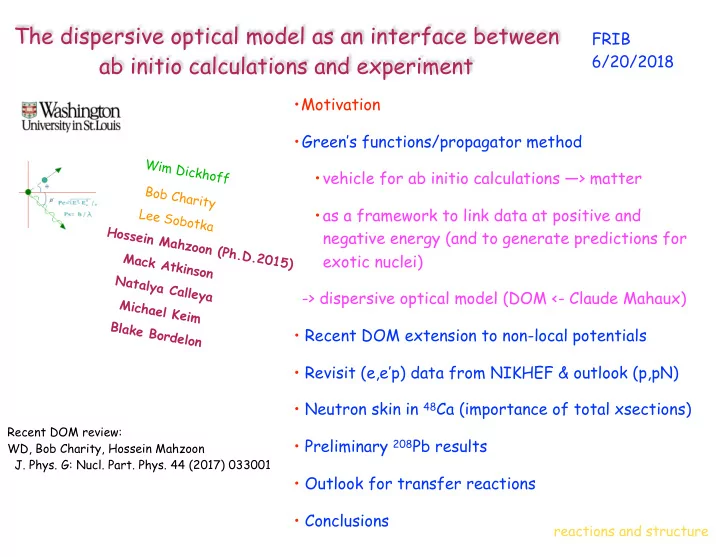
The dispersive optical model as an interface between ab initio calculations and experiment

  • Motivation
  • Green’s functions/propagator method
  • vehicle for ab initio calculations —> matter
  • as a framework to link data at positive and

negative energy (and to generate predictions for exotic nuclei)

  • > dispersive optical model (DOM <- Claude Mahaux)
  • Recent DOM extension to non-local potentials
  • Revisit (e,e’p) data from NIKHEF & outlook (p,pN)
  • Neutron skin in 48Ca (importance of total xsections)
  • Preliminary 208Pb results
  • Outlook for transfer reactions
  • Conclusions

W i m D i c k h

  • f

f B

  • b

C h a r i t y L e e S

  • b
  • t

k a H

  • s

s e i n M a h z

  • n

( P h . D . 2 1 5 ) M a c k A t k i n s

  • n

N a t a l y a C a l l e y a M i c h a e l K e i m B l a k e B

  • r

d e l

  • n

Recent DOM review: WD, Bob Charity, Hossein Mahzoon

  • J. Phys. G: Nucl. Part. Phys. 44 (2017) 033001

FRIB 6/20/2018

slide-2
SLIDE 2

reactions and structure

Motivation

  • Rare isotope physics requires a much stronger link between

nuclear reactions and nuclear structure descriptions

  • We need an ab initio approach for optical potentials —> optical

potentials must therefore become nonlocal and dispersive

  • Current status to extract structure information from nuclear

reactions involving strongly interacting probes unsatisfactory

  • Intermediate step: dispersive optical model as originally proposed

by Claude Mahaux —> recent extensions discussed here

slide-3
SLIDE 3

reactions and structure

Problems with ab initio optical potentials

  • angular momentum constraints (illustrated here)
  • configuration space & density of low-lying states
  • multiple scattering T x rho cannot be systematically improved
  • consistency requires simultaneous description of particle removal

which determines the density

PHYSICAL REVIEW C 95, 024315 (2017)

Optical potential from first principles

  • J. Rotureau,1,2 P

. Danielewicz,1,3 G. Hagen,4,5 F. M. Nunes,1,3 and T. Papenbrock4,5

slide-4
SLIDE 4

reactions and structure

Comparison with ab initio FRPA calculation

  • Volume integrals of imaginary part of nonlocal ab initio (FRPA)

self-energy compared with DOM result for 40Ca

  • Ab initio
  • S. J. Waldecker, C. Barbieri and W. H. Dickhoff


Microscopic self-energy calculations and dispersive-optical-model potentials.


  • Phys. Rev. C84, 034616 (2011), 1-11.
slide-5
SLIDE 5

reactions and structure

Ab initio calculation of elastic scattering n+40Ca

  • Dussan, Waldecker, Müther, Polls, WD PRC84, 044319 (2011)
  • Also generates high-momentum nucleons below the Fermi energy
  • ONLY treatment of short-range and tensor correlations

DOM & data DOM l≤4 CDBonn l≤4

slide-6
SLIDE 6

reactions and structure

Propagator / Green’s function

  • Lehmann representation
  • Any other single-particle basis can be used & continuum integrals implied
  • Overlap functions --> numerator
  • Corresponding eigenvalues --> denominator
  • Spectral function
  • Spectral strength in the continuum
  • Discrete transitions
  • Positive energy —> see later

G`j(k, k0; E) = X

m

hΨA

0 | ak`j |ΨA+1 m

i hΨA+1

m

| a†

k0`j |ΨA 0 i

E (EA+1

m

EA

0 ) + iη

+ X

n

hΨA

0 | a† k0`j |ΨA1 n

i hΨA1

n

| ak`j |ΨA

0 i

E (EA

0 EA1 n

) iη

S`j(k; E) = 1 π Im G`j(k, k; E) E  ε−

F

= X

n

  • hΨA−1

n

| ak`j |ΨA

0 i

  • 2

δ(E (EA

0 EA−1 n

)) q Sn

`j φn `j(k) = hΨA−1 n

| ak`j |ΨA

0 i

S`j(E) = Z ∞ dk k2 S`j(k; E)

slide-7
SLIDE 7

E−

n = EA 0 − EA−1 n

Sn

`j =

Z dk k2 hΨA−1

n

| ak`j |ΨA

0 i

  • 2 < 1

reactions and structure

Propagator from Dyson Equation and “experiment”

Equivalent to …

Self-energy: non-local, energy-dependent potential With energy dependence: spectroscopic factors < 1 ⇒ as extracted from (e,e’p) reaction

Schrödinger-like equation with:

Dyson equation also yields for positive energies

Elastic scattering wave function for protons or neutrons Dyson equation therefore provides: Link between scattering and structure data from dispersion relations

Spectroscopic factor

⇥ χelE

`j (r)

⇤∗ = hΨA+1

elE | a† r`j |ΨA 0 i

k2 2mφn

`j(k) +

Z dq q2 Σ∗

`j(k, q; E− n ) φn `j(q) = E− n φn `j(k)

slide-8
SLIDE 8

reactions and structure

Propagator in principle generates

  • Elastic scattering cross sections for p and n
  • Including all polarization observables
  • Total cross sections for n
  • Reaction cross sections for p and n
  • Overlap functions for adding p or n to bound states in Z+1 or N+1
  • Plus normalization --> spectroscopic factor
  • Overlap function for removing p or n with normalization
  • Hole spectral function including high-momentum description
  • One-body density matrix; occupation numbers; natural orbits
  • Charge density
  • Neutron distribution
  • p and n distorted waves
  • Contribution to the energy of the ground state from VNN
slide-9
SLIDE 9

reactions and structure

Dispersive optical potential <--> nucleon self-energy

  • e.g. Bell and Squires --> elastic T-matrix = reducible self-energy
  • e.g. Mahaux and Sartor

– relate dynamic (energy-dependent) real part to imaginary part – employ subtracted dispersion relation – contributions from the hole (structure) and particle (reaction) domain

General dispersion relation for self-energy: Calculated at the Fermi energy Subtract

εF = 1

2

  • (EA+1

− EA

0 ) + (EA 0 − EA−1

) ⇥

Re Σ(E) = ΣHF − 1 π P Z 1

E+

T

dE0 Im Σ(E0) E − E0 + 1 π P Z E−

T

1

dE0 Im Σ(E0) E − E0 Re Σ(εF ) = ΣHF − 1 π P Z 1

E+

T

dE0 Im Σ(E0) εF − E0 + 1 π P Z E−

T

1

dE0 Im Σ(E0) εF − E0 Re Σ(E) = Re Σ

g HF (εF )

− 1 π (εF − E)P Z 1

E+

T

dE0 Im Σ(E0) (E − E0)(εF − E0) + 1 π (εF − E)P Z E−

T

1

dE0 Im Σ(E0) (E − E0)(εF − E0)

  • Adv. Nucl. Phys. 20, 1 (1991)
slide-10
SLIDE 10

reactions and structure

Functional form and fitting

  • Choice of potentials based on empirical knowledge
  • Volume absorption —> WS
  • Surface absorption —> WS’
  • Coulomb
  • Spin-orbit
  • Hartree-Fock —> WS & WS’
  • non-locality —> Gaussian
  • E-dependence imaginary part <—> some theory
  • Many parameters have canonical values
slide-11
SLIDE 11

reactions and structure

Nonlocal DOM implementation PRL112,162503(2014)

  • Particle number --> nonlocal imaginary part
  • Ab initio FRPA & SRC --> different nonlocal properties above and

below the Fermi energy

  • Include charge density in fit
  • Describe high-momentum nucleons <--> (e,e’p) data from JLab

Implications

  • Changes the description of hadronic reactions because interior

nucleon wave functions depend on non-locality

  • Consistency test of interpretation (e,e’p) reaction (see later)
  • Phys. Rev. C84, 034616 (2011) & Phys. Rev.C84, 044319 (2011)
slide-12
SLIDE 12

reactions and structure

Differential cross sections and analyzing powers

50 100 150

A

5 10 15 20 25

Ca

40

p+

50 100 150

Ca

40

n+ [deg]

cm

θ

50 100 150

[mb/sr] Ω /d σ d

5

10

12

10

19

10

26

10

33

10 Ca

40

n+

< 10

lab

0 < E < 20

lab

10 < E < 40

lab

20 < E < 100

lab

40 < E > 100

lab

E

50 100 150 Ca

40

p+

[deg]

cm

θ

slide-13
SLIDE 13

Local version Charge density 40Ca radius correct… Non-locality essential

PRC82,054306(2010) PR PRL 112,162503(2014) High-momentum nucleons —> JLab can also be described —> E/A

2 4 6

r [fm]

0.02 0.04 0.06 0.08 0.1 0.12

!ch(r) [fm

  • 3]

reactions and structure

Critical experimental data—> charge density

ρ

experiment calculated

PRC82, 054306 (2010)

slide-14
SLIDE 14

reactions and structure

Do elastic scattering data tell us about correlations?

  • Scattering T-matrix (neutrons)
  • Free propagator
  • Propagator
  • Spectral representation
  • Spectral density for E > 0
  • Coordinate space
  • Elastic scattering also explicitly available

Σ`j(k, k0; E) = Σ⇤

`j(k, k0; E) +

Z dqq2Σ⇤

`j(k, q; E)G(0)(q; E)Σ`j(q, k0; E)

G(0)(q; E) = 1 E − ~2q2/2m + iη

Gp

`j(k, k0; E) =

X

n

φn+

`j (k)

h φn+

`j (k0)

i⇤ E − E⇤A+1

n

+ iη + X

c

Z 1

Tc

dE0 χcE0

`j (k)

h χcE0

`j (k0)

i⇤ E − E0 + iη

G`j(k, k0; E) = δ(k − k0) k2 G(0)(k; E) + G(0)(k; E)Σ`j(k, k0; E)G(0)(k; E) Sp

`j(r, r0; E) =

X

c

χcE

`j (r)

⇥ χcE

`j (r0)

⇤⇤

χelE

`j (r) =

2mk0 π~2 1/2 ⇢ j`(k0r) + Z dkk2j`(kr)G(0)(k; E)Σ`j(k, k0; E)

  • Sp

`j(k, k0; E) = i

2π h Gp

`j(k, k0; E+) − Gp `j(k, k0; E)

i = X

c

χcE

`j (k)

⇥ χcE

`j (k0)

⇤⇤

slide-15
SLIDE 15

reactions and structure

Determine location of bound-state strength

  • Fold spectral function with bound state wave function
  • —> Addition probability of bound orbit
  • Also removal probability
  • Overlap function
  • Sum rule

Sn+

`j (E) =

Z dr r2 Z dr0 r02φn

`j (r)Sp `j(r, r0; E)φn `j (r0)

Sn

`j (E) =

Z drr2 Z dr0r02φn

`j (r)Sh `j(r, r0; E)φn `j (r0)

q Sn

`jφn− `j (r) = hΨA−1 n

| ar`j |ΨA

0 i

1 = nn`j + dn`j= Z "F

−∞

dE Sn−

`j (E)+

Z ∞

"F

dE Sn−

`j (E)

slide-16
SLIDE 16

reactions and structure

Spectral function for bound states

  • [0,200] MeV —> constrained by elastic scattering data
  • 100
  • 50

50 100

E [MeV]

10

  • 4

10

  • 3

10

  • 2

10

  • 1

10

Sn(E) [MeV

  • 1]

0s1/2 0p3/2 0p1/2 0d5/2 0d3/2 1s1/2 0f7/2 0f5/2

εF

40Ca

Emptiness constrained!

PRC90, 061603(R) (2014)

slide-17
SLIDE 17
  • Orbit closer to the continuum —> more strength in the continuum
  • Note “particle” orbits
  • Drip-line nuclei have valence orbits very near the continuum

reactions and structure

Quantitatively

Table 1: Occupation and depletion numbers for bound orbits in

40Ca.

dnlj[0, 200] depletion numbers have been integrated from 0 to 200 MeV. The fraction of the sum rule that is exhausted, is illustrated by nn`j + dn`j[εF , 200]. Last column dnlj[0, 200] depletion numbers for the CDBonn calculation.

  • rbit

nn`j dn`j[0, 200] nn`j + dn`j[εF , 200] dn`j[0, 200] DOM DOM DOM CDBonn 0s1/2 0.926 0.032 0.958 0.035 0p3/2 0.914 0.047 0.961 0.036 1p1/2 0.906 0.051 0.957 0.038 0d5/2 0.883 0.081 0.964 0.040 1s1/2 0.871 0.091 0.962 0.038 0d3/2 0.859 0.097 0.966 0.041 0f7/2 0.046 0.202 0.970 0.034 0f5/2 0.036 0.320 0.947 0.036

PRC90, 061603(R) (2014)

slide-18
SLIDE 18

reactions and structure

Another look at (e,e’p) data

  • collaboration with Louk Lapikás and Henk Blok from NIKHEF
  • Data published at Ep = 100 MeV Kramer thesis NIKHEF for 40Ca(e,e’p)39K
  • Phys. Lett. B227, 199 (1989)

Results: S(d3/2)=0.65 and S(s1/2)=0.51

  • More data at 70 and 135 MeV (only in a conference paper)
  • What do these spectroscopic factor numbers really represent?

– Assume DWIA for the reaction description – Use kinematics (momentum transfer parallel to initial proton momentum) favoring simplest part of the excitation operator (no two-body current) & sufficient energy for the knocked out proton – Overlap function: – WS with radius adjusted to shape of cross section – Depth adjusted to separation energy – Distorted proton wave from standard local non-dispersive “global optical potential” – Fit normalization of overlap function to data -> spectroscopic factor

Why go back there?

slide-19
SLIDE 19

reactions and structure

Removal probability for valence protons
 from
 NIKHEF data


  • L. Lapikás, Nucl. Phys. A553,297c (1993)

Weak probe but propagation in the nucleus of removed proton using standard optical potentials to generate distorted wave --> associated uncertainty ~ 5-15% Why: details of the interior scattering wave function uncertain since non-locality is not constrained (so far…..) but now available for 40Ca! S ≈ 0.65 for valence protons Reduction ⇒ both SRC and LRC

(e,e’p)

slide-20
SLIDE 20

reactions and structure

NIKHEF analysis PLB227,199(1989)

  • Schwandt et al. (1981) optical potential
  • BSW from adjusted WS
slide-21
SLIDE 21

reactions and structure

NIKHEF data PLB227,199(1989)

  • NIKHEF: S(d3/2)=0.65±0.06
  • Only DOM ingredients
slide-22
SLIDE 22

reactions and structure

NIKHEF data unpublished

  • Only DOM ingredients
  • DWEEPY code C. Giusti
slide-23
SLIDE 23

reactions and structure

NIKHEF data unpublished

  • Only DOM ingredients
  • at this energy DWIA may no longer be the whole story
slide-24
SLIDE 24

reactions and structure

Thesis G. J. Kramer (1990)

  • s1/2 strength fragmented
  • Not yet included in DOM
  • Corrects DOM spectroscopic factor to 0.62
slide-25
SLIDE 25

reactions and structure

NIKHEF data unpublished

  • Only DOM ingredients
slide-26
SLIDE 26

reactions and structure

NIKHEF data PLB227,199(1989)

  • NIKHEF: S(s1/2)=0.51±0.05
slide-27
SLIDE 27

reactions and structure

NIKHEF data unpublished

  • Only DOM ingredients
slide-28
SLIDE 28

reactions and structure

Message

  • Nonlocal dispersive potentials yield consistent input
  • Constraints from other data generate spectroscopic factors

S(d3/2)=0.71 in 40Ca for ground state transition

  • Experimental s1/2 strength distribution: 2.5 MeV —> S(s1/2)=0.62
  • NIKHEF 0.65±0.06 and 0.51±0.05, respectively (local)
  • Implications for transfer reactions significant
  • (p,2p) reaction for stable targets can be constrained and then

extended to unstable ones

  • Consistent with inelastic electron scattering data
slide-29
SLIDE 29

reactions and structure

Project (p,pN) with Ogata et al.

  • Distorted waves and overlap from DOM
  • Can gauge interaction (beyond free T-matrix)
  • Can predict results for exotic nuclei using DOM extrapolations
slide-30
SLIDE 30

reactions and structure

Location of 
 single-particle
 strength in closed-shell (stable) nuclei

SRC SRC theory For example: protons in 208Pb

NIKHEF (e,e’p) data


  • L. Lapikás
  • Nucl. Phys. A553,297c (1993)

JLab E97-006

  • Phys. Rev. Lett. 93, 182501 (2004) D. Rohe et al.

Elastic nucleon scattering

Reviewed in Prog. Part. Nucl. Phys. 52 (2004) 377-496

slide-31
SLIDE 31

reactions and structure

DOM results for 48Ca

  • Change of proton properties when 8 neutrons are added to 40Ca?
  • Change of neutron properties?
  • Can hard to measure quantities be indirectly constrained?
slide-32
SLIDE 32

reactions and structure

What about neutrons?

  • 48Ca —> charge density has been measured
  • Recent neutron elastic scattering data —> PRC83,064605(2011)
  • Local DOM OLD Nonlocal DOM NEW

50 100 150

Ω /d σ d

5

10

12

10

19

10

26

10

33

10 Ca

48

n+

0 < Elab < 10 10 < Elab < 20 20 < Elab < 40 40 < Elab < 100 Elab > 100

50 100 150 Ca

48

p+

[deg]

cm

θ

slide-33
SLIDE 33

reactions and structure

Results 48Ca

  • Density distributions
  • DOM —> neutron distribution —> Rn-Rp

r [fm]

slide-34
SLIDE 34
  • -> drip line

Comparison with small neutron skin

  • Data sensitivity and error
  • CREX will clarify

500 1000 1500 2000 3.5 3.6 3.7 3.8

∆rnp=0.132 ∆rnp=0.249 All σtotal

dσ dΩ

(c) χ2 rn [fm]

slide-35
SLIDE 35
  • -> drip line

Constraining the neutron radius

  • Using total neutron cross sections
  • M.H. Mahzoon, M.C. Atkinson, R.J. Charity, W.D.

1000 2000 40 80 120 160 200

20 40 60

σ [mb] Elab [MeV]

  • Phys. Rev. Lett. 119, 222503 (2017)
slide-36
SLIDE 36

reactions and structure

208Pb Charge density and neutron skin

  • Possible to get a good charge density (preliminary)
slide-37
SLIDE 37

reactions and structure

208Pb (not finished)

  • Total neutron cross sections and proton reaction cross section
slide-38
SLIDE 38
  • -> drip line

Comparison of neutron skin with other calculations and future experiments…

  • Figure adapted from

C.J. Horowitz, K.S. Kumar, and R. Michaels, Eur. Phys. J. A (2014)

  • Ab initio (soft NN):
  • G. Hagen et al., Nature Phys. 12, 186 (2016)
slide-39
SLIDE 39

reactions and structure

What about spectroscopic factors?

  • Automatically generated from DOM potential
  • DOM results consistent with (e,e’p) data but ~ 0.7 for 40Ca
  • N-Z dependence -> 48Ca
  • What about 208Pb?
  • Future predictions must include pairing considerations for open shells
slide-40
SLIDE 40

reactions and structure

Gade et al. Phys Rev C77, 044396 (2008)

⇒ Spectroscopic factors become very small; way too small?

RS ≠ not spectroscopic factor Reduction w.r.t. shell model neutrons more correlated with increasing proton number and accompanying increasing separation energy & vice versa

slide-41
SLIDE 41

reactions and structure

Correlations from nuclear reactions

Different optical potentials --> different reduction factors for transfer reactions Spectroscopic factors > 1 ???

PRL 93, 042501 (2004) HI PRL 104, 112701 (2010) Transfer

(e,e’p)

Recent summary —> Jenny Lee Different reactions different results??? In (e,e’p) proton still has to get

  • ut of the nucleus —> optical

potential

  • Nucl. Phys. A553,297c (1993)

Appears more or less consistent with DOM analysis!

Linking nuclear reactions and nuclear structure —> DOM

slide-42
SLIDE 42

reactions and structure

Transfer reactions and the drip line

slide-43
SLIDE 43

reactions and structure

132Sn(d,p)

How does it work when the potentials are extrapolated?

  • Ingredients from local DOM
  • Overlap function
  • p and n optical potential
  • Reaction model ADWA (Ron Johnson)
  • MSU-WashU:-->
  • 40,48Ca,132Sn,208Pb(d,p)
  • Data: K.L. Jones et al., Nature 465, 454 (2010)
  • Ed = 9.46 MeV 132Sn(d,p)133Sn

– CH89+ws --> S1f7/2 =1.1 – DOM --> S1f7/2 =0.72

  • N. B. Nguyen, S. J. Waldecker, F. M. Nuñes, R. J. Charity, and W. H. Dickhoff
  • Phys. Rev. C84, 044611 (2011), 1-9
slide-44
SLIDE 44

reactions and structure

Recent effort

  • State of the art inclusive (d,p)
  • Employs local DOM potentials constrained for 40Ca and 48Ca and

extrapolated to 60Ca

  • Explores link with (n,𝛅) process
slide-45
SLIDE 45

reactions and structure

Why DOM?

  • Compare standard optical potential with DOM
  • Current effort: implement nonlocal potentials and apply also to

(p,d) together with Gregory Potel

slide-46
SLIDE 46

reactions and structure

Program to improve the description of the deuteron

  • Present

– Local potentials – Non dispersive

Collaboration with Gregory Potel

  • Approach motivated by DOM for nucleons

– p-n propagator in the medium – Fold with deuteron wave function – Directly generates deuteron elastic cross section – Distorted wave can be constructed – Use NN interaction + correction adjusted to data for p-n interaction in the medium and in-medium p and n (DOM) – Can start with real correction extend to dispersive one

slide-47
SLIDE 47

reactions and structure

Ongoing work

  • 208Pb fit —> neutron skin prediction
  • 48Ca(e,e’p)
  • 112Sn and 124Sn total neutron cross sections being analyzed
  • 64Ni measurement of total neutron cross section just completed
  • Local then nonlocal fit to Sn, and Ni isotopes
  • Integrate DOM ingredients with (d,p) - (n,𝛿) surrogate- and (p,d) codes
  • Insert correlated Hartree-Fock contribution from realistic NN

interactions in DOM self-energy—> tensor force included in mean field

  • Extrapolations to the respective drip lines becoming available

necessitating inclusion of pairing in the DOM

  • Analyze energy density as a function of density and nucleon asymmetry
  • Ab initio optical potential calculations initiated CC and Green’s

function method

slide-48
SLIDE 48

reactions and structure

Conclusions

  • It is possible to link nuclear reactions and nuclear structure
  • Vehicle: nonlocal version of Dispersive Optical Model (Green’s

function method) as developed by Mahaux in a local version

  • Interface between theory and experiment
  • Can be used as input for analyzing nuclear reactions
  • Can predict properties of exotic nuclei
  • Can describe ground-state properties

– charge density & momentum distribution – spectral properties including high-momentum Jefferson Lab data

  • Elastic scattering determines depletion of bound orbitals
  • Outlook: reanalyze many reactions with nonlocal potentials...
  • For N ≷ Z sensitive to properties of neutrons —> weak charge

prediction, large neutron skin, perhaps more…