The Electric Tiger Experiment a Proof-of-Concept for the Periodic - - PowerPoint PPT Presentation

the electric tiger experiment
SMART_READER_LITE
LIVE PREVIEW

The Electric Tiger Experiment a Proof-of-Concept for the Periodic - - PowerPoint PPT Presentation

The Electric Tiger Experiment a Proof-of-Concept for the Periodic Dielectric Loaded Resonator Supported by DOE Grants DE-FG02-97ER41029, DE-FG02-96ER40956, DE- Benjamin J Phillips AC52-07NA27344, DE-AC03-76SF00098, the Heising-Simons


slide-1
SLIDE 1

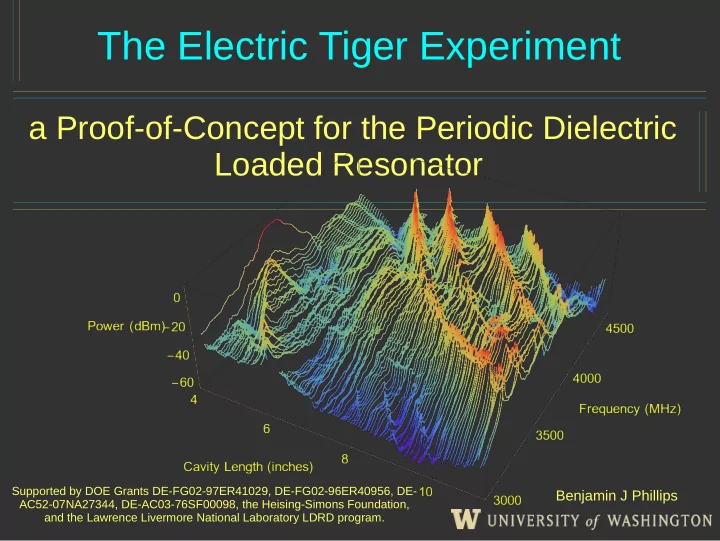
The Electric Tiger Experiment

a Proof-of-Concept for the Periodic Dielectric Loaded Resonator

Supported by DOE Grants DE-FG02-97ER41029, DE-FG02-96ER40956, DE- AC52-07NA27344, DE-AC03-76SF00098, the Heising-Simons Foundation, and the Lawrence Livermore National Laboratory LDRD program.

Benjamin J Phillips

slide-2
SLIDE 2

Motivation

Design Goals

  • Experiment to search high frequency regions

( 4 – 7 GHz )

  • Rapid prototyping with on-hand materials
  • Cavity is reasonably simple to tune (e.g.

manageable mode crossings )

  • Lay foundations for experiments that rely on

dielectrics ( very high frequency searches )

slide-3
SLIDE 3

Motivation

  • Makes use of dielectric

media inside a resonant cavity

  • Dielectric media

compresses wavenumber – prevents form-factor integral from going to zero

The P.D.L.R. Design

slide-4
SLIDE 4

Motivation

  • Resonant cavities that use dielectrics are

difficult to tune – dielectrics have to be moved in unison

  • Tuning procedures developed by Electric Tiger

can be used by these types of experiments ( e.g. Orpheus )

Laying Foundations

slide-5
SLIDE 5

Implementation

  • Rectangular waveguide with one

stationary antenna, one movable

  • Dielectric media is provided by

three nylon blocks

  • Tuning is provided by scissor-jack

and stepper motor driving auger screw

  • Cavity length is measured by

string potentiometer

  • Cavity design limits mode Quality

Factor

Construction of Cavity

slide-6
SLIDE 6

Implementation

  • Rectangular cavity geometry

permits use of constant z- axis magnetic field

  • Magnetic field provided by

1.54 Tesla DC Magnet

Magnetic Field

slide-7
SLIDE 7

Implementation

  • Cavity has a non-trivial amount of static structure
  • Modes are broad and amplitude is not always significantly

higher than static structure

Cavity Structure (Transmission)

slide-8
SLIDE 8

Implementation

  • Simulations of cavity determines mode that couples best with

axion field

  • Mode moves over a wide frequency range, ~3.5 – 6.5 GHz,

including regions currently blocked by RF components

Cavity Structure (Transmission)

slide-9
SLIDE 9

Implementation

  • Static structure in transmission measurements

makes modes difficult to follow

  • Q’s of ~ 250
  • Traditional approaches (e.g. Lorentzian fitting) are

unsuitable

Transmission

slide-10
SLIDE 10

Implementation

  • Reflection modes show much less static structure
  • Strategy: Identify and follow modes in reflection,

switch to transmission to take data

Reflection

slide-11
SLIDE 11

Implementation

  • Even in reflection,

traditional mode-tracking techniques are not appropriate

  • Simple band-pass filters

either suppress actual peaks, or amplify static structure

  • Solution: Use non-linear

filters – suppress noise while preserving peaks

Filtering

slide-12
SLIDE 12

Implementation

Non-Linear Filters

  • Mode Identification scheme
  • nly needs heuristic idea of

what a peak is

  • Criteria is ~ f’[n] < 0 &

f’[n+1] > 0

  • Since we only need a loose

idea of what a peak is, namely that it is ‘sharp’, we can use filters that do not linearly modify signal power

  • Use bilateral filter, a

specific example of a non- linear convolution

slide-13
SLIDE 13

Implementation

Non-Linear Filters

  • Effects of Bilateral filter are more obvious when looking at 2D figures
  • Low-pass filters ( Gaussian Blurs ) suppress noise, but erase features
  • Bilateral filter suppresses noise while preserving edges

Original Gaussian Blur Bilateral Filter

slide-14
SLIDE 14

Implementation

Thoughts on Mode Maps

  • Why not rely on the mode map

alone?

  • Electric Tiger has a high degree of

mechanical slop

  • Modes tend to vanished at certain

cavity positions

  • Goal is to divorce mode tracking

procedure from mode map

  • Current mode tracking procedure

uses mode map – real peaks can be ~ 175 MHz away from mode map

slide-15
SLIDE 15

Data Collection

  • Initial data run performed at room temperature
  • Exclusion limits set in 4-4.2 GHz Range using

rudimentary equipment

  • Sensitivities of ~10-9
  • Mode tracking scheme was able to follow modes

throughout tunable range

  • Experiment ran autonomously for ~8 days

Preliminary Results

slide-16
SLIDE 16

Data Collection

Preliminary Results

slide-17
SLIDE 17

Data Collection

Next Steps

  • Initial data run made use of Signal Analyzer – collected ~105 points per

spectra, averaged ~104 signals

  • Next data run will make use of digitizer – 108 points per spectra, virtually

unlimited number of averages

  • Longer integration times
  • Cryogenic temperatures

Projected Sensitivity for 8 week integration time

slide-18
SLIDE 18

“Side Effects”

High Performance Signal Processing

  • Wide band-widths and fast

digitization rates require very fast data processing

  • Use GPU for signal

processing operations to keep up with data stream

  • GPU - accelerated

methods are completely general and can be used by other experiments

slide-19
SLIDE 19

“Side Effects”

  • Analysis procedure

developed by Electric Tiger is generic

  • Applicable to wide variety
  • f resonate cavity

searches

  • May be incorporated into

ADMX analysis in the near future

Analysis Procedures

slide-20
SLIDE 20

Conclusion

  • Platform to address concerns raised by other searches
  • Electric Tiger is validation of the P.D.L.R. Design – will search

in unexplored axion-like particle parameter space

The two roles of Electric Tiger